Force
-
When a block of wood of mass 2kg was pushed along the horizontal flat surface of a bench, the friction force measured was 4 N. When the block was pushed along the same bench with a force of 10 N, it moved with a
a. speed of 3/m
b.speed of 5m/s
c.acceleration of 3m/s2
d. acceleration of 5m/s2
A little question for you guys. Does friction force ALWAYS remain the same on a particular surface and independent of the amount of force exerted on the object?
-
Does friction force ALWAYS remain the same on a particular surface and independent of the amount of force exerted on the object?
Yes, if the weight of the load remains the same, because Fk = μkN, where F is the kinetic frictional force, μk is the coefficient of kinetic friction for the surface, and N is the normal force acting on the load perpendicular from the direction of motion. Thus, if the surface is not horizontal but tilted at an angle θ, only the necessary weight component applies i.e. W cos θ.
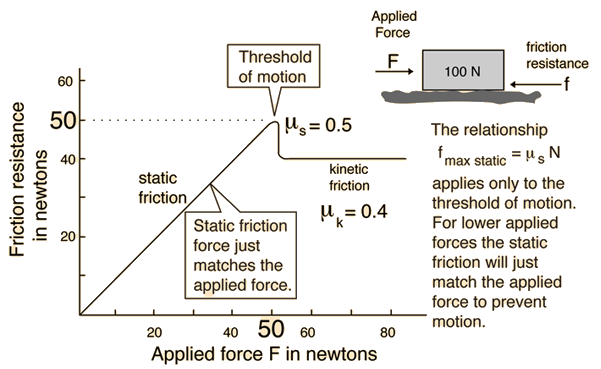
This is slightly different from static frictional force Fs = μsN, which is the maximum force (F) between the surfaces in contact required to overcome inertia. Once in motion, Fk = μkN applies.
The answer should be c. -
Okay thanks. If that's the case, it brings me to another possible occurrence. Lets say we have a wooden block with a mass of 2kg being pulled with a force of 2N on a rough surface. The wooden block doesn't move becasue of friction.
We can thus safely assume that frictional force is 2N because it balances up and result in onject staying stationary.
but when the wooden block is pulled with a force of 5 N, the block moves with CONSTANT SPEED.
Now, what is the net force acting on the wooden block?
Should it be 0 N or 3 N? because like you just mentioned, friction remains the same in all circumstances. so i got 3 N by subtracting 2N from 5N. but i think the correct answer is 5 N.
and what is the frictional force exerted on the wooden block now?
5N or 2 N?
-
nothing
Awaiting tamago. I think frictional force is non existent unless you move the block?
-
Originally posted by davidche:
Awaiting tamago. I think frictional force is non existent unless you move the block?
Yes. For a stationary piece of block, we are more interested in static frictional force Fs, how much frictional force we need to overcome to get the block moving. -
Static frictional force is always higher than kinetic frictional force. The reason is because surfaces are never totally smooth if we go into the molecular view. When stationary, the uneven edges of one surface rest happily in the 'dents' of the other surface (and vice versa). However, when moving, these edges do not have the time to 'rest'...
Sorry, don't really know how to explain without drawing diagrams... Me not as good as the textbooks I read last time...
-
something liek this
>�
-
Not really the same as what I'm explaining... Was trying to explain why there's a threshold...