Physics -- Regarding Energy
-
Hello All..
First of all.. This question is regarding energy.. E=mc^2.. Why is it E=mc^2 and not E=mc^3? or E=mc^4? And from this equation, this shows that the speed of light could be increased. So as most of us know, light is a particle and a wave. For particle, at absolute zero, 0F, there is absolutely no movement... So does that mean light can stop at absolute zero?
Next.. there is many definition of energy... Energy gain/ loss could be 0.5(mass)(velocity)^2..could also be (mass)(gravitational field strength)(height)...could also be ( Force)(Distance) which is work done... could also be (Mass)(speed of light)^2... could also be (Mass)(Gravitational Field Strength)(Distance)... So.. by equating all of the equations.. we should get 0.5(mass)(velocity)^2 = ( Force)(Distance) OR 0.5(mass)(velocity)^2= (Mass)(speed of light)^2...And many more defintions of energy...
But I have a particular concern over here.. which is, (Mass)(speed of light)^2=(mass)(gravitational field strength)(height)...
So by cancelling the constant Mass from both side... we will get (speed of light)^2=(gravitational field strength)(height).. So how reliable is this definition of Energy...furthermore we can bring the g.f.s over to the LHS.. which becomes speed of light ^2 / g.f.s =height... How reliable is the Einstein Theory?
The universe makes the mind goes round..
-
Hi,
First of all.. This question is regarding energy.. E=mc^2.. Why is it E=mc^2 and not E=mc^3? or E=mc^4? And from this equation, this shows that the speed of light could be increased. So as most of us know, light is a particle and a wave. For particle, at absolute zero, 0F, there is absolutely no movement... So does that mean light can stop at absolute zero?
This equation does not show anything about the speed of light. The speed of light is included in the equation here for mass difference occuring during changes in the mass of the molecules due to nuclear or chemical or any events that will cause molecules or atoms to change. Example would be that hydrogen and oxygen, when the individual atoms join up to form a water molecule, the atomic mass of the water molecule is less than the sum of the total atomic masses of 2 hydrogen atoms and 1 oxygen atom. This is because of some bonding energy between the atoms (forgot exact term for it; it is energy required to break the bonds within the molecule) and this bonding energy has the value as E=mc^2. Speed of light is always a constant in vaccum. Also, the equation E=mc^2 also states that c is the speed of light in vaccum.
This E=mc^2 is a simplification from a more chim energy equation for relativistic energy, in which the energy of particles moving near the speed of light are calculated. For all cases much slower, we can use the simplified E=mc^2
However, I'm not exactly sure how Einstein came about with all his equations on relativity. This E = mc^2 included.
Next.. there is many definition of energy... Energy gain/ loss could be 0.5(mass)(velocity)^2..could also be (mass)(gravitational field strength)(height)...could also be ( Force)(Distance) which is work done... could also be (Mass)(speed of light)^2... could also be (Mass)(Gravitational Field Strength)(Distance)... So.. by equating all of the equations.. we should get 0.5(mass)(velocity)^2 = ( Force)(Distance) OR 0.5(mass)(velocity)^2= (Mass)(speed of light)^2...And many more defintions of energy...
Yes, but it depends on usage. With this in mind, you can use the powerful concept of the conservation of energy to solve many questions purely by equating.
But I have a particular concern over here.. which is, (Mass)(speed of light)^2=(mass)(gravitational field strength)(height)...
So by cancelling the constant Mass from both side... we will get (speed of light)^2=(gravitational field strength)(height).. So how reliable is this definition of Energy...furthermore we can bring the g.f.s over to the LHS.. which becomes speed of light ^2 / g.f.s =height... How reliable is the Einstein Theory?
When we equate energy equations, we usually equate change in energy. E=mc^2 does not denote any change in energy; it denotes the total energy (due to mass). Only if there's a change in mass (usually atomic), then there will be a change in energy.
The mgh that you stated normally has a base point; mgh merely refers to a change in gravitational potential energy. The change is manifested in the value of h. Strictly speaking, even for energy = force * distance, the change in energy is manifested in distance.
Thus, you cannot equate the two together.
-
Hello back.. ^^
Never mind about the E=mc^2... Just take it as it is E=mc^2 first.. So, light is a particle and a wave as well.. So, does it implies that light will not move in erm.. 0F... which is absolute zero..?
Secondly, erm.. E=mc^2 does denote that as matter is approaching the speed of light it's mass is decreasing.. Similarly, Energy is being lost by matter in order to accelerate towards the speed of light. In a way, there is a change in energy.. Energy = mgh.. But if it can be equated with 0.5(mass)(velocity)^2... why not with mgh?...
-
E=mc^2 does denote that as matter is approaching the speed of light it's mass is decreasing..
It is only a simplification. The full formula, when approaching the speed of light, is
where p is the momentum, and is given by
where
 is the invariant mass of the object moving,
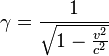 is the Lorentz factor
 is the relative velocity between an object and an observer
 is the speed of light.
so for low v (or even zero velocity), p will tend to mv. And (mv)^2 is much smaller than (mc^2)^2.
Hence, the simplification to the formula you have listed, which is E=mc^2And you mentioned it. Mass is decreasing. As I have mentioned, you need to take into account the changes in energy, which in this case is due to mass. It can be equated with 0.5(mass)(velocity)^2 or Energy = mgh, but you will have to consider the changes in mass in all of the equations.
-
Oh ya, and most likely the mass you are using for other equations are referring to a different mass. Eg, nuclear reaction, E=mc^2 is used for the decrease in mass of the radioactive molecule. But the kinetic energy = 0.5(mass)(velocity)^2 is for the neutron that has been ejected.
-
So, light is a particle and a wave as well.. So, does it implies that light will not move in erm.. 0F... which is absolute zero..?
This wave particle duality concept can wait... Get the understanding of how the energy equations work first...
-
oh.. I understand le.. haha .. Thanks!

