P6 Maths Question
-
Thank you for your help.
-
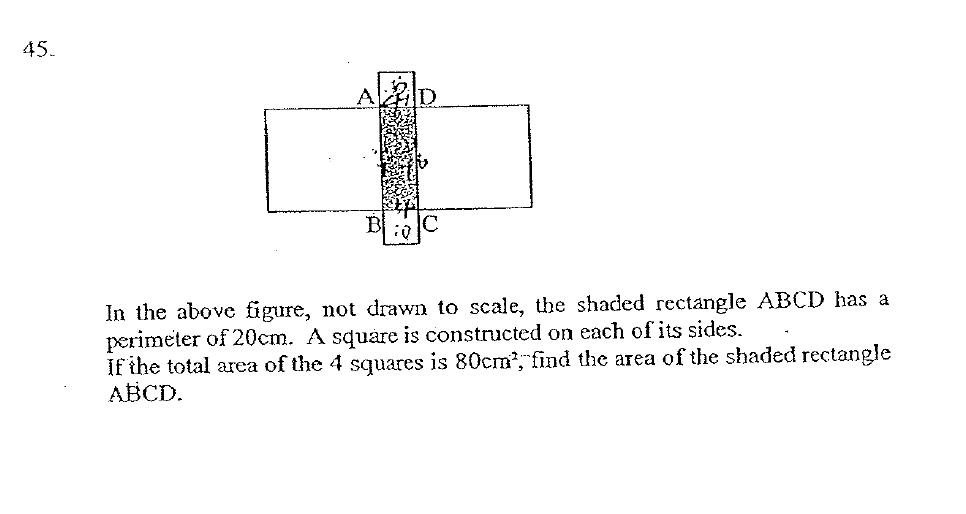
where got 4 suqares?
-
Let AD be X and AB be Y
Solve this:
2 X (square) + 2 Y (square) = 80 -----------------(1)
2 X + 2 Y = 20 ---------------------------------------(2)
When you find out X and Y, multipy it and you will get the area of your shaded area.
-
Originally posted by Mospeada:
where got 4 suqares?
Two big squares and 2 small squares.Hope you can see them as the picture is not clear. -
Originally posted by Girl_Next_Door:
Let AD be X and AB be Y
Solve this:
2 X (square) + 2 Y (square) = 80 -----------------(1)
2 X + 2 Y = 20 ---------------------------------------(2)
When you find out X and Y, multipy it and you will get the area of your shaded area.
Hi
Could you help to elaborate on
2 X (square) + 2 Y (square) = 80 -----------------(1)
-
2 big square + 2 small square = 80cm2 area
means 1 big square + 1 small square = 40cm2 area
which means you take 36 + 4= 40. Lengthof big square is 6 cm. Length of small square is 2 cm.
Area of shaded region = 6 x 2 = 12cm2
-
Originally posted by weewee:
2 big square + 2 small square = 80cm2 area
means 1 big square + 1 small square = 40cm2 area
which means you take 36 + 4= 40. Lengthof big square is 6 cm. Length of small square is 4 cm.
Area of shaded region = 6 x 4 = 24cm2
HiCould you help to elaborate on
which means you take 36 + 4= 40.
If length of small square is 4, then it's area is 16sqcm, leaving area of big square as 24sqcm
-
6 + 2 = 8
then perimeter only 16 not 20.
i wonder if there is a problem with the question.
-
Let AD be x cm and AB be y cm
Perimeter of the rectangle ABCD = 2x + 2y = 20 cm
x + y = 10
x = 10 - y ------------ (1)
Total areas of the 4 squares = 2x^2 + 2y^2 = 80 cm^2
x^2 + y^2 = 40 ------------- (2)
Substitute x = 10 - y into equation (2) ie
(10 - y)^2 + y^2 = 40
100 - 20y + y^2 + y^2 = 40
2y^2 - 20 y + 60 = 0
y^2 - 10 y + 30 = 0
no real solution for y
Hence, the question is WRONG !
Alternatively, we can use the guess and check method
x y Perimeter of the rectangle ABCD = 20 cm Areas of 4 squares = 80 cm^2
1 9 1+9+1+9 = 20 2(1)^2 + 2(9)^2 = 163
2 8 2+8+2+8 = 20 2(2)^2 + 2(8)^2 = 136
3 7 3+7+3+7 = 20 2(3)^2 + 2(7)^2 = 116
4 6 4+6+4+6 = 20 2(4)^2 + 2(6)^2 = 104
5 5 5+5+5+5 = 20 2(5)^2 + 2(5)^2 = 100
6 4 6+4+6+4 = 20 2(6)^2 + 2(4)^2 = 104
So, it is impossible for the areas of the 4squares to be 80 cm^2. Hence, the question is Wrong !
-
Originally posted by baiyun:
HiCould you help to elaborate on
which means you take 36 + 4= 40.
If length of small square is 4, then it's area is 16sqcm, leaving area of big square as 24sqcm
paiseh made an error. question indeed got error and i was led into believing the sides were 6 cm and 4cm respectively.Question cannot be solved .
x^2 + y2 = 40
2x + 2y = 20
x + y = 10
x = 10 -y(10-y)^2 + y^2 = 40
100 - 20y +2y^2 = 40
2y^2 - 20y + 60 = 0
which cannot be solved. discriminant b^2 - 4ac < 0. -
wah now p6 qns like amath siol. :X
-
very soon primary school kids will be learning C maths and F maths.
-
how come got wrong question one...
-
Originally posted by skythewood:
how come got wrong question one…
Teacher fail Amath also
-
wow soon P6 can learn partial fractions already. differentiation/integration all!