BedokFunland JC's A Level H2 Chemistry Qns (Part 2)
-
Snowmine asked :
Give a reason for each of the following statement:
When testing for sulfate ions, the test solution should be acidified with dilute nitric acid before aqueous barium nitrate is added.
Suggested answer:
The hydrogen ions from the acid will react with carbonate ion to form carbon dioxide.
2H+ + CO2−3 -> CO2 + H2O
This helps to remove carbonate ions and hence prevents the formation of barium carbonate, which is also a white precipitate.
I took this from an assessment book but I feel that the answer is weird.
In the first place, the question didn't mention anything about carbonate ion hence why did the suggested answer talks about carbonate ion instead of sulfate ion?
Can someone please enlighten me! THANKS!
SkyedAngel added :my chem teacher went through before but I didn't really listen. Something about if you don't remove the carbonate ions then your precipitate of whatever could actually be the carbonate compound not sulfate, end up you get wrong results.
I intervened to assist :
Because carbonate and hydrogen carbonate anions may be generated from the hydrolysis of atmospheric carbon dioxide, and because most carbonates (other than Na, K, NH4+, etc) are insoluble and can result in a false positive white precipitate, which can mislead the student into erroneously thinking sulfate anions are present.
If after acidification, a white precipitate is still observed when barium nitrate is added, you can safely deduce it's due to sulfate ions, and not due to carbonate ions (since acidification will protonate the carbonate ion into carbonic acid, which exists in equilibrium with, and hence can decompose into carbon dioxide and water).
Bonus (for JC students) :
Because carbon dioxide is relatively insoluble in water, due to limited hydrogen bonding and weak van der Waals interactions, and also because being electrophilic it undergoes hydrolysis (ie. attack by water nucleophile) rather than hydration, it readily leaves the reaction mixture, pulling the position of equilibrium over to the right as predicted by Le Chatelier's principle, resulting in dissolving of any carbonate precipitate under acidic conditions. Furthermore, the generation of gaseous carbon dioxide is thermodynamically favoured due to a significantly positive entropy change.
JC H2 Chem students should attempt drawing the mechanisms for both the forward and reverse reactions :
1) hydrolysis of CO2 to generate H2CO3 intermediate which exists in equilibrium with, and partially dissociates into H+ and HCO3- ions (ie. small Ka values, weak monoprotic acid, even weaker diprotic acid).
2) acidification / protonation of a metal carbonate to generate H2CO3 intermediate, which exists in equilibrium with, and hence decomposes into CO2 and H2O (you memorized this equation at Ordinary levels, now prove yourself a worthy Advanced level student by drawing out this mechanism to demonstrate true understanding rather than blind memorizing). -
Originally posted by hoay:
Both water and ice have H-bonding between their molecules. Ice is less denser than the liquid water because of the longer H-bonds in ice as compared to liquid water and secondly ice has expnaded structure.
What do you mean by the longer H-bonds in ice? Have they been meausred?
Open structure in ice...well the liquid water has also open structure. I did not get this. Please explain.
The H bonds are 'forced' to be longer in ice, due to the rigid lattice structural arrangement in solid ice. No such rigid lattice arrangement occurs in liquid water, which means closer proximity, and therefore shorter (hence stronger) H bonds, are possible for liquid water.The difference in lengths of the H bonds in solid vs liquid water, is unlikely to be part of the Cambridge mark scheme (at least for the Singapore syllabus). The exact H bond length in solid ice, also depends on the exact cystalline form of ice, for which over a dozen different forms have been identified.
Interestingly, for Cambridge A level Chemistry, students need not be familiar with the most common crystalline form of ice, which is ice 1-hexagonal (because this would be more difficult for A level students), but instead Cambridge allows A level Chem students to draw out or describe the less common, but more familiar (due to the similarity to the lattice structure of diamond, which all 'O' and 'A' level Chem students are already familiar with) crystalline form of ice 1-cubic (ie. the diamond structure).
The so-called 'open structure' of ice, refers to the fact that there are lots of empty (or 'open') spaces between the H2O molecules in solid ice. In contrast, there is very little empty space between H2O molecules in liquid water.
Why? Because H2O molecules are forced to spread apart with some distance between them, in the fixed lattice (ie. regular repeating pattern) crystalline structures in solid ice (analogy : 100 disciplined soldiers doing a weapons precision drill parade, would have to keep some distance apart from each other and occupy a huge space in an open field), while in the liquid state, the H2O molecules are milling in close contact with each other, with no fixed lattice structure (analogy : 100 frenzied women now squeezing chaotically at some super discount sale in some small clothes/shoes departmental store).
This is the reason why solid ice is less dense than liquid water.
-
^_^
-
^_^
-
Originally posted by hoay:
Many thanks for unceasing support and excellent explanation in the field of chemistry in general and A-level chemistry in particular.
Another question from nov 2012:
Q. Rat poison needs to be insoluble in rain water but soluble at the low pH of stomach contents. What is a suitable barium compound to use for rat poison?
A barium carbonate
B barium chloride
C barium hydroxide
D barium sulfateD is the answer.
And if i am not mistaken I used the salt hydrolysis approach for this question.
A will have ph > 7
B will have ph > 7
C will have ph > 7.
Is it correct?
Totally welcome.

The answer should be BaCO3.
Although both BaSO4 and BaCO3 are insoluble (ie. sparingly soluble) at neutral pH, in acidic pH only BaCO3(s) undergoes a reaction to generate the toxic Ba2+(aq) ions.
The solubility of BaSO4 remains largely unchanged with pH, since Ba(OH)2 and H2SO4 are both considered strong base and strong acid respectively, hence there is little common ion effect or shifting of positions of equilibrium, which are the underlying principles of salt hydrolysis (to generate a significant amount of either the hydroxonium ion or the hydroxide ion, depending on whether the salt is acidic or basic).
The reaction of BaCO3(s) is as follows :
CO3 2- carbonate(IV) ions function as Bronsted-Lowry bases, and are protonated in acidic pH to generate H2CO3 carbonic(IV) acid, which exist in equilibrium with, and hence can decompose into, CO2(g) and H2O(l). Because CO2(g) leaves the reaction mixture, it pulls the position of equilibrium over to the right, as predicted by Le Chatelier's principle. Furthermore, non-gaseous reactants generating a gaseous product implies a positive entropy change of reaction, which is thus thermodynamically favourable and thermodynamically driven.
The toxic Ba2+(aq) is thus freed from the solid BaCO3(s) lattice structure, and available to do its merciless, murderous, lethal work coursing through the arteries and veins of the helpless rodent, who will soon experience multiple organ failure and die a terrible, excruciating, shrieking, convulsive, woeful death. The counter anion for the Ba2+(aq) ion, would be the Cl-(aq) ions of the HCl(aq) acid in the rat's stomach.
-
^_^
-
Originally posted by Theplayfulgirl brainy:
Ah. I had some questions:
1. pH of ethers : acidic, basic or neutral
2. The addition reaction into benzen ring (=>xycloankalines): Is it nucleophllic or electrophillic
Ethers are neutral (ie. neither acidic nor basic). Their conjugate bases are not resonance stabilized (unlike carboxylic acids, phenols or enols). Oxygen atoms are a little too electronegative to be willing to donative a dative bond to be protonated readily (unlike say, N atoms of amines). But between being an acid and being a base, ethers would rather behave as a Bronsted-Lowry base. This behaviour underscores the underlying mechanisms for both generating vs cleavage of ethers :To cleave ethers using a strong hydrohalic acid :
R-O-R + H-X ---> [R-OH-R]+ + -X ---> R-X + R-O-H
and to generate ethers, with a strong acid catalyst :
R-O-H + R-O-H + H+ ---> [R-OH2]+ + R-O-H ---> [R-OH-R]+ + H2O ---> R-O-R + H2O + H+
Mechanism :

Guys like Girls, hence Nucleophiles like Electrophiles. Only Nucleophiles have the balls (ie. lone pair, or pi bond pair) to attack (ie. donate a dative bond to) Electrophiles.
Benzene is obviously the guy (although he's a weak guy coz his balls are delocalized by resonance), who attacks the girl (though to force chemical intercourse/reaction to occur, you gotta either give the guy more balls = substitute electron-donating by resonance groups onto the benzene ring, or you gotta make the girl more chio = using a Lewis acid catalyst to induce a formal positive charge on the girl), hence all such reactions that directly involve the benzene ring guy shooting out his balls (pi electrons) to any girl electrophile, is called Electrophilic Aromatic Substitution.
-
A BedokFunland JC Original Qn
Question : Which molecule is more acidic? 2-hydroxypropanoic acid, or 3-aminopropanoic acid? Give three different reasons to justify your answer.
Solution :
2-hydroxypropanoic acid is a stronger acid compared to 3-aminopropanoic acid.
Reason #1 - the conjugate base of 2-hydroxypropanoic acid is stablized by the formation of an intramolecular hydrogen bond between the COO- carboxylate group and the OH hydroxy group. This hydrogen bond in the conjugate base is particularly strong (and hence particularly stabilizing), due to a formal (ie. not just partial) negative charge on the COO- carboxylate group.Or, from the perspective of the pre-proton dissociation, the COOH proton dissociation enthalpy is made less endothermic, due to the weakening of the carboxylic O-H bond, in turn because the carboxylic O-H sigma bond electrons are inductively withdrawn away, due to the intramolecular hydrogen bond between a lone pair on the (partial negative) carboxylic O atom (hydrogen bond acceptor), and the (partial positive) H atom of the hydroxy group (hydrogen bond donor).
No such intramolecular hydrogen bond exists to stabilize the conjugate base of 3-aminopropanoic acid, because the inter-atomic distance is too large for the formation of a similar intramolecular hydrogen bond.
(Note : Cambridge will require the A level student to explicitly draw out and label the intramolecular hydrogen bond that's responsible for the greater acidity.)
Reason #2 - Although the OH hydroxy group and the NH2 amino group, are both electron withdrawing by induction, and therefore both exerting stabilizing effect on the conjugate base; however because oxygen is significantly more electronegative compared to nitrogen, accordingly the OH hydroxy group is more strongly electron withdrawing by induction, compared to the NH2 amino group. Consequently the 2-hydroxypropanoate anion conjugate base is more effectively stabilized by induction, compared to the 3-aminopropanoate anion conjugate base.
Reason #3 - Although the OH hydroxy group and the NH2 amino group, are both electron withdrawing by induction, and therefore both exerting stabilizing effect on the conjugate base; however inductive effect decreases rapidly with distance, or number of intervening sigma bonds. Accordingly, because the OH hydroxy group in 2-hydroxypropanoate ion is closer to the COO- carboxylate group, compared to the NH2 amino group in 3-aminopropanoate ion; consequently the 2-hydroxypropanoate anion conjugate base is more effectively stabilized by induction, compared to the 3-aminopropanoate anion conjugate base.
Because of these three different or separate reasons, 2-hydroxypropanoic acid is a stronger acid compared to 3-aminopropanoic acid. -
Originally posted by hoay:
Oxygen in water or in any other molecule can make two H-bonds per molecule with itself the reason Two lone pairs on Oxygen. But flourine on the other hand only make only one H-bond per molecule despite the fact that f contains 3 lone pairs......Is it due to high electronegativitiy of F than O?? Or any other plausible explanation.
In H-F molecules, because the F atom has 3 lone pairs, so in theory, it is possible for the F atom to be engaged in 3 hydrogen bonds simultaneously.However, this does not happen for 2 reasons :
The 1st reason : each time a lone pair is used up to form a hydrogen bond, the other lone pairs (on the F, O, or N atom) are withdrawn away by induction (towards the hydrogen bond) and become less available to participate in it's own hydrogen bond.
Then why can the O atom of water use both of its lone pairs to participate in 2 hydrogen bonds simultaneously, as in solid ice? This is more possible for water than for hydrogen fluoride, because water has 2 H atoms that (being less electronegative) can donate its (bonding) electrons inductively toward the (more electronegative) O atom, resulting in the lone pairs of the O atom being more available to participate in their own hydrogen bonding. In contrast, hydrogen fluoride only has 1 H atom that donates inductively. With less 'income', the F atom is forced to be more 'miserly' with it's limited 'shopping money'.
The 2nd reason : each hydrogen fluoride molecule only has 1 partial positive H atom to participate in intermolecular hydrogen bonding, while in contrast each water molecule has 2. As an analogy : the classroom of water has 2 guys (lone pairs) and 2 girls (partial positive H atoms); the classroom of ammonia has 1 guy (lone pair) and 3 girls (partial positive H atoms); the classroom of hydrogen fluoride has 3 guys (lone pairs) and 1 girl (partial positive H atom).
How many heterosexual (non-gay, non-lesbo) relationships can each class have? Obviously, water will have the most number of intermolecular hydrogen bond relationships, and therefore water has a higher boiling point than either ammonia or hydrogen fluoride.
While water as solid ice can gain maximum thermodynamic stability by forming 4 hydrogen bonds per water molecule in a tetrahedral geometry (eg. in ice 1-cubic); in contrast for hydrogen fluoride, the maximum thermodynamic stability (ie. most efficient way of arranging themselves to achieve maximum number of hydrogen bonds for the entire population) is achieved by forming zig-zag chains of HF in the liquid and solid states, with each HF molecule having 2 primary (semi)-permanent hydrogen bonds within each chain (as shown below); and between the chains, secondary (and weaker, more temporary) hydrogen bonds and/or permanent dipole - permanent dipole Keesom van der Waals interactions may occur.
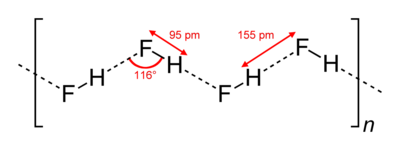
https://en.wikipedia.org/wiki/Hydrogen_fluoride -
^_^
-
^_^
-
^_^
-
Originally posted by Theplayfulgirl brainy:
The radius of ion and atom decrease in order : P 3-, S2-.Ar, Cl-.
It is Ok for the decreasing of P, S and Cl but Ar. Why it is biger than Cl-
For A level purposes, just write the following and you'll get full marks :All of the species mentioned above are isoelectronic; as proton number increases, the nuclear charge and effective nuclear charge (since for isoelectronic species the shielding effect is exactly the same), also increases; hence the ionic/atomic radius decreases as proton number increases, from P3- to S2- to Cl- to Ar.
The tricky bit here, is that noble gases (particularly the lower periods) do not chemically combine with other atoms readily. Hence, while P, S and Cl have 4 different values for atomic radii : namely atomic, covalent, ionic and van der Waals ; however for Ar, being a noble gas element, experiments can ascertain only its van der Waals radius. This results in different values quoted from different sources, which confuse students.
For A level purposes, you need not concern yourself with these matters. Cambridge has no wish to confuse students with such a despicable low blow, (at least ostensibly) preferring to assess students on their fundamental chemistry concepts such as the simple relationship between proton number, electron configuration, effective nuclear charge and (simple) atomic radius.
-
^_^
-
Another BedokFunland JC original question
If methylamine were allowed to react with an equimolar mixture of methyl iodide and ethyl iodide, assuming the reaction came to completion, generating only tertiary amines as the products, and ignoring steric and electronic factors (ie. assume both alkyl halides are equally electrophilic), if you were playing a game of Roulette at the Chemistry Casino, what would your odds of winning be, if you were to place your bet on the identity of a product (picked randomly from a randomized sample of the products) as :
a) trimethylamine
b) dimethyethylamine
c) diethylmethylamine
d) triethylamine
Answers (in percentages) :
a) vīgintī quīnque (latin), venticinque (italian), ni-juu-go
(japanese)b) quīnqu�gint� (latin), cinquanta (italian), go-juu (japanese)
c) vīgintī quīnque (latin), venticinque (italian), ni-juu-go
(japanese)d) [100 - (a + b + c) ] %
-
^_^
-
^_^
-
Originally posted by Theplayfulgirl brainy:
Hm. I want the Lewis structure of IF3 because I wonder that whether F can borrow only 1 e from I ? Can you draw it in dot-dot Lewiss
In terms of formal charge, F didn't 'borrow' any electrons. Its 3 lone pairs are its own, and half of its bond pair belongs to F, the other half belongs to I. For formal charge, 3 lone pairs and 1 bond pair = 7 valence electrons, thus F has no formal charge.In terms of stable octet, F and I share both electrons in the bond pair, so the F atoms have a stable octet, while the I atom has an expanded octet. For stable octet, 3 lone pairs and 1 bond pair = 8 valence electrons for F, and 2 lone pairs and 3 bond pairs = 10 valence electrons for I, which has vacant, energetically accesible orbitals to accomodate an expanded octet.
In terms of oxidation state, which is formal charge + electronegativity consideration, for every I-F bond present, the I atom loses 1 electron, and each F atom gains 1 electron. Afterall, that's the definition of electronegativity, the capacity to attract electrons due to effective nuclear charge. I has 0 formal charge, but 3 bond pairs with more electronegative F atoms, and hence the OS of the I atom is 0 + +3 = +3. The OS of each F atom is 0 (formal charge) + -1 (electronegativity consideration) = -1.
-
Phenolphthalein is an example of an organic molecule that does not contain a transition metal ion, and yet is coloured (indeed, its capacity for colour is the basis for its function as an acid-base indicator). Suggest how colour arises in (coloured) organic molecules that do not contain a transition metal ion.
Solution :
Protonating or deprotonating phenolphalein alters or modifies, and thus changes the colour of, the molecule's conjugated system (ie. a system of connected p-orbitals with delocalized electrons in compounds with alternating single and multiple bonds).
Conjugated systems have the capacity for colour, because similar to the d-d* electron transitions of a transition metal ion, electrons of organic molecules' conjugated systems, are also able to transit between the different energy levels of a conjugated system's pi molecular orbitals, absorbing light in the various wavelengths in the process (which provide the energy required for the pi to pi* electron transitions), and reflecting wavelengths of a complementary colour.
http://en.wikipedia.org/wiki/Phenolphthalein
http://en.wikipedia.org/wiki/Conjugated_system
-
^_^
-
^_^
-
NeverLess asked :
what's the rationale behind adding the volume of Na2S2O5 and HA together in order to get the concentration? I thought it's supposed to be just the no. of mole of NaA divide by the volume of NaA only, even after adding the two solutions together?
Your misconception is a common one amongst students (not just O level students, but many JC students still don't properly understand about this).
Once you've added the two solutions (eg. soln A and soln B) together, the new volume of the new solution of A = new volume of the new solution of B = old volume of A + old volume of B.
There is no such thing (ie. it's nonsense) to say "the new solution = x volume of soln A + y volume of soln B".
To illustrate with concrete examples :
If you add 100cm3 of NaCl, to 100cm3 of KBr, there's only ONE new solution.
This ONE solution can be called any of the following :
a solution of Na+ ions
a solution of Cl- ions
a solution of K+ ions
a solution of Br- ions
a solution of NaCl
a solution of NaBr
a solution of KCl
a solution of KBr
best description to use : a solution containing Na+, Cl-, K+ and Br-.
And the volume of this ONE solution (any of the 8 labels above, refer to the SAME ONE solution), is simply 100 + 100 = 200 cm3.
Hence to find the new molarity (ie. molar concentration) of any of the species, Na+ or Cl- or K+ or Br- or NaCl or KCl or NaBr or KBr, is simply take the moles of that species, divided by the new volume of this ONE solution, which is 100 + 100 = 200 cm3, to obtain the new molarity of the species you're interested in.-------------------------
NeverLess replied :
Wow I get it now! To think I bore this huge misconception with me all this while! Thank you sir! Both for your effort and kindness to give this thorough explanation! THANK YOU!
-------------------------
No prob, you're totally welcome! :) -
^_^
-
^_^
-
A BedokFunland JC Original Qn
50cm3 of sulfuric(VI) acid of unknown molarity was mixed with 75cm3 of 0.45mol/dm3 of aqueous potassium hydroxide. 55cm3 of the resulting alkaline solution A was mixed with 80cm3 of 0.35mol/dm3 of phosphoric(V) acid. 90cm3 of the new resulting acidic solution B required 39.97cm3 of aqueous sodium carbonate(IV) for complete neutralization. In a separate experiment 625cm3 of the same sulfuric(VI) acid required 192.3cm3 of the same sodium carbonate(IV) solution for complete neutralization. Calculate the molarities of the sulfuric(VI) acid and the sodium carbonate(IV) solutions.
Answers :
[H2SO4] = 0.2 mol/dm3
[Na2CO3] = 0.65 mol/dm3

