Originally posted by gohby:Regarding Q4, wouldn't the emission of 4 alpha particles result to the emission of 12 protons and 12 electrons, how does that gel with the answer of 10 protons and 10 electrons?
Regarding Q1: Thanks, I overlooked the fulfillment of the octet structure for beryllium. If I may be inquisitive about it - how do I know that there wouldn't be any steric hindrance that would prohibit the formation of the addition product, given that there are 3 methyl groups in trimethylamine?
ACJC Prelim 12:
The empirical formula of a fluorocarbon is CF2. At the same temperature and pressure, 1dm³ of the fluorocarbon weighs 8.93g while 1dm³ of fluorine gas weighs 1.80g.
What is the molecular formula of the fluorocarbon?
A. CF2,
B. C2F4
C. C4F8
D. C5H10
Remarks: I worked out the Mr of the fluorocarbon to be ~188 --> [(1.8/38) moles of fluorocarbon weighing 8.93g]. Whilst C is definitely the best answer, I have some disquiet about the choice as 188 vs 200 is a bit of a stretch.
I have found a website dated July 2000 of a similar question (http://www2.hmc.edu/www_common/chemistry/TUTORIALS/reviewSolution07Frame.html), except that the 1dm³ of fluorine gas weighs 1.70g. This will result to the Mr of the fluorocarbon being 200. Hence I am wondering if there is something wrong with this question.
Originally posted by hoay:Q . For each of the following reactions predict the sign of G. If a prediction is not possible because the sign of G will be temperature dependent, describe how G will be affected by raising the temperature.
(a) An endothermic reaction for which the system exhibits an increase in entropy
(b) An exothermic reaction for which the system exhibits an increase in entropy
Ans (a) For the reaction to be spontaneous and feasible the enthalpy change must be exothermic and the entropy change must be positive i.e G negative. The first factor does not support here so for G to be –ve the reaction should be carried out at high temperature.
Ans (b) The sign of G would be negative since both the conditions are right for the reaction to be feasible and spontaneous
One point if we forget here the need for the temperature control is to look at the sign of enthalpy change if it is +ve then high temperature is applied or -ve low temperature should be applied. Are my answers correct??
Originally posted by hoay:are feasibility and spontaneity of a reaction same terms? spontanous means the reaction must occur without the help of external indicators. Feasibility is about what?
Originally posted by Metanoia:Would a system be expected to experience an increase in entropy when it undergoes an endothermic reaction?
Originally posted by gohby:Hi UltimaOnline, thank you for your response. :) I have 2 further questions on Chem Bonding.
Q1: Which of the following is most likely to be true for sodium ethanoate?
A: It is more soluble in water than sodium chloride
B: A solution of sodium ethanoate has a higher electrical conductivity than a solution of sodium chloride.
Remarks: Both choices are wrong. For A, I reckon the ion-dipole interaction between Cl- and water is more exothermic than that of CH3CO2- and water because Cl- has a higher charge density, so the ion-dipole complex is more stable. Is this correct? As for B, how do I evaluate the relative electrical conductivity of 2 ionic compounds (esp in this case where both ions in both compounds are singly charged?)
Q2: This question is regarding hydrogen bonding in ice/water.
(i) Why is the bond angle about oxygen in ice is 109.5?
Is it not possible to form the lattice arrangement if the bond angle is 105?
Wikipedia states: “This tetrahedral bonding angle of the water molecule essentially accounts for the unusually low density of the crystal lattice – it is beneficial for the lattice to be arranged with tetrahedral angles even though there is an energy penalty in the increased volume of the crystal lattice.� My question: Okay, but why is it beneficial for the lattice to be arranged with tetrahedral angles?
(ii) In my notes, it states: “Hydrogen bonding is maximised (in ice) because the water molecules are arranged in an ordered way to form a regular lattice�. My question: what is hindering hydrogen bonding in water from being arranged in an ordered way to form a regular lattice?
Originally posted by hoay:the Enthalpy change of formation of elements in their standard states have a zero value. Why the same is not true for standard entropy change?
Hi UltimaOnline, I have some questions on Reation Kinetics :)
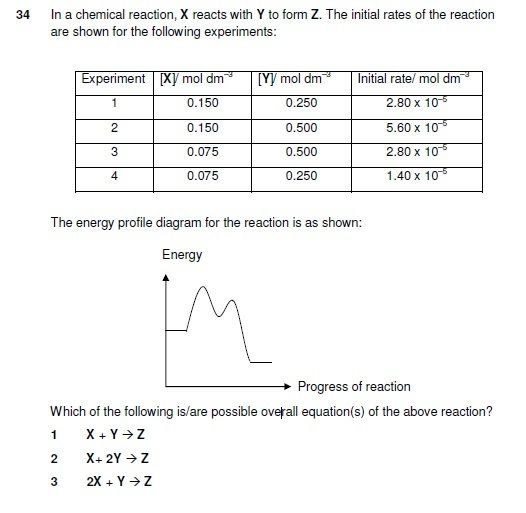
Q1: http://img.photobucket.com/albums/v700/gohby/Chemistry/Q34%20ACJC_zps63m4r5pe.jpg
Response: The order of reaction wrt X is 1 and wrt Y is 1. But how to proceed from there?
Q2: 2SO2(g) + O2(g) ⇔ 2SO3 (g) â–²H = -98kJ/mol
Which of the following conditions increase both the rate of reaction and the yield of products?
Add a suitable catalyst and add a suitable solvent to dissolve SO3
Decrease the volume of the vessel
Increase the temperature and decrease pressure
Remarks: The answer is 1 and 2. I don’t understand why the answer is 1 because if we use a suitable solvent to dissolve SO3, wouldn’t the yield of sulphur trioxide drop instantly?
Q3: If the rate equation (and its concomitant rate order(s)) is experimentally derived - how come we are able to deduce it from mechanisms - isn’t that being theoretically derived then?
Q4: 2O3(g) → 3O2(g)
This reaction is thought to occur via a two–step mechanism:
Step 1 O3(g) O2(g) + O(g) fast, reversible
Step 2 O3(g) + O(g) → 2O2(g) slow
The rate law that is consistent with this mechanism is k[O3]²/[O2].
Remarks: I know how to get the answer, but I am wondering why the rate equation contains the product as well (shouldn’t it only be expressed in terms of the reactants)? How can the concentration of the product affect the rate of reaction when it is an not a reversible reaction?
Thank you very much, UltimaOnline :)
Hi UltimaOnline,
Thank you for your response. :)
For Q1, why does the presence of an intermediate rule out option 1 being the possible overall equation? Am I right to say any option that follows: a X + b Y → Z, where a and b are not 1 would be a plausible option?
For
Q3: Am I right to say that mechanisms are merely guesses at how a
reaction takes place step by step at a molecular level? Which is why
when even we derive the orders from the slow step in a mechanism we are
still deriving it experimentally (rather than it being theoretical since
we already know the mechanism already)? At the H3 level (or even at
times at H2 Chem!) one would have to deduce a mechanism from a given
reaction, and deducing mechanisms requires certain theoretical knowledge
(e.g. start from an electron rich region, hydride shifts etc.), so
isn’t mechanisms deduced theoretically then (and thus rate equations
could be said to be deduced theoretically)?
I have two other further questions:
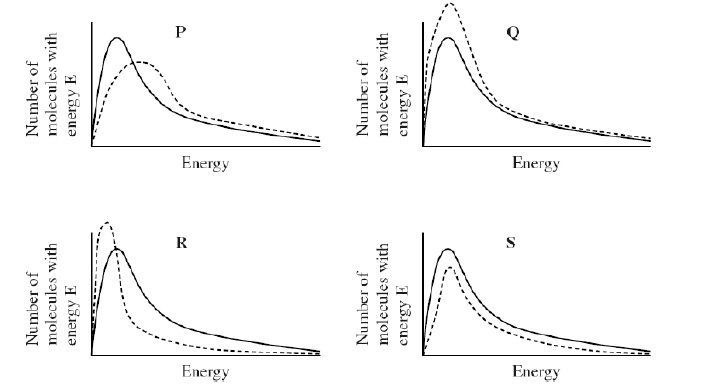
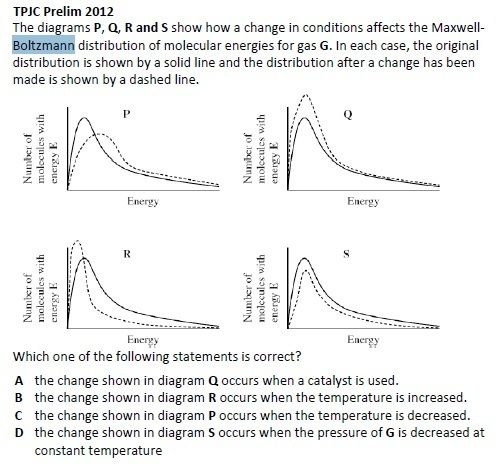
Q5: The diagrams P, Q, R and S show how a change in conditions affects the Maxwell-� Boltzmann distribution of molecular energies for gas G. In each case, the original distribution is shown by a solid line and the distribution after a change has been made is shown by a dashed line. Which one of the following statements is correct?
http://img.photobucket.com/albums/v700/gohby/Chemistry/Q26%20TPJC_zpsa9xv8jje.jpg
Answer: The change shown in diagram S occurs when the pressure of G is decreased at constant temperature
Remarks: How will a decrease of pressure lead to a decrease in the total number of molecules?
Q6: Substances R, S and T react according to the following equation:
R(aq) + 2S(aq) + T(aq) → 2U(aq) + V(aq)
To find the rate equation for the above reaction, two sets of separate experiments were performed and the results are shown below.
http://img.photobucket.com/albums/v700/gohby/Chemistry/Q31%20RI_zpsurt489vr.jpg
What can be deduced from the information shown?
3 The overall order of the reaction is two.
Remarks: How do I tell whether 3 is correct?
Q1: Can I say that any option for a X + b Y → Z, where a and b are not 1, can be accepted (since we don’t know how does the mechanism works?)
Q5: I redacted the options but in the interest proving your conjecture here’s the question in full:
http://img.photobucket.com/albums/v700/gohby/Chemistry/Q26%20TPJC_zpszfdhvewd.jpg
Yes I was very perplexed by the choices; A-C are evidently wrong. I thought that D was an option only when I inject a sample of gas into the original sample at the same temperature (or an equilibrium system as you’ve suggested). If this has been transcribed accurately from the actual Prelim Paper, I would be worried as it would be a difficult task to read the minds of the question setters. I am surprised that even in A Levels there are examples of conceptual errors, are you able to point out a couple?
Response to Q6:
The order of reaction wrt R is 0 because with reference to the any of the graphs in the first diagram, [R] decreases linearly, i.e. a decrease in [R] does not lead to a decrease in the rate of reaction → Order wrt R = 0.
The order of reaction wrt T is 1 because the with reference to the curve in the second diagram, the half life is constant.
I wasn’t too sure about the order of reaction wrt S though, I know it can’t be 0 because from the graphs it affects the rate of depletion of R and T when [S] is increased, but here’s my take (don’t know if it’s the most efficient way of thinking): the rate of depletion of [R] is increased by a factor of 4 (this is determined by comparing the gradients of the two graphs in diagram 1) when [S] is doubled. Given that the concentrations of other reactants remain unchanged, the order of reaction wrt S has to be 2. (2²=4).
Q7: To identify an oxide of nitrogen, 0.10 mol of the oxide was mixed with 10 dm³ of hydrogen gas and passed over a heated catalyst. At the end of the reaction, 0.4 dm³ of hydrogen gas remained. The ammonia produced required 125 cm3 of 1.6 mol/dm³ HCl for neutralisation.
All gaseous volumes were measured at room temperature and pressure. What is the formula of the oxide of nitrogen?
A:NO B: N2O C: NO2 D:N2O4
Remarks: Essentially from the calculations, the ratio of nitrogen oxide: H : NH3 = 1:4:2. Hence, B is the answer because it is the only choice which fulfills this ratio (N2O + 4H2 → 2NH3 + 2 H2O). However, my qn is - how do I know that a nitrogen oxide, when mixed with a hydrogen gas will produce water (in addition to ammonia as stated in the question)? If I am unable to ascertain the other product in addition to ammonia, how do I then write an equation for all the choices to obtain the answer?
Thank you UltimaOnline :)
Hi UltimaOnline, I have some further questions (on ionic equilibria this time):
Re Q7 @ 21 Jul 15: this is a redox reaction (which more capable students should be able to recognize based on the description given)
Remarks: How can I recognise that it’s a redox reaction? Just because there’s reduction when a nitrogen oxide is reduced to ammonia? But how does that ensure oxidation will occur?
Q1:
http://img.photobucket.com/albums/v700/gohby/Chemistry/CJC2012_zpsnohp6cyi.jpg
Answer: 1 and 2 are correct.
Remarks:
For 2, what is meant by the point when the slope of the curve is at maximum at its centre?? Is it the point as indicated by the arrow (which I have inserted) in the diagram? If so then 2 is correct because the first neutralisation reaction would have been complete and the salt produced has no net charge.
For 3, is it wrong because at pH 9.7, there are equal concentrations of H3N+CH(CH3)COO- and H2NCH(CH3)COO- (because pH= pKa → max buffer capacity → where the concentrations of the weak acid and its conjugate base is the same)
Q2: Does this statement “H+ (aq) + OH¯ (aq) ions react exothermically” give a correct explanation for “The ionic product of water, Kw increases with increasing temperature”?
Remarks: I am of the opinion that the first statement gives a correct explanation for the second statement. Given the water dissociation equation: H2O ↔ H+ + OH¯, if H+ (aq) + OH¯ (aq) ions react exothermically, the forward reaction must be endothermic. Hence, when the temperature increases, by LCP, the equilibrium will be shifted to the right to minimise the disturbance, which would increase the concentration of H+ + OH¯ at equilibrium, which will increase the ionic product of water. However, according to the answer, the statement statement “H+ (aq) + OH¯ (aq) ions react exothermically” does not give a correct explanation for “The ionic product of water, Kw increases with increasing temperature” and I don’t understand why.
Q3:
http://img.photobucket.com/albums/v700/gohby/Chemistry/CJC20122_zps4ftdajiy.jpg
Remarks: Why is B wrong? I thought the degree of dissociation, which is related to the Ka, will only be affected by changes in temperature? How is D the correct answer? (Kb of ammonia is larger than water → it is a stronger base than water → what’s the relation of the strength of HA in liquid ammonia?
Thank you for your help, much appreciated. :)
Hi, i am studying Cambridge Internation A level chemistry and have found that the questions asked are easier but very similar to the H2 chemistry papers. And as CIE is increasing the difficulty of papers each year, the questions will be more like the ones in the singapore prelim papers. Hence, i would like to ask questions that i have found tricky and difficult from both CIE and H2(i cant even solve some of the H2 prelim questions).
Q1:)
Please look at Q3(d)(iii) of the following paper
http://papers.xtremepapers.com/CIE/Cambridge%20International%20A%20and%20AS%20Level/Chemistry%20(9701)/9701_w13_qp_23.pdf
How will i know what products will be formed when BrCl reacts with KI....i know its supposed to be displacement reaction but how can i be sure that KBr and KCl will be formed instead of Br2.....
Q2.) Similarly, how would i know the products of the reaction of NaH(sodium hydride) with water if i only that MgH,NaH both react with H2O to give the same colourless guess?
Is there any general way of knowing the products of chemical reactions such as above in keeping the fact that we know all the reactions of the chapter of periodicity(such as chlorides and oxides with water,etc)?
Thank You for answering!
Originally posted by Light5:Q1.)Thanks alot, couldnt have even thought of bronsted lowry theory for Q2..do you have any advice as to how to study reaction mechanisms for Inorganic chemistry(any book,webisite,etc) that can be of help? Instead of the Period 3 chlorides,oxides and group2,group 7 chapters, should i learn more compounds formed by period 3 elements and their corresponding reactions and if so, which ones should i focus on?
Q2.) I know that HBr is an acid and Br, being more electronegative than H, has a partial negative charge..Also, Br has few lone pairs on it...if this is the case why cant HBr participate in a nucleophilic substitution or nucleophilic addition reaction with halogenoalkanes and aldehydes/ketones respectively?
Q3.) How is Mg + 2HCL = MgCl2 + H2 an acid- reaction? I know that HCl is giving out H+ ions, but it isnt donating these protons to Mg, in fact it is donating Cl- ions to Mg...so how does this reaction stand true with bronsted-lowry acid-base theory?
Q4.) Is there any general strategy for drawing correct structural isomers ensuring that none of them are repeated...how can i do this on a piece of question paper(since we dont get a rough sheet for the MCQ paper 1). Even if you can demonstrate it with an example, that will be fine?
Again, thank you for answering my questions. I know my queries arent as advanced as those of singapore students but some of these misconceptions have arised while solving CIE past year questions...i will start asking questions related to singapore prelim papers once i start solving some of the difficult P1 and P3s.
Originally posted by Light5:Q5.) What could be the products and the mechanism for the following reaction :
NO2 + H2O = ...?
All i can predict is that nitric acid will be formed as NO2 is an acidic oxide however, that does not balance the equation so what will be the other product?
Hi UltimaOnline,
Continuing from the previous thread, I have further questions on equilibria to seek clarification:
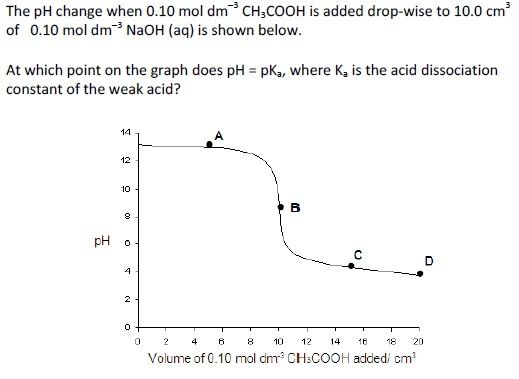
Q1:
http://img.photobucket.com/albums/v700/gohby/Chemistry/SRJC_zpswcv8i3zn.jpg
Answer: C
Remarks: Where pH=pKa, [weak acid] = [conjugate base]. Number of moles of CH3COONa = 0.0001. So shouldn’t the answer be D, because at point D the number of moles of excess ethanoic acid when 20cm³ of it has been added be 0.0001 too?
Q2: Bleaching solutions are manufactured by dissolving chlorine gas in sodium hydroxide solution to give the following reaction. Cl2 (g) + 2OHâ€� (aq) ↔ OClâ€� (aq) + Clâ€� (aq) + H2O (l) Users are warned not to mix the bleach with other cleaning solutions to prevent evolution of hazardous chlorine gas. Which of the following actions will lead to liberation of chlorine gas?
A Addition of water to bleach
B Mixing of an alkali with bleach
C Shaking bleach with table salt, NaCl
D Subjecting bleach to high pressure
Answer: C
Remarks: Why doesn’t A result to the liberation of chlorine gas too since the equilibrium will shift to the left upon the addition of water? Wrt choice D, if I were to subject the equilibrium system to high pressure, am I right to say that the equilibrium will shift to the right so as to reduce pressure by reducing the number of gaseous particles instead?
Q3: A car burning lead�free fuel has a catalytic converter fitted to its exhaust. On analysis, its exhaust gases are shown to contain small quantities of nitrogen oxides. Which modifications would result in lower exhaust concentrations of nitrogen oxides?
1 an increase in the surface area of the catalyst in the converter.
2 an increase in the rate of flow of the exhaust gases through the converter.
3 a much higher temperature of combustion in the engine
Answer: 1 only
Remarks: My understanding is this: 2 is wrong because an increase in the rate of flow of gases does not increase the number of active sites on the catalyst, which will not lead to an increase in the rate of reaction. 3 is also wrong because combustion is not a reversible reaction so the higher temperature will not affect the concentration of products. Am I right?
Q4: Pure NOCl gas, was heated at 320°C in a 2 dm³ vessel. At equilibrium, 30% of the NOCl gas had dissociated according to the equation below and the total pressure was p atm. 2NOCl (g) ↔ 2NO (g) + Cl2 (g) What is value of Kp?
Answer: 0.0120p
Remarks:
My workings:
2NOCl (g) ↔ 2NO (g) + Cl2 (g)
Initial no of moles a 0 0
Change “ -0.3a 0.3a 0.15a
Eqm “ 0.7a 0.3a 0.15a
Mole Ratio 0.7/1.15 0.3/1.15 0.15/1.15
Kp = (0.15/1.15)p x (0.3/1.15)²p²
_______________________
(0.7/1.15)²p²
That works out to ~0.024p, and I can’t figure out where the mistake lies.
Thank you for your time, UltimaOnline :)
I have a question on organic synthesis.
I understand that P will react with aqueous sodium hydroxide (nucleophilic substitution), resulting to the substitution of the 3 Cl groups to 3 OH groups. However I do not understand how/why the ketone in Q is formed.
Originally posted by Light5:Q1.)
(a) State the colour you would expect for the interhalogen compound BrCl
(b.) Predict the equation of the reaction between BrCl (interhalogen) and AgNO3.
(c.) Describe what you would observe when the products of (a) are added to Dilute NH3 in a test tube.
Q2.) http://gceguide.com/papers/A%20Levels/Chemistry%20(9701)/9701_s15_qp_11.pdf
Please explain how to solve Q13 and Q24 from the above paper.
Mark Scheme : http://gceguide.com/papers/A%20Levels/Chemistry%20(9701)/9701_s15_ms_11.pdf
Thank You !
Originally posted by Light5:Sorry if the interhalogen question was vague....i actually constructed the question by myself because cambridge has a knack of asking weird questions from time to time. They have already tested displacement reactions of interhalogen compounds so i wondered if they could test a question like this as well.
In q1(c) , we would obviously have a colourless test tube as all nitrates are soluble and AgCl is also soluble but what would be the products of the nucleophilic attack of NH3 and H2O on BrNO3?
In q13(from the CIE paper), how can i predict the temperature required for decomposition of the 3 fire retardants since there are 2 Group 2 elements in one fire retardant.
Thanks Again.
Originally posted by Mrworry:Hi again :D
For Organic chem made easy page 258,
Example 8.4, part b)
Why cannot it be:
1. Add conc H2SO4(aq) 170C
2.Cl2 (aq), heat
3. Add Ethanolic KCN, heat
4. HCl (aq), reflux
xie2=3