BedokFunland JC's A Level H2 Chemistry Qns (Part 2)
-
Originally posted by BCML:
TYS 2013/P1/30
why is option D considered an amino acid when there is no proper amino can carbonyl group? (if I’m not wrong it is an imine group? reference to TYS2010/P2/5)
Also, since the question ask for hydrogen bond to be formed, then ALL the options would be able to form hydrogen bond because that is a characteristic of the secondary structure of protein, then is there something wrong with this question?
And to cause a “bend� in the alpha helix would mean that the R group is bulky am i right? then from option A B and C, only C would cause the bend or some form of distortion in the alpha helix right?
What is the difference between the Alpha helix and the Beta pleated sheet? like why would one occur instead of the other?
TYS 2013/P1/28
why is the formation of disulfide bridge considered an oxidation reaction? Like why is condensation wrong? (am i right to say that H2 is evolved in the formation of the disulfide bridge)
TYS 2013/P1/30
As explained previously, proline is more correctly considered an alpha-amino acid with a secondary amine group, rather than an alpha-imino acid (since it doesn't have a true C=N imine group).
You must be able to interpret the Cambridge phrasing correctly. The question is asking for you to verify the capacity for both ends (ie. the amine end and the carboxylic acid end) of each amino acid (in the 4 options) to each form a peptide group that are both capable of both accepting H bonds (ie. by the -C=O peptide group) and donating H bonds (ie. from the -N-H peptide group).
Thus, the answer is proline (option D), because upon nucleophilic acyl substitution and condensation to generate the peptide group, the secondary amine has lost it's only H atom (eliminated as H2O, enzyme catalyzed in biosynthesis), and as such the peptide group generated at this end, does not contain a H atom, and thus is incapable of donating a H bond.
The standard usual hydrogen bond for secondary structure of proteins, involve the -C=O group acting as hydrogen bond acceptor, and -N-H peptide group acting as hydrogen bond donor.
Consequently, the proline amino acid residue's peptide group's inability to donate a H bond, together with the steric hindrance effect caused by the exceptional conformational rigidity of proline (in turn due to the distinctive cyclic structure of proline's R group side chain), results in proline acting as a structural disruptor in the middle of secondary structures such as alpha helices and beta sheets.
As to your loaded question on why some sections of a polypeptide chain, preferentially form alpha helices while others form beta sheets, this goes beyond both H2 Chemistry and H2 Biology. Of course it has to do with the primary structure (of which the secondary, tertiary and quaternary structures build upon), or the sequence of amino acids in the section of the polypeptide chain, and the configuration of different R groups of the different amino acid resides exerting a compound effect on whether the alpha helix or beta sheet would be more thermodynamically favorable.
Certain amino acid residues favor forming the alpha helix (ie. high alpha-helical propensities), while other amino acid residues favor forming the beta sheet (ie. low alpha-helical propensities), depending on the amino acid's R group. Check out the following table on amino acid alpha-helical propensities :
https://en.wikipedia.org/wiki/Alpha_helix#Table_of_standard_amino_acid_alpha-helical_propensities -
Originally posted by BCML:
TYS 2013/P1/28
why is the formation of disulfide bridge considered an oxidation reaction? Like why is condensation wrong? (am i right to say that H2 is evolved in the formation of the disulfide bridge)
There are 2 reasons why this reaction is more properly labeled as a redox reaction, rather than a condensation reaction.
1stly, because sulfur is more electronegative than H, the OS of the S atoms become more negative when adding H atoms to break the disulfide bond or bridge into 2 separate thiol groups of cysteine amino acid, hence this is a reduction reaction. And when the disulfide bond or bridge is generated from the removal of H atoms from 2 separate thiol groups of cysteine amino acid, the OS of the S atoms become more positive, hence this is an oxidation reaction.
(Note : the actual numerical OS values of the S atoms before and after the disulfide bond forming / breaking redox reaction, depends on which electronegativity system you ascribe to : some electronegativity systems regard S to be more electronegative than C, while other electronegativity systems regard C to be more electronegative than S. The different electronegativity systems, named after the different chemists using different experimental criteria and data, are Pauling's, Mulliken's, Allred–Rochow's, Sanderson's, and Allen's.)
2ndly, a condensation reaction (in organic chem, not physical chem) refers to the actual elimination of 1 small molecule to join 2 molecules together. You do *not* eliminate an actual H2 molecule when forming the disulfide bond or bridge. Rather, the mechanism (whether enzyme-catalyzed in biosynthesis, or laboratory / industrial synthesis) involves eliminating 2 H+ ions and 2 electrons (instead of a H2 molecule), and hence this does not strictly qualify as a condensation reaction. -
Originally posted by BCML:
Delta G (Gibbs free energy) = 0
when there is equilibrium or state change like from H2O(l) <=> H2O(g),
but from H2O(s) to liquid the entropy will change so is the Gibbs free energy of that reaction not 0?
At 273K (ie. the melting / freezing point of water), the kinetic rate and thermodynamic feasibility of both the freezing and melting processes are the same, hence Gibbs free energy change for both the forward (eg. melting) and backward (eg. freezing) reactions are both zero.
It's true that the exact values for entropy change and (even) enthalpy change of a particular reaction depends on its temperature; but for A level purposes, in order to simplify calculations, you have no choice but to make the assumption (and Cambridge has indeed asked before in past A level papers, "State the assumptions in carrying out your calculations") that the variation in entropy and/or enthalpy across the temperature range (involved in the question) is negligible, when plugging in the delta S and delta H values into your delta G formula. -
[Malaysia] - Man falls into factory’s sulfuric acid tank!
https://sg.news.yahoo.com/man-falls-factory-sulphuric-acid-073452179.html
YouTube videos of a simulated acid burn wound :
https://www.youtube.com/watch?v=vq0wPfQyEzw
https://www.youtube.com/watch?v=F47mjNVi6K4 -
Originally posted by Shanflopstoground:
General Conceptual Questions:
(1) Is there resonance in CH3CO3- anion? (I'm guessing no, but I don't know why.)
(2) Why is it a "reflux" for KCN(alc) reactions?
A Level Questions:
2013P3Q2(b)[ii]
The answer key says "NH3 acts as a reducing agent as it reduced HNO2 to N2, itself being oxidised to N2." It's a bit confusing to me. Is the thing being reduced N as well? Is this a disproportionation reaction?
2013P3Q2(d)[ii]
"Benzylamine does not decolourise reddish-brown bromine water and does not form white ppt."
Why does it not decolourise reddish-brown bromine water? Is it not a ring activated by a NH2 group that can have Br groups attached to it?
2013P3Q3(c)[ii]
The answer said that "KMnO4 reacts with SO2 to form colourless products" then proceeded to say "a permanent pale pink colur is seen at the end-point". Is it colourless or pale pink? (Saw both colourless and pale pink in a lot of other Qs too, very confused on this front.)
2014P3Q5(c)[i]
Why is H2O not oxidised instead? The answer placed E value of Ni2+/Ni instead, but E value of H2O (-0.83) is more negative than Ni2+/Ni (-0.25)?
2014P3Q5(d)
"silver will drop to the base as anode sludge."
What is anode sludge and how does it work? Why does it not stay at the anode? (This is very confusing for me because even though it's a alloy with many components oxidising away gradually, I don't see how it will just fall off? *confused face* *brings out hot tea to calm self* Sorry if the question is kinda dumb, haha.)
_________________________________________________
Thanks :)
General Conceptual Questions:

Q1. No, and there are 2 ways of looking at why not. 1stly, in a peroxycarboxylate ion (conjugate base), the central O atom is sp3 hybridized (2 lone pairs + 2 bond pairs), hence no unhybridized p orbital available to overlap sideways, required for resonance delocalization of p or pi electrons to occur.
2ndly, if you try to delocalize the -ve formal charge on the terminal O atom, by using lone pair form bond pair with the central O atom, the central O atom will have it's octet configuration 'kena violated' (recall period 2 elements do not have vacant, energetically accessible 3d orbitals to accommodate an expanded octet).
Q2. Yes, you need to know how to draw, label and describe the use of the reflux apparatus (when it came out in the Singapore A levels a few years ago, most Singapore JC students couldn't do this question). There are 2 main types of reflux setups that can be tested at A levels : simple reflux, and reflux with distillation.
Heating is required for most organic chemistry reactions (other than those whose reactants or products are vulnerable to thermal decomposition or undesired side reactions, then room temperature or warming is required instead of heating), as most organic chemistry reactions involve breaking of covalent bonds and hence involve high Ea.
However, heating alone without reflux (ie. the use of a condenser) causes problems : organic reactants and solvents, being simple covalent molecular with weak intermolecular van der Waals are volatitle (ie. low boiling point). As such, either the solvent, or one or more of reactant(s), may vaporize and escape, instead of remaining in the reaction mixture, which sabotages the reaction by preventing it from continuing and/or reaching equilibrium yield for the product.
Hence heating under reflux (ie. with the use of a condenser) has 2 main purposes :
1) Ensuring the solvent does not vaporize away and cause the reaction vessel to boil dry, stopping the reaction. In addition, as a particular solvent has its own fixed boiling point, hence by careful choice of solvent, you can control the temperature within a very narrow range, to allow the reaction will proceed at the temperature ideal for that particular reaction. The constant boiling action also serves to continuously mix the solution, ensuring the reactants can continue to effectively mix and collide and thus reach equilibrium yield for the product.
2) Ensuring that the organic, volatile reactants (1 or more of which may have boiling points below the solvent and products) do not vaporize away and cause the reaction to slow down and stop, which prevents reaching the maximum equilibrium yield possible. -
Originally posted by Shanflopstoground:
General Conceptual Questions:
(1) Is there resonance in CH3CO3- anion? (I'm guessing no, but I don't know why.)
(2) Why is it a "reflux" for KCN(alc) reactions?
A Level Questions:
2013P3Q2(b)[ii]
The answer key says "NH3 acts as a reducing agent as it reduced HNO2 to N2, itself being oxidised to N2." It's a bit confusing to me. Is the thing being reduced N as well? Is this a disproportionation reaction?
2013P3Q2(d)[ii]
"Benzylamine does not decolourise reddish-brown bromine water and does not form white ppt."
Why does it not decolourise reddish-brown bromine water? Is it not a ring activated by a NH2 group that can have Br groups attached to it?
2013P3Q3(c)[ii]
The answer said that "KMnO4 reacts with SO2 to form colourless products" then proceeded to say "a permanent pale pink colur is seen at the end-point". Is it colourless or pale pink? (Saw both colourless and pale pink in a lot of other Qs too, very confused on this front.)
2014P3Q5(c)[i]
Why is H2O not oxidised instead? The answer placed E value of Ni2+/Ni instead, but E value of H2O (-0.83) is more negative than Ni2+/Ni (-0.25)?
2014P3Q5(d)
"silver will drop to the base as anode sludge."
What is anode sludge and how does it work? Why does it not stay at the anode? (This is very confusing for me because even though it's a alloy with many components oxidising away gradually, I don't see how it will just fall off? *confused face* *brings out hot tea to calm self* Sorry if the question is kinda dumb, haha.)
_________________________________________________
Thanks :)
A Level Questions :
2013P3Q2(b)[ii] : This is not a disproportionation reaction, but a symproportionation or comproportionation reaction. It does not change the fact that NH3 is being oxidized and hence is the reducing agent, and that HNO2 is being reduced and hence is the oxidizing agent.
2013P3Q2(d)[ii] : This molecule isn't phenylamine, it is benzylamine. The NH2 group cannot donate electrons by resonance into the benzene ring, as it is inhibited or blocked by the sp3 C atom, and hence resonance delocalizaton of the N atom's lone pair to the benzene ring sp2 C atom (remember that resonance requires sideways overlap of unhybridized p orbitals) cannot occur without 'violating' the octet of the sp3 C atom.
2013P3Q3(c)[ii] : Purple MnO4- is reduced to Mn2+, which is a very pale pink colour, which in diluted solutions appear colorless. The end-point is indicated by the first sighting of a permanent pink colour (even after swirling the conical flask). This "permanent pink colour" is *not* due to the very pale pink colour of Mn2+, but instead is due to the last drop (from the burette) of the purple KMnO4 which indicates the end-point has been reached, and that the last drop is an 'extra' drop of KMnO4 in excess which doesn't react away (since the analyte has already been fully oxidized), hence the "permanent pink colour".
And if you're wondering "but won't that mean the volume reading won't be accurate, since there's an 'extra' drop in excess?", then 2 things : 1stly, that single extra drop is relatively inconsequential and negligible, compared to the other inevitable experimental limitations : limitations of measuring instruments, uncertainty values, human errors, systematic errors, and random errors. 2ndly, remember that the end-point only approximates equivalence point. We can only claim the value obtained to be the end-point, which we can only hope (with minimal experimental error) to be sufficiently close to the true equivalence point. Hence to ensure reliability and reproducibility, you have to repeat the titration several times until you obtain concordant titres.
2014P3Q5(c)[i] : Eh walau you. -_-". -0.83V is the standard reduction potential of H2O to H2 gas. Since the standard reduction potential of Cu2+ to Cu is +0.34V (ie. reduction potential more positive than -0.83V the standard reduction potential of H2O to H2), obviously Cu2+ wins and is hence reduced to Cu at the cathode (instead of H2O being reduced to H2 gas). If you wanna compare the standard oxidation potential of Ni to Ni2+ which is +0.25V, to the standard oxidation potential of H2O to O2 which is -1.23V, then obviously Ni wins (ie. oxidation potential more positive) and is hence oxidized to Ni2+ at the anode (instead of H2O being oxidized to O2 gas). And you can use +0.83V only if you want to oxidize H2 gas (in alkaline solution) to H2O, but wherefore cometh the H2 gas (and the required OH-(aq) ions) in this question?
2014P3Q5(d) : "Anode sludge" is the term given for the gooey disguisting stuff (ie. sludge) that is deposited below the anode. Why does it fall off and drop down? Because metals are insoluble in water *and* denser than water. Imagine you have a cake with many small stones embedded in it. As the cake is being eaten away by ants, won't the stones fall? As the Cu atoms in the block of impure Cu ore rock (which is the anode) is being oxidized to *aqueous* Cu2+ (ie. cations are soluble (unlike solid metals in atomic state) thanks to ion - permanent dipole interactions can dissolve and become aqueous, making the block of impure Cu ore rock which is the anode appear to dissolve away), the less reactive (ie. less electropositive and hence harder to oxidize) metals such as silver, remaining as the unoxidized solid metal, and solid metals being insoluble in water and denser than water, naturally drop down from the impure copper block of ore rock (ie. the anode), which together with any unreactive (organic or inorganic) material left over from the ore rock (eg. sand, soil, etc), becomes the gooey disgusting mess below the anode, which we call "anode sludge". -
Using Data Booklet redox potentials, show that reaction between CuSO4 (aq) and KI (aq) to generate CuI(s) is unlikely to occur. Suggest why the reaction does in fact occur.
Originally posted by tjyj:With regards to mrworry's qn on the reaction between CuSO4 and KI,
1. E cell= -0.39V < 0, hence, according to the data booklet this reaction is not feasible.
2. However, Cu2+ gets reduced to form Cu+. Cu+ is precipitated to form CuI. By LCP, position of equilibrium shifts to the right. Therefore, E Cu2+/Cu+ is more positive than +0.15 as stated in data booklet. So this reaction is feasibl.
Excellent, Tjyj. Your answer should get full marks from Cambridge, but to play safe, also do mention that "as a consequence of the CuI(s) precipitation, [Cu+] decreases" then your Le Chatelier statement, and finally the conclusion that "hence the cell potential under these non-standard conditions (where CuI(s) precipitates out), becomes positive, and the reaction becomes thermodynamically feasible." -
Originally posted by hoay:
A buffer solution is to be made using 1.00 mol dm–3 ethanoic acid, CH3CO2H, and
1.00 mol dm–3 sodium ethanoate, CH3CO2Na.
Calculate to the nearest 1 cm3 the volumes of each solution that would be required to
make 100 cm3 of a buffer solution with pH 5.50.
Clearly show all steps in your working.Ka (CH3CO2H) = 1.79 × 10⁻⁵ mol dm–3
Answer.
Putting pH and pKa in the Handerson-Hassalbach Equation we will get [A]/[HA] = 0.753..... Now to calulate the volume i want to use c = n / v; c = 1 M but no clue where to find the number of moles ??
Let the volumes (in dm3) of A- and HA be V and (0.1-V) respectively. Then (V dm3 x 1M) / ((0.1-V) dm3 x 1M) = (753 / 1000). Solve for V, then convert from dm3 to cm3, round off to nearest 1cm3. -
Originally posted by gohby:
Hi UltimaOnline,
I have further questions on electrochem:
I. The diagram below shows the sodium-nickel(II) chloride battery, which is a high power, high capacity cell suitable for electric traction applications.
The electrolyte used is molten sodium aluminium chloride, which has a melting point of 157°C. In the reaction, nickel(II) chloride is reduced to nickel. Which of the following statements is incorrect?
A: Terminal E is the negative terminal.
Question: How do I know which is the positive and negative terminal?
II: In the construction of pacemakers for the heart, a tiny magnesium electrode can be used to create an electrical cell with the inhaled oxygen. The relevant half�equations are as shown:
Mg2+ + 2e− ⇌ Mg (Equilibrium 1)
½ O2 + 2H+ + 2e− ⇌ H2O (Equilibrium 2)
In the body, a potential of 3.20V is usually obtained. What is the best explanation for this e.m.f.?
A The small size of the magnesium electrode
B The low concentration of Mg2+ surrounding the magnesium electrode
C The high resistance of the body fluids surrounding the electrodes
D The physiological pH of between 7 and 8 of the body fluid surrounding the electrodes
Answer: D
Remarks: Since the Ecell according to the Data Booklet for this reaction +3.61V, and in the body the usual emf is 3.20V, this would mean either the [Mg2+] is greater in reality, or that there or lower [H+] or [Oxygen] in reality. I can infer that D is correct because of the low [H+] in a pH environment between 7 to 8, but how do I know the other choices are wrong/not good explanations?
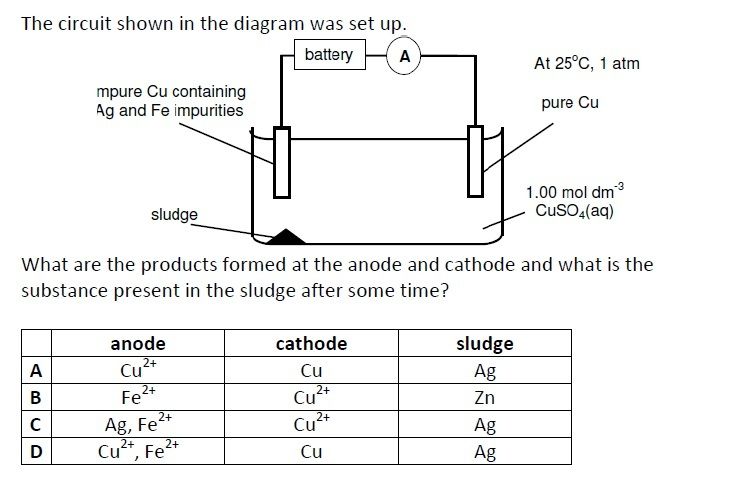
III: http://img.photobucket.com/albums/v700/gohby/Chemistry/sludge_zpsimhrdrbj.jpg
Answer: D
Remarks: Comparing the Ered values, I can gather that Cu2+ will be reduced to Cu at the cathode.
(i) What is meant by “Ag and Fe impurities�? If they refer to metallic compounds, wouldn’t it be unfavourable for the metallic ions to be oxidised (since it is at the anode) even further?
(ii) If “Ag and Fe impurities� refers to the metals itself, how do I know that Cu2+ and Ag+ will be formed, since the Eox (Cu/Cu2+) and Eox (Ag/Ag+) are negative? And how does Ag “fall off� the electrode and form the sludge?
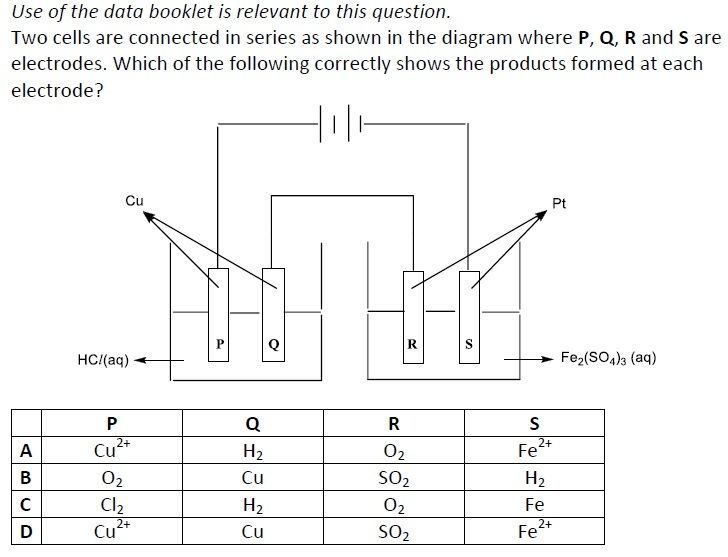
IV: http://img.photobucket.com/albums/v700/gohby/Chemistry/doublelec_zpshzwpp2ja.jpg
Answer: A
Remarks:
(i) If it is an open-ended question, will I know if the product at S would be Fe2+ (instead of Fe)? I think it can be both (so long as the Ecell is positive) but I can’t be sure.
(ii) At electrode Q, comparing the Ered potentials between (Cu2+/Cu) and (H+/H2), wouldn’t Cu2+ be preferentially reduced compared to the latter - so why would hydrogen gas be the products formed at Q?
Thank you! :)
Hi Gohby,
QI. Oxidation potential of Na to Na+ is more positive than oxidation potential of Ni to Ni2+. Hence Na is oxidized, so Terminal E is the anode.
QII. For electrochem electrodes, size doesn't matter. [Mg2+] should be larger, not smaller. If resistance is higher, voltage is higher, not lower.
QIII. Impurities could refer to either (reduced or unoxidized) metallic or (oxidized) ionic state. At the anode, both Fe and Cu are oxidized, while Ag remains unoxidized and hence metallic and hence falls off into the anode sludge. At the cathode, Cu2+ is reduced, while Fe2+ remains in aqueous state. Regarding the sludge, this is what I wrote in another thread :
"Anode sludge" is the term given for the gooey disguisting stuff (ie. sludge) that is deposited below the anode. Why does it fall off and drop down? Because metals are insoluble in water *and* denser than water. Imagine you have a cake with many small stones embedded in it. As the cake is being eaten away by ants, won't the stones fall? As the Cu atoms in the block of impure Cu ore rock (which is the anode) is being oxidized to *aqueous* Cu2+ (ie. cations are soluble (unlike solid metals in atomic state) thanks to ion - permanent dipole interactions can dissolve and become aqueous, making the block of impure Cu ore rock which is the anode appear to dissolve away), the less reactive (ie. less electropositive and hence harder to oxidize) metals such as silver, remaining as the unoxidized solid metal, and solid metals being insoluble in water and denser than water, naturally drop down from the impure copper block of ore rock (ie. the anode), which together with any unreactive (organic or inorganic) material left over from the ore rock (eg. sand, soil, etc), becomes the gooey disgusting mess below the anode, which we call "anode sludge".
QIV. Under aqueous conditions, you cannot reduce Fe2+ to Fe. You'll need molten iron for that. But since electrolysis is expensive, the blast furnace method is utilized instead. You cannot use standard redox potentials, because in aqueous soluions, molarity of water is much larger than 1M (molarity of pure water is 55.555M, and Cambridge may ask A level students to show this via calculations), hence position of equilibrium shifts to RHS, hence reduction potential of H2O becomes more positive than stated in Data Booklet.
At cathode Q, H+ is reduced to H2 gas instead of Cu2+ being reduced to Cu, because the electrolyte doesn't have any Cu2+ to begin with. Sure, Cu2+ is being generated at anode P, but at the start of the electrolysis (for which the qn is based on), the molarity of H+ far outweighs the molarity of Cu2+ (which is technically zero M at initial).
No prob :) -
^_^
-
^_^
-
^_^
-
^_^
-
^_^
-
^_^
-
^_^
-
^_^
-
^_^
-
^_^
-
^_^
-
^_^
-
^_^
-
^_^
-
A couple of BedokFunland JC Buffer Riddles
The conjugate acid of a weak base B, has a pKa value of 9.2014 at room temperature. What volumes of 0.1 mol/dm3 of HCl(aq) and 0.05 mol/dm3 of a solution of B, may be mixed to generate 500cm3 of a buffer solution with a pH of 8.90?
Final answer :
125cm3 of 0.1 mol/dm3 of HCl, and 375cm3 of 0.05 mol/dm3 of B, are required to generate 500cm3 of buffer solution with pH 8.9 pH.
--------------------------------------------------------------------------------------------------
A buffer solution is titrated with NaOH(aq). Upon addition of 3 volumes of NaOH(aq), the buffer solution becomes most effective. Equivalence point is attained when 8 volumes of NaOH(aq) is added.
a) Calculate the ratio of the molarities of both members of the conjugate acid-base pair of the buffer solution, before the NaOH(aq) is added.
b) Given that the original pH of the buffer solution (ie. before NaOH(aq) is added) is 4.16, calculate the proton dissociation constant of the acidic component of the buffer.
Solution :
a) At maximum buffer capacity :HA + OH- ---> A- + H2O
Initial (mol) 8y 3y x-8y n.a.
Change (mol) -3y -3y +3y n.a
Final (mol) 5y 0 x-5y n.a.At equivalence point :
HA + OH- ---> A- + H2O
Initial (mol) 8y 8y x-8y n.a.
Change (mol) -8y -8y +8y n.a.
Final (mol) 0 0 x n.a.First, complete the ICF table for equivalence point. Next, complete the ICF table for maximum buffer capacity, bearing in mind that the initial moles of HA and A- are the same (for both tables).
Since at maximum buffer capacity, [HA] = [A-], this implies 5y = x-5y and hence x = 10y.
Substituting x = 10y into the initial moles of A-, we have moles of A- = 2y.
Therefore, the ratio of the amounts of both members of the conjugate acid-base pair present in the buffer (before NaOH(aq) is added), is 8y HA : 2y A-, ie. 4 HA : 1 A-
b) Using the Henderson-Hasselbalch equation, we havepH = pKa + log ( [base] / [acid] )
4.16 = pKa + log (1/4)
pKa = 4.762
Ka = 1.73 x 10^-5
-
Originally posted by BCME:
AJC_P2_2013
1(a)(iii) Is there any other solvent that is suitable besides the one given in the solution?
Also we required to know the functions of ether?
HCJC_P2_2013
1(b) How do we know that the precipitation of barium sulfate is exothermic and sodium sulfate is not?
ACJC lah, not AJC.
Grignard reagents, like LiAlH4, must be anhydrous and kept in dry ether, because they are sources of C- and H- strong Lewis bases, which are strong nucleophiles and strong Bronsted-Lowry bases, and hence will readily abstract protons H+ from moist air (which will result in your expensive Grignard and LiAlH4 reagents being wasted, and worse, pose a safety flammable explosive hazard due to the H2 generated for LiAlH4) if not kept safely solvated in a dry solvent.
You need to know that ether is an excellent solvent to use because it is inert (it is aprotic due to a lack of a partial positive H atom and thus non-acidic; and it is non-nucleophilic and non-basic as it's already bonded to 2 R groups which are non-viable leaving groups) and it's a good balance of polar (the partial negative charged O atom) and non-polar (the hydrophobic alkyl groups) and although it can't donate H bonds, it can receive H bonds, and consequently it is an excellent inert solvent which can dissolve almost all organic molecules (both polar and non-polar, both protic and aprotic), including phenol and phenylamine.
HCJC_P2_2013 - Wah biangz eh, all sodium salts are soluble lah (everything covered in O levels is examinable at A levels!). So obviously no sodium ppt forms. BaSO4 is famously insoluble (O levels!), and (as part of the H2 syllabus, you should know this mah) obviously ionic precipitations are exothermic due to the formation of (large no. of strong ionic bonds holding together the) giant ionic lattice structure that you see (with your naked eye) as a precipitate.