BedokFunland JC's A Level H2 Chemistry Qns (Part 2)
-
Originally posted by BCML:
TYS 2011 Paper 2 question 4e
how do you determine which half equation to use for the V3+ "in a solution containing V3+" like what hints tell u that you are supposed to consider the VO2+ half equations and that there is further reaction?
First, you should be aware (if you didn't know, now you know liao) that the OS of V in the common V containing ions are 0, +2, +3, +4, +5 and +5, in V, V 2+, V 3+, VO 2+, VO2 + and VO3 - respectively.
(Special Note : The equilibrium between the dioxovanadium(V) ion and vanadate(V) ion isn't a redox reaction, but an acid-base equilibrium, similar to the equilibrium between chromate(VI) and dichromate(VI) ; you can figure out exactly which species with this OS is present under acidic vs alkaline conditions, by looking at whether H+ is present on the LHS or RHS).
Observe PbCl4 : obviously the strongest redox effect of PbCl4, is its oxidizing power (since Pb4+ is unstable and wants to be reduced to Pb2+, which is more stable due to lower anionic charge density and/or the inert pair effect).
Hence, Let Pb4+ be reduced to Pb2+, and let V be oxidized from V3+ to VO 2+ (ie. OS change from +3 to +4). Prove using Cell potential = Reduction potential @ Cathode + Oxidation potential @ Anode, that this redox reaction is thermodynamically feasible.
Next, notice that VO +2 (OS of +4) *might* be able to be further oxidized to VO2 + (OS of +5) under acidic conditions. Again prove using Cell potential = Reduction potential @ Cathode + Oxidation potential @ Anode, that this redox reaction is thermodynamically feasible.
Therefore, the observable color change is from green V3+ to blue VO 2+ to yellow VO2 +, using Pb4+ reduced to Pb2+ as the oxidizing agent in both (thermodynamically feasible) redox reactions. Warning : between blue VO 2+ to yellow VO2 +, a green colour can be observed. This is not due to an intermediate OS between +4 and +5 (which is impossible), but it's due to a mixture of blue VO 2+ and yellow VO2 +, which we humans perceive as green (ie. blue + yellow = green), a common exam trick question. -
Originally posted by BCML:
TYS 2011 Qn 4c(ii) can the explanation be that CCl4 is non polar hence unable to form intermolecular bonds with water molecules that are strong enough to overcome the hydrogen bonding In water hence CCl4 is inert?
Totally wrong. Zero marks. This is basic H2 syllabus stuff that you need to memorize (with understanding of course), how can you not know this when Paper 2 is just a few hours away?!? Be careful not to lose easy marks like this, whether in P2 or P3!
Chan Kim Seng + Jeanne Tan : Physical / Inorganic book page 376.
George Chong : Inorganic book page 59.
Jim Clark : simpler A level explanation : http://www.chemguide.co.uk/inorganic/group4/chlorides.html
Rod Beavon : more advanced A level / University level explanation : http://rod.beavon.org.uk/hydrolys.htm
-
Originally posted by BCML:
How do gaseous molecules Kp and Kc value relate to each other? Why when u use Kc the value is different if u calculate the gas in terms of partial pressure instead of concentration?
There is a formula to intercovert Kc and Kp values (which are different because Kc is in molarities, Kp is in partial pressures). This formula isn't required in the H2 syllabus, so Cambridge will provide you with the formula if the question requires you to use it. Or (less likely) if the Cambridge wants to be sadistic, the queston may ask you to derive the formula by yourself (linking H2 syllabus topics Ideal Gas Law PV=nRT with Equilibria Kc & Kp).
Read the following to understand (memorize the final formula if you like, it's simple enough, but don't memorize the derivation process, just understand it can liao).
http://bilbo.chm.uri.edu/CHM112/lectures/KpKc.htm
http://chem-guide.blogspot.sg/2010/04/relation-between-kp-and-kc-derivation.html
http://www.thebigger.com/chemistry/free-energy-and-chemical-equilibria/derive-the-relationship-between-kp-and-kc/
https://www.youtube.com/watch?v=L_PebPmCNuY -
Originally posted by Flying grenade:
Since amide and ester can react with both naoh and hcl, can it be said that they are amphoteric /amphiprotic?
Cannot lah.
Originally posted by Flying grenade:When/what can say amphoteric/amphoprotic species
When the species (eg. HCO3-) can both donate and accept a proton in an acid-base reaction. An ester or amide can only *kena hydrolyzed* by acid or alkali in a *hydrolysis* reaction, not acid-base reaction.
And it's "amphiprotic" lah, still write what "amphoprotic" leh, make Cambridge laugh at Singapore students.
Oh, in case you're wondering (or if Cambridge decides to play punk and asks) "What's the difference between "amphoteric" and "amphiprotic"?", go read Jim Clark's http://www.chemguide.co.uk/physical/acidbaseeqia/theories.html
Bonus : If Cambridge asks "What's the difference between "amphoteric" and "amphiprotic"? Illustrate your explanation with an example of a species that is amphoteric but not amphiprotic."
Well, Al2O3 is an example of a species that is amphoteric but not amphiprotic. Can you figure out why? ;) -
Originally posted by Vitalitylx:
Hi for MJC Prelim 2014 P2/Q3b(iii)
The answer written for the oxidation state of cobalt in salt A is +4, but I cannot see why? From drawing the structure shouldn't it be 0?
Yes you're right, the OS of cobalt in salt A is 0 (formal charge 4-) and in salt B is +3 (formal charge 3-).Originally posted by Vitalitylx:On my paper it says state the oxidation state of both salts, and the answers gave +4 in A and +3 in B. But okay thank u!
Yes, the OS of Co in that salt A is definitely zero. What probably happened : the MJC teacher wrote the wrong answer in an earlier version of the Prelim paper with the wrong OS of +4 (that you have), subsequently when other MJC teachers pointed out the error, the MJC teacher released a later version of the Prelim paper with the correct OS of 0. Good for you that you realized the given answer couldn't have been correct.
Another frequently encountered neutral coordination complex (you cannot say "complex molecule", there is no such thing, unlike "complex ion" which is an acceptable shortcut for "ionic coordination complex") is the iron(0) pentacarbonyl coordination complex, in which Fe has an OS of 0 and formal charge of 5-, C has an OS of +2 and formal charge of 0, and O has an OS of O is -2 and a formal charge of 1+. Overall ionic charge (which is sum of formal charges and also the sum of oxidation states) is therefore zero, and that's why it's a neutral coordination complex.
https://en.wikipedia.org/wiki/Iron_pentacarbonyl -
Originally posted by Sugarfortress:
Hi Ultima, was just hoping you could provide some advice on these questions:
1. This is pertaining to the 2 factors that affect the basicity of amines:
1i. Factor 1 would be the availability of the lone pair of electrons on N. Generally, we learn that it can be affected by the presence of electron donating alkyl groups. In applying what we've learnt about steric hindrance, I was wondering if this factor can also be affected by bulky alkyl groups not because of their electron donating capabilities but also if they can "obstruct the protons from reaching the lone pair of electrons for coordinate bonding" due to their size / steric hindrance. Is that a flawed reasoning or will it be accepted?
1ii. Factor 2 would be on amine/ammonium salt solubility. On doing papers I realised there are 2 different explanations for this factor, one would be that the presence of bulky non-polar groups makes the amine insoluble and thus less basic (regardless of whether it has been protonated or not) (case in point used by the solutions being why benzylamine is less basic than ethylamine). Another explanation would be based on the ability to form hydrogen bonds, where if an amine has a lack of H atoms attached to the N atom (case in point being N,N,N-trimethylamine), it would be less basic . Both still address the main factor of solubility. However, which explanation of this Factor 2 would be more acceptable in your opinion?
2. This is pertaining to the acidic hydrolysis of acid anhydrides. Following the "pattern" of the hydrolysis of esters, why does the carbonyl segment of the acid anhydride not become a H2CO3 but a CO2 instead? Under what circumstances would H2CO3 exist more preferentially then?
3. This is pertaining to the oxidation of alcohols. Generally, we learn that tertiary alcohols do not tend to undergo oxidation, but why does a tertiary benzyl alcohol (pardon for the loose nomenclature) undergo oxidation?
4. This is pertaining to the aqueous bromination of phenols. When this common question is asked in papers, the generally accepted answer / product for such a reaction is tribromophenol. However, must we take into consideration the ionisation / deprotonation of the tribromophenol to give tribromophenoxide instead? Is that overthinking and how should we reconcile such "environmental" factors in determining the end product of reactions?
5. This is related to Question 4 on tribromophenols. The general baseline is that tribromophenols are highly insoluble and give a white ppt. But with more and more permutations given in exams (with other groups present on the benzene such that we only get dibromo or even monobromo), do nontrisubstituted phenols still give a white ppt? Can we say that as long as the benzene seems "highly substituted" with non-hydrogen groups (besides Br and halogens), it will be a white ppt? In what cases will it then be soluble?
Thanks so much!
Q1i. Steric hindrance affects nucleophilicity much more than it affects basicity (as H+ or H3O+ ions are small and thus relatively unaffected by steric hindrance*). So use steric hindrance to explain reduced nucleophilicity rather than basicity. Note that any Bronsted-Lowry base can potentially also function as a nucleophile, and vice-versa, as they're all Lewis bases.
* Evidence : The deliberately built-in steric hindrance of lithium diisopropyl amide forces it to function only as a Bronsted-Lowry base, but not as a nucleophile. It's function as a Bronsted-Lowry base is uncompromised, but it's function as a nucleophile is completely nullified.
Q1ii. Solubility only indirectly affects basicity, but hydrogen bonding directly affects basicity. Because the more stable the conjugate acid, the stronger the base. Magnitude of hydrogen bonding stabilization energy for primary ammonium > secondary ammonium > tertiary ammonium, conjugate acids.
Q2. When 1 mole of acid anhydride is hydrolyzed (no need for acidic or alkaline conditions), the only products are 2 moles of carboxylic acids. No carbonic(IV) acid or CO2 is generated. On a separate note, carbonic(IV) acid exists in equilibrium with, and hence can decompose into, gaseous carbon dioxide and liquid water, with thermodynamically favorable positive entropy change. Moreover, gaseous carbon dioxide leaves the reaction mixture, pulling the position of equilibrium over to the RHS. Which is why (unless you're actively pumping in carbon dioxide gas to shift the position of equilibrium over to the LHS*), the position of equilibrium always lies on the RHS, and any carbonic(IV) acid will instantaneously decompose (mechanism : after intramolecular Bronsted-Lowry acid-base proton transfer reaction, elimination of H2O yields CO2) to carbon dioxide gas.
* Even then, H2CO3 will undergo Ka1 proton dissociation (or hydrolysis) to yield HCO3- and H+ (or H3O+). Molecular H2CO3 can only be isolated under exceptional conditions, not under standard aqueous conditions.
Q3. As long as a benzene ring has a benzylic H atom, the functional group (as far as oxidation by KMnO4 is concerned) is no longer considered a typical alcohol or ketone or alkyl group, but falls under "oxidation of benzene ring side chain (provided a benzylic H atom is present) to benzoic acid".
Q4. It is precisely the Ka partial proton dissociation of the phenolic OH group, that makes the phenolic OH group strongly electron donating by resonance, due to the negative formal charge present on the O atom of the phenoxide C6H5O- ion. With a negative formal charge on the O atom, the electron-rich O- atom is no longer electron withdrawing by induction (unlike the OH phenolic group), allowing for the full effect of its electron donating by resonance capabilities. When you state the product as "tribromophenol", you're already implicitly stating "tribromophenol (and it's conjugate base in an acid-base equilibrium)" because anyone with any chemistry sense knows that all acids exist in equilibrium with their conjugate base (provided, of course, that the solvent employed allows for this).
Q5. As you're aware, aqueous solubility of halogenated phenols (and phenylamines) decreases significantly with the multiplicity of halogenation. Hence aqueous solubility of mono-halogenated phenol > di-halogenated phenol > tri-halogenated phenol. Similarly, for other substituted groups other than halogens (which of course, you must take into consideration the polarity, proticity (can accept and/or donate H bonds?) and presence/absence of formal/ionic charge, of these other substituents, as such would contribute to the overall solubility/insolubility of the entire molecule). So whether a ppt is observed or not, depends on its molarity, its molar solubility and the temperature. In conclusion there isn't a simplified rule for this (ie. case-by-case basis, but for A level purposes it's quite safe to state that tri-halogenated phenols usually forms a ppt under aqueous conditions, while mono-halogenated phenols usually do not), and because Cambridge knows this, they'll set reasonable MCQ options (or for P2 & P3, accept reasonable answers in this context), eg. by eliminating the other more obviously wrong options. -
Originally posted by Sugarfortress:
Thanks for the prompt reply!
So sorry I got confused by the acid anhydride, I actually wanted to ask about the hydrolysis of - this "functional group"(not too sure what it is called) -o(c=o)o- which would yield co2 when hydrolysed.
But thanks for the clear explanation for h2co3 and co2! :)
Totally welcome, Sugarfortress :)
Here ya go : https://en.wikipedia.org/wiki/Carbonate_ester
-
Originally posted by MagicLeprechaun:
Hi Ultima, rlly appreciate what you are doing here! Hoping that you can help me clarify some doubts:
1) Regarding the coordination number of a complex, I understand that it is defined as the number of coordination bonds around the central metal atom/ion. For the case of a porphyrin ring complexed with Mg2+ in chlorophyll a, I understand that 2 of the N forms ionic bonds while the other 2 N coordinate bonds with the Mg2+ ion. In such a case, would the coordination number be 2 or 4? Also, since complex is when the no. of coordination bonds exceed the O.S of the central metal ion, would this compound even be a complex since it only has 2 coordinate bonds?
2) Regarding optical isomerism in metal complexes, while i am aware of the propeller chirality in compounds such as (cr(cro4)3)3-, I was wondering if there would also be such isomerism in tridentate or even hexadentate ligand complexes like fe edta complex.
3) Regarding cyanohydrins, will basic hydrolysis of it yield coo- or will the original aldehyde be produced instead (Oh- extracts H from Oh in cyanohydrin which results in formation of c=o bond again and the elimination of cn-)
4) For the amino acid tyrosine, the OH in the phenol is apparently neutral and tyrosine is not ionised at physiological ph of 7. However, we learnt that phenol usually exists as phenoxide at ph7. Is there a particular reason why tyrosine is neutral at ph7 and if we are asked to circle an ionisable r grp at ph7, can we circle the phenol in tyrosine?
5) When asked for possible interactions between R groups, do we assume they are protonated or not, because does assuming that they are not protonated / charged rule out interactions like ionic interactions? This is especially so if the question does not give the amino acid residues in their charged form yet it is quite obvious that ionic
interactions are possible
6) Pertaining to questions that ask for the reactions of period 3 elements with oxygen and chlorine, do we give the reaction that least oxidised the element or the reaction that most oxidises the element when it is not specified. Eg
should we give the formation of p4o6 or p4o10 when p4 is burnt in oxygen?
Thank you!
No problem, MagicLeprechaun.
Q1. In complex (no pun intended) and unusual cases such as these, the proper chemist and exam-smart student would specify exactly which type of bonds are involved in calculating the coordination number. Because different chemists and different authors have a different take on whether ionic bonds should be included or not. For instance, in a P2 or P3 qn, you should write, "coordination number is 2 if we only count the dative covalent bonds; coordination number is 4 if we also include the 2 ionic bonds." and Cambridge would go, "now there's a smart student.". If it were an MCQ however, then it would be the question's fault for not specifying this, then the exam-smart student would deduce the best option by eliminating more implausible options. But all things considered, as far as the underlying definitional purpose of "coordination" is concerned (as opposed to a shallow, dogmatic, specific interpretation), it's actually better (more sensible) chemistry to include *all* bonds (after all, all of the bonds herein, whether ionic or dative covalent, are in truth part ionic, part covalent anyway) that the central metal cation is coordinated with. Concordantly, the coordination number of Mg2+ in chlorophylls (ignoring any other ligands not included in the simplified diagrams given in A level exams) is better regarded as 4 (ie. including ionic bonds) instead of 2. And yes, the Mg-chlorin ring in chlorophylls is considered a coordination complex.
Q2. Yes, it's possible, as long as the coordination complex is overall tetrahedral or octahedral, and the mirror image is non-superimposable (or more strictly, non-superposable) on the molecule itself. But assuming you're a H2 Chem student (are you? or do you take H3 Chem as well?) this is beyond H2 Chem syllabus and shouldn't be your concern.
Q3. MagicLeprechaun and Twe375, because the nucleophilic addition of CN- to a carbonyl compound is reversible (HCN is a slightly stronger acid than H2O, so CN- conjugate base is slightly more stable than OH- conjugate base because even though the negative formal charge is on C which is less electronegative than O, but the C atom being sp hybridized has high % s orbital character), hence under alkaline hydrolysis conditions, you do get a mixture of both (carbonyl and amide) products initially. But because the first hydrolysis product of the nitrile group is an amide, which is itself further hydrolyzed eventually to a carboxylic acid (acidic hydrolysis) or carboxylate ion (alkaline hydrolysis), this pulls the position of equilibrium eventually to the RHS, which is why for the H2 Chem syllabus, you simply have to state that the final product of cyanohydrin / hydroxynitrile hydrolysis is a hydroxycarboxylic acid (acidic hydrolysis) or hydroxycarboxylate ion (alkaline hydrolysis).
Q4. "We learnt that phenol usually exists as phenoxide at pH 7". This is not correct. The pKa of phenol is 9.95 (in aqueous solvent), which means at pH 7, which is more acidic than the pKa value of 9.95, the majority of phenol molecules exist as the protonated conjugate acid form, instead of the deprotonated conjugate base form. Notice that the pKa of the phenol side chain in Tyrosine is 10.07, which reflects its slightly weakened acidity (compared to phenol by itself), as a result of the benzylic sp3 C atom which donates electrons slightly by induction (but only slightly, because of the electronegative N atom of the alpha amine). If by "ionizable" you mean a small percentage exists in it's anionic deprotonated form at pH 7, that's still technically correct, by definition of acid-base equilibria. But for A levels, it wouldn't be acceptable, because if Cambridge asks the question, it implies "circle the most ionizable group(s) at pH 7" and the phenolic side chain of Tyrosine ranks a distant 3rd place behind the the alpha COOH/COO- and alpha NH2/NH3+ groups, and Cambridge would think, "this student's answer implies he/she doesn't know the alpha groups ionize to a far greater extent than the R group, so zero marks for him/her!".
Q5. Again, be exam-smart. If the pH is given, use the predominant form (ie. either protonated or not at that pH). If the pH is not given, then you should take the initiative to state "at physiological pH, these groups exists as..." and label the R group interactions accordingly. Or if there isn't an obvious predominant form at the pH indicated, then you should (be exam-smart and) give both answers : eg. as conjugate base form, NH2 can donate and accept H bonds ; as conjugate acid form, NH3+ can donate H bonds and participate in ionic bonding. If it's an MCQ, then (be exam-smart and) eliminate the less plausible choices, and the remaining option will clue you in on what the Cambridge question setter wanted.
Q6. Again, be exam-smart. Give both eg. "in limited oxygen P4O6 is formed ; in excess oxygen P4O10 is formed", if you're uncertain on which one the question wanted. You won't be penalized because both equations would be correct. Cambridge would accept the one they wanted, and ignore the one they didn't want (in some cases, Cambridge will accept either, eg. P4O6 or P4O10, unless the question precluded one of them in its description). You'll only be penalized if one of your answers contradict or nullify the other point (in which case Cambridge would go "KNN this bugger trying to cheat!"). But in the context of your question, and especially if you're too short of time to write both answers, you should give the form of the compound that is more thermodynamically stable under standard conditions and thus more common, eg. SO2 instead of SO3, and/or the form that assumes excess O2 and Cl2 is present and available for complete reaction, ie. P4O10 instead of P4O6, and PCl5 instead of PCl3. -
Originally posted by chemistryiskool:
Hey Ultima!
Thank you so much for doing this :) Really enjoy trying to solve all the challenging chem questions you post on your website
My question pertains to the oxidation of a benzene ring with an alkene side chain. When we add acidified KMnO4, do we oxidise the alkene first before oxidising the side chain or do we simply oxidise off the entire side chain without bothering about the alkene inside?Thank you!
U're welcome, and glad to hear you enjoyed my BedokFunland JC's website questions :)
With hot acidified KMnO4, oxidize the alkene side chain (with oxidation cleavage) first, then oxidize the benzene ring together with its alkyl side chain (provided a benzylic H atom is present) to benzoic acid. So your answer (if this was an A level exam qn) should include at least 2 different organic products (ie. excluding inorganic CO2 and H2O), unless of course the alkene side chain upon oxidative cleavage is oxidized to methanoic acid or ethandioic acid (both of which would be further oxidized to carbonic(IV) acid, which exists in equilibrium with, and hence can decompose into, CO2 and H2O, with thermodynamically favourable positive entropy change, and with the position of equilibrium pulled over to the RHS as predicted by Le Chatelier's principle, as gaseous CO2 leaves the reaction mixture), or if the other side of the alkene side chain is also another benzene ring which is also oxidized to the same product benzoic acid (eg. if the reactant molecule is symmetrical or close to symmetrical about the alkene double bonds outside the benzene rings). -
Originally posted by Pandankaya123:
Hi Ultima,
Some questions here which I hope I can seek your advice :)
1. With reference to 2014 TYS Paper 2, why is FeS2 considered a "complex" with a yellow / gold colour even though it is supposed to be ionic (Fe2+ and (S2)2- ions)?
2. Also with reference to the trend of boiling points of the Transition Metals, why does chromium have a higher boiling point of 2672 than that of Mn of 2061 despite it having less 4s electrons that Mn? Shouldn't having more electrons in Mn result in stronger metallic bonding?
3. Generally, what is the safest / most efficient bet when Cambridge asks for the "structural formula" of a compound? What about "displayed formula"? In such circumstances, should we draw 1) condensed 2) all bonds 3) skeletal? Or is a hybrid even accepted by Cambridge?
4. Regarding the usage of "in paper" and "out of paper" wedges in illustrating Walden's Inversion in Sn2 Mechanism, do the orientations of the wedges (how they are placed before and after reaction i.e. "do they flip or stay the same") matter and does Cambridge see it as a marking point?
5. In Sn2 Mechanism, in the transition state, is it a must to label the nucleophile and leaving group as delta minus and the attacked carbon atom as delta plus? Are there any circumstances where we do not label as such?
6. I understand that one can use "arrow pushing" to illustrate "inorganic mechanisms" such as how SO2 becomes H2SO3 and how CO2 becomes H2CO3 when attacked by H2O. In seeking a better understanding of other similar reactions, how can we also use "arrow pushing" to illustrate how giant covalent SiO2 becomes ionic Sio3 2- when reacted with concentrated NaOH?
7. I understand that we often use terms like pi / π electron cloud / ring system / aromatic ring system interchangeably. I would like to ask if all of these terms are accepted by Cambridge and if not, which would be the safest bet to use in elaboration in Paper 2 and 3 (for instance when illustrating partial double bond character in chlorobenzene)
8. With regards to the graph of rate of reaction against concentration of substrate, we often say that at low concentrations of substrate, the order of rxn is 1 wrt substrate. When at high concentrations of substrate, the order of rxn is 0 wrt substrate due to catalyst saturation. However, what if even without the substrate, the order of reaction wrt to the reactant (our substrate) is non-zero. How would that change how the graph looks like at low and high reactant (substrate) concentrations in the presence of catalyst?
9. In illustrating complex ions, say CuCl4 2-, which would be the preferable way of writing in equations: 1) [CuCl4(H2O)2] 2- or 2) [CuCl4-]2-. If it is the former, should we be writing precipitates that we commonly know of (like CuOH2) as [Cu(OH)2(H2O)4] from then on? Also, will we be penalised when we state the molecular geometry of the complex based on our answer in 1) and 2)? i.e. when we write 1), we would then proceed to write "octahedral" but when we write 2), we would tend to write "square planar" later on if the question requires.
10. In solving "calculate pH" questions given the intial acid/base concentration and the ka / kb values respectively, what would be the most correct statement to use/write to assume that [acid/base intial] =approx= [acid/base eqm]?
11. In questions where Cambridge asks why compounds like Al2O3 react with acid and base, will it suffice to just say high charge density = acidic, and ionic oxide = basic? Must we go in depth to talk about how Al3+ deprotonates coordinating H2O molecules to make Al2O3 acidic and how O2- is a strong base and thus this makes Al2O3 basic?
Thx alot! :)
Q1. Unlike O levels, now at A levels you begin to appreciate that Chemistry, a microcosm of real-life, is not so clear-cut black-&-white, but many fascinating shades over the entire spectrum. While it's still not wrong to consider FeS2 as ionic, it's also not wrong for Cambridge to call it a complex, because there's an area of overlap between the 2, for which FeS2 falls in. Firstly, unlike O, S atoms have a significantly more polarizable electron charge clouds (due to larger ionic radius and shielding effect), and hence the bonds for FeS2 are actually closer to dative covalent than ionic. Secondly, in the crystal lattice structure of FeS2, each S atom (of S2 2- disulfide anions) donates 3 bond pairs unto each Fe2+ cation, concordantly each S2 2- dilsulfide anion donates 6 bond pairs unto each Fe2+ cation, while each Fe2+ cation accepts dative bonds from, and is thus (distorted octahedrally) coordinated with, 6 S atoms (of S2 2- disulfide anions), giving rise to the stoichiometry of 1 Fe2+ : 1 S2 2-, ie. FeS2. Cambridge chose to call it a coordination complex, simply out of convenience in the context of the (coordination complex topical) questions they chose to ask the A level candidate.
Q2. For a variety of reasons too complex to be dealt with at A levels, different metals across the d block have different metallic crystal lattice packing structures, with significantly closer packing for Cr compared to Mn. This is evidenced by the fact that in spite of the significantly higher molar mass of Mn over Cr, they have similar g/cm3 densities. Closer packing allows for stronger metallic bonds, which explains why Cr has a higher melting/boiling point and hardness compared to Mn.
Q3. When "structural formula" is asked, Cambridge accepts either displayed / full, skeletal, condensed, or a hybrid of all 3. Students should use whichever they're most comfortable with. More competent students will find skeletal structure to be advantageous, both in terms of being less time-consuming, as well as being clearer (for both the student and Cambridge marker).
Q4. Cambridge requires A level students to draw the following diagram :
https://en.wikipedia.org/wiki/SN2_reaction#Reaction_mechanism
Q5. Yes it is required : all formal charges must always be shown, and partial charges must be shown when relevant. Although the positive (partial or occasionally formal) charge on the electrophilic C atom should be illustrated in the reactant rather than transition state. Understand the meaning of transition state, and apply chemistry sense to adjust accordingly for different cases or exceptions, eg. if the incoming nucleophilic atom has a negative formal charge, it'll have a partial negative charge in the transition state to reflect its process of donating its lone pair and losing its negative formal charge, eg. hydroxide ion ; if the incoming nucleophilic atom has a no formal charge and only a partial negative charge, it'll have a partial positive charge in the transition state to reflect its process of donating its lone pair and gaining a positive formal charge, eg. ammonia molecule. And likewise for the leaving group.
Q6. As far as helping you to understand the process and to elucidate the product is concerned, you can proceed with the mechanism by visualizing SiO2 as a simple covalent molecule rather than a giant covalent lattice. Just be aware that because the reactant exists as a giant lattice, so will (at least some of) the products (even as you draw it as simple molecular for the sake of simplification). After which, you can proceed to write out the overall balanced equation (which will be all that Cambridge would require from you in the A levels).
Q7. Yes, they are mostly all acceptable, and different JCs will use different terms and phrasing. A safe bet is to follow the phrasing of CS Toh, Chan Kim Seng & Jeanne Tan, and George Chong in their A level books. If you're still worried about this point, go look up the Cambridge Mark Schemes to learn exactly how they mark (as I've said many times before, Cambridge is more reasonable and less anal than JC teachers in marking students' answers).
Q8. You would have to mathematically adjust the graph of course, but which is beyond the A level Chem syllabus and will not be asked.
Q9. [CuCl4-]2- is [CuCl4-]2-, totally different from [CuCl4(H2O)2] 2-. The former is tetrahedral and the correct formula, while the latter is octahedral and the wrong formula. Other than the common coordination complexes from the A level H2 syllabus, for uncommon coordination complexes the Cambridge question will give you sufficient data for you to elucidate the correct formula and accordingly, the correct geometry. You should write the formulae of precipitates as Cu(OH2)(s) and not as [Cu(OH)2(H2O)4](s). There is usually error carried forward for such questions, but not always.
Q10. For most pH calculation questions, there is no need for a specific declaration of estimation (in spite of what your anal JC teacher might insist), unless of course, specifically required by the question, in which case any clear explanatory phrasing will suffice, eg. "Because the Ka value is very small *and* the initial molarity is fairly large, hence the change in molarity x, may be considered negligible relative to the initial molarity, and concordantly it will be mathematically valid to 3 significant figures to approximate the equilibrium molarities back to the initial molarities".
Q11. No details of the underlying mechanism to explain the acid-base nature of metal vs non-metal oxides are required in the basic A level H2 syllabus (but of course, it's entirely possible for distinction-type questions, for Cambridge might go with "Suggest a mechanism to explain..." etc). For the basic A level H2 syllabus, students need only state that "metal oxides, being ionic oxides, are basic oxides; non-metal oxides, being covalent oxides, are acidic oxides ; oxides with a high degree of both covalent and ionic character are amphoteric", and of course, the balanced equation must always be written for such questions, eg. Al2O3 reacting with acids, and Al2O3 reacting with alkalis.
No prob :) -
Originally posted by Kahynickel:
Layers of graphite is called graphene. But is graphene a different substance ?? I mean it a hydrocarbon so it is diferent from diamond, graphite and buckminster ?
Please also make clear whether the melting point of diamond is higher than graphite? Graphite is more stable than diamond in what terms.
Graphite and graphene may both be considered allotropes of carbon, but graphene is also the basic structural element of other carbon allotropes, including graphite (which is composed of layers of graphene stacked together with van der Waals interactions between graphene layers), carbon nanotubes and fullerenes (including Buckminsterfullerene).
The melting points of graphite and diamond are very similar, and pressure dependent. It's a common misconception among O level and A level students (and even some school teachers and private tutors) that the melting point of graphite is lower than diamond because less energy is required to overcome the weak van der Waals forces between graphene layers of graphite, compared to the tetrahedral giant covalent lattice structure of diamond. Because just overcoming the weak van der Waals forces allows you to write with a graphite pencil, but not melt it. To fully and properly melt graphite requires breaking the partial double bonds within each graphene layer, which brings us to the next point.
Graphite is more thermodynamically stable than diamond, because of the partial double bond character for each C-C bond in graphene / graphite. The stronger the bonds (and obviously the partial double C-C bonds in graphene / graphite, are stronger than the C-C single bonds in diamond), the more exothermic the bond formation enthalpy, and hence the more thermodynamically stable (as illustrated by the Gibbs free energy formula).
Originally posted by Kahynickel:But graphene is a hydrocarbon while graphite is C only. Do we incorporate Hydrogen in graphite by chemical reaction??
Secondly as you said and we know that both Diamond and graphite are carbon. both in their structure have many Carbon atom joined via covalent bonds. In polymer like poly(ethene) many small units add to produce a large unit which has highMr, while diamond has mass of 12 which is th Ar of one carbon atom. Why dont we consider the mass of all the carbon atom in diamond or graphite? Is it due to the reason that the number of atoms in Diamond cannot be counted. Is this the reason?
Graphene is pure C, no H.
Diamond and graphite is a giant covalent molecule, which means, depending on the exact size of the piece of diamond or graphite in your hand, there could be millions, tens of millions, hundreds of millions, billions, tens of billions, hundreds of billions of C atoms present. Eg. a piece of diamond which has a mass of 12g has 12/12 = 1 mol = 6.02214086 × 10^23 C atoms present.
Originally posted by Kahynickel:I am extremely sorry. I misread graphane as graphene. Actually graphane was given in an AQA question paper June 2013. It is a hydracarbon and as the name suggest -ane.
I still did not uderstand your avogadro-based explanation of diamond's atomic mass.
Ah ok right. Graphane (CH)n, is basically hydrogenated graphene, with each C atom being sp3 hybridized instead of sp2. It can also be thought of as a 2D analog (ie. version) of diamond, but with each C atom bonded to a H atom (alternating above and below the sheet).
https://en.wikipedia.org/wiki/Graphane
About diamond, basically you're right, different pieces of diamond have different no. of C atoms, which is why there's no such thing as molar mass of diamond. To tell how many moles of C atoms are present in a piece of diamond, we take the sample mass of the diamond, and divide it by the molar mass of C, ie. 12g. -
Originally posted by Kahynickel:
NaCl dissolves in water without any chemical reaction (hydration), while SiCl4 is hydrolysed by water. Can we say that ethanol which soluble in water undergoes hydration?? I think that hydration is the dissolution of ions in water without chemical reaction. ethanol has no ions i aqueous solution so ethanol in water in neither hydration nor hydrolysis.
Mostly Covalent molecules are said to be hydrolysed and those having ionic plus some covalent character such as MgCl2 up to little extent.
Awaiting for ur thoughts.
Hydrolysis refers to chemical reaction with water (in which either the water molecule or the other reactant, or both, is 'lysed' or broken up), and a chemical reaction is defined as one in which a sigma bond (including dative bonds) is formed or broken.
Hydration is a subset of solvation (in which the solvent is water), and solvation refers to any physical (non-chemical) interaction between the solute and the solvent, eg. hydrogen bonding, ion - permanent dipole interactions, etc.
As such, ethanol (as a solute in the minority) may be considered to undergo hydration (with water as a solvent in the majority), rather than hydrolysis (as no sigma bonds are formed or broken), when ethanol accepts and donates hydrogen bonds from and to water. But if you prefer not to see or label it as hydration, it won't be an issue for A level purposes, as Cambridge won't specifically ask in this context.
1 related point to take note of : For the 2 equations that AlCl3(s) dissolved in water participates in to generate an acidic solution as required by all A level syllabuses, the 1st equation where AlCl3(s) dissolves in water to generate [Al(H2O)6]3+(aq) and 3Cl-(aq), while this may technically be considered hydrolysis (since Al3+ has sufficiently high cationic charge density to accept dative bonds from H2O ligands, rather than simply ion - permanent dipole interactions), is more usually labeled as hydration, in order to avoid confusion with what occurs next, ie. the 2nd equation, which is even moreso characteristically a hydrolysis reaction (and hence correctly labeled as such),
[Al(H2O)6]3+ ⇌ [Al(OH)(H2O)5]2+ + H+ or
[Al(H2O)6]3+ + H2O ⇌ [Al(OH)(H2O)5]2+ + H3O+ -
Originally posted by gohby:
Hi UltimaOnline,
(i) When oxygen is reduced at the cathode, how do I know which of the following half-equations should I use (1st equation is O2 + 4H+ + 4e --> 2H2O with +1.23V, 2nd equation is O2 + 2H2O + 4e --> 4OH- with +0.40V) and what is the basis for it? I understand that the latter is used for the cathode reaction for fuel cells..
(ii) When a compound is left to oxidise in air, which half-equation should I use? How would I know whether oxygen reacts with H+ or a water molecule?
Thank you!
Hi Gohby, which equation to use, depends on the pH of the electrolyte solution. In fuel cells, because the electrolyte has to be alkaline (in turn because H2 can only be oxidized to H2O in alkaline conditions), hence the 2nd equation is the correct one.
Originally posted by gohby:To confirm: you meant O2 being reduced to H2O in alkaline conditions right?
If the question asks if a compound would be oxidised in air, we would use the first equation (with E0 value being +1.23V) for the reduction of water. But where does the H+ come from?
No, I meant H2 can only be oxidized to H2O under alkaline pH at the anode, hence we need the cathode reaction to generate the required alkaline pH, therefore we reduce O2 under non-acidic conditions to OH-. If we had used acidic pH, O2 would be reduced to H2O, which although has a more positive reduction potential and hence would generate more electricity (ie. higher cell potential) in theory, but would not work because we need alkaline pH at the anode, and the cathode and anode need to be connected with the same electrolyte for current to flow.
The H+ comes from an inorganic acid which you used to set up the acidic pH in the first place. That is, if you're aware the pH is acidic (because of an inorganic acid used earlier to make it so), then use the half-equation which has H+ on the LHS. If you're aware the pH is neutral or alkaline, then use the half-equation which does not have H+ on the LHS. -
Originally posted by BCME:
In Alevel_2011_P3
Q1(e) When amides undergo hydrolysis
RCONH2 + OH- ---> ROO- +RNH2
Why is it not the case for the last reaction? Also what is the role of Br2 in the last reaction?
Thanks
Because of a Uni level reaction mechanism known as the Hofmann rearrangement (which is of course beyond the H2 syllabus, but since part d of the Qn was talking all about it and giving you the info you need, you should therefore suspect part e of the Qn might be linked to part d) :
https://en.wikipedia.org/wiki/Hofmann_rearrangement -
Originally posted by gohby:
Hi UltimaOnline,
I have some questions on transition elements:
Q1
Copper (I) sulphate is a white power which reacts with water to give a blue solution and a pink-colored solid. By reference to the E data from the Data Booklet, identify the products formed, describe the reaction undergone.
Remarks: I understand that disproportionation took place given the products formed as hinted in the question. However, if Cu+ is disproportionated, why is it stated in the question that Copper (I) sulphate “reacts with water�?
Q2: Chromium is a metal commonly used to make stainless steel and for the chromium-plating of steel articles.
Remarks: for Q2b(i) Can I confirm if the answer for Q is [Cr(H2O)4Cl2]+? Do we write down any excess water molecules which are not attached to the transition element in the complex?
As for Q2c, would the proposed response be correct?
Ligand exchange took place as the sulphate ions that were initially bound to the chromate ion were replaced by the oxalate ion. This is because the ligand strength of the oxalate ion is stronger than that of the sulphate ion, as the size of the d-orbital splitting in the complex is larger.
Thank you!
Hi Gohby, no prob :)
Q1. It's just the phrasing. Of course, water isn't oxidized or reduced, but it's presence is required for the disproportionation of Cu+ to occur.
Q2bi) Since 0 moles of AgCl is precipitated, all 3 moles of Cl- must be ligands instead of counter ions. Hence Q is the neutral coordination complex [Cr(Cl)3(H2O3)].3H2O and yes for such questions (in which the overall formula is given as CrCl3.6H2O you need to include and balance the water molecules, and you can regard the H2O outside the coordination complex as 'water of crystallization'.
Q2c) Not quite. Since the exact colour change isn't specified, you cannot be sure if the new ligands have a stronger or weaker ligand field strength, and/or that the new magnitude of d-d orbital splitting is larger than before the ligand substitution. You can only state with certainty that ligand substitution / exchange has occurred, either because the new ligands have a stronger ligand strength, ie. Kstab or Kf larger, or because the molarity of the new ligands are significantly larger than that of the old ligands, or both. In answering the question, you can only confidently state that the magnitude of d-d splitting has changed upon ligand substitution, resulting in light energy in a different region or wavelength of the electromagnetic spectrum is absorbed, and therefore the observed colour (which are the colours not absorbed) will concordantly be different. -
Originally posted by Flying grenade:
Ultima, can u explain the 'U' and the '+' in the benzene ring?
https://www.dropbox.com/s/ul2ufrclclwiphy/Screenshot_2015-11-19-14-33-23.jpg?dl=0
https://www.dropbox.com/s/tfmaugbgthzlr2x/Screenshot_2015-11-19-14-35-24.jpg?dl=0
It represents the resonance hybrid of the tetrahedral sp3 hybridized intermediate of the benzene ring during electrophilic aromatic substitution, in which the positive formal charge is delocalized by resonance over the ortho, para and ortho C atoms (excluding the meta C atoms, which is misleadingly implied by the simplified A level version of the mechanism).
If you want further clarification, join my BedokFunland JC tuition (assuming you're retaking your A levels) and discuss it during tuition. Alternatively, as is the case with 99% of Singapore JC students, just "memorize it and don't ask so much" as JC teachers would instruct.
Originally posted by Flying grenade:Huh?? But the picture of the intermediate, shows the U across the 3rd C too, relative to the C atom that is fully filled
Just as O levels you were lied to that all compounds are either covalent or ionic, then at A levels you learnt the truth that all compounds lie within a spectrum between covalent and ionic; concordantly A levels is similarly simplified for the purpose of preparing you for University studies, which is when you start to properly learn the leading-edge relative truths, to the best of capacities of human science on this planet as of now. -
Originally posted by Sugarfortress:
Hi Ultima,
Really sorry for the late reply! I'm a H2 student. Also, thanks for that clarification pertaining to CuI!
On another note, could I seek your advice pertaining to the Mcq question below? The answer provided is C, but we couldn't figure out why. We understand that they are asking for fractions instead of just concentration of X so it's less clear cut, yet we know that there is more than 1 variable in the fraction changing at any point in time (ie LHS, RHS, fraction numerator, fraction denominator). How should we approach such questions?
https://drive.google.com/file/d/0B0qaWFuyyNByRjBCSFJoRW1wQlE/view?usp=docslist_api
Thanks so much! :)
Your past posts revealed a deeper insight than possessed by most Singapore JC students, Sugarfortress. If indeed as you say you're currently only a JC student, you'd do well to consider taking Chemistry related disciplines in the University, eg. Medicine.
This MCQ is a classic killer A level Chemistry MCQ that is designed to sieve out only the most able students for an A grade, and has been recycled over the years across different JC prelim papers. There are 2 parts to this MCQ.
Firstly, the shape of the curve (at either pressure). The shape is consistent with either a product of an endothermic reaction, or the reactant of an exothermic reaction. Concordantly, 1 and 2 are possible options.
Secondly, at higher pressures, there is less of the species, which is consistent with the species being gaseous, and belonging to the side (ie. LHS vs RHS) with greater moles of gas. Concordantly, 1, 2 and 3 are possible options.
As such, the correct answer to this MCQ is B (1 & 2 only), instead of C (2 & 3 only).
Assuming that's your paper and handwriting, you and your friends actually correctly worked it out, but were sabotaged by your teacher's wrong marking. Don't let the term "fraction" confuse you. Just replace it with the word "moles" or "molarity", then you're good to go.
You were probably confused with the use of the term "fraction" only after you got back your script, and only because of your teacher's wrong marking, misleading you into thinking the use of the term "fraction" adds some deeper, more insidious, tricky element on the question. Btw, why didn't you and your friends go ask your school teacher or private tutor (whoever wrongly marked you wrong) to explain why he/she marked you wrong? Or if you did, what did he/she retort? ;Þ
You're welcome ;) -
I posted on another forum
Just to add (as of Nov 2015) : all 3 of you (DrBiology, Matsuri and OrbitalRadius) are / will be / have been studying Medicine (with Matsuri currently doing his housemanship).
Matsuri's point is that just because you didn't succeed within the Singapore education system (eg. if you failed to get into local Med school with local A level results), doesn't necessarily mean you're not good enough for the Uni course you failed to get into. You could have been unfairly sabotaged by one of many things, eg. the compulsory 2nd language requirement of the Singapore education system, or even something as general as the unhealthy, sterile, unnourishing, ultra-competitive, punishing, zombie-like learning environment in Singapore (which is a complex socio-political matter and blaming any one factor or party would be an oversimplification). Which I agree with, of course.
DrBiology and OrbitalRadius' point, is that it would not be judicious or beneficial to dumb down the A level system to make it easy, as the original article was suggesting. Dumbing down the education system at all levels, from O levels to A levels to Uni levels, just so everyone can effortlessly get stellar O level and A level results leading to a Uni degree for the sake of having a Uni degree, won't work to benefit the functioning of human society as it currently is. Which I also agree with, of course.
So these are separate, non-mutually exclusive and equally valid points here, yall medical-doctors-to-be. -
See, this here, pisses me off.
Every year, due to the ill-conceived and unjustly small number of places available in local Medical schools, many hundreds of Singapore students (who perform better academically and thus are better qualified than many foreigners who get to study Medicine in their own countries with much larger Med school intakes), many with straight As, are forced to spend a million dollars (with some parents going into serious debt or selling their homes to support their son/daughter's aspirations) to study Medicine overseas.
And most of these Singaporeans do succeed in completing their medical degrees from Universities and medical schools recognized by Singapore Medical Council (SMC). Some of these overseas Med schools and Universities are even more reputable and internationally recognized than local Med schools.
So this proves it's not truly a matter of prudently restricting local Med school student intake for the sake of quality control, but more actually a matter of ill-conceived and maladjusted education policies resulting in overly small local Med school intakes, resulting in a critical shortage of medical doctors in Singapore, in turn resulting in thousands of foreigners (some with dubious academic performance, medical training and professional qualifications) being imported in to meet Singapore's needs.
How would you feel if you were one of many such hundreds of Singaporeans every year, perform better (eg. straight As) than many of the foreigners imported in to meet the shortage, and thus feel you're more deserving but are nonetheless turned away from local Med schools, only because of the overly small intake of students for local Med schools.
Which leaves you with 2 choices : either struggle to borrow a million dollars to receive a Medical school education overseas recognized by SMC, or give up on your lifelong aspirations to serve society as a doctor. While every year, you see/hear the local media announce, "Shortage of medical doctors in Singapore, foreign doctors imported in to meet Singapore's needs".
S'pore sees a rise in foreign doctors
More than a quarter of the doctors in the public healthcare sector are foreigners.
At the end of last year, public hospitals and polyclinics had more than 2,100 foreign doctors in their employ and the number continues to grow as Singapore faces a shortage of trained medical staff.
Full article :
http://mypaper.sg/top-stories/spore-sees-rise-foreign-doctors-20151123 -
Originally posted by gohby:
Hi UltimaOnline,
Ok, so further to this, with reference to A Level 2007 P1 Q36,
CS Toh’s A Level suggested solution are as follows:
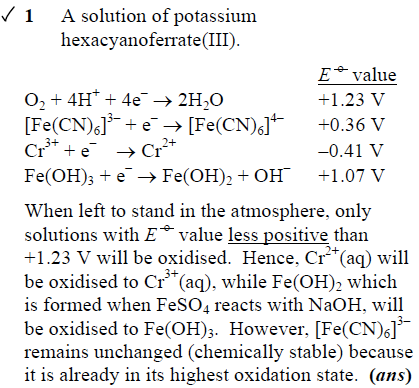
For choices 2 and 3 - the compounds scrutinised are chromium (II) chloride and iron (II) hydroxide. Hence, shouldn’t we be using the half-equation which does not have H+ on the LHS (i.e +0.40V)? Why is the solution suggesting that we use the half equation with H+ on the LHS for all 3 compounds?
Secondly (as per the solution), why are we using the reduction potential of iron (III) hexacyanoferrate instead of potassium hexacyanoferrate (III) itself?
With regards to Fe(OH)2 being oxidized to Fe(OH)3 when left exposed to the air, this is a common experimental observation that both O level and A level students are expected to recognize and/or memorize. Your reasoning (regarding H+ vs OH-) is fair, but because you're also supposed to know (ie. memorize) that this reaction does occur, you can come up with a couple of plausible explanations for this, eg. unlimited O2 available in the atmosphere, hence non-standard molarities, Le Chatelier's principle, etc. Cambridge didn't ask the student to explain, just to be able to state the reaction does occur.
With regards to hexacyanoferrate(III), CS Toh is correctly using the coordination complex formula (the Fe3+ is not the counter ion, but the complex ion), and his explanation that Fe3+ cannot be readily oxidized further is also correct. To oxidize Fe3+ to Fe6+ in the form of FeO4 2-, you'll need a far stronger oxidizing agent than atmospheric O2. -
Originally posted by gohby:
Hi UltimaOnline,
The previous thread on equilibria question has been locked due to inactivity (!) so I am creating a new thread here! I have a question on ionic equilibria from RI Prelim 2013.
Q40:
Ans: A
Remarks: For 1, how do I establish the PH of the second equivalence point is 6.84? Secondly, during the first equivalence point, is it a COOH that is deprotonated or the H3N+ that is deprotonated first?
Thank you! :)
COOH groups are always more acidic than NH3+ groups, even as alpha groups are more acidic than R groups.
To find the pH at equivalence point containing an amphiprotic salt, use the amphiprotic pH formula : pH = (3.86 + 9.82) / 2 = 6.84 -
Originally posted by gohby:
Hi UltimaOnline,
I have 2 questions on Inorganic Chemistry from RI Prelim 2011 P1
Q17: Why is D wrong? Since the acid strength of HX increases down the group, wouldn’t HAt(aq) have a lower pH than HCl(aq) of the same concentration?
Q18: Remarks: I reckon that B is wrong because iron (III) iodide is soluble so there wouldn’t be a brown ppt. However, I do not understand why A & C are wrong and D is correct.
Thank you very much for your help! :)
Q17. Although acidity strength increases down the group, but in aqueous solvents, all HX acids (other than HF) are considered 'strong', meaning they dissociate completely, which means there will be negligible difference in pH between HAt(aq) vs HCl(aq).
Q18. [CuCl4]2- is a favourite complex ion for Cambridge, so all A level Chem students should already be familiar with forming this complex ion in excess Cl-(aq). Cr3+(aq) is acidic enough to protonate CO3 -2, decomposing it into CO2(g). Acidic conditions, you get Cr2O7 2-, alkaline conditions, you get CrO4 2-. Not the other way round. -
Originally posted by gohby:
Hi UltimaOnline,
I have 2 Organic Chem Questions from RI Prelim 2013 P1 to ask:
Q19:
How do I know that C is correct? Is it because graphite is made up of huge layers of carbon atoms, thereby having stronger intermolecular forces of attraction (or is it about efficiency in packing?)
Q37
Ans: A
Remarks: Upon the boiling of sodium hydroxide, a carboxylate salt and an alkanolamine are formed. Firstly, which is the aqueous and organic layer? I would have thought that the alkanolamine would be the aqueous layer since it has smaller number of Cs as compared to the carboxylate salt. However, the answer that 1 & 2 are correct suggests otherwise. Next, why is 3 correct - why would AgBr be formed when the Br is attached to a C=C group (thereby having partial double bond character)? Is it because the resonance between Br and C=C is not perfect due to the ineffective sideways overlap between the diffused 3p orbital with the 2p orbital of the C atom?Thank you! :)
Q19. Simple covalent molecular versus giant covalent sheets.
Q37. Ion - permanent dipole interactions are thermodynamically favoured in aqueous solvents over hydrogen bonding. And no, all vinyl halides are considered resistant to hydrolysis... hint : this is a despicable trick question. ;Þ
Originally posted by gohby:Erm is it because when they are treating the aqueous later they are also reacting with the organic layer since it is less dense? :/
Where is the aryl halide? I was referring to the Br attached to the alkene group in the aqueous layer (C=C-Br). I would think the C-Br can be resistant to hydrolysis since it has a partial = bond character due to resonance. However I've my doubts on the strength of the resonance too as there is ineffective sideways overlap between the diffused 4p orbital of the Br with the 2p orbital of the C atom.
Paiseh, typo, I meant vinyl halide. What you've pointed out, is the reason why halogens are (vis-Ã -vis the benzene ring) are ortho-para directing (because they donate by resonance), but yet are deactivating (because they withdraw by induction more strongly than they donate by resonance), something not only H2 students don't realize, but even many H3 students and JC teachers themselves don't appreciate.
For this RJC qn though, it's another despicable trick altogether. I repeat : the vinyl halide doesn't undergo hydrolysis due to partial double bond character for the C-X bond in the resonance hybrid. Yet, you *do* indeed get 1 mole of AgBr(s) ppt when adding AgNO3(aq) to the aqueous layer. Why? Because this is RJC. *evil grin* -
Originally posted by gohby:
Hi UltimaOnline,
I have some further questions on electrochem:
1.
Remarks: The answer states that 2 is wrong. However, given the half-equation for reduction, i.e.
wouldn’t the presence of water shift the equilibrium to the left, thereby reducing the magnitude of the Ered, which would decrease the Ecell? From the answer I presume that the correct theory is that the addition of water will reduce both [VO2+] and [VO2+] so the Ecell will remain unchanged. However, why is the first theory wrong?
This does not reconcile with the suggestion in the answer that choice 3 is accurate in this question:
2. For QI posted on 21 Oct 4pm in the same thread, how is the battery able to work if the electrolyte and the sodium electrode are kept separate by a separator?
3. When nitric acid is added to iron filings, a brown gas that turns moist blue litmus red is observed. What is the standard cell potential of the reaction?
Remarks: The relevant half equations are as follows:
[R] NO3- + 2H+ + e <-> NO2 + H2O (+0.81V)
[O] Fe2+/3+ +2/3e <-> Fe (-0.44V/-0.04V)
How do I know which Fe half equation to use? Do I take the one which will lead to a more positive as cell?
4:
Remarks: In an electrolytic cell, is the Ecell of the reaction the voltage provided by the battery or do we not even talk about the Ecell at all? In addition, why could 1 be a possible reason for the failure?
Q1. Stoichiometry is different for both cases. Only in the Cr case, does Le Chatelier's principle predict the position of equilibrium shifts to the side of 2 Cr3+ to generate more ions to oppose the dilution.
Q2. The separator allows for ions to pass through.
Q3. Yes, choose the half-equation that gives the more thermodynamically feasible overall reaction. Fe prefers to be oxidized to Fe2+.
Q4. Correct ; the Ecell of the reaction the voltage provided by the battery *HENCE* we not even talk about the Ecell at all. The electrolyte needs to contain Cu2+(aq), otherwise either Cr3+ or H2O will be reduced at the cathode (depending on molarities), which either contaminates the cathodic copper (ie. no longer pure), and/or wastes electricity (and thus not an acceptable setup) before the [Cu2+] reaches a sufficiently high molarity to be reduced at the cathode. -
Originally posted by gohby:
Could you elaborate a bit on this? Actually the question said "The Data Booklet is relevant to the question" - so I looked at the E values previously - (Cr3+/Cr2+) = -0.41V, (Water/H2) = -0.83V and (Cu2+/Cu) = +0.34V. I suppose the molarities could potentially affect Cr3+ or water being reduced (even in spite of the significant disparity of the E values) instead, but wouldn't this be (i) insignificant; and (ii) goes against the line "The Data Booklet is relevant.."?
(i) Molarities certainly and strongly affect the redox and cell potentials (see the Nernst equation), because redox and cell potentials are an expression of equilibrium, and equilibrium is about molarities ; the Data Booklet values are relevant only for standard molarities (ie. 1 mol/dm3 for all species with 1 mol as the stoichiometric coefficient). You certainly don't need the Data Booklet for this question (as well as many other MCQs that claim the Data Booklet is relevant). At the most fundamental level, in the first place as part of both the O and A level syllabuses, the student must memorize the compulsory use of a Cu2+(aq) electrolyte, most commonly CuSO4(aq) for the purification of copper setup, so just based on this fundamental point, statement 1 is already (and obviously) wrong.