The price the 'Big Four' are paying for success
-
Football's REAL aristocrats - and the price Chelsea, Man United, Liverpool and Arsenal are paying for success
Money seems to be no object for England's Big Four, but will their reckless spending catch up with them?
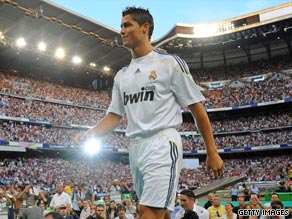
Ronaldo: Had Real Madrid splashing out seriously obscene money for him.
It makes me wonder if the world has gone mad.
In these times when banks are collapsing and people who are losing their life savings are screaming for the lynching of Bernie Madoff, Real Madrid are splashing out seriously obscene money for Kaka and Cristiano Ronaldo.
I have no qualms about the rich spending money – that's their prerogative. In this respect, Real Madrid are super-rich. Backed by a global audience that is as likely to come from the backyards of Bangkok as they are to come from Tetuan or Salamanca or Barajas or any Madrid suburb, their worldwide revenue source is no longer dependent on the earnings of the Castilian fan base.
Thus they populate their playing population with Galacticos who in turn attracted serious sponsorship money from the likes of sporting giants Adidas. Including money from television rights, they are the world’s richest club and their Galacticos appeal to every football citizen in every corner of the globe.
So for Real Madrid’s president Florentino Perez, paying a world-record fee of £56m for the Brazilian superstar Kaka is merely meeting expectation of a super-club. So too for the £80m for Ronaldo.
That’s Real Madrid. They live on a different plane of reality stemming from their aristocratic roots. They are the club of kings and behave in no less a fashion.
English clubs, on the other hand, find all their roots in the traditional blue-collar worker who knows what it means to sweat a day’s sweat to earn a day’s dollar.
The mind boggles then that English clubs, I guess flushed with the money brought about by the popularity of the Premier League, are the leaders in spending money as if they were the next Real Madrid – albeit without the aristocratic history and the expectation to boot.
From the start of the Premiership/Premier League in 1992 to date, the Big Four - Manchester United, Liverpool, Chelsea and Arsenal - have between them spent a whopping £1,569,895,000 on players (Source: transferleague.co.uk). That’s an average of about £30m per club per season.
In the last five seasons alone, the Big Four spent £732,390,000 or £36m per club.
This silly season, the records are about to be re-written with Manchester City and Tottenham entering the fray, and with the expected arrival of some of Europe’s best to English shores.
Again, I have no qualms about the rich spending what they have. But let’s face it, unlike the gargantuan machine that is Real Madrid, only Manchester United can match the Spanish Club’s global income, appeal and perhaps capacity to expend on players.
Other English clubs are heavily dependent on their patrons' pockets to fund their expenditure. Roman Abramovich at Chelsea is solely and singly responsible for keeping Chelsea solvent. So too is Sheikh Mansour bin Zayed Al Nahyan for the survival of Manchester City.
Their combined 'oil money' will probably see them tempting a host of stars to join their ranks. In Chelsea's case, they have even proved immune to excessive failures and still remained viable. Note the high-profile flops of Deco, Khalid Boulahrouz, Andrei Shevchenko, Shaun Wright-Phillips and Tiago, Mateja Kezman. That’s £79m wasted in the last five years alone.
Liverpool are not so lucky. Their patriarchs haven't got such deep pockets as they would like. Recently the club announced soaring debts costing them £36.5m in interest payments alone and whose own auditors warned of a "material uncertainty which may cast significant doubt upon the group’s ability to continue as a going concern" (Source: The Times, June 5, 2009).
Nonetheless, manager Rafa Benitez has splash a whopping £18m on Glen Johnson, a full-back of promise but not nearly the finished article or not even ranking alongside the better (let alone the best) full-backs in the world.
This expenditure is not to be balanced by the displacement of coveted assets like Javier Mascherano and Xabi Alonso, both wanted by Barcelona and Real Madrid respectively and both of whom would command a sizeable sum in exchange. And by all accounts, that’s not the end of Rafa’s spending, with much more on David Silva to come.
Is it peer-pressure that is forcing Benitez to spend to the point of being reckless? Last season Robbie Keane was a £21m misfit that, financially, his club could ill afford. Remember that Liverpool did end the season without a trophy. The fact that they came close is immaterial. Despite running Manchester United a close second, Liverpool are, as the American would put it, still losers.
Should Benitez be concerned about club finances first? Should he take a leaf out of Arsene Wenger’s book and yield to financial common sense to keep his club afloat? After all, there is more ambition than his coffers will allow him in the near future, including the building of a new stadium.
There is a strong case to suggest that last season was Rafa’s last chance to clinch the Premier League title before his club hunkers down to some financial reality. Success was supposed to bring richess. Failure is to be financing from one’s own pocket.
Perhaps because of how close he came, the Liverpool board may give him next season as a final try, but just how long Liverpool can keep coming close and paying for it without a benevolent patriarch is questionable.
Wenger's saving grace is that he has been exceptionally financially successful off the pitch. If he wasn’t a football manager, he would have readily found a job as a private banker persuading his clients to invest in youth and them selling them for gargantuan returns – the odd mistake like Jose Reyes aside.
Nonetheless, those are odds that any investor will readily accept as Arsenal generated £37m in profits for the financial year ending May 2008.
Arsene’s prudent transfer record over the history of the re-structured League is: £259.9m spent, £180.7m recouped with a net loss of £79.2m averaging £4.6m a season. This compares with £391.1m; £190.5m; £200.5m and £11.7m for Manchester United and £380.1m; £177.6m; £202.4m and £11.9m for Liverpool.
In the last five years, Arsene Wenger has done much better: £102m; £81.7m; £20.3m and £4m compared with £169.4m; £76m; £93.4m and £18.6m for Manchester United and £212.4m; £102m; £110.4m and £22m for Liverpool.
Imagine that. Arsene would arguably have done much much better if he had sold Patrick Vieira and Thierry Henry at premier prices instead of what he actually got by waiting a season longer to sell. Given inflation, which has seen United's and Liverpool's average expenditure soar, Arsenal’s spending has remained surprisingly flat, despite the arrival of record signing Andrei Arshavin.
But let's not forget that United’s average is about to take a massive dip after Ronaldo’s transfer becomes final, whereas Liverpool’s hoarding of players, coupled with their willingness to splash-and-dash (read Robbie Keane), is about to take their average over the stratosphere.
But of course, any fan will say that a manager’s record is not defined by the profit he makes, but by the trophies he has won, and in that respect, Wenger’s policies have been an abject failure.
To achieve success, you must have the best. The best in this modern world gone mad, costs not only an arm and a leg, but your children’s arms and legs as well. To compete, you have to mortgage your future in order to secure your present.
This season may prove to be the most expensive in history. In England alone, David Villa, David Silva, Carlos Tevez, Sergio Aguero, Franck Ribery, Samuel Eto’o and Karim Benzema have all yet to be priced and all may find their way into the Premier League.
If so, that’s roughly a quarter billion pounds worth of talent right there . . . or am I underestimating the value? Furthermore, I haven’t mentioned the clear-out-and-buy-in of Tottenham yet. That turnover alone may well be worth over £100 million.
And then there’s Liverpool. Glen Johnson will be the first and probably more will follow . . . provided they haven’t gone bust by then!
Should Benitez be concerned about club finances first? Should he take a leaf out of Arsene Wenger’s book and yield to financial common sense to keep his club afloat? After all, there is more ambition than his coffers will allow him in the near future, including the building of a new stadium.
There is a strong case to suggest that last season was Rafa’s last chance to clinch the Premier League title before his club hunkers down to some financial reality. Success was supposed to bring richess. Failure is to be financing from one’s own pocket.
Perhaps because of how close he came, the Liverpool board may give him next season as a final try, but just how long Liverpool can keep coming close and paying for it without a benevolent patriarch is questionable.
Wenger's saving grace is that he has been exceptionally financially successful off the pitch. If he wasn’t a football manager, he would have readily found a job as a private banker persuading his clients to invest in youth and them selling them for gargantuan returns – the odd mistake like Jose Reyes aside.
Nonetheless, those are odds that any investor will readily accept as Arsenal generated £37m in profits for the financial year ending May 2008.
Arsene’s prudent transfer record over the history of the re-structured League is: £259.9m spent, £180.7m recouped with a net loss of £79.2m averaging £4.6m a season. This compares with £391.1m; £190.5m; £200.5m and £11.7m for Manchester United and £380.1m; £177.6m; £202.4m and £11.9m for Liverpool.
In the last five years, Arsene Wenger has done much better: £102m; £81.7m; £20.3m and £4m compared with £169.4m; £76m; £93.4m and £18.6m for Manchester United and £212.4m; £102m; £110.4m and £22m for Liverpool.
Imagine that. Arsene would arguably have done much much better if he had sold Patrick Vieira and Thierry Henry at premier prices instead of what he actually got by waiting a season longer to sell. Given inflation, which has seen United's and Liverpool's average expenditure soar, Arsenal’s spending has remained surprisingly flat, despite the arrival of record signing Andrei Arshavin.
But let's not forget that United’s average is about to take a massive dip after Ronaldo’s transfer becomes final, whereas Liverpool’s hoarding of players, coupled with their willingness to splash-and-dash (read Robbie Keane), is about to take their average over the stratosphere.
But of course, any fan will say that a manager’s record is not defined by the profit he makes, but by the trophies he has won, and in that respect, Wenger’s policies have been an abject failure.
To achieve success, you must have the best. The best in this modern world gone mad, costs not only an arm and a leg, but your children’s arms and legs as well. To compete, you have to mortgage your future in order to secure your present.
This season may prove to be the most expensive in history. In England alone, David Villa, David Silva, Sergio Aguero and Franck Ribery have all yet to be priced and all may find their way into the Premier League.
If so, that’s roughly a quarter billion pounds worth of talent right there . . . or am I underestimating the value? Furthermore, I haven’t mentioned the clear-out-and-buy-in of Tottenham yet. That turnover alone may well be worth over £100 million.
And then there’s Liverpool. Glen Johnson will be the first and probably more will follow . . . provided they haven’t gone bust by then!