S'pore economy expected to grow 9% this year
-
Originally posted by Seowlah:
GDP per capita = GDP / population.
Case I
Assume no massive influx of FT and new population
For the past 2 - 3 years, Singapore's economy is in recession ie the GDP will fall sharply, so the GDP per capita will decrease sharply with the population unchanged as it is under the assumption of no massive influx of FT and new population
Case 2
Assume massive influx of FT and new population
WIth the influx of the FT and new population, GDP did not fall as much, the GDP per capita did not fall as much in case 1 using the statistics in your earlier post.
ie S$58,058 in 2007, after 2 years of FT penetration, the GDP per capita dropped to S$53,143 ie a fall of approximately of 10% in GDP per capita, taking note that the population has increased by 50% using the statistics in your earlier post.
All these are your assumptions. Increase in population does not mean increase in GDP per Capita, language barriers and different work habits all reduce productivity.

If we let in another million of FT picking up cardboard boxes from the street, the GDP will definitely rise, but GDP per Capita will fall, which is the case for Singapore in 2008.
If the population is unchanged, same number of people producing the same amount, the GDP per capita will remain constant. In fact, increasing the amount of foreigners in Singapore who in turn displace REAL Singaporeans from their jobs also decreases the GDP per Capita, less is produce and more Singaporeans are unemployed.
You also need to take note, that 2007 and 2008 were good growth years, the recession only started beginning of 2009. In 2008, there was already a decline in GDP per Capita.
Who ever said that GDP is falling? Suggest you read my short post again.
(It should be 3 years, not 2 years because it's 2007 to 2009, my error).
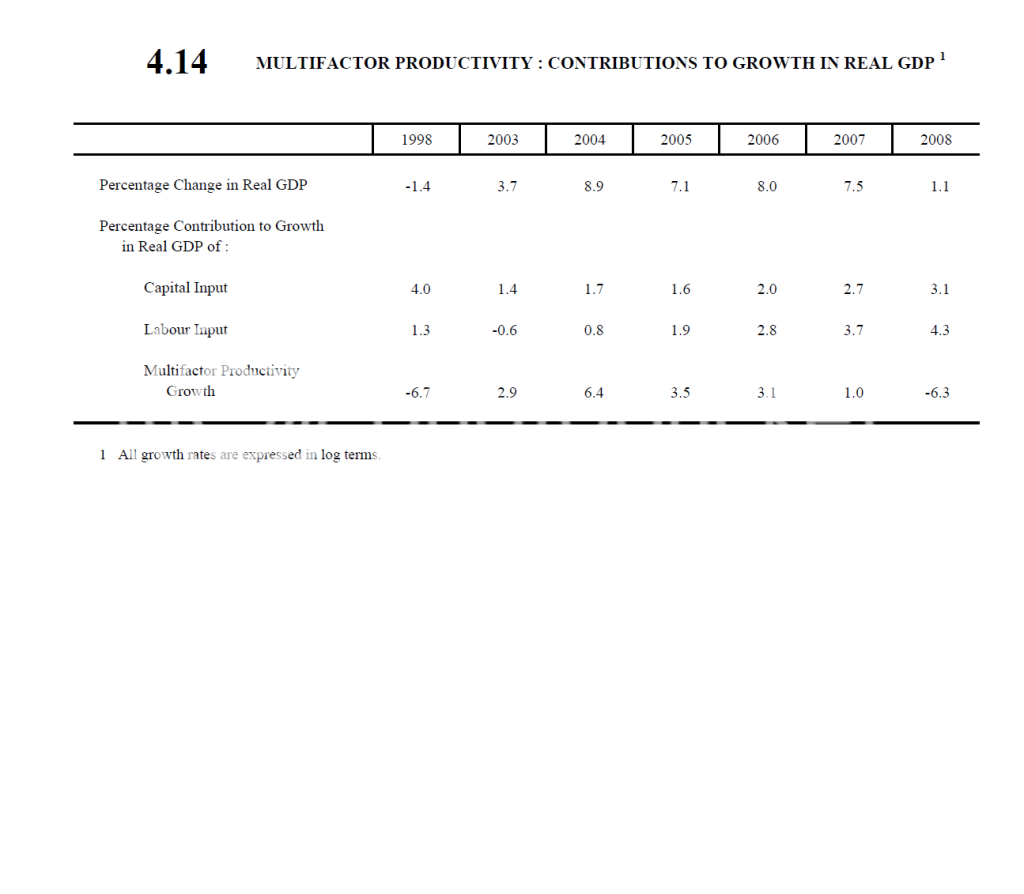
There was positive Real GDP growth for Singapore 2007=7.5%, 2008=1.1% and 2009 = -1.3.
How do you explain the decrease of GDP per Capita of 10% when the Real GDP is growing at 7.5%, 1.1% and -1.3%?
Only logical explanation is that the new FTs are not as productive as before, that's why GDP per Capita dropped and the quality of earnings dropped. More Singaporeans are being displaced by cheaper FTs decreasing the GDP per Capita.
http://www.singstat.gov.sg/news/news/gdp1q2010.pdf
-
Originally posted by βÎτά:
All these are your assumptions. Increase in population does not mean increase in GDP per Capita, language barriers and different work habits all reduce productivity.
If we let in another million of FT picking up cardboard boxes from the street, the GDP will definitely rise, but GDP per Capita will fall, which is the case for Singapore in 2008.
If the population is unchanged, same number of people producing the same amount, the GDP per capita will remain constant. In fact, increasing the amount of foreigners in Singapore who in turn displace REAL Singaporeans from their jobs also decreases the GDP per Capita, less is produce and more Singaporeans are unemployed.
You also need to take note, that 2007 and 2008 were good growth years, the recession only started beginning of 2009. In 2008, there was already a decline in GDP per Capita.
Who ever said that GDP is falling? Suggest you read my short post again.
(It should be 3 years, not 2 years because it's 2007 to 2009, my error).
There was positive Real GDP growth for Singapore 2007=7.5% and 2008=1.1%.
How do you explain the decrease of GDP per Capita of negative 10% when the Real GDP is growing at 7.5% and 1.1%?
Only logical explanation is that the new FTs are not as productive as before, that's why GDP per Capita dropped and the quality of earnings dropped.
Massive influx of FT and new population provides cheap and abundant labour for Singapore economy and lowers the unit cost of production and output increases.
ie the FT and new population replaces the costly and less productive older workers and PMETs to lower the unit cost of production and keeps the competitiveness of the Singapore economy
Just to provide another view on the issue of FT and new population.

-
Originally posted by Seowlah:
Indeed, Cliveness did not mention individuals.
I just wish to clarify that the 19 respondents actually referred to 19 predictions of 19 econometric models of the Singapore economy developed by the economists of the 19 banks and institutions.
Econometrics is the science and art of using economic theory and statistical techniques to analyse economic data. Econometric methods are used in many branches of economics, finance, labor economics, macroeconomics, microeconomics, marketing and economic policy. Econometric methods are also commonly used in other social sciences, including political science and sociology.I thought I also clarify with you the meaning of econometrics so you understand the meaning of econometrics.
-
Originally posted by Seowlah:
Massive influx of FT and new population provides cheap and abundant labour for Singapore economy and lowers the unit cost of production and output increases.
ie the FT and new population replaces the costly and less productive older workers and PMETs to lower the unit cost of production and keeps the competitiveness of the Singapore economy
Just to provide another view on the issue of FT and new population.
Then explain the increase in GDP and the decrease in GDP per Capita.
Real GDP grew at 7.5%, 1.1% and -1.3% for the 3 years, while GDP per Capita dropped by 10%. If what you said is correct, then GDP per Capita should be increasing and not decreasing.
-
Originally posted by Seowlah:
The 19 respondents are not just 19 individuals.
These 19 respondents represent the 19 predictions of 19 econometric models of the Singapore economy developed by the economists of the 19 banks and institutions.
I also wish to clarify that there was NO mention of "19 repondents making 19 predictions of 19 econometric models of the Singapore economy developed by the economist of the 19 banks and institutions."
Maybe my comprehension is shoddy, maybe they did mention it implicity in that article, but could you please point out any passage that suggest what you said.
-
oh no, time for salary raise again . . lets dicuss that in bahliarhmen
-
Originally posted by βÎτά:
Econometrics is the science and art of using economic theory and statistical techniques to analyse economic data. Econometric methods are used in many branches of economics, finance, labor economics, macroeconomics, microeconomics, marketing and economic policy. Econometric methods are also commonly used in other social sciences, including political science and sociology.I thought I also clarify with you the meaning of econometrics so you understand the meaning of econometrics.
Granduncle, your understanding of econometrics is from wikipaedia only right ?
-
Originally posted by βÎτά:
Then explain the increase in GDP and the decrease in GDP per Capita.
Real GDP grew at 7.5%, 1.1% and -1.3% for the 3 years, while GDP per Capita dropped by 10%. If what you said is correct, then GDP per Capita should be increasing and not decreasing.
Granduncle, GDP per capita = GDP / population. you said that new population increase by 50% you know. Do your calculation again please. Thank you.
-
Originally posted by βÎτά:
I also wish to clarify that there was NO mention of "19 repondents making 19 predictions of 19 econometric models of the Singapore economy developed by the economist of the 19 banks and institutions."
Maybe my comprehension is shoddy, maybe they did mention it implicity in that article, but could you please point out any passage that suggest what you said.
Granduncle, economists do not pluck a figure from the air and use it as a forecast.
The private economists that are being interviewed are professional economists from the banks and institutions. They made the forecasts based on the econometrics models developed on the Singapore economy with the vast economic data. There are more than one hundred of equations and variables in each of the econometric models.
So, 19 respondents are 19 predictions of 19 econometric models of the Singapore economy developed by the economists of the 19 banks and institutions.