[11th March 2011] 8.9 magnitude quake hit northeast Japan
-
Toll from Japan disasters over 7,700
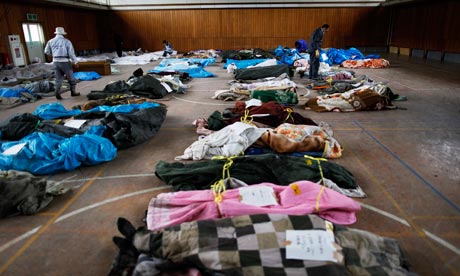
TOKYO - JAPAN'S police agency says 7,700 are dead and more than 11,600 are missing after last week's earthquake and tsunami.
A week after the disasters devastated the northeast coast, the National Police Agency said Sunday that 7,700 people died and 11,651 were missing.
Some of the missing may have been out of the region at the time of the disaster. In addition, the massive power of the tsunami likely sucked many people out to sea. If the 2004 Indian Ocean tsunami is any guide, most of those bodies will not be found.
-- AP
-
“There is a sacredness in tears. They are not the mark of weakness, but of power. They speak more eloquently than ten thousand tongues. They are messengers of overwhelming grief...and unspeakable love.”


-
Fukushima plant operator faked repair records
OSAKA - DAYS before Japan plunged into an atomic crisis after a giant earthquake and tsunami knocked out power at the ageing Fukushima nuclear plant, its operator had admitted faking repair records.
The revelation raises fresh questions about both Tokyo Electric Power Co (Tepco)'s scandal-tainted past and the government's perceived soft regulation of a key industry.
The operator of the Fukushima No. 1 plant submitted a report to the country's nuclear watchdog ten days before the quake hit on March 11, admitting it had failed to inspect 33 pieces of equipment in its six reactors there.
A power board distributing electricity to a reactor's temperature control valves was not examined for 11 years, and inspectors faked records, pretending to make thorough inspections when in fact they were only cursory, Tepco said.
It also said that inspections, which are voluntary, did not cover other devices related to cooling systems including water pump motors and diesel generators. The report was submitted after the regulator ordered operators to examine whether inspections were suitably thorough.
'Long-term inspection plans and maintenance management were inadequate,' the nuclear safety agency concluded in a follow-up report two days after Tepco's admission. 'The quality of inspection was insufficient.' The safety agency ordered the operator to draw up a corrective plan by June 2.
-- AFP
-
Two survivors found nine days after Japan quake
OSAKA - TWO survivors, including an elderly woman, were rescued from under rubble in the devastated Japanese city of Ishinomaki on Sunday, nine days after a massive earthquake and tsunami, police said.
'An 80-year-old woman and a 16-year-old boy were found under debris,' said a spokesman for the Ishinomaki Police Department.
'Their temperatures were quite low but they were conscious. Details of their condition are not immediately known. They have been already rescued and sent to hospital.' -- AFP
-
"To be a human being among human beings, and remain one forever, no matter what misfortunes befall, not to become depressed, and not to falter--this is what life is, herein lies its task." - Fyodor Dostoevsky, The Brothers Karamazov.

-

-
Japan quake dead, missing nears 21,000
KAMAISHI, Japan : Workers were close to restoring power to a nuclear plant's overheating reactors on Sunday as the toll of dead or missing from Japan's worst natural disaster in nearly a century neared 21,000.
Amid the devastation on the northeast coast left by a March 11 quake and tsunami, police reported an astonishing tale of survival with the discovery of an 80-year-old woman and her 16-year-old grandson alive under the rubble.
"Their temperatures were quite low but they were conscious. Details of their condition are not immediately known. They have been already rescued and sent to hospital," a spokesman for the Ishinomaki Police Department said.
They were in the kitchen when their house collapsed but the teenager was able to reach food from the refrigerator, helping them survive for nine days, broadcaster NHK quoted rescuers as saying.
But with half a million tsunami survivors huddled in threadbare, chilly shelters and the threat of disaster at the Fukushima No. 1 nuclear plant stretching frayed nerves, the mood in the world's third-biggest economy remained grim.
Food contaminated with radiation was found for the first time outside Japan - where milk and spinach have already been tainted by a plume from Fukushima - as Taiwan detected radioactivity in a batch of imported Japanese fava beans.
The discovery of traces of radioactive iodine in Tokyo tap water, well to the southwest of the crippled atomic power plant on the Pacific coast, compounded public anxiety but authorities said there was no danger to health.The Fukushima plant was struck on March 11 by a massive earthquake and tsunami which, with 8,199 people confirmed killed, is Japan's deadliest natural disaster since the Great Kanto quake levelled much of Tokyo in 1923.
Another 12,722 are missing, feared swept out to sea by the 10-metre (33-foot) tsunami or buried in the wreckage of buildings.
In Miyagi prefecture on the northeast coast, where the tsunami reduced entire towns to splintered matchwood, the official death toll stood at 4,882.
Miyagi police chief Naoto Takeuchi, however, told a task force meeting that his prefecture alone "will need to secure facilities to keep the bodies of more than 15,000 people", Jiji Press reported.
Cooling systems that are meant to protect the Fukushima plant's six reactors from a potentially disastrous meltdown were knocked out by the tsunami, and engineers have since been battling to control rising temperatures.
The radiation-suited crews were striving to restore electricity to the ageing facility 250 kilometres (155 miles) northeast of Tokyo, after extending a high-voltage cable into the site from the national grid.
A spokesman for Japan's nuclear safety agency said electricity had apparently reached the power distributor at the No. 2 reactor, which in turn would feed power to the No. 1 reactor.
Plant operator TEPCO confirmed an electricity supply had been restored to the distributor but said power at the reactor unit was not back on yet.
Engineers were checking the cooling and other systems at the reactor, aiming to restore power soon, TEPCO said late on Sunday.
"It will take more time. It's not clear when we can try to restore the systems," spokesman Naohiro Omura said.
Fire engines earlier aimed their water jets at the reactors and fuel rod pools, where overheating is an equal concern, dumping thousands of tonnes of seawater from the Pacific.
Six workers at the Fukushima plant have been exposed to high levels of radiation but are continuing to work and have suffered no health problems, TEPCO said.
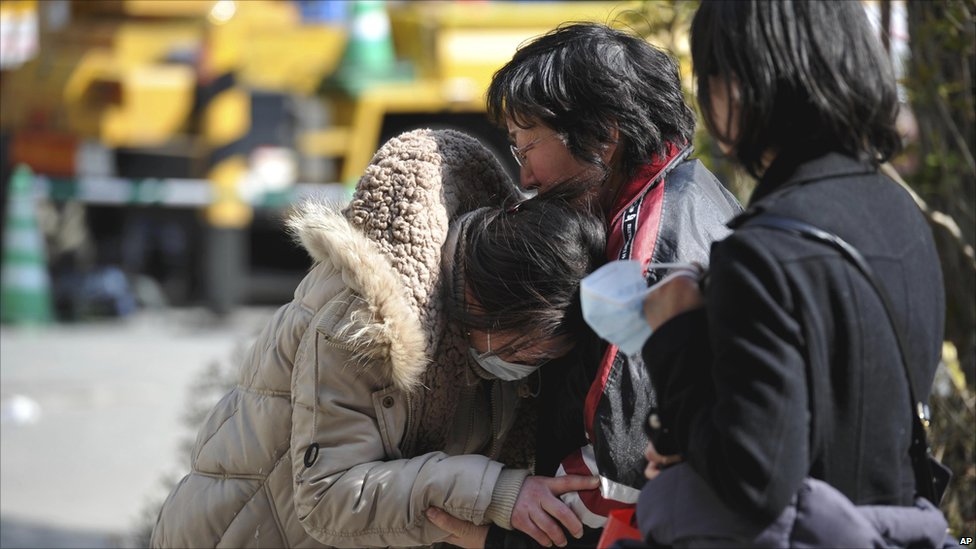
According to the charity Save the Children, around 100,000 children were displaced by the 9.0-magnitude quake and tsunami, and signs of trauma are evident among young survivors as the nuclear crisis and countless aftershocks fuel their terror.
"We found children in desperate conditions, huddling around kerosene lamps and wrapped in blankets," Save the Children spokesman Ian Woolverton said after visiting a number of evacuation centres in Japan's northeast.
"They told me about their anxieties, especially their fears about radiation," Woolverton said, adding that several youngsters had mentioned the US atom bomb attacks on Hiroshima and Nagasaki, which they know from school.
The government has insisted that there is no widespread threat of radiation. But the discovery of the tainted fava beans by Taiwanese customs officers will do nothing to calm public anxiety that has already spread far beyond Japan.
Several governments in Asia have begun systematic radiation checks on made-in-Japan goods, as well as of passengers arriving on flights from the country.
But Tsai Shu-chen of Taiwan's Food and Drug Administration stressed that the radioactive iodine and caesium-137 found on the fava beans were well below national safety levels.
In the disaster epicentre of northeast Japan, authorities have been battling to get more fuel and food to survivors enduring freezing temperatures.
At shelters, some grandparents are telling children stories of how they overcame hardships in their own childhood during and after World War II, which left Japan in ruins.
"We have to live at whatever cost," said Shigenori Kikuta, 72.
"We have to tell our young people to remember this and pass on our story to future generations, for when they become parents themselves."
There was better news for residents in Rikuzentakata, where construction teams began erecting 36 prefabricated units, the first of many more temporary houses being built for the tsunami homeless.
"They won't be very big, but whatever they are, it will be better than being in here," said great-grandmother Tokiko Kanno, who has been sleeping on a school stage.- AFP/ac/ms
-
The dead cannot cry out for justice; it is a duty of the living to do so for them...

-
Contamination at Fukushima plant to last 'decades'
PARIS - LOCAL contamination from Japan's quake-damaged Fukushima nuclear power plant will be a problem that will last 'for decades and decades,' France's Nuclear Safety Authority (ASN) said on Monday.
Releases of radioactivity from the plant 'are now significant and continuing,' the head of the agency, Andre-Claude Lacoste, told a press conference.
'We have to assume that Japan will have a long-term issue of managing the impacts,' he said. 'It's a problem that Japan will have to deal with for decades and decades to come.' The releases stem in part from deliberate venting of steam and gas, which also contain radioactive particles, to ease pressure in overheating reactor vessels, he said. Another source is 'leaks' of as-yet unknown origin, he said.
'Ground deposits of radioactive particles (around the plant) are significant,' said Jean-Luc Godet, in charge of ionising radiation management at the ASN.
'The Japanese authorities have not drawn up, or communicated, a map of these deposits, and it is not vain thinking to believe that this (contaminated) zone extends beyond 20 kilometres,' he said, referring to the 12-mile zone within which local inhabitants have been evacuated.
On Sunday, the Japanese government said it had detected 'abnormal levels' of radiation in milk and spinach taken from areas near Fukushima, but this did not pose any threat to health.
-- AFP
-
“The best lacks all conviction, while the worst are full of passionate intensity....Things fall apart, the centre cannot hold....” - William Butler Yeats

-
Strong quakes jolt Japan's tsunami-hit north-east
OSAKA - A SERIES of strong earthquakes rattled north-east Japan on Tuesday, keeping residents on edge more than a week after a devastating tremor and tsunami battered the region.
Two 6.6-magnitude tremors and one 6.4 quake struck within two and a half hours off Japan's tsunami-stricken north-east coast, starting from 0718 GMT (3.18pm Singapore time), the US Geological Survey reported.
There were no reports of casualties or damage and no tsunami warnings.
A record 9.0 magnitude which spawned a towering tsunami battered Japan's north-east coast on March 11, leaving more than 21,000 people dead or missing and triggering a crisis at a nuclear power plant in Fukushima.
Around 20 per cent of the world's most powerful earthquakes strike Japan, which sits on the 'Ring of Fire' surrounding the Pacific Ocean.
-- AFP
-
And death shall have no dominion.
Dead men naked they shall be one
With the man in the wind and the west moon;
When their bones are picked clean and the clean bones gone,
They shall have stars at elbow and foot;
Though they go mad they shall be sane,
Though they sink through the sea they shall rise again;
Though lovers be lost love shall not;
And death shall have no dominion.
And death shall have no dominion.
Under the windings of the sea
They lying long shall not die windily;
Twisting on racks when sinews give way,
Strapped to a wheel, yet they shall not break;
Faith in their hands shall snap in two,
And the unicorn evils run them through;
Split all ends up they shan't crack;
And death shall have no dominion.
And death shall have no dominion.
No more may gulls cry at their ears
Or waves break loud on the seashores;
Where blew a flower may a flower no more
Lift its head to the blows of the rain;
Though they be mad and dead as nails,
Heads of the characters hammer through daisies;
Break in the sun till the sun breaks down,
And death shall have no dominion.- Dylan Thomas

-
Japanese police say disaster death toll near 9,100
TOKYO - JAPAN'S police agency says nearly 9,100 people are dead after an earthquake and tsunami. Another 13,800 are missing.
Those tallies are likely to overlap, but police officials estimate that the final figure will likely exceed 18,000 deaths.
A police spokesman from one of the of the hardest-hit prefectures, Miyagi, estimates that the deaths will top 15,000 in that region alone.
Police in other devastated areas declined to estimate eventual tolls, but said the confirmed deaths in their areas already number nearly 3,400.
The National Police Agency said the overall number of bodies collected so far stood at 9,080, while 13,561 people have been listed as missing. -- AP
-
Blow hope to terror; blow seeing to blind
(blow pity to envy and soul to mind)
-whose hearts are mountains, roots are trees,
it's they shall cry hello to the spring
what if a dawn of a doom of a dream
bites this universe in two,
peels forever out of his grave
and sprinkles nowhere with me and you?
Blow soon to never and never to twice
(blow life to isn't: blow death to was)
-all nothing's only our hugest home;
the most who die, the more we live.
- e e cummings
-
Tokyo water unsafe for babies, farm food blocked
TOKYO: Tokyo on Wednesday warned that radioactive iodine over twice the safe level for infants had been detected in its tap water due to the disaster at a quake-hit nuclear plant northeast of Japan's capital.
The news compounded fears over the impact of the crippled Fukushima power station that also led the government to ban farm produce from areas near the charred complex, where emergency crews were battling to prevent a meltdown.
The United States blocked imports of dairy and other produce from areas near the plant, which has been belching radiation since it was hit by a powerful quake and tsunami on March 11, followed by a series of explosions and fires.
France urged the European Union to also control Japanese food imports.
In one Tokyo ward, a water sample contained 210 becquerels of iodine per kilogramme, more than double the legal limit, a city official said at a press conference - news that triggered a 1.6 per cent dive on the Tokyo stock market.
"Under government guidelines, water containing a radioactive substance of more than 100 becquerels per kilogramme should not be used for milk for babies," the city official told reporters.
The government advised residents throughout the city to avoid using tap water to make infant formula until further notice.
Prime Minister Naoto Kan earlier ordered a stop of shipments of untreated milk and vegetables including broccoli, cabbage and parsley from areas near the Pacific coast plant, about 250 kilometres northeast of Tokyo.
Farm produce shipments were halted from Fukushima and three nearby prefectures - Ibaraki, Tochigi and Gunma - while radiation monitoring of farm and seafood products was stepped up in six others, officials said.
The new inspection zone extends to Saitama and Chiba, part of the greater Tokyo urban sprawl that is home to more than 30 million people.
The health ministry said radioactivity drastically exceeding legal limits had been found in 11 kinds of vegetable grown in Fukushima.
Radioactive caesium at 82,000 becquerels - 164 times the legal limit - was detected in one type of leaf vegetable, it said.
The ministry said that if people eat 100 grams a day of the vegetable for about 10 days, they would ingest half the amount of radiation typically received from the natural environment in a year.
"Even if these foods are temporarily eaten, there is no health hazard," said top government spokesman Yukio Edano, following reports that some products may have already entered the market.
"But unfortunately, as the situation is expected to last for the long term, we are asking that shipments stop at an early stage, and it is desirable to avoid intake of the foods as much as possible."
Even if the short-term risk is limited for now, scientists pointing to the 1986 Chernobyl disaster warn that some radioactive particles concentrate as they travel up the food chain and stay in the environment for decades.
The US Food and Drug Administration said it had placed an import alert on all milk, dairy products, fresh vegetables and fruits from four prefectures.
"In addition, FDA will continue to flag all entries from Japan in order to determine whether they originated from the affected area," it said.
"FDA will test all food and feed shipments from the affected area."
France urged the European Commission to impose "systematic controls for all fresh produce reaching Europe's borders" from Japan, while stressing that it was not calling for a total embargo on Japanese food products "at this stage".
Around Asia, many Japanese restaurants and shops are reporting a decline in business and governments have stepped up radiation checks on the country's goods.
Tainted fava beans from Japan have already cropped up in Taiwan.
Japan - a highly industrialised and mostly mountainous island nation - is a net food importer.
According to the European Commission, the EU imported 9,000 tonnes of fruits and vegetables from Japan in 2010.
In Japan, any further food shortages threaten to compound the misery for hundreds of thousands made homeless by the 9.0-magnitude quake and the jet-speed tsunami it spawned that erased entire communities.
The confirmed death toll rose Wednesday to 9,408, and Japan holds out little hope for 14,716 officially listed as missing.
Japan estimated the economic cost at up to 25 trillion yen (US$309 billion).
As grieving survivors huddled in evacuation shelters amid the rubble of their former lives, their fate was overshadowed by the struggle to avert another massive catastrophe - a full nuclear meltdown at Fukushima.
Fire engines and giant concrete pumps have poured thousands of tonnes of seawater onto its reactors and into spent fuel rod pools, to cool them and stop fuel from being exposed to the air and releasing large-scale radiation.
Engineers hope to restart the cooling systems of all six reactors that were knocked out by the 14-metre (46-foot) tsunami, and they have already reconnected the wider facility to the national power grid.
As the engineers forged on with their dangerous and complex task at the 1970s-era plant, more nerve-jarring aftershocks hit nearby.
In Vienna, the UN's International Atomic Energy Agency said radiation continues to leak from the site.
"The question is, where exactly is it coming from: from the primary containment vessels or from the spent fuel ponds," said James Lyons, IAEA head of nuclear installations safety.
"Without the ability to go up there and actually poke around, it's hard to determine."
- AFP/fa/cc -
We must embrace pain and burn it as fuel for our journey.
~Kenji Miyazawa

-
There are things that we don't want to happen but have to accept, things we don't want to know but have to learn, and people we can't live without but have to let go.

-
RIP to those who are dead. may God bless those who are still alive and living.
-
Nor dread nor hope attend
A dying animal;
A man awaits his end
Dreading and hoping all;
Many times he died,
Many times rose again.
A great man in his pride
Confronting murderous men
Casts derision upon
Supersession of breath;
He knows death to the bone
Man has created death.- William Yeats


-
Do not go gentle into that good night,
Old age should burn and rave at close of day;
Rage, rage against the dying of the light.
Though wise men at their end know dark is right,
Because their words had forked no lightning they
Do not go gentle into that good night.
Good men, the last wave by, crying how bright
Their frail deeds might have danced in a green bay,
Rage, rage against the dying of the light.
Wild men who caught and sang the sun in flight,
And learn, too late, they grieved it on its way,
Do not go gentle into that good night.
Grave men, near death, who see with blinding sight
Blind eyes could blaze like meteors and be gay,
Rage, rage against the dying of the light.
And you, my father, there on the sad height,
Curse, bless, me now with your fierce tears, I pray.
Do not go gentle into that good night.
Rage, rage against the dying of the light.- Dylan Thomas
-
prayers are the epitome of humanistic expression in all languages without shame and doubts for being a human among humans...


-
Power back at Japan's reactor one control room
OSAKA - TECHNICIANS restored power to the reactor number one control room of Japan's Fukushima nuclear plant on Thursday, even as white steam wafted from four reactors at the tsunami-damaged seaside facility.
The incremental progress means workers can now use two crucial control rooms - at reactors one and three - which they were earlier forced to abandon after a series of explosions and amid strong radiation and in darkness.
The March 11 quake and tsunami cut electricity to the plant and knocked out backup systems, causing the cooling systems to fail. This left the fuel rods inside to heat up and evaporate water, threatening a full meltdown.
Fire engines have hosed down the reactors and topped up spent fuel rod pools to prevent the uranium and plutonium from being exposed to the air - desperate steps intended to stop a major disaster, but also creating radioactive steam.
Reconnecting the reactor control rooms was seen as a key step as workers hope to restart the original cooling systems. Previously they had to work with flashlights, and without air-conditioning that would have extracted some radiation.
'The light went on in the control room of the number one reactor at 11.30am (0230 GMT, 10.30am Singapore time),' a nuclear safety agency official said. 'But we are still unsure whether this means the cooling system will be restored.' -- AFP
-
Japan toll tops 26,000 dead or missing
OSAKA - THE number of people confirmed dead or listed as missing in Japan rose above 26,000 on Thursday, nearly two weeks after a massive earthquake and tsunami struck the country's north-east coast.
There are fears of a much higher toll from the disaster, which flattened entire towns along the Pacific coast of northern Honshu island.
The National Police Agency said in its latest update that 9,737 people had been confirmed dead and 16,423 officially listed as missing - a total of 26,160 - as a result of the March 11 catastrophe.
A total of 2,777 people have been injured.
The quake has become Japan's deadliest natural disaster since the 1923 Great Kanto Earthquake, which killed more than 142,000 people.
Hundreds of thousands of people have been displaced from their homes and have taken shelter in emergency facilities. -- AFP
-
A lonely impulse of delight
Drove to this tumult in the clouds;
I balanced all, brought all to mind,
The years to come seemed waste of breath,
A waste of breath the years behind
In balance with this life, this death- William Yeats


-
Life, death, - death, life; the words have led for ages
Our thought and consciousness and firmly seemed
Two opposites; but now long-hidden pages
Are opened, liberating truths undreamed.
Life only is, or death is life disguised, -
Life a short death until by Life we are surprised.- Sri Aurobindo