[11th March 2011] 8.9 magnitude quake hit northeast Japan
-
Singapore inventor to send 100 Eco-ffins

PLANS are under way for a Singaporean inventor to ship at least 100 of his environmentally-friendly coffins to Japan.
The lightweight Eco-ffins created by Dr Ng Khee Yang, 47, are made of cardboard, plywood and compressed wood dust. These materials burn more quickly than that of a regular coffin and as a result, use less fuel.
It is intended to help overcome the reported shortage of fuel for cremation and coffins in villages and small towns that have been overwhelmed by the thousands who died after a massive earthquake and tsunami hit north-east Japan on March 11.
Said Dr Ng, a director of the Centre for Applications in Environmental Technology at Singapore Polytechnic: 'I see it as a duty to use my product to meet just one of the many needs in Japan.'
Japan's death toll has exceeded 9,700 and about 16,500 people are missing.
Although the dead need to be removed from the open quickly to avoid the spread of waterborne diseases, returning volunteers from Singapore non-governmental organisations (NGOs) had indicated that relief efforts were focused on helping the living, he said.
-- ST
-
Nothing I cared, in the lamb white days, that time would take me
Up to the swallow thronged loft by the shadow of my hand,
In the moon that is always rising,
Nor that riding to sleep
I should hear him fly with the high fields
And wake to the farm forever fled from the childless land.
Oh as I was young and easy in the mercy of his means,
Time held me green and dying
Though I sang in my chains like the sea.- Dylan Thomas

-

-
Reactor fear at Japan plant as toll tops 10,000
SENDAI, Japan : The operator of a disaster-struck Japanese nuclear plant on Friday reported possible damage to a reactor vessel - casting a new shadow over efforts to control a steady radiation leak.
Two weeks after a giant quake struck and sent a massive tsunami crashing into the Pacific coast, the death toll from Japan's worst post-war disaster topped 10,000 and there was scant hope for 17,500 others still missing.
The tsunami obliterated entire towns. Some 250,000 homeless in almost 2,000 shelters are braving privations and a winter chill, with a degree of discipline and dignity that has impressed the world.
The focus of Japan's fears remained the Fukushima nuclear plant, which was still emitting radioactive vapour that at one point this week made the capital's drinking water unsafe for infants.
China, South Korea and the EU joined the United States, Russia and several other nations in restricting food imports from Japan, which itself has ordered a stop to vegetable and dairy shipments from the region near the atomic plant.
A day after two workers at the 1970s-era facility were hospitalised with radiation burns, its operator Tokyo Electric Power Co (TEPCO) reported possible damage at reactor number three.
"It is possible that the pressure vessel containing the fuel rods in the reactor is damaged," a TEPCO spokesman told AFP.The new safety scare could hamper urgent efforts to restore power to the all-important cooling systems at the plant, located 250 kilometres (155 miles) northeast of Tokyo.
"Radioactive substances have leaked to places far from the reactor," said a spokesman for Japan's nuclear safety agency, Hideyuki Nishiyama.
"As far as the data show, we believe there is a certain level of containment ability but it's highly possible that the reactor is damaged."
The reactor is a particular concern because it is the only one of six at the plant to use a potentially volatile mix of uranium and plutonium.
A hydrogen explosion badly damaged the unit's outer building on March 14, and a partial meltdown is also suspected.
Higher radioactivity has also been detected in the ocean near the Fukushima plant on Japan's Pacific coast, raising public fears about the safety of fish and seaweed, which are traditional staples in the island nation's diet.
"This terrifies me from the depth of my heart," Sunao Tsuboi, a survivor of the US atom bomb attack on Hiroshima in 1945 who is in his mid-80s, told AFP.
"Radiation damages genes and DNA. This is something that no doctor can fix. There is no proper remedy for radiation exposure."Two Japanese travellers were briefly sent to hospital in China with radiation levels well above normal levels after they arrived in the eastern city of Wuxi on Wednesday on a flight from Tokyo, China's safety watchdog said.
A doctor at a hospital in the nearby city of Suzhou told AFP the pair were checked, "decontaminated" and released, and the safety watchdog said they did not pose any threat to other travellers.
Radiation was also detected on a Japanese merchant vessel that berthed in the southeastern Chinese port city of Xiamen on Monday, the Chinese watchdog said.
The list of contaminated foodstuffs grew Friday when the health ministry said radiation above the legal limit had been detected in Japanese mustard spinach grown in Tokyo.
At the Fukushima plant, workers kept spraying seawater onto overheating reactors and fuel rod pools as a stop-gap measure to prevent a larger meltdown, while trying to rebuild the original cooling systems.
The pair hospitalised Thursday were installing cables in the basement of the third reactor's turbine building when they stepped into water containing iodine, caesium and cobalt 10,000 times the normal level, TEPCO said.
The men, aged in their 20s and 30s, were wearing radiation suits but had on ill-fitting shoes, and they had ignored a warning alarm from their dosimeters, "assuming a problem with the device", a TEPCO official said.
A total of 17 workers have been exposed to more than 100 millisieverts, the level at which the risk of developing cancer rises, the company says.
TEPCO admitted on Friday it may take at least another month to achieve a cold shutdown of all reactors - when temperatures inside fall below boiling point and its cooling systems are back at atmospheric pressure.
Japan's top government spokesman Yukio Edano asked people still living within 20-30 kilometres of the plant to leave voluntarily.
- AFP/al -
Originally posted by QX179R:
Reactor fear at Japan plant as toll tops 10,000
SENDAI, Japan : The operator of a disaster-struck Japanese nuclear plant on Friday reported possible damage to a reactor vessel - casting a new shadow over efforts to control a steady radiation leak.
Two weeks after a giant quake struck and sent a massive tsunami crashing into the Pacific coast, the death toll from Japan's worst post-war disaster topped 10,000 and there was scant hope for 17,500 others still missing.
The tsunami obliterated entire towns. Some 250,000 homeless in almost 2,000 shelters are braving privations and a winter chill, with a degree of discipline and dignity that has impressed the world.
The focus of Japan's fears remained the Fukushima nuclear plant, which was still emitting radioactive vapour that at one point this week made the capital's drinking water unsafe for infants.
China, South Korea and the EU joined the United States, Russia and several other nations in restricting food imports from Japan, which itself has ordered a stop to vegetable and dairy shipments from the region near the atomic plant.
A day after two workers at the 1970s-era facility were hospitalised with radiation burns, its operator Tokyo Electric Power Co (TEPCO) reported possible damage at reactor number three.
"It is possible that the pressure vessel containing the fuel rods in the reactor is damaged," a TEPCO spokesman told AFP.The new safety scare could hamper urgent efforts to restore power to the all-important cooling systems at the plant, located 250 kilometres (155 miles) northeast of Tokyo.
"Radioactive substances have leaked to places far from the reactor," said a spokesman for Japan's nuclear safety agency, Hideyuki Nishiyama.
"As far as the data show, we believe there is a certain level of containment ability but it's highly possible that the reactor is damaged."
The reactor is a particular concern because it is the only one of six at the plant to use a potentially volatile mix of uranium and plutonium.
A hydrogen explosion badly damaged the unit's outer building on March 14, and a partial meltdown is also suspected.
Higher radioactivity has also been detected in the ocean near the Fukushima plant on Japan's Pacific coast, raising public fears about the safety of fish and seaweed, which are traditional staples in the island nation's diet.
"This terrifies me from the depth of my heart," Sunao Tsuboi, a survivor of the US atom bomb attack on Hiroshima in 1945 who is in his mid-80s, told AFP.
"Radiation damages genes and DNA. This is something that no doctor can fix. There is no proper remedy for radiation exposure."Two Japanese travellers were briefly sent to hospital in China with radiation levels well above normal levels after they arrived in the eastern city of Wuxi on Wednesday on a flight from Tokyo, China's safety watchdog said.
A doctor at a hospital in the nearby city of Suzhou told AFP the pair were checked, "decontaminated" and released, and the safety watchdog said they did not pose any threat to other travellers.
Radiation was also detected on a Japanese merchant vessel that berthed in the southeastern Chinese port city of Xiamen on Monday, the Chinese watchdog said.
The list of contaminated foodstuffs grew Friday when the health ministry said radiation above the legal limit had been detected in Japanese mustard spinach grown in Tokyo.
At the Fukushima plant, workers kept spraying seawater onto overheating reactors and fuel rod pools as a stop-gap measure to prevent a larger meltdown, while trying to rebuild the original cooling systems.
The pair hospitalised Thursday were installing cables in the basement of the third reactor's turbine building when they stepped into water containing iodine, caesium and cobalt 10,000 times the normal level, TEPCO said.
The men, aged in their 20s and 30s, were wearing radiation suits but had on ill-fitting shoes, and they had ignored a warning alarm from their dosimeters, "assuming a problem with the device", a TEPCO official said.
A total of 17 workers have been exposed to more than 100 millisieverts, the level at which the risk of developing cancer rises, the company says.
TEPCO admitted on Friday it may take at least another month to achieve a cold shutdown of all reactors - when temperatures inside fall below boiling point and its cooling systems are back at atmospheric pressure.
Japan's top government spokesman Yukio Edano asked people still living within 20-30 kilometres of the plant to leave voluntarily.
- AFP/al
My heart is crying for Japan. -
I will pray for Japan.
-
Hope is a strange invention --
A Patent of the Heart --
In unremitting action
Yet never wearing out --
Of this electric Adjunct
Not anything is known
But its unique momentum
Embellish all we own --- Emily Dickinson

-
Radiation spike in sea near Japan nuclear plant
SENDAI, Japan: Radiation levels have jumped 10-fold in days in seawater near Japan's tsunami-hit nuclear plant, officials said Saturday, as workers battled to stabilise the crippled power station.
Drinking a half-litre (20-ounce) bottle of similarly contaminated fresh water would expose a person to their annual safe dose, said an official who however ruled out an immediate threat to aquatic life and seafood safety.
The iodine-131 level in the Pacific Ocean waters just off the Fukushima plant was 1,250 times above the legal limit -- compared with readings of 126 times higher taken on Tuesday, and 145 higher on Thursday.
"This is a relatively high level," nuclear safety agency official Hidehiko Nishiyama said in a televised press conference on the test results from Friday released by plant operator the Tokyo Electric Power Company (TEPCO).
Assessing the likely impact on aquatic life, Nishiyama added: "Generally speaking, radioactive material released into the sea will spread due to tides, so you need much more for seaweed and sea life to absorb it."
He added that because iodine-131 has a half-life -- the time in which half of it decays -- of eight days, "by the time people eat the sea products, its amount is likely to have diminished significantly."
However, TEPCO in a statement also said that levels of caesium-137, which has a half life of about 30 years, was 79.6 times the legal maximum.
The assurances did little to lift the gloom that has hung over Japan since a massive 9.0-magnitude earthquake struck on March 11 and sent a monster tsunami crashing into the northeast coast in the country's worst post-war disaster.
The wave easily overwhelmed the world's biggest sea defences and swallowed entire communities. The confirmed death toll rose to 10,151 on Saturday, with little hope seen for most of the 17,053 listed as missing.
The wave knocked out the cooling systems for the six reactors of the Fukushima plant, leading to suspected partial meltdowns in three of them and hydrogen explosions and fires that have ripped through the facility.
Fire engines have hosed thousands of tons of seawater onto the facility in a bid to keep the fuel rods inside reactor cores and pools from being exposed to the air, where they could reach critical stage and go into full meltdown.
Radioactive iodine, caesium and cobalt levels in water in the turbine buildings next to reactors one and three were 10,000 times the normal level -- raising fears that the reactor vessels or their valves and pipes are leaking.
The worst-case scenario at reactor three would be that the fuel inside the reactor core -- a volatile uranium-plutonium mix -- has already started to burn its way through its steel pressure vessel.
Worried about the salt buildup in the crippled plant, engineers have started pumping in fresh water instead. More is being shipped in, including on two US military water barges headed for the plant from a naval base near Tokyo.
Radioactive vapour from the plant has contaminated farm produce and dairy products in the region, leading to shipment halts in Japan as well as the United States, European Union, China and a host of other nations.
Higher than normal radiation has also been detected in tap water in and around Tokyo, some 250 kilometres (155 miles) from the plant, leading authorities at one stage to warn against using it for baby milk formula.
Japan widened the zone around the plant where it suggests people evacuate, to 30 kilometres (20 miles) -- still below the 80 kilometres advised by the United States, and larger areas including Tokyo in other nations' alerts.
Environmental watchdog Greenpeace started its own monitoring near the plant, charging that "authorities have consistently appeared to underestimate both the risks and extent of radioactive contamination".
"We have come to Fukushima to bear witness to the impacts of this crisis and to provide some independent insight into the resulting radioactive contamination," said the group's radioactivity safety advisor Jan van de Putte.
The campaign group said it would provide "an alternative to the often contradictory information released by nuclear regulators".
-AFP/ac -

-
A huge Tsunami,
Is you survive this nightmare,
It will be okay,
You are not alone,
Its not quite the beginning,
of the end of life,
Never feel lonely,
Its certainly not the end,
We are here with you,
Don't give up your hope,
We cry for your family,
Together we stand,
With us by your side,
We will fight and defend,
for the world is one,
Your pain is our pain,
Some sakura trees still stand,
Your symbol of hope,
We'll support your fight,
you just keep standing so strong,
As long as we try,
we can all stop this,
this won't all disappear
-
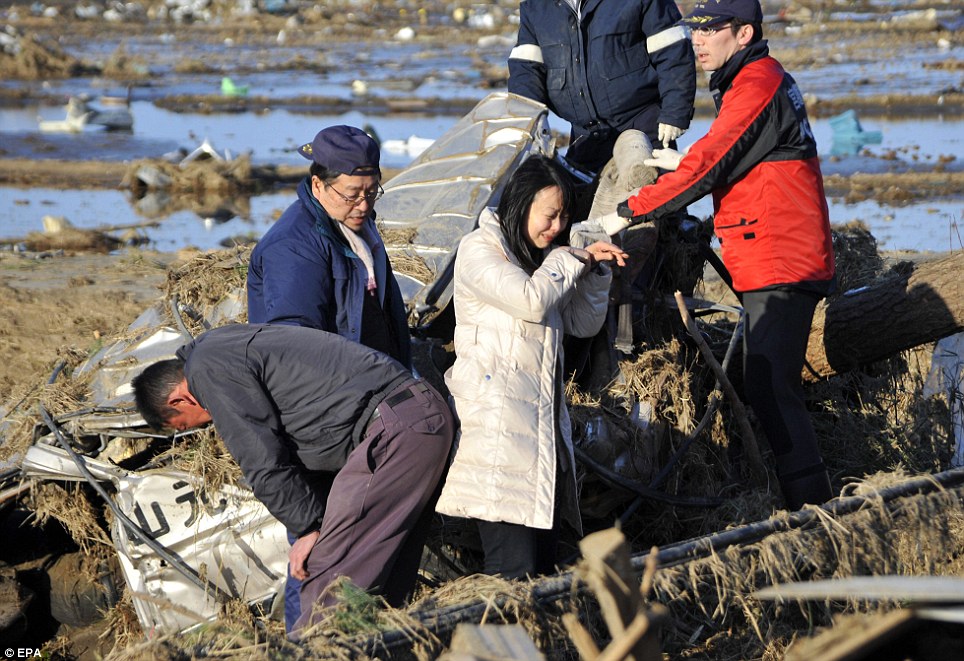
Saw news on this old man at the disaster site still looking for his kin. He cried.
-
Workers evacuated as radioactivity rises in reactor
OSAKA - EXTREMELY high levels of radiation were detected in water leaking from reactor two of the stricken Fukushima nuclear plant, forcing the evacuation of workers, its operator said on Sunday.
A spokesman for Tokyo Electric Power said the level of radiation found in the leaked water was 10 million times higher than it should be for water inside the reactor, indicating damage to the fuel rods.
'We detected 1,000 millisieverts per hour of radiation in a puddle of water at the reactor number two. This figure is 10 million times higher than water usually kept in a reactor,' the spokesman said.
'We are examining the cause of this, but no work is being done there because of the high level of radiation.
'High levels of caesium and other substances are being detected, which usually should not be found in reactor water. There is a high possibility that fuel rods are being damaged.' -- AFP
-
Nothing has changed.
The body is painful,
because the soul is:
a stranger to itself, evasive,
at one moment sure, the next unsure of its existence,
while the body is and is and is
and has no place to go.- Wislawa Szymborska
-
when hopes run dry
tears dried like threads
hanging onto this last
one more wintry white night
searching for lost souls

-
Highly radioactive water spreads at Japan plant
OSAKA, Japan : Highly radioactive water has leaked from a reactor turbine building at a stricken nuclear plant in Japan, the operator said on Monday, adding to fears the liquid is seeping into the environment.
The water, found in an underground tunnel linked to the number two reactor at the Fukushima plant, showed a radiation reading of more than 1,000 millisieverts per hour, a Tokyo Electric Power official told reporters.
There is estimated to be several thousand cubic metres of water inside the tunnel.
"We need to check if the water could flow directly into the sea," he said.
Each reactor turbine building is connected to a maintenance tunnel large enough for workers to walk through.
In the case of the reactor two tunnel, the water has risen to within one metre (three feet) of the top of a 15.9-metre access shaft which is located 55 metres from the sea, raising concerns it could overflow.
Levels of radioactive iodine some 1,850 times the legal limit were reported Sunday several hundred metres offshore, but officials ruled out an immediate threat to marine life and seafood safety.
Radiation of more than 1,000 millisieverts per hour was earlier found in water in the turbine building of the number two reactor, delaying urgent work to restore the cooling systems and bring the facility back under control.
The exposure limit set by the government for workers at the tsunami-stricken plant is 250 millisieverts per year. A single dose of 1,000 millisieverts can cause temporary radiation sickness, including nausea and vomiting.
Workers are trying to pinpoint the exact source of the radioactive water leak, but there are concerns that fuel rod vessels or their valves and pipes are damaged.
A March 11 magnitude 9.0 earthquake and towering tsunami knocked out cooling systems for the six reactors at the Fukushima plant, leading to suspected partial meltdowns in three of them.
Huge amounts of seawater has been hosed onto the plant in a bid to keep the fuel rods from being exposed to the air, and prevent a full meltdown.
The tunnels for reactors one and three are also close to overflowing, but so far workers have not detected such high radiation levels in the water in those, the official said.
Nuclear safety agency spokesman Hidehiko Nishiyama said the operator would focus on trying to pump water out of the turbine buildings, which it hopes will ease the problem with the water in the tunnels.
- AFP/al -
East hails the morning
a huge silent waveswallows the light
We wait for sunriseCry of an infant
Cry of a blessed miracle
Cries of hope, prayers
-

Earth quakes bereft
of her children I build cranes
tens upon thousandsSitting I fold paper cranes
the trees swaying bald
outside my window.
I look at them
and think of nuclear stillness
No amount of cranes enoughStay strong
A tear
it drops upon a pond
reflected back a drowning sun -

The WIND blows DEATH upon us
As the EARTH shakes under our feet
The SEA rises from his lay
Sweeping the lands RAGE
GAZE into the Night
Beckoning A MESSAGETEARS mix with salt
Silent WAVE raining down
HOPE is what remains

-
Toxic plutonium seeping from Japan's nuclear plant
TOKYO - HIGHLY toxic plutonium is seeping from the damaged nuclear power plant in Japan's tsunami disaster zone into the soil outside, officials said on Tuesday, further complicating the delicate operation to stabilise the overheated facility.
Plutonium has been detected in small amounts at several spots outside the Fukushima Dai-ichi power plant for the first time, plant operator Tokyo Electric Power Co said.
Safety officials said the amounts were not a risk to humans but support suspicions that dangerously radioactive water is leaking from damaged nuclear fuel rods - a worrying development in the race to bring the power plant under control.
'The situation is very grave,' Chief Cabinet Secretary Yukio Edano told reporters on Tuesday. 'We are doing our utmost efforts to contain the damage.' A tsunami spawned by a magnitude-9.0 earthquake March 11 destroyed the power systems needed to cool the nuclear fuel rods in the complex, 220km north-east of Tokyo.
Since then, three of the complex's six reactors are believed to have partially melted down, and emergency crews have grappled with everything from malfunctioning pumps to dangerous spikes in radiation that have sent workers fleeing.
Radiation seeping from the plant has made its way into produce, raw milk and even tap water as far away as Tokyo, prompting some nations to halt imports from the region. Residents within a 20km radius of the plant have been urged to leave or stay indoors. -- AP
-
distant surge pieces
stirring deep disrupting peace
washing hearts away;one cannot do much
but take one’s love and tears -
accept that strength, as thoughone branch bends to another
nation to nation
under one sky.
-

a nation prays
a thousand sparks of kindness
igniting thousands more
wind chimes stir
shedding the tears
of those who left usa sakura cries
a dark feather in its heart
as cold butterflies
mother earth has shout its hard pains
as delicate acid rains -
Japan PM urges clean energy push
OSAKA - JAPAN'S Premier Naoto Kan said on Tuesday the country must push alternative energy sources as it recovers from its quake and tsunami disaster and struggles to contain a nuclear emergency.
'Taking this as a lesson, we have to lead the world in clean energy, such as solar and biomass, and make it a major pillar of a new Japan,' the centre-left leader told a parliamentary committee.
His top spokesman, Yukio Edano, later said that the use of clean energy sources would likely be a key feature of a reconstruction plan for the north-eastern region where entire towns were swept away on March 11.
'In overcoming the devastation and creating a future-oriented vision, we are looking into the possibility of promoting and pushing more for clean energy,' Mr Edano was quoted as saying by Kyodo News agency.
A massive 14m tsunami sparked by the seabed quake hit the coastal Fukushima nuclear plant north-east of Tokyo, which has since emitted radiation into the air and sea, sparking international concern.
Resource-poor Japan, highly dependent on Middle Eastern oil, meets about one third of its energy needs with nuclear power, but its high-tech companies are also world leaders in many environmental and energy-saving technologies. -- AFP
-
lives torn asunder
by nature, igniting
human strengthblack tears cascaded -
saw a white crane
of hope - our prayer

-
Low-level radiation found in Massachusetts rainwater
BOSTON (Reuters) - Trace amounts of radioactive iodine linked to Japan's crippled nuclear power station have turned up in rainwater samples as far away as Massachusetts during the past week, state officials said on Sunday.
The low level of radioiodine-131 detected in precipitation at a sample location in Massachusetts is comparable to findings in California, Washington state and Pennsylvania and poses no threat to drinking supplies, public health officials said.
Air samples from the same location in Massachusetts have shown no detectable radiation.
The samples are being collected from more than 100 sites around the country that are part of the U.S. Environmental Protection Agency's Radiation Network monitoring system.
"The drinking water supply in Massachusetts is unaffected by this short-term, slight elevation in radiation," said Massachusetts Public Health Commissioner John Auerbach.
"We will carefully monitor the drinking water as we exercise an abundance of caution," he said.
At concentrations found, the radioiodine-131 would likely become undetectable in a "relative short time," according to a statement issued by agency.
Trace amounts of radiation believed to have originated from damaged Fukushima Daiichi reactors in the aftermath of Japan's devastating 9.0 earthquake on March 11 have also been detected in air samples in several western U.S. states, but at levels so small they posed no risk to human health.
-
The impossible is the hint of what shall be,
Mortal the door to immortality.- Sri Aurobindo
