
Sandanbeki: Three Step Cliffs
One thing tourists in Shirahama should visit are the Sandanbeki (三段å£�) also known as “Three Step Cliffs”. They are located on the south shore of Senjojiki (scroll down for further information).
There’s an observation platform that will offer great views of the cliffs. They were used as a look-out point from which swarms of fish and passing ships were easily spotted.
http://zoomingjapan.com/travel/shirahama-wakayama/
Enjoy Shirahama’s beauty in Wakayama Prefecture
I know I keep repeating myself, but Wakayama Prefecture has a lot to offer.
Unfortunately most tourists don’t know about it.
Before I went further down to the Kii Peninsula to explore the Kumano Kodo Pilgrimage Trails, I spent one day in Shirahama with its beautiful white sand beach.
.gif) Visited: November 3rd 2012
Visited: November 3rd 2012

Shirahama in Wakayama Prefecture
The Shirahama (白浜) I want to introduce today is located in Wakayama Prefecture (map).
There are several places called “Shirahama” in Japan which can easily lead to confusion. Another famous Shirahama can be found on the Izu Peninsula in Shizuoka Prefecture (map).
Shirahama is known as one of Japan’s biggest onsen resorts and is also famous for its beautiful white sand beach. It is not too far from Osaka and makes a nice day or weekend trip.
There are other attractions you can enjoy as well and I want to introduce a few of them today:
Sandanbeki: Three Step Cliffs
One thing tourists in Shirahama should visit are the Sandanbeki (三段å£�) also known as “Three Step Cliffs”. They are located on the south shore of Senjojiki (scroll down for further information).
There’s an observation platform that will offer great views of the cliffs. They were used as a look-out point from which swarms of fish and passing ships were easily spotted.

The cliffs stretch over 2km from south to north and are 50-60m high. There’s also a network of caves within the cliffs. You can see the entrance to it in this photo where the cliff has a door-shaped hole.

Right next to the observation platform you’ll find the entrance to the cave. From there you’ll go down by using an elevator.
The sea cave was once used by the Kumano Suigun (navy) as a secret hiding place for ships during the Heian period.


Sandanbeki Dokutsu Cave
The entrance fee is a little bit high at 1200 yen. Opening hours are from 8 a.m. – 5 p.m.
Enshrined within the cave is “Murodai Benzaiten” (牟å©�大辯財天) who is known as the protector of the sea and guardian of shrines and temples.

Here you can see the “hole” I mentioned earlier. That’s the one you can see from the viewing platform.

The colors and shapes of the rocks inside of the cave were really impressive!
The rocks were shaped by strong waves. Those marks are some thousand years old.

After visiting the cave you can walk on top of the cliffs. You’ll find a surreal, but interesting landscape.

That’s the view after walking for a few minutes. You can see the building that is the entrance to the cave on the left.

It’s a steep way down from the cliffs, so it’s a bit dangerous, but there are signs and it’s “off limits” close to the edge of each cliff.

Senjojiki Rock Formations
A huge white rock has been gradually eaten away by the powerful waves which have broken on the coast over the years. As a result it now looks like a pile of rocks – and with that the Senjojiki rock formations were born. Stretching out into the Pacific Ocean the sandy rock dates back to the Tertiary period.

Senjojiki (å�ƒç•³æ•·) literally means “1000 tatami mats” because that’s what the rock formations look like.

The waves are extremely strong, no wonder they continuously reshape the rocks.

There are so many things to explore there.

Hundreds of tiny holes in the rocks. Also very interesting colors.

It’s worth spending some time there and explore all of the tiny details that mother nature has created.
You don’t have to pay an entrance fee or worry about opening hours there!

Not only the waves, but also people craved something into the rocks.

It’s really a unique view. I haven’t seen anything like that in Japan before! I’ve seen similar things, but this one was certainly a new experience for me.

Shirahama’s White Sand Beach
Shirahama Beach is located in Kanayama Bay. It’s a rather small beach (640m).
In summer there are many palm trees, creating the feeling of a tropical resort. Hawaii’s Waikiki Beach and Shirahama Beach have been sister beaches since 2000.
However, it will also be extremely crowded in summer as it is promoted as a good alternative to Okinawa for people living in Kansai.

Because it’s such a small beach you can walk along it in just a few minutes. Across from the hotels there’s a small shrine.

Just keep walking along the rocky coast for a while. It’s so beautiful there and totally worth your time!

You’ll even come across a onsen for your feet (足湯) where you can relax and enjoy the beautiful scenery.


Engetsu Island (円月島)
Just a few more minutes away from the “foot spa” is another small attraction. The official name of this tiny island (130m long, 35m wide, 25m high) is “Takashima”, but because of the full-moon-shaped sea cave in the center of the island, it is more commonly known as “Engetsu Island” (Full Moon Island). The sunsets there in winter and summer are especially beautiful.
You cannot visit the island itself as it is too small, but viewed from farther away reveals its beauty.

Engetsu Island is even featured on the manhole cover of Shirahama.

As you keep walking along the coast you’ll get closer to the small island.
The water around there has some amazing colors!

Glass Bottom Boats:
You’ll finally reach the point from where little glass bottom boats depart regularly. The tour takes about 25 minutes.

That’s the kind of view you’ll get from within the boat. You’ll also get closer to Engetsu Island.

They had this “performance” by staff members, but it wasn’t a big deal.
To be honest the glass boat tour was nothing special at all. It might be fun for little kids, but it might be disappointing for adults. It was definitely not worth the 1500 yen I paid (750 yen for children). The boats operate from 8:45 to 16:10.

Shirahama Art Museum – Museum of Tibetan Buddhism
The name “Shirahama Art Museum (白浜美術館)” is misleading as this museum houses a rare collection of statues and portraits, including icons of androgynous gods and Buddhist statues from Tibetan and esoteric sects. The entrance fee of 500 yen is ok for what it has to offer. It’s open from 8:30 to 17:00.

Kanki Jinja (Shrine):
Kanki Jinja (æ“喜神社) is on the museum grounds. It is visited by many for its purported efficacy in bringing marriage and fertility.

It is one of the very few shrines with phallus / fertility symbols in Japan. Another one is in Kawasaki City (Kanagawa Prefecture) where the annual “Phallus Festival” (Kanamara Matsuri) is held.

Even the ema of the shrine are full of phallus symbols.

Other attractions in Shirahama:
As you can see Shirahama has a lot to offer.
Apart from the beautiful beach and relaxing onsen, the breath-taking scenery and the shrines, there are also museums and amusement parks.
One onsen that is outside and faces the ocean is “Saki no Yu“. When I went there I was the only one and had the whole thing for myself. It was paradise and I highly recommend it! The entrance fee of 400 yen is fair enough. Please note that it’s closed on Wednesdays.
Recently the “Nanki Shirahama Adventure World” became very popular as they had a baby panda. It was the new attraction when I visited Shirahama, but with an entrance fee of 3800 yen(!!), I decided not to go. It’s expensive, but a great location if you travel with children!
You certainly won’t get bored in Shirahama. You can try snorkeling, diving, canoeing, Indigo dyeing, pottery, rice harvesting or river prawn fishing as well!


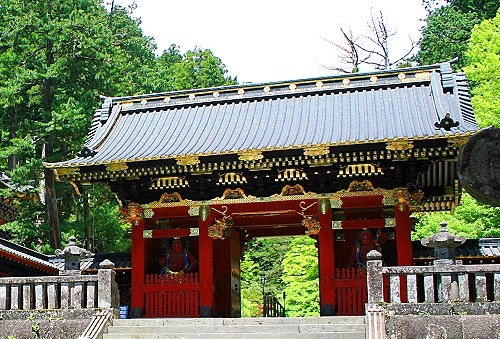
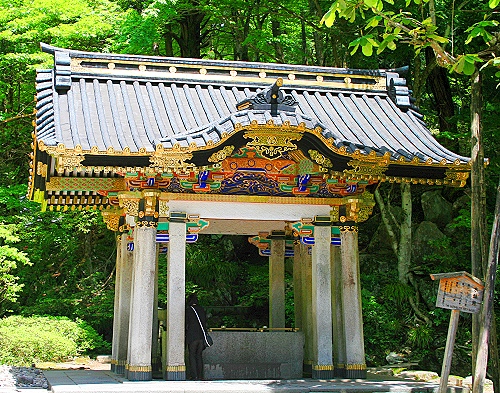 Nikko is a Shrine and temple in the mountains north Hondshus. The images are from Taiyuin-byo Shrine and Toshu-gu Shrine, the most beautiful cry plants of Nikko, which are decorated with beautiful carvings.According to our guide Taiyuin-byo was in 1653
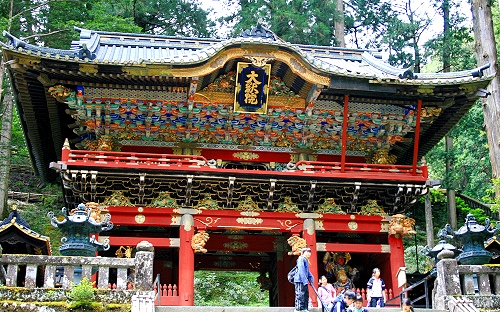 completed, it served as a mausoleum for Tokugawa Iemitsu (1603-1651), who drove Japan into a 200-year isolation.His ashes are buried in the sixth and final goal.
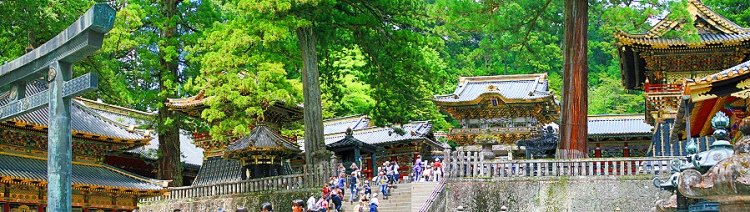
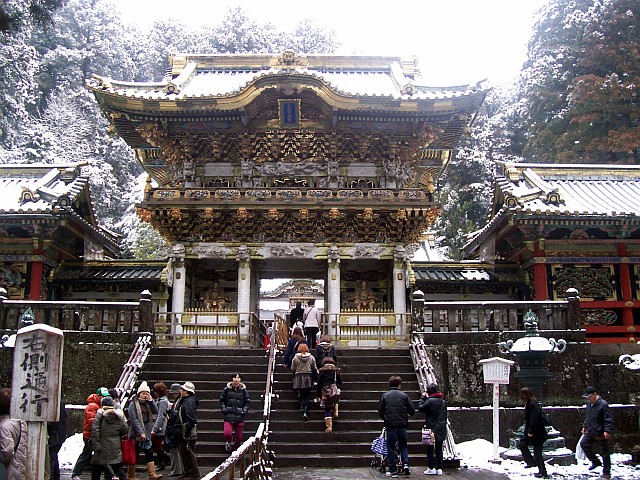
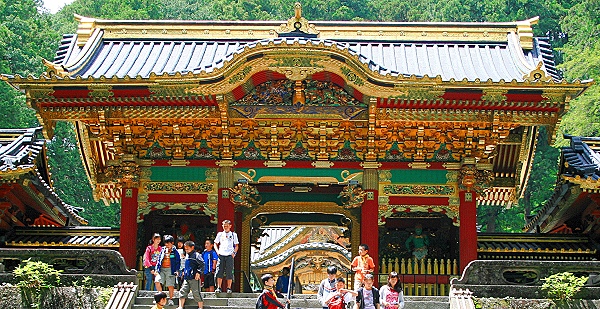 In Figure 1 you can see the Niomon Gate, it is the main entrance to the shrine. Thereafter, the granite fountain and the Nitemon Gate follow. Four guardian figures are in the niches, forward the gods Komoku and Jikoku and behind the wind and thunder god. The third goal Yoshamon gate is gilded and contains four statues of Yasha, a guardian spirit. Next is the Karamon, decorated with carvings of a crane pair.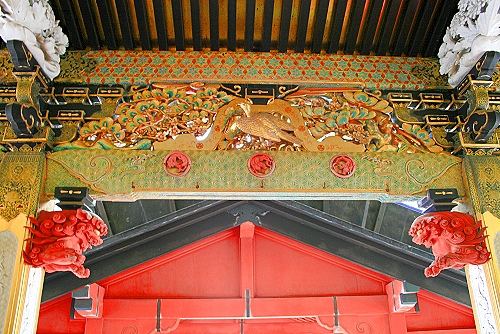
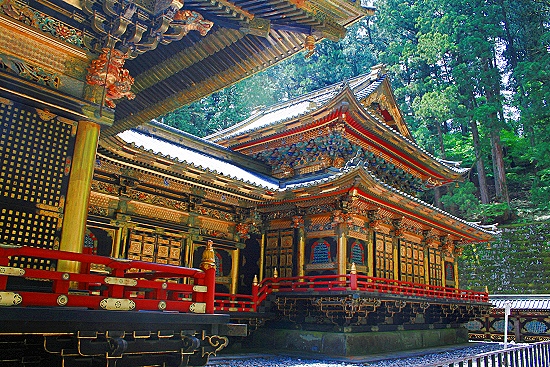 Ai No Ma is a joint chamber, it is richly decorated with carvings and reflects the splendor of the shrine again. One can not get enough of it.
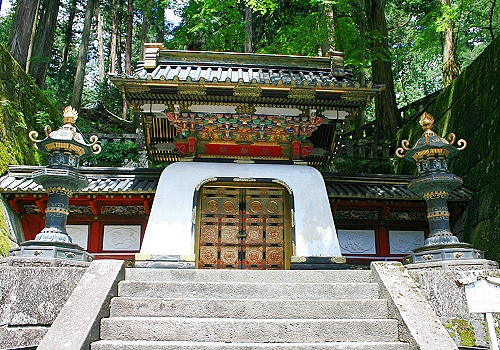 The Kokamon Gate in the style of the Chinese Ming Dynasty is the way to Iemitsus grave.
 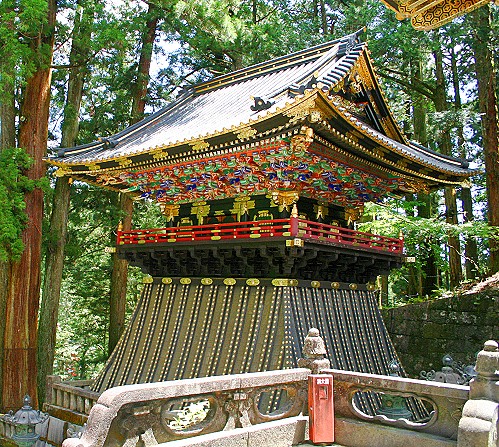 Before Yashamon Gate are the right and left of the Drum and Bell Tower, Drum stands for birth, the bell for death.
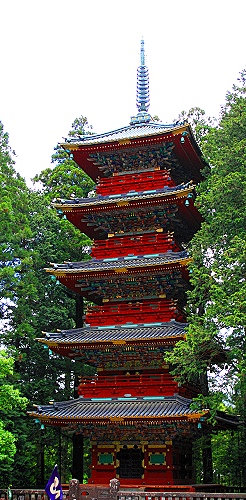 Not far from the Taiyuin-byo shrine is the Toshu-gu Shrine, in the entrance area, a five-story pagoda of 1650 stands. After a fire in 1818 this pagoda was rebuilt.
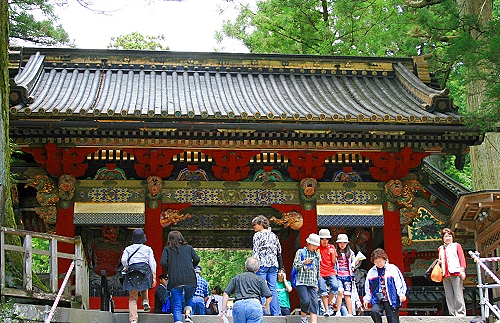 The Toshu-gu Shrine was built as a mausoleum for the grandfather of Tokugawa Iemitsu. It is known for its magnificent buildings and splendid color sculptures. One enters the shrine by the Niomon Gate, which is guarded by two fearsome Nio figures.
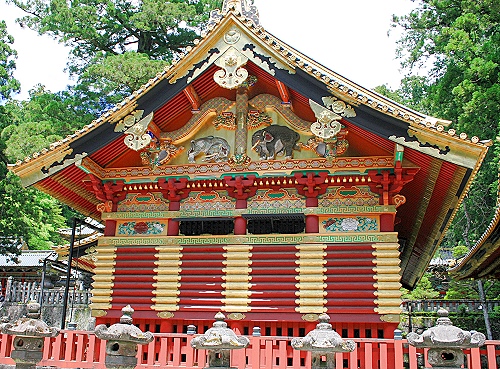 On the opposite side there are three sacred memory houses that were built in the traditional style.
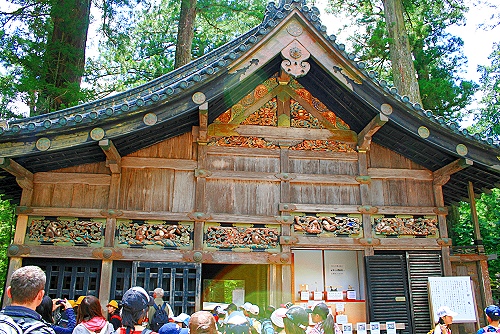 The Holy stable.The gable area there is a carving of the three famous monkeys: Do not look evil, hear no evil, speak no evil.
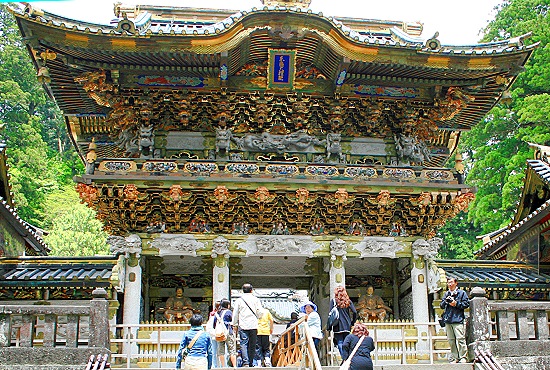
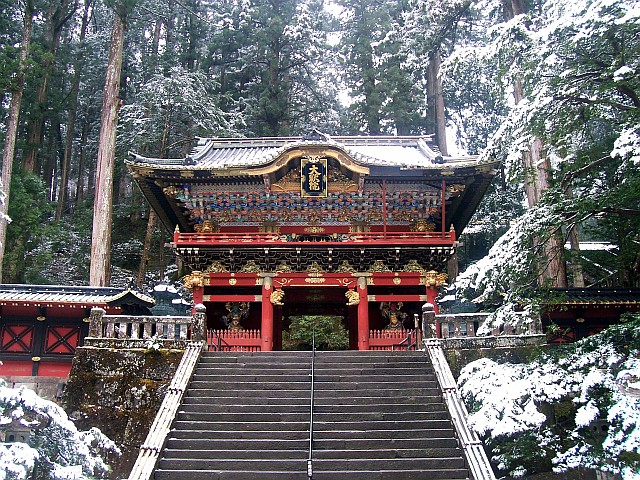
 In Toshu-gu Shrine - View of the Yomeimon Gate, which is the landmark of the shrine.Below the Yomeimon gate on the right and left are respectively the drum tower and bell tower.
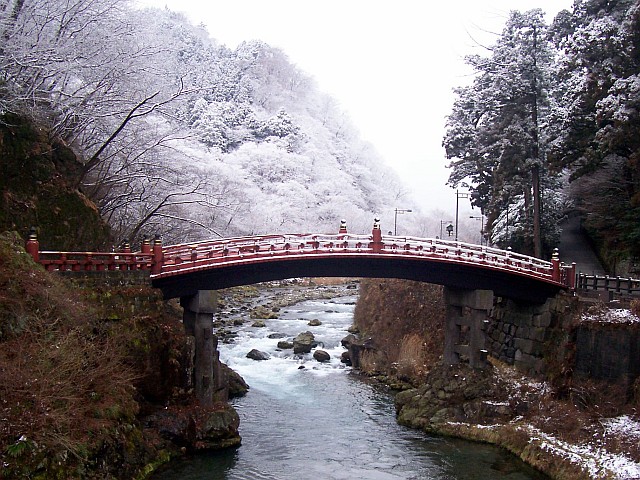
 The
The





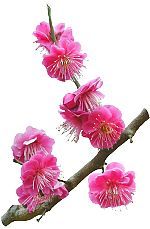 The Japanese plum or ume (sometimes referred to as a Japanese apricot) has played an important role in
 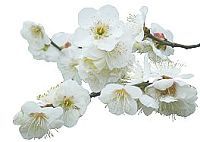 Like
Like 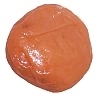 The actual ume fruit is more sour than the western plum or apricot, and is usually processed in various ways before eaten.


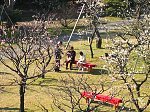
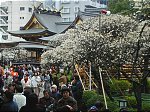
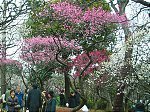


 Bakery Kawa's Kishu Ume Burger is drawing raves in Wakayama Prefecture. | KYODO


 â– Regular days off : Wednesday
 â– Regular days off : Open 7 days a week
 â– Regular days off : Open 7 days a week
 â– Regular days off :Irregular days off
 â– Regular days off : Tuesday

 Green Corner strives to serve delicious and affordable food while creating a bright and relaxing atmosphere in their shop. Their original “Tenkake-Ramen” became famous since it was featured on a TV show. The soup is a simple blend of chicken stock and soysauce and topped with wakame (seaweed), tenkasu (tempura scraps) and ginger. Also the ‘Green Soft’ (maccha green tea ice cream) is famous and exceptionally delicious.


 â– Regular days off : Monday


 Wakayama Prefecture faces the Pacific ocean, and is located in the southwestern part of the Kii peninsula which is the biggest peninsula in Japan. It has beautiful nature and historical treasures. With beautiful green mountains and a wonderful coast line whose length is 600km. There is a beautiful river between the mountains and the sea. The gorgeous scenery in Wakayama attracts visitors year-round. Kumano sanzan and Koyasan have awed people for ages and were granted World Heritage status. The mild climate and richness of nature provides gifts from the mountains, river and sea. Wakayama is rich in tourism resources and products.


