This post is also available in: Chinese (Traditional)
You’re going to Japan! Congrats. You will be riding a train for 70% of your time there.
This, I hope, will be an extremely helpful guide you use to learn how to properly ride the trains in Tokyo. I mean the whole process: getting to the station, buying your ticket, how to get on the train, etc. Hopefully it has all the answers to your burning questions: how do I buy a pass so I don’t have to pay for a ticket each time? How do I differentiate between the kinda-red line and the super-red line? How do I switch lines without looking like a complete and utter tourist idiot? Can I ride the JR and the subway? Oh my God, there’s a subway? (There is a subway. At some point, you might get on it. Don’t be afraid! You can do it! ) When there’s a train delay because of jinshin jiko, does this actually mean someone killed themselves? Wait: people kill themselves on the train tracks!? Wait: what do I do if there’s a train delay?
The guide is separated into 3 parts: the JR, the metro and an FAQ, which is really just a list of questions I thought up that I’m not sure are frequently asked, if asked at all. But they might help anyway!
An Introduction
This guide will focus on using commuter trains in the Tokyo area. Thus, the examples will use stations and trains used in the city, and shinkansen will not be covered as they are not technically commuter trains. The metro part of this guide will also only cover the system as it exists in the Tokyo area. If you go out of Tokyo, there are different subway systems, like the Yokohama subway and the Nagoya subway. However, the process of buying a ticket, getting on the train, buying a pass, etc all remains largely the same.
You may wonder if there is a way to travel through cities in Japan that isn’t by train. There are two choices: you can walk or you can take taxis. Honestly, walking through Tokyo is not bad if you are staying in the city center. You can walk from Shibuya to Ebisu in about 12 minutes. You probably don’t want to walk from Mitaka (where the Studio Ghibli museum is) to Shibuya, though, because that takes 3 hours. Taking a taxi might be less crowded and much easier, and in some cases faster, but cab fares are relatively expensive in Tokyo, and if you only use taxis to get from one place to another you’ll find that you’ll have spent most of your budget on transportation. Going from Nakano to Koenji by train, for instance, takes 2 minutes and costs about 140 yen or so. Taking a taxi from Nakano to Koenji takes about 10-15 minutes and can go up to 2000 yen.
Needless to say, taking the train is part of the Japanese lifestyle and it is the easiest way to experience what living in Japan is like.
The JR System
JR stands for Japan Railways. There are several branches of the Japan Railways Group depending on the location–for instance, Japan Railways East (JR East) covers Tohoku and Kanto, where Tokyo is. Likewise, JR West does Kansai and JR Kyushu does Kyushu.
How do I get to the JR station?
If you are staying in a hotel or a hostel, there is most likely information available with directions on how to get to the nearest train station. However, I put this question here for a reason. Make sure you know if you’re traveling by metro or JR, and which line you’re using, because depending on the station, you could end up wasting your day trying to find out where you need to go. Simply asking “where is Shinjuku station” or “where is Tokyo station” could land you on the opposite end of where you need to be, and by the time you get where you need to go, precious time will have been lost.
JR stations and JR lines can be identified by the JR symbol:

wpedia.goo.ne.jp
If you are inside the station, there will be signs pointing to the location of the JR lines. Take note that if you arrive at the station by metro, you will need to exit the metro section–that is, insert your ticket or use your IC card to get through the ticket gates–before you reach the JR section.
How do I buy a JR ticket?
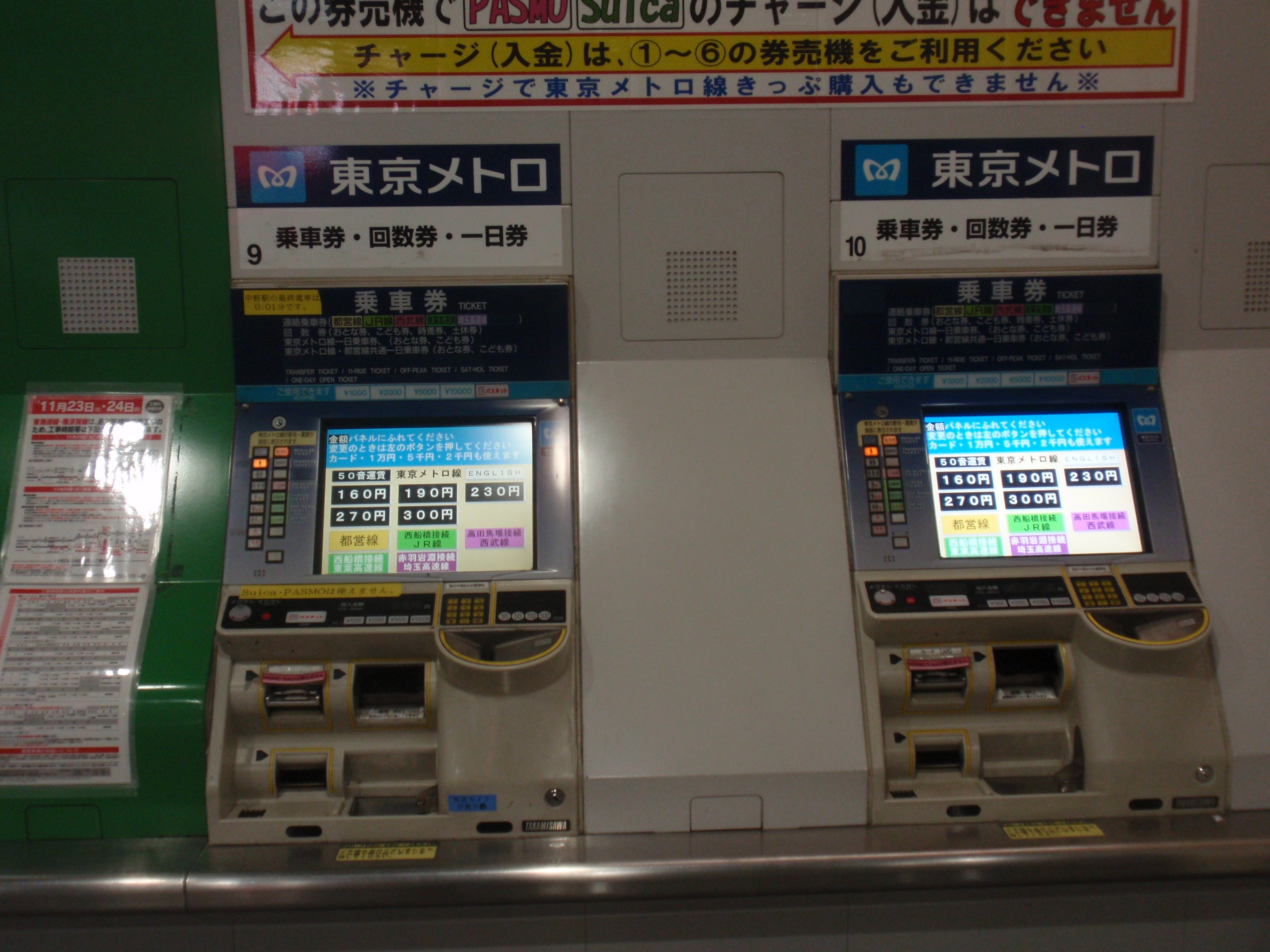
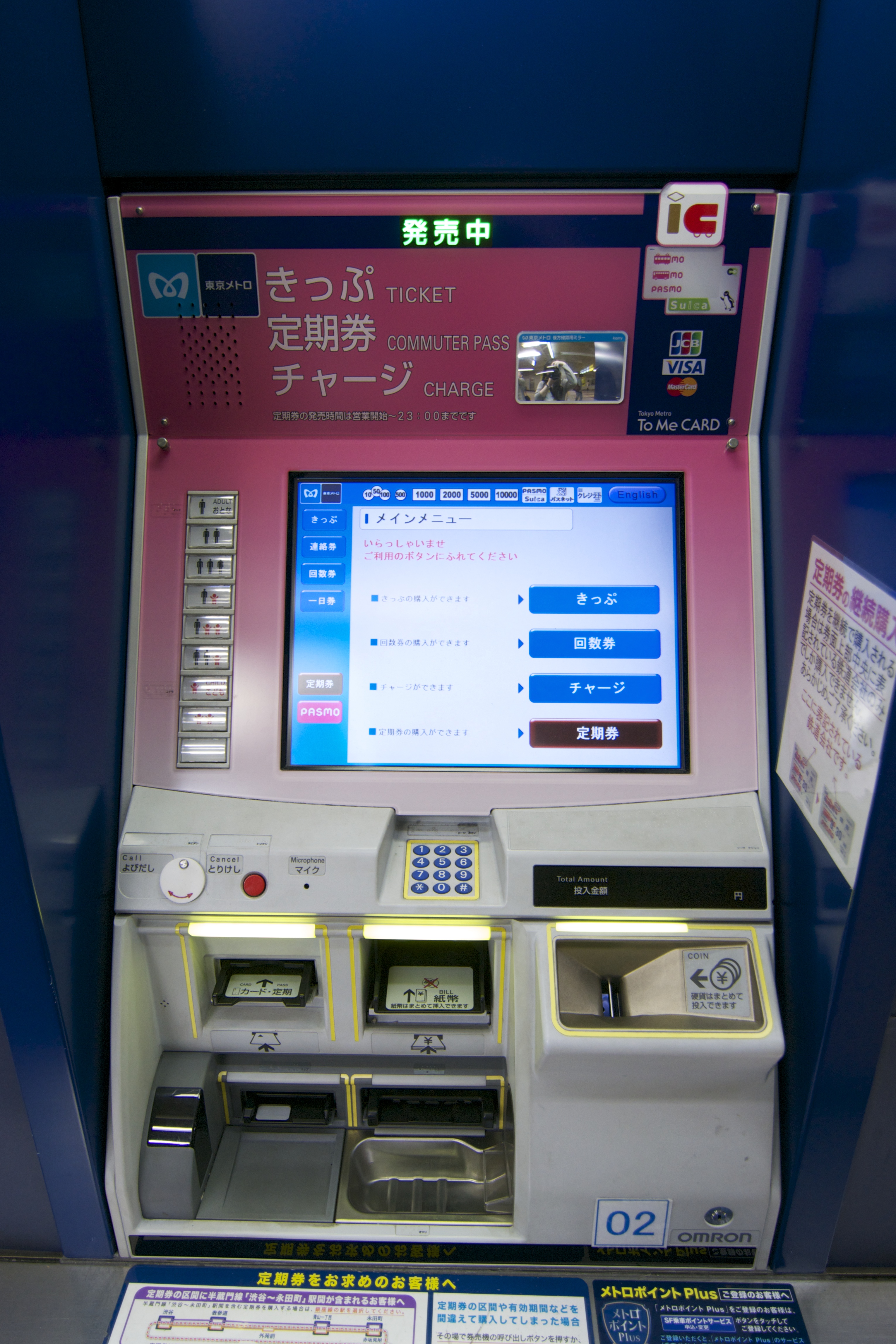
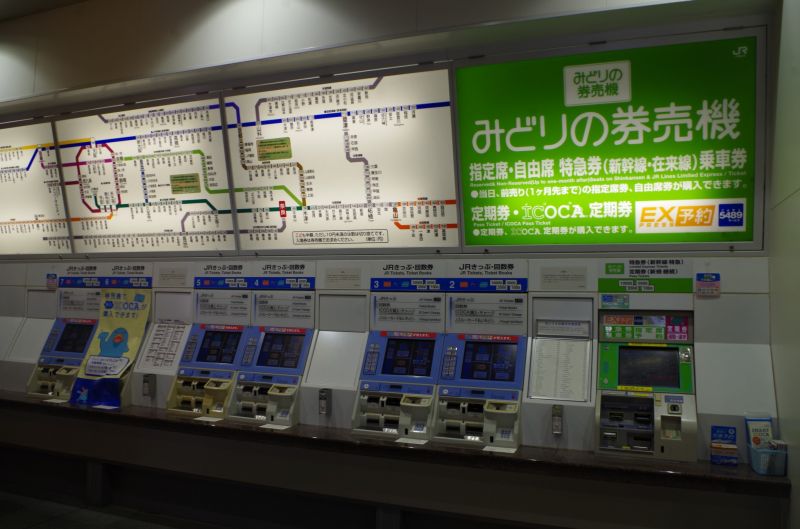
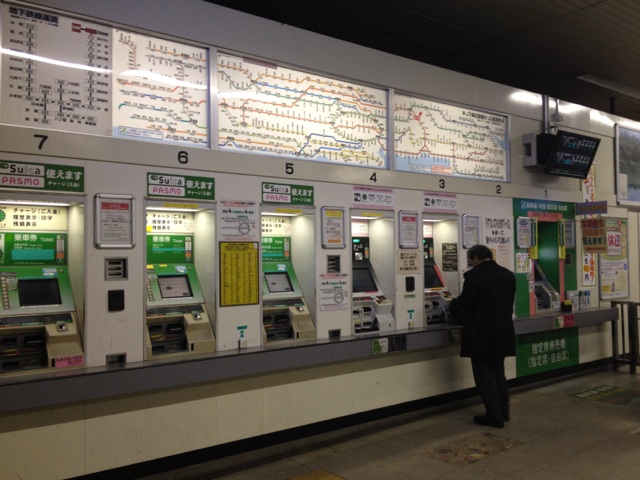
Tickets can be bought at these machines located next to or near the ticket gates:
www.lococom.jp 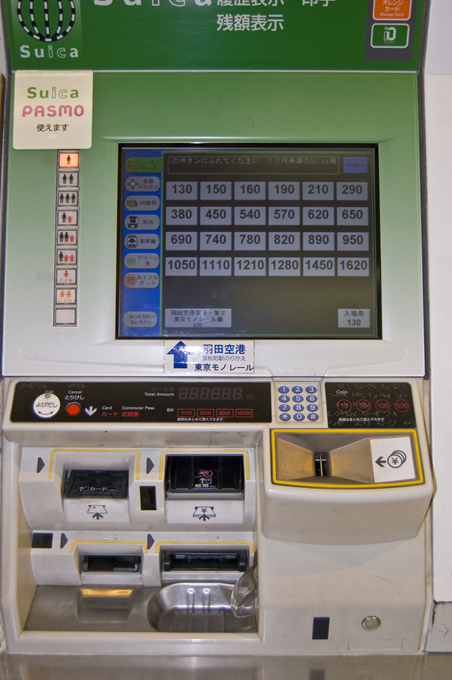
mystudyabroadjapan.blogspot.jp
You can use them in English (unless you are at a very, very tiny station in the middle of nowhere) by selecting the button that says “English,” usually in the top left or right corner.
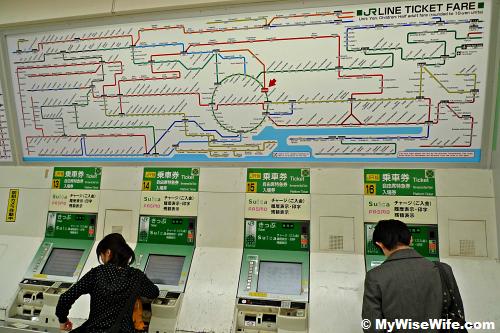
When you approach the screen it will light up (unless someone was using it immediately before you, in which case it’s already active) and you will see boxes with numbers on the screen. These are the prices of the tickets. To figure out how much it takes to get to your destination, just look at the map.
mywisewife.com
This map is usually located above the ticket machines and is a diagram of all the lines you can take from where you are and how much it costs to get to each station. The station you are at is usually the biggest square on the diagram, and if you’re staying on the same line and you know how many stops you’re going, you can just count the squares in the direction (for example, towards Shinjuku station or away from Shinjuku station). If you’re transferring, you have to find the corresponding transfer line connected to the line you are currently at and then go from there.
It sounds confusing, and it definitely is the first few times you try it, but it gets easier. It’s also much easier to do at stations that aren’t very crowded and are smaller, so the map doesn’t have 128953847 differently colored lines. Also: sometimes the map is only in Japanese. Don’t worry–you can either ask the information counter and they will gladly help you, or you can buy a ticket for the lowest price and just do a fare adjustment (covered in the next question) when you get to where you’re going and just pay the difference.
Once you’ve figured out how much you have to pay, touch the box on the screen and follow the instructions (inserting your money). You can also select how many people you are buying the tickets for from the buttons on the left side (hence the people figures). Children have cheaper ticket prices, so you can adjust for that as well. You can also buy each ticket separately.
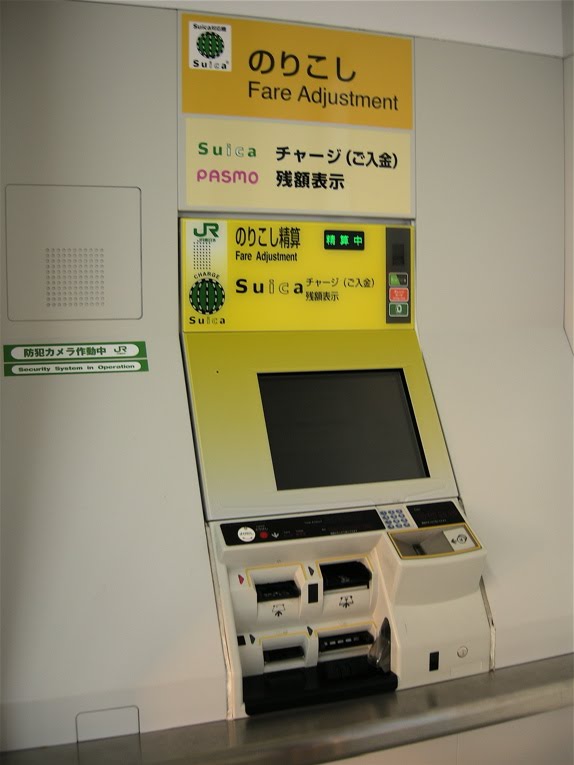
What if I pay for the wrong ticket price?
panoramio.com
When you get off at your final destination, there will be a fare adjustment machine (called exactly that) by the ticket gates. Insert your ticket and it will inform you of how much you need to pay to adjust your fare. If you have an IC card (see below), you can also charge your card at these machines if you don’t have enough to get through the gates.
Can I buy a pass instead?
gaijinjapan.org
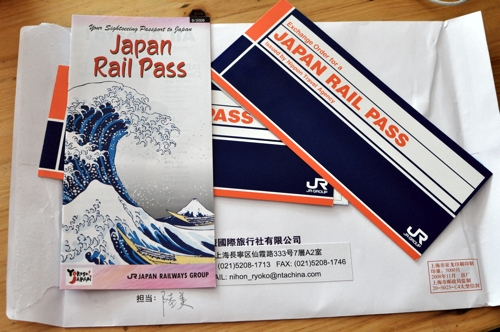
Yes! If you are traveling to Japan on a tourist visa–which is up to 90 days, so short-term exchange students may be on a tourist visa–you are eligible for the JR Rail Pass. You buy this before you come to Japan, and you are not able to get it within the country. It begins when you want it to–so if you are in Japan for two weeks, but aren’t traveling for the first week, you can activate it when the second week starts.
I won’t go into much more detail than that on the JR Rail Pass. Instead, if you aren’t on a tourist visa, you can purchase a prepaid IC card, which you can load with money and just touch-and-go when you enter and exit through the ticket gates. It’s much more convenient than buying tickets all the time, and it removes the hassle of staring at the train map in front of the ticket machines going “@%$#& BUT HOW MUCH IS IT!?”
What is this prepaid IC card you speak of?
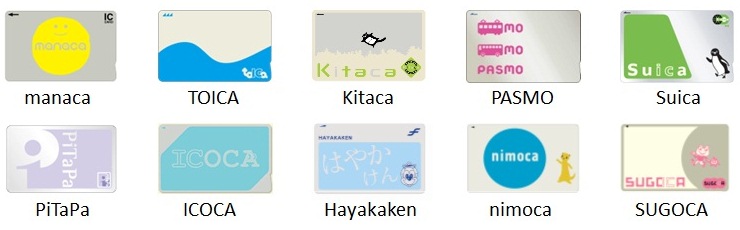
There are different IC “brands,” like the Suica and the Pasmo (bought in Tokyo for the JR and non-JR companies, respectively) or the Toica and the Manaca (Nagoya, same distinction) or Icoca and the PiTaPa (Osaka, same distinction). Basically, if you have a Suica and you ride the non-JR trains, it’ll be a little more expensive; if you have a Pasmo and you ride the JR trains, it’s a little more expensive.
kotsu.city.nagoya.jp
The IC cards of the following cities–Tokyo, Osaka, Hiroshima, Okayama, Nagoya, Sapporo, Fukuoka, Kumamoto, Kagoshima, Oita, Nagasaki–are interchangeable. That is, if you buy an IC card in Osaka, you can use it for the trains in Tokyo or Sapporo. Yes, any train–doesn’t matter if it’s JR or subway. You can use IC cards on most commuter buses as well. You cannot use IC cards for shinkansen, special trains (such as limited express trains, which have special fees), highway buses and the Kyoto city buses (unless you are reading this after December 24th, 2014, in which case IC card payment on Kyoto city buses has already begun).
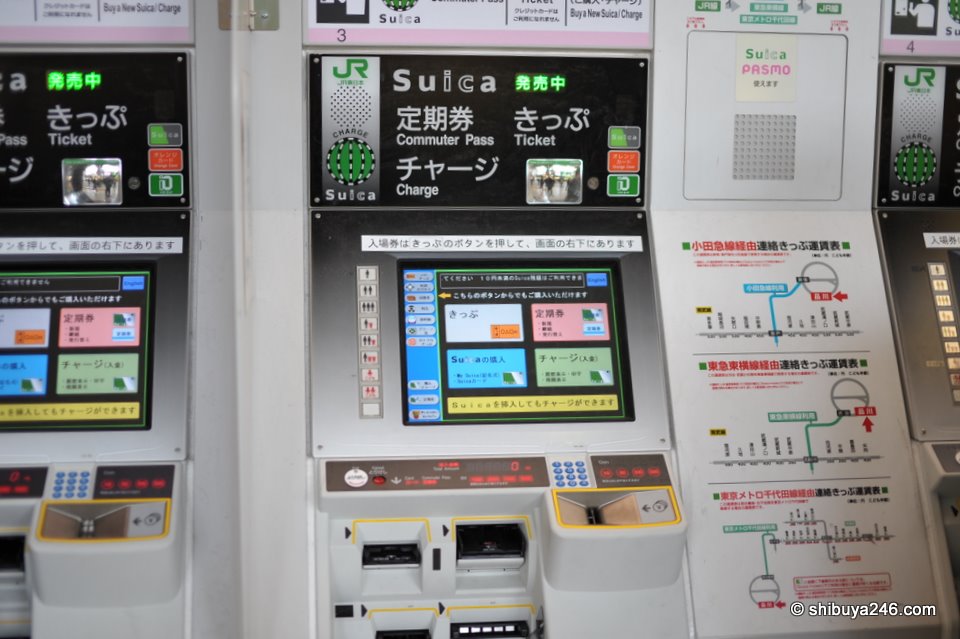
For Tokyo, Suica and Pasmo can be bought at ticket machines or counters in stations. For the machines, it has to say that it will dispense Suica or Pasmo cards (Suica and Pasmo are both romanized, so you will be able to see this on the machine itself even if it’s in Japanese, though the machines can be used in English as well). When buying your first Suica or Pasmo, you will be charged a fee for the card as well as for how much you initially charge it for.
shibuya246.com
Which brings me to explaining how to charge your card. You can do this at any ticket machine. It doesn’t have to be specifically for Suica or Pasmo. Insert your card into the slot (it usually has a blinking red light next to it), and a menu will come up with options. Select “charge.” You will usually only be able to charge your card in increments of 1000, but some machines let you add just 500 yen. Insert the money and the card will come out soon after.
IC cards can also be used to shop in convenience stores with the same touch-and-go technology. Some other places may accept your IC card as a form of payment as well. You have to charge the card at stations and convenience stores where you can use it.
How do I change trains for the JR?
When you get off your first train, immediately look for signs on the platform (hanging from the ceiling or on the walls) that will point you in the direction you need to go. The signs will usually name the lines or be more general, such as “JR lines.” In any case, just find out where you need to go and follow the arrow.

myphotos-h.blogspot.jp
Sometimes you will need to pass through ticket gates to get from one area of the station to another, especially if you are going from the metro to the JR lines, or one subway company to another.
One thing to note here is that you have to know in which direction you’re going. Sometimes the signs will say “Hibiya Line – to Naka-Meguro” and “Hibiya Line – to Ueno.” At certain points along the platform, there will be signs listing the stations on the Naka-Meguro side/on the Ueno side. But even if you get on the wrong platform, there is always a passageway to the other side so you can get to where you need to go.
What’s up with all this express, limited express, super express, blah blah express business?

kurofunetrain.livedoor.biz
These labels just denote how fast the train is going:
Local (普通) – stops at every station.
Rapid (快速) – skips some stations.
Express (急行) – skips a lot more stations. The fee for these trains is higher than the local/rapid trains.
Limited Express (特急) – only stops at major stations. Also requires an extra fare (sometimes as much as 4000 yen).
Your best bet is to stick to only the local and rapid trains (though if you’re riding rapid, make sure the train stops at the station you want to go to). Express and limited express trains can be tricky, though if you are going further out of the metropolitan area (or going into central Tokyo from far away), these might be better options lest you find yourself on the train for 2 plus hours.
How do I know I’m on the right JR platform?
Signs, signs, signs! You will be relying on signs a lot when in Japan, and luckily you’ll be looking at ones that are in English as well as Japanese.
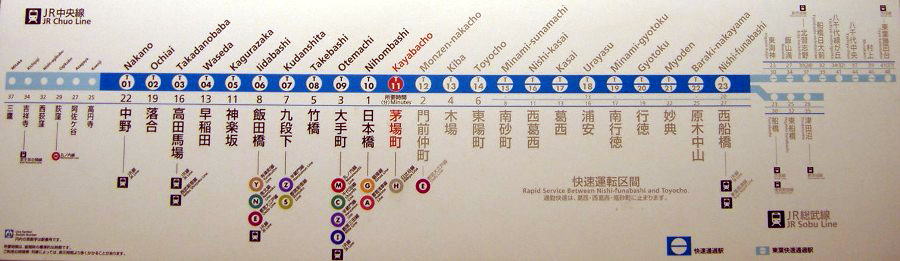
Platforms will usually have a station list posted on a pillar that denotes a) what line you are getting on, b) what station you are currently at (usually in bold and a bigger font size than the other station names) and c) what direction you are going in. For the JR, you will have to eyeball where you’re going and if you’re going the right way. It’s a little easier to check the direction you’re going on the subway.
The signs hanging above the platforms will also usually say the major stations you’ll pass in that direction. If you are going to a major transport hub like Shinjuku, Tokyo or Shinagawa stations, they’ll definitely be listed on those smaller signs.
How do I get on the train for the JR?
You probably think this is a really stupid question, but it may prove useful for you, so read the answer anyway.

sarahlynnpablo.wordpress.com
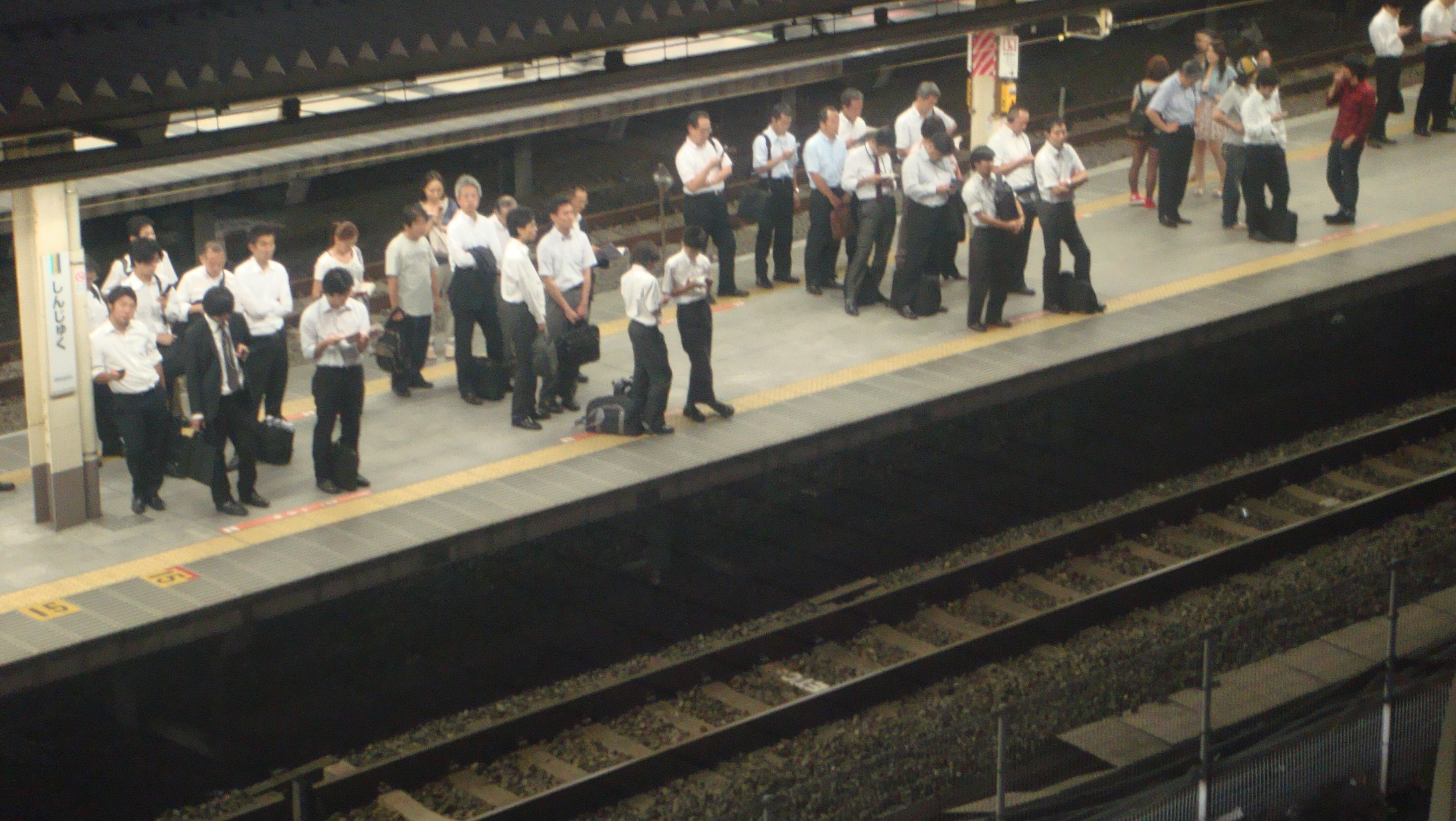
Once you pass through the ticket gate and you’ve found the right platform, you’ll notice that there are numbers on the opposite wall or ledge from the platform. These numbers indicate where the doors of each car will open, and so this is where people line up. The middle cars of the train are usually the most crowded, and your chances of finding a seat are higher if you’re in the first or last car, but of course this depends on what line you’re on and what time you’re taking the train. Finding a seat during rush hour, of course, is a very funny thought.
Line up as usual. When the incoming train stops, you’ll have to wait until everyone has gotten off. This is sometimes really fascinating to watch, especially if the train is really crowded.
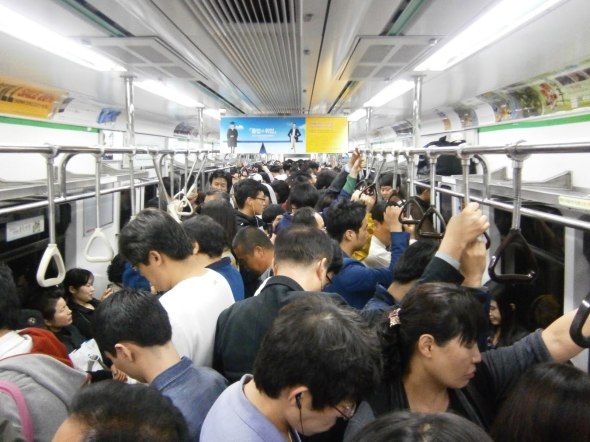
Once you get on the train, move to the sides of the car to free up space in the middle. Yes, it might get very crowded, and you might find yourself closer to people than you’re used to, but that’s train life.
japantoday.com
The subway system
The subway system in Tokyo is divided into two companies: the Tokyo Metro and the Toei Subway. There is no real pattern, nor any rules, as to whether or not you have to take one or the other, or if you can only take the subway and not the JR. You can mix and match to your heart’s content, or you can only take JR, or you can only take the subway. As for the two companies, there’s not much difference between them except for where they go and the prices (the Toei subway is a little more expensive). The Toei Subway, for instance, has the Asakusa line, which takes you to Skytree and Asakusa. The metro, though, goes to Omotesando. So it’s really all a matter of convenience.
How do I get to the subway station?
The Tokyo Metro symbol looks like this:
ebay.com
It is usually only denoted by the white “m” on the left side.
The Toei Subway symbol looks like this:

rapidtransit.wikia.com
It is not always the case that there will be both a metro and a Toei line at the same station. Likewise, it is not always guaranteed that a station will be both JR and metro, or JR and Toei. When deciding where to stay, it is advisable to choose a hotel or hostel near a station with several lines on either (or both) the JR or subway in case one is delayed.
For more detailed information on the Tokyo metro and Toei subway companies, such as the individual lines, check out these articles:
How do I buy a subway ticket?
Buying tickets for the subway is exactly the same as buying tickets for JR.

tiredoframen.wordpress.com 
okapianda.hatenablog.com
However, the way to buy the tickets is exactly the same: look at the map to find out how much it costs to get where you’re going, select the button with the desired amount on the screen, pick how many people if you are buying for more than one, insert your money and yay: ticket!
Just like with the JR, if you accidentally buy the wrong ticket price or need to recharge your IC card, you can do this at the exact same fare adjustment machines.
Can I buy a pass/IC card for the subway instead?
You can use the IC passes discussed in the JR section for the Tokyo subway. If you’re going to be traveling mostly on the subway, purchase a Pasmo instead of a Suica.
izuhakone.co.jp
How do I change trains for the subway?

jokmksqblog.seesaa.net
Changing trains on the subway is exactly the same as with the JR: simply follow the signs! If you are staying on the Tokyo metro or the Toei, there may be no need to pass through the ticket gates when trying to get to the other line. Going from the metro to the Toei, or vice versa, will have you go through ticket gates (and also if you are changing to the JR lines). This isn’t anything that should trip you up, however. As long as you follow the signs–and follow them well, as they do get confusing, especially in bigger and busier stations–you’ll find your way.
How do I know if I’m on the right platform for the subway?
Once again: signs, signs, signs!
asahi-net.or.jp
As with the JR, platforms will usually have a station list posted on a pillar that denotes a) what line you are getting on, b) what station you are currently at (usually in bold and a bigger font size than the other station names) and c) what direction you are going in. For the subway, these signs will usually be very big and will sometimes have the other side–i.e., the direction you’re not going in–blurred out, or won’t be listed at all, so you know you’re definitely going the right way.
How do I get on the train for the subway?
Again, getting on the subway trains is exactly the same as getting on the the JR trains. Be aware, though, that some subway lines like the Marunouchi or the Tozai can get EXTREMELY crowded during rush hour. Just because it’s the subway doesn’t mean that it’s less congested than the JR lines.
Does the subway have express trains as well?
Yes, and they work exactly the same way as they do with the JR.
Getting from Point A to Point B (JR & subway)

blog.livedoor.jp
Here is an example train “schedule,” denoting the steps that need to be taken to get from your initial destination to the end.
1. Arrive at station.
2. Find JR or subway section of station.
3. Find the area where your desired line is.
4. Find ticket machines near ticket gates (wicket). If you already have an IC card that is charged, you can just go through the gates at this point.
5. Buy your ticket or charge your IC card.
6. Go through the ticket gates.
7. Find the direction you want to go in, which corresponds to the platform you will be using to get on.
8. After you’ve found the platform, line up to get onto the train.
9. Once the train arrives, wait until everyone has gotten off the train before following the line into the car.
10. Move toward the inside or the side of the car to free up space near the doors.
11. Once you’ve gotten to your station, get off the car (no special procedure here) and proceed to the exit you want. A note about exits: There are usually multiple throughout a single station, and exiting at one can put you at the exact opposite place from where you need to be, so check beforehand! Tourist areas, restaurants and shops will usually have what exit you should take listed on their website.
12. Head toward the ticket gate (wicket) and insert your ticket or touch your IC card. Or do a fare adjustment first if you need to, and then exit.
Or, if you are transferring:
11. Once you’ve gotten to your station, get off the car (no special procedure) and look for signs denoting where you need to switch to your new line.
12. Follow the signs. At some point, you may or may not need to pass through a ticket gate (wicket).
13. Once you’ve reached the platform you need, line up again and wait for the next train.
That’s all!
FAQ
1. You only covered JR and the subway. What about the Keio/Tobu/Denentoshi/Yurikamome/etc. lines?

nicolaingiappone.blogspot.com
Since the JR and the metro are the main trains used within the Tokyo area, I only covered those. However, there are other privately operated train lines such as the ones listed (and many more). Their operation, however, is pretty much consistent with the JR and metro.
2. Is rush hour really as bad as everyone says?

wanryoku.com
The peak of rush hour is pretty bad: there really are helpers on the platforms to help squeeze everyone into the cars, and once inside the car, it’s pretty packed. You’ll be pushed up every which way against people you’ve never met in your life, and chances are you won’t be able to raise your arms to look at your phone or change the song on your iPod.
The good news is that after major stations, most people leave, so you’ll be able to move again if you’re not getting off with them.
3. What is this jinshin jiko business?
Jinshin jiko literally means a “personal accident” and contains the kanji for “oneself” and “person.” Basically, when there is a jinshin jiko on a train line–which happens quite a bit in Tokyo–it means a person caused a disturbance of some kind on the train tracks. This could be anything from someone who fell off the platform onto the tracks to suicide. While you may have heard a lot about train suicides in Japan, the truth is that mostjinshin jiko occur because of overcrowding on platforms, or people who are drunk and not aware of where they’re stepping, and thus people accidentally fall onto the tracks.
This is why at a lot of busy stations and/or busy lines, you’ll notice that there are automated barriers between the platform and the train which remain closed until the train arrives and the doors open.
4. What are other reasons trains get delayed?
Besides jinshin jiko, trains sometimes get delayed for surprise maintenance or because of other mechanical check-ups and/or problems. However, this is the Japanese train system, and when a train is delayed the company tries its best to get that part of the line–or the whole line–working up to full speed as soon as they can.
If your train line is delayed, don’t worry: wherever you’re going, there’s probably an alternate route. Ask a conductor or the information counter, or even someone waiting around on the platform, provided they don’t look super busy. If your train line is stopped altogether and you really needed that line in particular, it might be best to take a taxi instead.
5. All the train lines have similar colors! How do I tell them apart?
superpro.com.tw
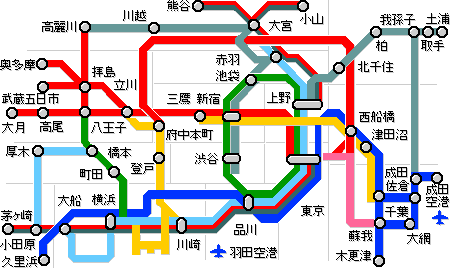
I feel you. The sad news is, if the colors are too confusing, you’ll have to rely on the station names. It’s a good idea to write everything down BEFORE you get on with your day’s activities, so you know where you’re going. Saying to yourself “I need to take the orange line” is not a good idea, because if you’ve seen the Tokyo train map, there are about fifty bajillion lines that could be orange. Did you mean light orange? Or gold-y orange? Or deep orange? Or burnt orange? Save yourself an art class and write down the name of the line instead. Or invest in a map, which are available at most stations, and a pen.
6. Will I be safe on the train?

murata-brg.co.jp
Generally, yes. Contrary to what everyone might tell you, Japan is not a ridiculously safe country, but it also isn’t ridiculously ridden with crime, either. The rules of being a smart tourist apply in Japan just as much as they do anywhere else. Don’t flaunt what you have, make sure your wallet is in a safe place near your body, don’t leave your stuff out unattended, etc.
You might notice that there are signs (like the one above) in stations saying to be on the lookout for chikan,or perverts on the train, and to be courageous yell if anything happens. Things like groping and secret cameras were a much bigger problem back in the day, but this doesn’t mean that it still doesn’t happen. Again, just be alert.
7. What if I leave something on the train?
If you forget something on the train, go to the main office at your nearest train station and explain your situation. They might have you go to to the office at a bigger, major station, but not all hope is lost. Don’t worry too much