Supposed Dragons photographed over Tibet
-
Dragons in the Tibet Sky
The Epoch Times
Aug 07, 2005
Above the Himalayas. (www.dajiyuan.com)
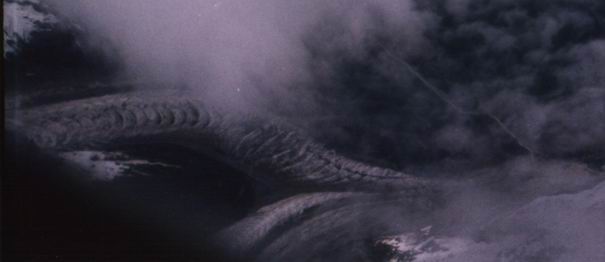
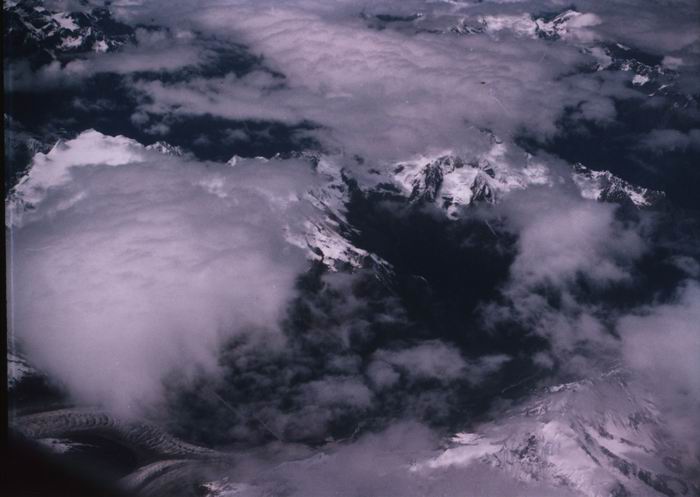
A photo of two peculiar dragon-shaped objects taken from a plane flying over Tibet’s Himalayas piqued many users’ interest when displayed on a Chinese website. The photographer is an amateur.
On June 22, 2004, the photographer went to Tibet’s Amdo region to attend the Qinghai-to-Xizang Railroad laying ceremony, and then took a plane from Lhasa to fly back inland. When flying over the Himalayas, he accidentally caught these two "dragons" in a picture that he took. He called these two objects "the Tibet dragons."
Looking at the photo, these two objects appear to have the characteristics of crawling creatures: The bodies seem to be covered by scales, the backs have spine-like protuberances, and also they have gradually thinning rear ends. Although the photo caught only a portion of the entire scene, it was sufficient to create the appearance of two gigantic dragons flying in the clouds.
This photo, shown on some websites such as post.baidu.com and other forums, aroused the website visitors’ curiosity. One person commented, “No wonder that China is the homeland of the dragon! Nature is truly mysterious and powerful, it can always produce spectacular sights beyond people's expectations.”
“Is it really true? Is it possible there is an ancient civilization that we don’t know about preserved in places that are sparsely populated?”
“It really looks like the dragons in fables, and I really hope it is.”
Certainly, most website visitors hoped that someone could confirm the authenticity of the dragons in the photo.
Photo of dragons taken from an airplane above the Himalayas. (www.dajiyuan.com)
In Chinese fairy tales, the dragon is a kind of rare heavenly creature. Fables say that it can conceal or reveal itself. It ascends to heaven in the spring breeze and dives and hides in deep water in the autumn wind. It can promote clouds and bring about rain. It also became the symbol of imperial authority later on; all emperors of previous dynasties self-designated as dragons, utensils were also decorated with dragons.
Culturally, the dragon is the Chinese ancestors' totem. Nearly all races in China had fables and stories with dragons as the main subject, such as dragon boat races, the dragon lantern dance to celebrate holidays, sacrificial offerings to the dragons to implore timely wind and rain for good crops.
Whether this kind of creature really exists is still an unsolved riddle. In the previous dynasties in China, there had been many documents recording eyewitness accounts of magical dragons. The most amazing events are the various "falling dragons," dragons that suddenly fell to the ground under peculiar circumstances, and were witnessed by many. A relatively recent tale occurred in the puppet Manchuria regime in August, 1944. A black dragon fell to the ground at the Chen Family’s Weizi Village, about 9.4 miles northwest of Zhaoyuan County, on the south shore of the Mudan River (the old name of a section of Songhua River) in Heilongjiang province. The black dragon was on the verge of death. The eyewitness said that this creature had a horn on its head, scales covering its body, and had a strong fishy smell that attracted numerous flies.
The records from previous dynasties also mentioned the connection between the emergence of these kinds of mysterious creatures, “dragons,” and the transition of dynasties on earth. The appearance of Tibet’s magical dragon invites our curiosity and imagination.
http://www.theepochtimes.com/news/5-8-7/31030.html -
what ? .... I don't see anything but clouds ......

-
another photographer claimed that unbelievable creature merged into a storm cloud, the whole thing whows up for few sec and moving around in the cloud. i m not sure if the pic was a hoax.
here are the photo shows the thing

it's sounds too crazy that we got any lifeform wraping upon the sky here on the earth. i would rather willing to believe these monsters in lake or what but it's goes too far to say we got gaint flying dinosaur.........after think it carefully, maybe the flyin one is hoax? wat would you say
any way i found another pic of a fossil claim to be the skull of a real kylin exposing in the Guangzhou museum
-
Another claimed to be an evidence of existence of cChinese dragon(news of -12-8-34) and CCTV investigation on the incident. one of the picture said is the bone fragment which collected at the "fallen dragon" crash site

-
the 2 scaly long objects in the pics supposed to show the tails of the dragons.Originally posted by Fatum:what ? .... I don't see anything but clouds ...... -
I saw the image of the Virgin Mary on a glazed doughnut.
 Some people will believe anything.
 -
HELP HELP!
The reptilians(the most powerful aliens) is coming to conquer us
-
we can blast the daylights out of them with surface to air missiles dont worry.Originally posted by maggot:HELP HELP!
The reptilians(the most powerful aliens) is coming to conquer us -
the first 2 pics, frankly i dont believe that a tail of that size (covering the moutains) of a massive creature be able to go undetected. If it exist, it is a serious threat to air space of that country. Radars would have picked it up by now. Not discounting the fact that it may exist but it can only do so if it came from outer space for a brief visit and governments hushed up the matter.
-
A small planetoid is coming towards us slowlyOriginally posted by vito_corleone:we can blast the daylights out of them with surface to air missiles dont worry. -
Radar cannot detect living creaturesOriginally posted by Mr Soh:the first 2 pics, frankly i dont believe that a tail of that size (covering the moutains) of a massive creature be able to go undetected. If it exist, it is a serious threat to air space of that country. Radars would have picked it up by now. Not discounting the fact that it may exist but it can only do so if it came from outer space for a brief visit and governments hushed up the matter.
-
flying fighter jets leave trails that look similar to dragon tails too.Originally posted by Mr Soh:the first 2 pics, frankly i dont believe that a tail of that size (covering the moutains) of a massive creature be able to go undetected. If it exist, it is a serious threat to air space of that country. Radars would have picked it up by now. Not discounting the fact that it may exist but it can only do so if it came from outer space for a brief visit and governments hushed up the matter. and going by the rules of physics a dragon with such a huge body mass cannot possibly propel itself up in the air without sufficient propulsion, where the neck are its massive wings? or do dragons have a similar lift-off system to the british harrier jet? -
What i meant was satellite surveillance would have picked it up by now.Originally posted by maggot:Radar cannot detect living creatures -
and what happened to the fallen dragon story....scientists could have examined the bones by now?
-
If they cloned it and mass produced........Originally posted by Mr Soh:and what happened to the fallen dragon story....scientists could have examined the bones by now?
-
dragons?
ahhhh anyone remembers Reign of Fire?
-
coudl these dragons be dinosaurs?Originally posted by Mr Soh:and what happened to the fallen dragon story....scientists could have examined the bones by now? -
unlikely cause dinosaurs that size cant hide long. What will they eat for a livng?Originally posted by vito_corleone:coudl these dragons be dinosaurs? -
as you said they cant hide that long given that size, let alone dragons of a similar scale.Originally posted by Mr Soh:unlikely cause dinosaurs that size cant hide long. What will they eat for a livng? what will they eat? birds maybe? -
its a known fact that living fossils have been found. these specimens are living creatures which have been found entombed in rocks, alive and in hibernation, including what seem to be a pterodactyl found in France in 1856 when workers were digging a railway tunnel thru a layer of Jurassic Limestone. The pterodactyl emerged from the boulder alive, but died almost immediately. But the fact is that it survived millions of years trapped in the rock b4 being freed.Originally posted by Mr Soh:unlikely cause dinosaurs that size cant hide long. What will they eat for a livng? -
Although it is not exactly paranormal in nature, the phenomenon of entombed animals is completely unexplainable by modern science. Frequently reported throughout history, people have been startled to find living animals trapped in stones, tree trunks, or concrete, sometimes hundreds of feet below the earthÂ’s surface. In every report, the animal (usually a frog or toad) is found as a rock was split open or a tree trunk was being sawed, with no possible way evident for the creature to end up inside the cavity of the stone or tree. The cavity is usually slightly larger than the animal, and often it is the same shape as the animal found inside. Animals that are suddenly freed from their stony prisons are often reported as turning darker in color, having difficulty breathing at first, and becoming full of life.
A toad estimated to be over 6000 years old was freed from itÂ’s stony prison in 1865, by excavators in Durham, England. The live toad was found in a block of magnesian limestone 25 feet underground. Its eyes were reported to be especially bright, its hind claws were particularly long and the claws of its forefeet were turned in. It grew darker in colour, from a pale colour matching the stone it was found in to a darker olive brown. It appeared to have difficulty breathing as it made a barking sound from its nostrils.
There is no scientific explanation as to how a frog or toad could survive in a seemingly air tight stone without water or food. Some suggest they collect water and nutrients that seep through the stone, especially if it is porous like limestone. Air could get in the same way. However, many of these entrapped animals are found hundreds of feet underground in rock believed to be thousands of years old. Even if the animal survived being trapped in stone, it is extraordinary that it would have remained alive for so long. Ironically, many reports of freed animals claim the creature only lived a few hours or days after being released into "survivable" conditions.
It is interesting to note that many reports of such trapped animals suggest that they were a prehistoric species as descriptions often match those of animals that were extinct or have since evolved. Perhaps some animals survive fossilization.
In 1818, a geologist named Dr. Edward D. Clarke was looking for fossils in a chalk quarry 270 feet underground. Dr. Clarke found some fossilized sea urchins and newts. He dug three well-preserved newts out and placed them on paper in the sun. To his astonishment, they began to move around. Two of the newts died shortly, but the third remained lively and was released into a pond. Dr. Clarke claimed the newts were unlike any other living at the time and were an extinct species unknown to science.
Most scientists will hold firm to the opinion that cases in which 6000 year old frogs survive such a long period of time encased in stone are absolutely impossible. Skeptics suggest the frogs or other creatures were actually discovered near the recently split stone or tree trunk and were assumed to be trapped inside as the observer noticed the small cavity. However, the reports of trapped animals are very similar, and many notice the creature inside the cavity before it is freed. Although frogs are known to hibernate for months at a time in mud, it is hard to imagine so many hibernating so long that the mud turned to stone, then sat for unknown periods of time until split open.
Here are a few more reports:
In 1719, French lumbermen were astonished to find a living frog directly in the center of a solid elm trunk about 4 feet above the root.
In 1853, a live horned lizard was freed from a block of solid stone. It was sent to the Smithsonian Institution. The lizard only lived two days after being freed.
An hour and a half after stoking his fire, Mr. W.J. Clarke, of Rugby, England, reached over to poke the coals. As he broke open one coal, he saw something move and snatched it out of the fireplace. It proved to be a living toad and it survived for nearly five weeks. It had no mouth and was nearly transparent. Photoraphs of this marvel were offered for sale by the London Steroscopic Company.
In the later part of the 19th century a venerable lama named Situ Pema Wangyal Rinpoche was making a journey to Lhasa in the company of several friends. One day, much to the alarm of his companions he fell into a wrathful mood and that evening insisted on making camp on a barren plain where neither firewood or water could be found. The next morning, still in a bad humor, he obliged the party to leave the route to Lhasa and to head north to, as far as his companions knew, to nowhere. Since they held him in high esteem though they followed without question. After several hours they came to an enormous outcrop of rock, which Situ announced, it was their duty to break open. Since they had no tools except their wooden staffs, they fared rather poorly at this task. At this point, the lama took his staff and struck the rock a single blow. It shattered, and revealed inside was a large, repulsive looking creature that the lama gently lifted out and placed at his feet. As the salamander like animal panted for breath, Situ sat down and began to perform a certain yoga on the animals behalf. In Tibetan, this yoga is called pho - wa and is usually described as a transfer of consciousness. It is performed by lamas for the benefit of the dying. After a while, the creature died, funeral rites were performed and the creatures body was burned.
The most amazing case of living fossils is one of a pterodactyl in France during the winter of 1856. Workmen were digging a railway tunnel through a layer of Jurassic limestone. They were startled to find a large creature stumbling out of a recently split boulder, flapping what looked like wings and croaking. It died immediately. The creature was identified as a pterodactyl by a local paleontology student who recognized the characteristic features of the extinct reptile. The stone in which it was found was consistent with the time period in which pterodactyls lived and formed an exact mold of the creatureÂ’s body. -
any links to this story? i'd like to read an article or see some photos.Originally posted by HENG@:its a known fact that living fossils have been found. these specimens are living creatures which have been found entombed in rocks, alive and in hibernation, including what seem to be a pterodactyl found in France in 1856 when workers were digging a railway tunnel thru a layer of Jurassic Limestone. The pterodactyl emerged from the boulder alive, but died almost immediately. But the fact is that it survived millions of years trapped in the rock b4 being freed. -
cannot see anything!
-
bottom leftOriginally posted by Fatum:what ? .... I don't see anything but clouds ...... -
will there be phoenix as well??
