India, China, Vimanas and Vailixi, Anti-gravity Machines?
-
Surfing the net at work, bored as usual.
Came across this, it may of been covered before, but is incredibally fasinating.
Im not sure of the exact date of when these manuscripts were written but heres a little info and pics, with links.
"The Indian Emperor Ashoka started a "Secret Society of the Nine Unknown Men": great Indian scientists who were supposed to catalogue the many sciences. Ashoka kept their work secret because he was afraid that the advanced science catalogued by these men, culled from ancient Indian sources, would be used for the evil purpose of war, which Ashoka was strongly against, having been converted to Buddhism after defeating a rival army in a bloody battle."
Now these Nine unknown men wrote nice books, presumably one each, called "The secret of Gravitation".
And it is said it is kept in a secret libary in India, Tibet or North America.
Who has these Manuscripts?
Now heres this statment regarding China.
"Only a few years ago, the Chinese discovered some Sanskrit documents in Lhasa, Tibet and sent them to the University of Chandrigarh to be translated. Dr. Ruth Reyna of the University said recently that the documents contain directions for building interstellar spaceships!"
And then goes to say this
"Ancient Indian Aircraft Technology"
"Naturally, Indian scientists did not take the texts very seriously, but then became more positive about the value of them when the Chinese announced that they were including certain parts of the data for study in their space program! This was one of the first instances of a government admitting to be researching anti-gravity."
Is there evidence of China incorperating this in their space program??
Apparently there were 32 secrets the pilot must know to fly one of these machines, here are a few.
1. Goodha: As explained in 'Vaayutatva-Prakarana', by harnessing the powers, Yaasaa, Viyaasaa, Prayaasaa in the 8th atmospheric layer covering the earth, to attract the dark content of the solar ray, and use it to hide the Vimana from the enemy.
2. Drishya: By collision of the electric power and wind power in the atmosphere, a glow is created, whose reflection is to be caught in the Vishwa-Kriya-drapana or mirror at the front of the Vimana, and by its manipulation produce a Maaya-Vimana or camouflaged Vimana.
3. Vimukha: As mentioned in "Rig-hridaya", by projecting the force of Kubera, Vimukha and Vyshawaanara poison powder through the third tube of the roudree mirror and turning the switch of the air mechanism, produce wholesale insensibility and coma.
4. Roopaakarshana: By means of the photographic yantra in the Vimana to obtain a television view of things inside an enemy's plane.
5. Stabdhak: By projecting apasmaara poison fume smoke through the tube on the north side on the Vimana, and discharging it with stambhana yantra, people in enemy planes will be made unconscious.
6. Chaapla: On sighting an enemy plane, by turning the switch in the force center in the middle section of the Vimana, a 4087 revolutions an hour atmospheric wave speed will be generated, and shake up the enemy plane.
7. Parashabda Graahaka: As explained in the "Sowdaaminee Kalaa: or science of electronics, by means of the sound capturing yantra in the Vimana, to hear the talks and sound in enemy planes flying in the sky.
So.....
A Myth?, A lost technology?
I have not of this before so any comments or info would be interesting. -
hey why not? I mean Egyptians were like super geniuses, they were great mathematicians . No telling what secrets they have kept and aren't discovered yet
-
Russians and Chinese studied ancient Sanskrit scriptures on Vimanas for their space program.
-
Yantras written on human body if done properly will gain the powers of the gods of the particular symbol of yantra.
Practised by singaporeans too so no surprises
-
you mean yoga? To aqquire that level of profeiciency is unheard.you need to be a master. The true masters of the mythical arts are not found here. They are found in the most deepest and remote parts of the worlds like Tibet and the Himalayas. Because such profeiciency needs equilibrium of mind, body and soul with the deepest of mother nature.....Originally posted by maggot:Yantras written on human body if done properly will gain the powers of the gods of the particular symbol of yantra.
Practised by singaporeans too so no surprises -
previously some time ago, there was news in many ufo websites of some alien spacecrafts landing in military zones of India. Are these the vimanas? are they terrestrial?
The book "Chariots of Gods" is useful on this subject. It is a detailed writeup of India's ancient technology. Old indian legends and epic stories describe flying vehicles used by the great kings and emperors of India. -
Whats most disturbing is the discovery of an ancient atomic blast site in Rajastan, India. carbon dating tests show the radioactivity there is a few thousand years old.It means ancient indians have knowledge of nuclear weaponary. This blast which wiped out an entire city until recently was thought to be a myth desribed in the Mahabaratha(?). As desribed in the story, sceitntists have found evidence that such a blast indeed occured as stated in the ancient indian epic during the era of the Rama empire...
The description is very much like what happened in Hiroshima. So there is no way the epic is lying. It is very true...... -
wah.. this is starting to sound like Star Wars!!!
Vimanas = Ancient Indian Jedis???
-
Much of Hollywood is ripped off from history and ancient legends.
-
The Rama Empire, supposedly the most advanced of all other Indian civilisations befoe and after according to ancient texts discovered in India, existed thousands of years ago, alongside the empire of Atlantis. The texts say that the two were constantly at war, and possessed advanced technology such as flying machines called Valixi (Atlantis) and Vimana (Rama). The texts even describe a battle between Rama and Atlantis on the moon. The Rama empire was also said to have possessed Brahmastra, a weapon "charged with all the power of heaven". The ancient accounts of "Brahmastra "seem to describe a nuclear weapon.
The "Brahmastra" is an irresistible divine weapon given by Brahma, the supreme creator-god of the universe. It is said that when a Brahmastra is used there will be famine on earth and for 12 years there would be no flora and fauna where it was used, unless the weapon is withdrawn properly following the procedure laid down in the scriptures.
Does this all sound like the Atomic Bomb in WW2? Remember this was thousands of years ago! -
Originally posted by poasdft:
I'm keeping my mind open about these things, because I also do not believe we are first modern industrial civilisation on this planet.
The Rama Empire, supposedly the most advanced of all other Indian civilisations befoe and after according to ancient texts discovered in India, existed thousands of years ago, alongside the empire of Atlantis. The texts say that the two were constantly at war, and possessed advanced technology such as flying machines called Valixi (Atlantis) and Vimana (Rama). The texts even describe a battle between Rama and Atlantis on the moon. The Rama empire was also said to have possessed Brahmastra, a weapon "charged with all the power of heaven". The ancient accounts of "Brahmastra "seem to describe a nuclear weapon.
The "Brahmastra" is an irresistible divine weapon given by Brahma, the supreme creator-god of the universe. It is said that when a Brahmastra is used there will be famine on earth and for 12 years there would be no flora and fauna where it was used, unless the weapon is withdrawn properly following the procedure laid down in the scriptures.
[b]Does this all sound like the Atomic Bomb in WW2? Remember this was thousands of years ago![/b]
-
i do not think likewise. Beause somewhere something went wrong ( like an atomic blast) . and civilisaion started from scratch again.Originally posted by LazerLordz:I'm keeping my mind open about these things, because I also do not believe we are first modern industrial civilisation on this planet. -
could be , and could be something else.The evidence is sketchy but it is worth a deeper investigation.Originally posted by poasdft:i do not think likewise. Beause somewhere something went wrong ( like an atomic blast) . and civilisaion started from scratch again.
have you read about the common thread of a global flood in the texts and scriptures of many of the older civilisations?
sumerian, mesopotamian, Indus Valley etc.. -
think the "Brahmastra" was used in Rajastan thousands of years ago. What really disturbs me is how the hell did the Rama empire get a nuclear weapon from?
-
The Indian Epics, especially the MAHABHARATA, pick up the thread of
the tale of devastation and destruction. Atlantis, rather displeased
at its humiliating defeat, deceived that they were no longer
interested in subjugating the Rama Empire (An Indian Empire), and
decided instead to annihilate the major cities using weapons of mass
destruction. Sanskrit scholars could not comprehend what was being
described in the Epics until the dropping of the first atomic bombs
on Japan. There are AUTHENTIC VERSES from the Indian Epics:
"Gurkha, flying a swift and powerful vimana (fast aircraft)
hurled a single projectile (rocket) charged with the power
of the Universe (nuclear device). An incandescent column of
smoke and flame, as bright as ten thousand suns, rose with
all its splendor.
It was an unknown weapon, an iron thunderbolt, a gigantic
messenger of death, which reduced to ashes the entire race
of the Vrishnis and the Andhakas.
The corpses were so burned as to be unrecognizable.
Hair and nails fell out; Pottery broke without apparent cause,
and the birds turned white.
...After a few hours all foodstuffs were infected...
...to escape from this fire the soldiers threw
themselves in streams to wash themselves and their
equipment."
ÄÄ The Mahabharata
Indeed, this story is said to be nearly 24,000 years old! If this is
true than we are not the most advanced. As the Bible says "There is
nothing new under the sun." Evidence for Atlantis is well
documented.
If the above was not enough to convince your let me take you in
Page 1
deeper into this nuclear war:
"(It was a weapon) so powerful that it could destroy the earth
in an instant ÄÄ A great soaring sound in smoke and flames ÄÄ
And on its sits death..."
ÄÄ The Ramayana
"Dense arrows of flame, like a great shower, issued
forth upon creation, encompassing the enemy...
A thick gloom swiftly settled upon the Pandava hosts.
All points of the compass were lost in darkness.
Fierce wind began to blow upward, showering dust and gravel.
Birds croaked madly... the very elements seemed disturbed.
The earth shook, scorched by the terrible violent heat of this
weapon.
Elephants burst into flame and ran to and fro in a frenzy...
over a vast area, other animals crumpled to the ground and died.
From all points of the compass the arrows of flame rained
continuously and fiercely.
ÄÄ The Mahabharata
The Ramayana and the Mahabharata seem like science fiction. Not
only did aircraft exist such as Vimanas and Vailxi (as the Atlantian
craft are called), they had nuclear weapons. There seems to be a
fear of educating the worlds people about the distant past. Even
empires and leaders of China's past to Christians to Arab peoples
would destroy history in such a way that records of there amazing
cultures and events are nearly all wiped out. Indian Epics however
are still with us intact. Records of South American history all but
gone. Fear, and other factors have removed most of history before
5,000 years. Some only 1,000 years ago. In the America's just 300 -
500 years all most all lost! Today, perhaps some UFO records are
going the way of fears gate! However, again a few stories live on.
In another amazing Indian text the Agastrya Samhita gives the
precise directions for constructing electrical batteries:
"Place a well-cleaned copper plate in an earthenware vessel.
Cover it first by copper sulfate and then moist sawdust.
After that put a mercury-amalgamated-zinc sheet on top of
an energy known by the twin name of Mitra-Varuna. Water will
be split by this current into Pranavayu and Udanavayu. A
chain of one hundred jars is said to give a very active
and effective force."
ÄÄ Agastya Samhita
(Indian Princes' Library)
By the way, MITRA-VARUNA is now called cathode-anode, and Pranavayu
and Udanavayu are to us oxygen and hydrogen. This document again
demonstrates the presence of electricity in the East, long, long
ago. In the not so distant past strange events are recorded in
Europe's past. -
Anti-matter weaponsOriginally posted by poasdft:think the "Brahmastra" was used in Rajastan thousands of years ago. What really disturbs me is how the hell did the Rama empire get a nuclear weapon from?
-
There are some ancient temples in India that have thick layers of lead in their underground chambers...this news I know about from the 90s alreadyOriginally posted by poasdft:Whats most disturbing is the discovery of an ancient atomic blast site in Rajastan, India. carbon dating tests show the radioactivity there is a few thousand years old.It means ancient indians have knowledge of nuclear weaponary. This blast which wiped out an entire city until recently was thought to be a myth desribed in the Mahabaratha(?). As desribed in the story, sceitntists have found evidence that such a blast indeed occured as stated in the ancient indian epic during the era of the Rama empire...
The description is very much like what happened in Hiroshima. So there is no way the epic is lying. It is very true......
-
Ever u seen the program about the Raja raja Chola I and his massive temples?
Discovery Ch or NGC (Lonely planet) .
Raja Rajan's legacy is not just wars and conquests. He is remembered today primarily for the construction of the Tanjore Big Temple .
The temple is also called "Rajarajeswaram" after him. This Saivaite Hindu temple is one of the most beautiful and magnificent architectural monuments in South Asia. The magnificent tower and the delicate sculptures are truly a feast for the eyes. Not only Hindus from all over the world, but also tourists from around the world visit this temple. The temple is a huge structure - towering up into the sky.It is really a big temple -everything about that temple is BIG : -
-
Can tell that the indians are also very good story writers , like this threadstarter who can write alot of good stories
keep it up! -
it is not a story, its history and archeologyOriginally posted by SMAPLionHeart:Can tell that the indians are also very good story writers , like this threadstarter who can write alot of good stories
keep it up! -
You actually believed that?Originally posted by poasdft:it is not a story, its history and archeology -
Vimanas is a fact... that its famous and present in Indian scriptures for thousands of years.Originally posted by SMAPLionHeart:You actually believed that?
Question is.. how did the Indians derive this technology?
In Buddhism ancient scriptures there are also many mentions about flying vehicles and interstellar travel. -
I am only aware of Atlantis and Rama empire being mentioned as having these flying machines. A report says One of these have been recovered by archeologists in a cave . After the news came no mention of it thereafter.Originally posted by An Eternal Now:Vimanas is a fact... that its famous and present in Indian scriptures for thousands of years.
Question is.. how did the Indians derive this technology?
In Buddhism ancient scriptures there are also many mentions about flying vehicles and interstellar travel.
Ndoubt about the Vimanas being fact because they have hundreds of ancient manuscripts with instructions on how to build and pilot them. I do beleive that nobody well go as far as that to do a frictious material -
U can give this book a try:
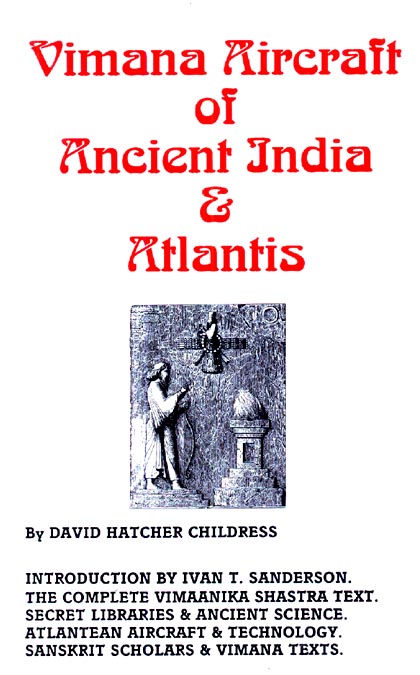
reviewed by Theresa Welsh
If you're into alternative theories of history, eventually you'll come across books by David Hatcher Childress. I admit I avoided them for some years, as they seemed too far out on the fringe even for me. But I could not resist this book about ancient flying machines when I found a mint-condition copy at a used book sale. Childress is not the first author to write about the "vimanas" mentioned in an ancient manuscript from India called the Mahabarata. Other authors have felt this puzzling source not only tells us about sophisticated flying ships, but also tells of nuclear wars raining terrible destruction on an apparently highly advanced civilization.
This particular Childress book is a hodge-podge of essays, pictures, and a complete translation of the "Vymaanika-Shaastra or Science of Aeronautics," purportedly a part of the famous Mahabarata, and found in an Indian library in 1908. This version is translated from the Sanskrit by one G.R. Joyser. The illustrations in the book make it worthwhile, as they are gathered from many sources and give numerous renditions of what the vimanas (from the Rama Empire of India) and the vailxi (from Atlantis) looked like. Okay, so these are just drawings and may arise only out of someone's imagination, but we cannot forget that much technology of today was predicted by novelists of yesterday.
Not all the illustrations are just imaginary though. The Sanskrit document included with the book gives detailed descriptions of how to build various kinds of vimanas. They were mainly powered by Mercury and magnetics. They were mainly saucer-shaped with a pole up the center. I will not attempt to explain, as the technical aspects are pretty obscure. I only skimmed the translated document, since it really is of little value to the casual reader. There are so many references to things that are unknown today, and words that have no meaning, and procedures that seem to make no sense. How can we be sure the translator has made sense of the original? Here is a randomly-selected passage, describing "Praana - Kundalinee Yantra"
"A peetha or stand 3 feet in diameter and 3 feet high, square or circular, should be made of vrishala metal, with 8 kendras or central spots. In each central spot, two wheels with revolving hinges; small peethas or plates with 3 holes, 4 teeth, 3 pivots, in their middle a central pivot, 3 red-colored tubes or pipes with opening and closing wheels, and switches for right motion, and reverse motion, with a shabda-nala in the center, with wheels (with hinges and rods) which will flap the wings; from the north-east and south-east Kendra and the middle Kendra in the west up to the middle of the course of the yaana kundalinee revolving wheels with pivots."
Reading this passage makes you yearn for a blueprint. How can anyone possibly evaluate such descriptions? Because the descriptions are so detailed (giving exact measurements and materials), they DO seem to arise from something real. But it is far from certain that anyone today could build anything from these descriptions.
The material on the Atlantis Vailxi is equally unreliable, but worthy of notice. The term "vailxi" (singular: vailx) comes mainly from an old occult manuscript called A Dweller on Two Planets, and from Edgar Cayce readings. A Dweller on Two Planets was dictated by automatic writing in 1883 by "Phylos the Thibetan," a spirit. It is a rambling story of many incarnations, including lives in Atlantis. The book includes illustrations of the vailxi that the author traveled in. These are long cigar-shaped craft that can go in the air or water. Edgar Cayce described similar vessels in his life readings for people who had previous incarnations in Atlantis. In the Cayce readings, the power source was a huge crystal kept in a domed building. The dome opened to catch the sun. This wireless source of power is reminiscent of Nikola Tesla's tower, which he said could supply power remotely. Unfortunately, Tesla went broke and his tower was destroyed before it could be put in operation.
This book contains some interesting speculation about electromagnetism and its relationship to gravity. The author discusses the work of William Clendenon (with whom he has written a more recent book, Atlantis and the Power System of the Gods: Mercury Vortex Generators and the Power Systems of Atlantis). He believes the caduceus, with its two snakes wound around a rod, and symbolic of the god Mercury, is an ancient indicator of flight powered by mercury andmagnetics. The central rod corresponds to the one in the vimanas. Further, Clenendon claims to have built vimanas that fly!