This guy is a nutcase

but i like his creation.. a CD Launcher that launches a CD at high speed
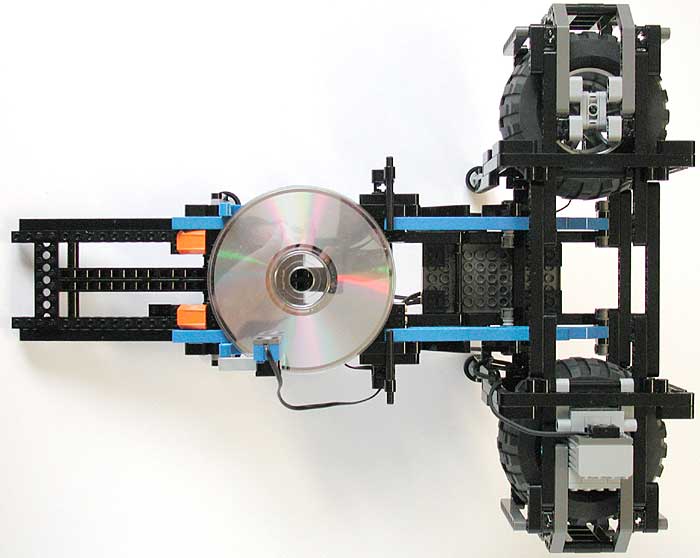
Hammerhead the CD thrower is composed of two main parts, the head that throws disks, and the tail which feeds the head with compact disks.
The Head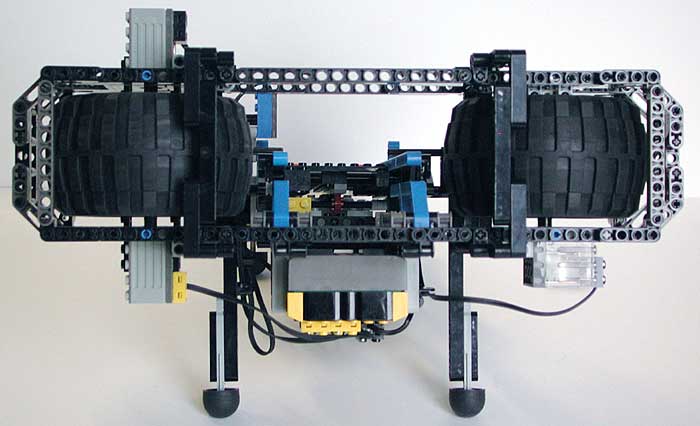
Two big
"4x4 off-roader" (8466) wheels, rotating very fast, grip the CD as it is inserted between them by the feeder, and eject it on the other side. This mechanism is inspired by the LEGO disk thrower described in
Ultimate Builders Set (3800), but much more powerful.

One of the wheels is powered by a single "Motor movers" motor, a powerful unit with medium rotation speed.
The other wheel turns much faster, as it is driven by two old 9V motors. Without down gearing, these motors can be easily stalled, but thanks to the mechanical energy stored in the heavy, fast rotating wheel, the slowdown as the CD passes between the wheels is barely noticeable.
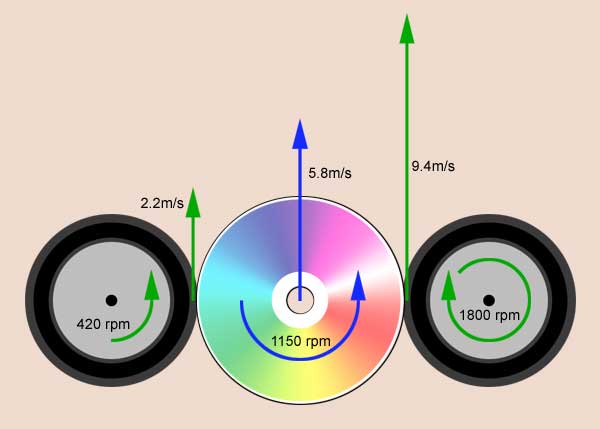
The benefit of two different wheel speeds is that the CD spins on itself after launch. This rotation stabilizes the disk flight.
Evaluation of disk ejection speed:
Rotation speed of slow wheel is 420 rpm, while fast one is 1800 rpm. As wheel diameter is 10cm and CD diameter is 12cm, we can derive disk ejection speed: 5.8 m/s (21 km/h or 13 mph) and spin speed: 1150 rpm.

Motor power is provided by two RCX outputs. As old 9V motors draw high current at startup while building up wheels speed, they are driven from separate RCX outputs. The other wheel motor, thanks to its internal down-gearing, consumes less power and share a RCX output with one of the old type motors. I used an old RCX 1.0 unit powered from mains, because the internal voltage is a bit higher than 9V and the motors turn slightly faster. I originally intended to use an external battery pack to power wheels motors, berhaps boosting voltage using 3V lithium cell to get even higher rotating speed... but finally I found that Hammerhead was scary enough!!!
The Tail
A carriage moves back and forth, guided by two side rails. Two lugs (orange) grip one disk at a time and push it between the wheels where it is caught and thrown.
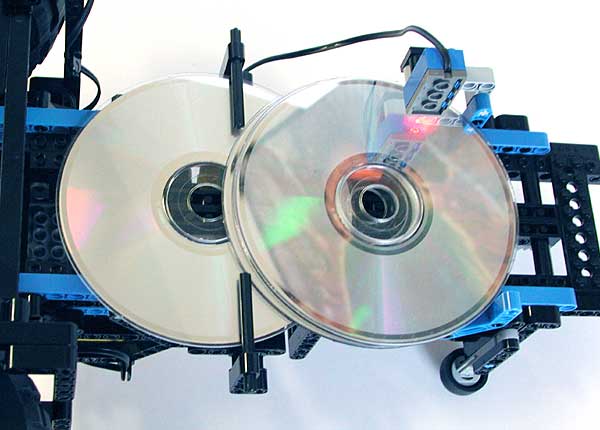
The two axles placed above the rails let only one disk to pass through.

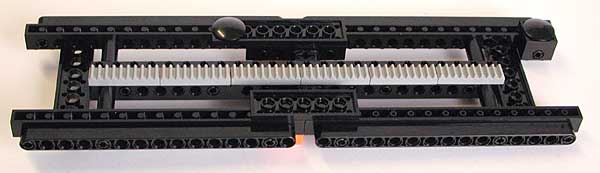
A motor (connected to the third RCX output) moves the carriage using the gear rack placed underneath

Two bumps activate a touch sensor when the carriage motion needs to be reversed.

A light sensor places above the CD stack checks when the magazine is empty and stops Hammerhead.
But.. you have to see it in action:
click here =>
Clip 1 from top viewand here =>
Clip 2 from rear view(source:
Philo's Home Page)