I am proud/not proud to be Singaporean because ........
-
With National Day round the corner, I thought this question might be interesting:
Are Singaporeans proud to be Singaporeans?
Feel free to write anything below. I'll start.
I am proud to be Singaporean because it allows me to enjoy good food served by various races.
-
don't relli care or think about this qn
-
I am proud to be Singaporean because we have efficient transport
-
Originally posted by Bangulzai:
I am proud to be Singaporean because we have efficient transport
Are u seriuous abt that sentence??? -
Never think of this question. Only think and hope that ruling party can make life better for all of us.
-
Originally posted by zenden9:
Are u seriuous abt that sentence???serious. our buses and mrt no good meh, u tink?
-
Originally posted by Bangulzai:
serious. our buses and mrt no good meh, u tink?
I go other country and think our one really no good. Especially our bus.Please don't compare ours to thrid world country like Indonesia, Malaysia or Thailand...
I'm talking abt HongKong, Taiwan or Holland..
-
ok maybe i should see more
-
What next?
Because we have the Flyer?
Because we have casinoes?
Because we have F1 racing?

-
Tan Kah Kee —"Henry Ford of Asia"
A Double Portion of Tan’s Spirit
Innovative education is of course nothing new at XMU. Our university has been pioneering all elements of modern education ever since it was founded in 1921 by the “Henry Ford of Asia,” Mr. Tan Kah Kee. This famous Overseas Chinese patriot gave an estimated USD 100 million to educa-tion, thanks his business acumen and frugal lifestyle. But Mr. Tan left us much more than mere money.
As I teach in Organizational Behavior, organizations’ personalities often reflect those of their founders, and XMU is certainly no exception. XMU’s 85 years of success show it has inherited a double portion of Mr. Tan’s spirit and vision for a better China, a better Asia, and a better humanity.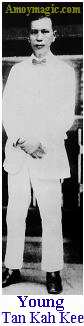
Our university’s founder, Mr. Tan Kah Kee (Chen Jiageng, 1874-1961), gave an estimated 100 million USD to education over his lifetime but he was born into a humble family of merchants in the village of Jimei, on the mainland across from Xiamen Island. Tan worked the fields and the fishnets until he started school at the age of nine, and in the fall of 1890 he moved to Singapore to help in his father’s rice shop. His father’s business went under in 1904, but the savvy son pulled together enough capital to buy 500 acres of forested land in Singapore and started a pineapple plantation.
Back to top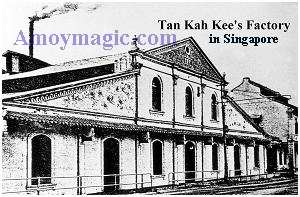
The Rubber Magnate Tan rapidly expanded into rice milling, manu-facturing, sawmills, real estate, and ocean transport, but it was rubber that really stretched his fortune. He set aside a few acres of his pineapple planta-tion and eventually had 10,000 acres of rubber trees. His expansion from rubber planting to rubber manufacturing helped create the rubber industry and made him one of the four great Rubber Barons.By the mid 1920s, the Rubber Magnate’s Singapore-based empire em-ployed over 30,000 people, had 150 offices on 5 continents, and did business with 48 countries. But prices plummeted after 1926 and rubber never quite bounced back. Even worse, after Mr. Tan protested Japan’s brutal “Jinan Massacre” (May 3rd, 1928), his factory was burned to the ground. Yet even as he struggled through the Great Depression he continued to finance Jimei School, Xiamen University, and Chinese and English schools in Singapore—a feat he managed in part because of his frugality.
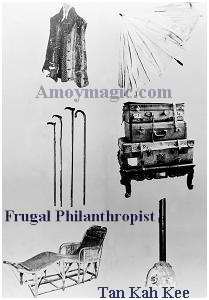
The Frugal Philanthropist Rich philanthropists generally give but a fraction of their wealth while alive, but leave behind large foundations since the only thing they can take with them when they die is their reputation. But Mr. Tan quite literally gave like a prince while living like a pauper, subsisting on little more than rice porridge and potatoes, and using the same umbrella and battered suitcases for decades. Other rich Chinese of his day built luxurious villas on nearby Gulangyu Islet, but Mr. Tan contented himself with a sim-pler home in his native Jimei. As he wrote to a relative, his hometown still had great needs and “I cannot put myself before the community.”
The Japanese destroyed Tan’s home in 1938, and when the Chinese government offered to rebuilt it after Liberation, Tan insisted that war-damaged school buildings be rebuilt first. His home was finally renovated in 1955 and he lived there from 1958 until 1960, when he moved to Beijing. Tan’s house was restored to its original design in 1980 and is now a museum and meeting place for the Jimei School Committee. I think the most moving exhibits are the battered suitcases, umbrellas and worn-out shoes that the “pauper millionaire” used for decades.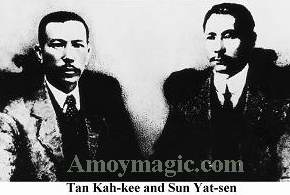
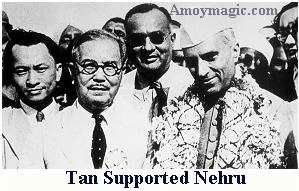
Mr. Tan’s Vision for China Mr. Tan was a social and political reformer from youth. He supported Sun Yat-sen, and at one point accounted for about 1/3 of the Kuomintang’s finances (a feat he no doubt regretted when Chiang Kai Shek absconded to Taiwan with his money and everyone else’s). But Tan’s greatest hope for China was in modern education.
 In 1894, at age 21, Tan began a family school in Jimei. In 1912, during
the first year of the new Republic of China, Tan returned to China and
on January 27, 1913 opened the Jimei Primary School. Between 1920 and
1926 he opened a school a year until Jimei School Village had 11 schools,
includ-ing a middle school and schools in agriculture, commerce, forestry,
navigation, etc. In addition, Jimei School Village’s education promotion
department donated to more than 70 middle schools and primary schools
throughout Fujian province.
In 1894, at age 21, Tan began a family school in Jimei. In 1912, during
the first year of the new Republic of China, Tan returned to China and
on January 27, 1913 opened the Jimei Primary School. Between 1920 and
1926 he opened a school a year until Jimei School Village had 11 schools,
includ-ing a middle school and schools in agriculture, commerce, forestry,
navigation, etc. In addition, Jimei School Village’s education promotion
department donated to more than 70 middle schools and primary schools
throughout Fujian province.
Back to top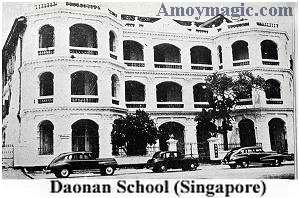
Supporting Education Abroad Tan also began or funded at least seven schools in Singapore, including Tao Nan (1907), Ai Tong (1912), Chung Fook Girls School (1915), Chung Poon (1915), the Singapore Chi-nese High School (1918), Nanyang Normal School (1941) and Nan Chaio Girls High School (1947). . His largesse was not limited to Chinese schools. He gave $30,000 to the Anglo-Chinese School in 1919 and in 1941 gave $10,000 to Raffles College, which later merged with the Medical College and eventually became the University of Singapore.
Xiamen University—Apple of Tan’s Eye In early November, 1920, Mr. Tan offered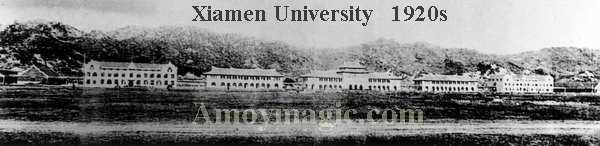 one
million Yuan to start Xiamen University, which began with the Normal and
Commerce Departments, and later expanded to five Colleges and 17 departments
in Literature, Science, Law, Commerce and Education. Xiamen University
captured the imagination of Chinese and foreigners alike. In the 1920s,
Paul Hutchinson wrote,
one
million Yuan to start Xiamen University, which began with the Normal and
Commerce Departments, and later expanded to five Colleges and 17 departments
in Literature, Science, Law, Commerce and Education. Xiamen University
captured the imagination of Chinese and foreigners alike. In the 1920s,
Paul Hutchinson wrote, 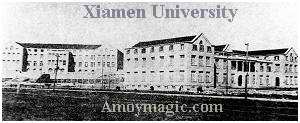 “This
school [Xiamen University] is entirely a Chinese institution, with no
foreign teachers and no foreign connections, and right out in a small
Chinese village. The course of study is being made very practical…
When we think of the future days, it is one of the most encouraging
things to be seen in the whole of China.”
“This
school [Xiamen University] is entirely a Chinese institution, with no
foreign teachers and no foreign connections, and right out in a small
Chinese village. The course of study is being made very practical…
When we think of the future days, it is one of the most encouraging
things to be seen in the whole of China.” 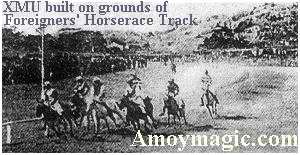
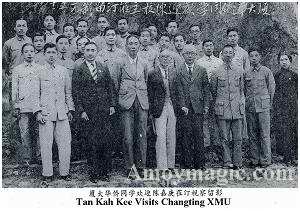
Mr. Tan emphasized quality education. He sent students abroad, hired teachers from other areas, purchased the latest equipment, and emphasized sports. By the spring of 1937, his financial fortunes had so suffered that he allowed the government to take over Xiamen University, but he continued to subsidize it. Tan wrote to the minister of education that he had had “a fine start and a poor finish,” and would “live in perpetual regret.” [If only he could see XMU today!]
Back to top
XMU Retreats to Changting That same year, Xiamen University relocated to Changting in West Fujian to escape destruction by the Japanese, who had occupied Xiamen. [Read more in the next chapter, “Sa Bendong”]. The Japanese surrendered in August, 1945, and on October 21, 500 mass organizations in Singapore welcomed Tan’s return from a decade of exile in Java. A large meeting in Chongqing on November 18, 1945, celebrated Mr. Tan’s safety, and Chairman Mao inscribed a scroll about Tan which read, “Banner of Overseas Chinese, Glory of the Nation.”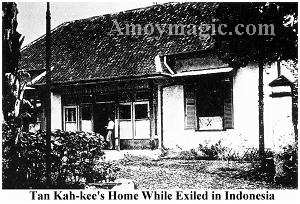
XMU returned to Xiamen after Japan’s defeat and the new president and eminent biologist, Dr. Wang Deyao, immediately set out rebuilding and ex-panding the campus. Tan’s vision and money and Wang’s leadership paid off. XMU was designated a key national university in 1962 and has been mushrooming ever since.
On October 1, 1949, Chairman Mao invited Mr. Tan to Tiananmen to participate in the ceremony of the founding of the People’s Republic of China. Tan settled down in his homeland in 1950 and devoted the rest of his life and fortune to its reconstruction.
Back to top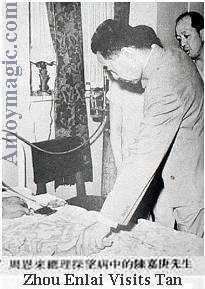
Tan’s Final Years During his last years Mr. Tan served in many posts, including Chairman of Returning Overseas Chinese League, Member of the Standing Committee of the National People’s Congress, and Vice-Chairman of the CPPCC. He was also responsible for innovations like China’s first sea-spanning bridge (the award-winning Xiamen-Jimei bridge), the Jimei Dragon Boat Pool, which has hosted numerous domestic and international aquatic events, and Jimei’s 15 storey Nanyuan Building, which has a navigational light on the roof to guide fishermen safely home.
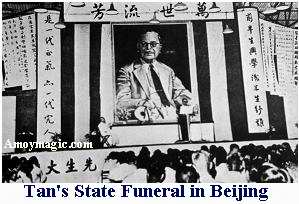
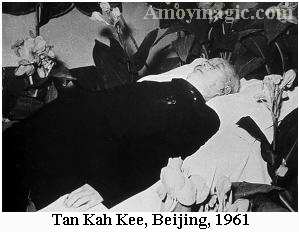
Mr. Tan died of cancer in 1961, and after a State Funeral in Beijing, a special train transported his body to his hometown of Jimei. Tan left behind three million Yuan in banks, but the man who gave like a prince and lived like a pauper evidently expected his descendants to do the same—or make their own fortune. He left no money to his family, but gave half a million to Jimei School Foundation, half a million to construct Beijing’s Overseas Chinese Museum, and over two million Yuan for education.
Tan’s International Legacy Altogether, Mr. Tan gave an estimated 100 million USD towards education, both in China and abroad, and the Tan Kah Kee Foundation has been awarding a Postgraduate Scholarship since 1983. In 1986, Nobel Prize Laureate Prof. C.N. Yang set up the Tan Kah Kee Inventors’ Award, and in 1992, Prof Yang and two other Nobel Prize Laureates, Prof Samuel C.C. Ting and Prof Li Yuan Tseh, together with Prof Changlin Tien, former Vice-chancellor of the University of California at Berkeley, and Prof Wang Gungwu, former President of Hong Kong University, set up the Tan Kah Kee International Society Foundation to the advancement of education and culture in the spirit of Tan Kah Kee.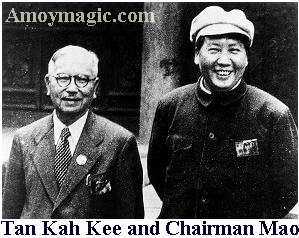 In
1991, Singapore’s president, Dr. Wee Kim Wee, launched the University
Endowment Fund in honor of Mr. Tan, and set a goal of raising 1$ billion
for education. On 11 March, 1990, the International Asteroid Center of
China named Asteroid 2963 “Tan Kah Kee Star.” The naming ceremony
was held at Xiamen University.
In
1991, Singapore’s president, Dr. Wee Kim Wee, launched the University
Endowment Fund in honor of Mr. Tan, and set a goal of raising 1$ billion
for education. On 11 March, 1990, the International Asteroid Center of
China named Asteroid 2963 “Tan Kah Kee Star.” The naming ceremony
was held at Xiamen University.
Lastly, the School of Chemistry in my home state’s University of California, Berkeley, has a “Tan Kah Kee Hall.” I hope more and more foreigners and Chinese alike will come to understand, and emulate, Tan Kah Kee’s spirit of sacrificial giving.
“A good traveler is one who does not know where he is going to, and a perfect traveler does not know where he came from.” Lin Yutanghttp://www.amoymagic.com/tankahkee.htm
Singapore needs real heros where we can feel proud and be inspired, not bastards who collaborated with Japanese in WWII.
-
I am proud to be Singaporean Because 1 day we will be playing in the world cup
-
I am proud to be singaporean becos it is the place where I am born but unfortunately, it is occupied and abused by some greedy bastard leadership.
-
In Memory of Linda Chen (1928-2002)
Linda Chen passed away peacefully on 29th December 2002, four days after she suffered a stroke at her home at Hua Guan Avenue on Christmas Day. She was cremated at Mount Vernon on New Year’s Day. A large crowd of friends and relatives attended the simple ceremony in which her husband Professor Dr Tan Seng Huat and their three children spoke with emotion on Linda the idealist, mother and friend.

Linda had a distinctive and unmistakable chuckle which was at once infectious and disarming. She was gracious and self-assured, and always wore a smile for any one she met. It was almost impossible to be angry with Linda, even if you disagreed strongly with what she said. She had a rare combination of courage and amiability, an unobtrusive intelligence coupled with an honest humility. In Seng Huat’s own words, she was simple and frugal in her personal lifestyle and needs, but she was always generous and helpful to friends.
She was born in China, but came to Singapore as a child when she was only one year old. She grew up and was educated in colonial Singapore, became proficient in three languages—Chinese, English and Malay, a rare feat in the 1950s and 60s, even more so now. Linda attended both Chinese and English schools, which was not an uncommon practice in those years. This explains her command and fluency in both languages in her later years. She entered the University of Malaya, then situated in Bukit Timah Campus in Singapore.
Linda was an active member of the University Socialist Club during her years in the university. She was one of the active student leaders involved in the formation of the Pan-Malayan Students’ Federation (PMSF), whose president then was Dr Philomen Oorjitam. Due to her fluency in the Chinese language, Linda was particularly useful in forging links with the student leaders of the Singapore Chinese Middle School Students’ Union, which was admitted as an associate member of the PMSF.
During the time she was studying the Malay language, she came to know many prominent Malay writers of the period, including Asraf and Usman Awang, who would later become the poet laureate of Malaysia. Usman wrote a poem dedicated to Linda and two of her friends—Lim Huan Boon and Goh Choo Keng, both of whom were then pursuing Malay Studies at Nanyang University. Lim and Goh, together with other Nanyang University students such as Liaw Yock Fang, Tan Ta Sen and Yang Quee Yee, eventually proceeded to further their Malay studies in Indonesia.
Together with Linda, this group formed the initial core of non-Malay scholars in Malay language and literature in Singapore. She later compiled one of the early Malay-Chinese dictionaries, which was quite widely used as a teaching guide in the study of the Malay language in the 1950s and 60s. She also published translations of children’s stories from Chinese into Malay.
Her academic exercise for her B.A. Honours degree on a prominent Muslim scholar and intellectual Syed Shaykh al-Hady, was published in a collection by the Malaysian Sociological Research Institute in Malaysia in 1999. Her pioneering monograph for her Masters of Arts degree, The early years of Chinese Newspapers in Singapore 1881-1912, was published by the University of Malaya Press in 1967 and remains the standard text on the origin of Chinese newspapers in the country.
Linda was a prominent and early advocate of women’s rights in Singapore. She was the founder and secretary of the Federation of Women in 1956. It was banned on 18 September 1956, the very day of her own detention without trial, under the Preservation of Public Security Ordinance, the precursor of the Internal Security Act. She was released on conditions in 1958 and married Dr Tan Seng Huat, whom she had met and fell in love with when both of them were members of the University Socialist Club in the early 1950s. When the PAP came to power in 1959, Linda was an active participant in the debate and discussions among women activists leading to the drafting of the Women’s Charter in 1960, which outlawed polygamy and instituted monogamy into marriage law in Singapore.
Linda was detained for the second time during Operation Coldstore in February 1963. Following her release from detention she accompanied Seng Huat to London where he was pursuing his postgraduate professional qualification. They returned to Singapore in 1967. Linda assumed management of her family business, Shanghai Book Company in Singapore, with another branch in Kuala Lumpur.
Despite her business commitments, Linda retained a continued concern on the status and position of women in society. In an obituary in the Straits Times, 1 January 2003, AWARE paid the following tribute to Linda, and succinctly summarized her continuing commitment in this direction:
AWARE extends its deepest condolences to the family of the late Linda Chen. We honour her as a role model and pioneer woman warrior who fought for nationalism in her youth, and never wavered despite the high personal cost of acting on her convictions. We acknowledge with deep appreciation her contributions to the work of AWARE as the stalwart volunteer and longer serving Counsellor on the help line. We remember Linda as a woman who lived by her values and whose commitment and constancy will continue to inspire us.
Seng Huat and Linda were inseparable throughout their married life; they entertained their wide circle of friends and colleagues generously at their home, and traveled regularly together. Linda recalled with fondness their second journey on the Silk Road with close friends and relatives in September 2002, three months before her passing.
Linda shall be sadly missed by relatives and the many friends whose lives she had touched. She shall be remembered by all those who shared her commitment for freedom and social justice.
-
Lieutenant Adnan bin Saidi and The Malay Regiment
The Unforgettable History
Between 13 and 14 February 1942, Singapore witnessed one of its fiercest battles ever known in her history. Amongst those who fought valiantly in that Battle for Pasir Panjang and lost their lives was a 27 year-old infantry officer, Lieutenant Adnan bin Saidi. Adnan Saidi and his 42-man contingent from the 1st and 2nd Battalion of the Malay Regiment fought fearlessly to defend Pasir Panjang Ridge. The ferocious fight put up by the Malay Regiment came for special mention in Lieutenant General A.E. Percival’s Despatch on the Operations of Malaya Command from 8th December 1941 to 15th February 1942.
Mentioned by Major General A.E. Percival (GOC Malaya 1941/42), from foreword to 'The Malay Regiment of 1933-1947' which was published in 1947 by Mubin C. Sheppard;- "When the war broke out in the Far East(Southeast Asia), the regiment was in process of expansion. In consequence, like many other units of our Imperial Force, (it) was not fully prepared for the ordeal which it was to face. Nevertheless, these young and untried soldiers acquitted themselves in the way which bore comparision with the very best troops in Malaya. In particular, by their stubborn defence of the Pasir Panjang Ridge at the height of the Battle of Singapore, they set an example of steadfastness and endurance which will become a great tradition in the Regiment and an inspiration for the future generations."
"After two hours of heavy shelling and mortaring, the Japanese attacked the Malay Regiment which was holding Pasir Panjang Ridge. The latter fought magnificently, but suffered heavy casualties, and by afternoon the enemy had reached the Gap (Pasir Panjang Ridge)…"
At this historic site, Singapore’s last stand for defence was made in an epic 48-hours battle, culminating in the only (recorded) fiery hand-to-hand combat against the Japanese Army.
Early Days in Malaya
Born 1915 at Kampung Sungei Ramal, Kajang, Selangor, Lt. Adnan Saidi was the eldest in his family. His younger siblings, Ahmad Saidi and Amarullah Saidi were soldiers too. Ahmad Saidi was killed in action after he joined the navy in 1939. The Japanese sank his ship, the HMS Pelanduk, enroute to Australia. The younger Mr. Amarullah Saidi survived the war and is now retired and resides in Kajang, Selangor.
Lt. Adnan Saidi received his education in Pekan Sungei Ramal in the English medium. He was a diligent student and excelled in his studies. Upon graduation, Adnan was chosen to be a trainee teacher and taught at his alma mater for over a year. Fate however had other plans for him. A firm man who took discipline seriously, Adnan Saidi chose instead to pursue the military vocation.
In 1933, when he was 18 years old, Adnan Saidi joined the Malay Regiment. A year later, he was chosen as best recruit. In 1936, Adnan was promoted to the rank of Sergeant – a promotion that came fast for a bright young soldier. In 1937, he was chosen to represent his platoon in a military ceremonial parade in London to honour the ascension of King George VI to the throne. Shortly thereafter, Adnan Saidi was promoted yet again to Company-Sergeant-Major and headed for Singapore for an officers’ conversion course. Upon graduation as 2nd Lieutenant, Adnan Saidi became the leader of the 7th Platoon, ‘C’ Coy(Charlie Company).
The Family Man
Upon his return from London, Lieutenant Adnan Saidi married an Islamic religous teacher from his village. Madam Sophia Pakih Muda(name spelling's may not be precise) bore him three children: two sons, Mokhtar and Zainudin (now living in Seremban and Johore respectively), and a daughter. Youngest of the three siblings, the baby girl died in her early infancy shortly after Singapore fell.
Despite his hectic schedule as a career soldier, Lt. Adnan Saidi settled down quickly as a family man. He loved his boys and would always try to find time for his kids. He brought them for walks or played games with them. The games that he played with his boys were rough and rugged. Adnan wanted his sons to grow up tough. In an interview with Berita Harian (9 Sept `95), Mokhtar Adnan described his father as thus:
"My father did not talk a lot. He was a firm man and believed in discipline. He was always serious and fierce…yet had a good heart. There seemed to be a ‘light’ illuminating his face."
In late 1941, Lt. Adnan Saidi was posted to Singapore and brought with him his family. They lived in a big house off Pasir Panjang, in an area reserved for the families of the Malay Regiment. When the rumblings of the war grew nearer and the Japanese began preparations to invade Singapore, Lt. Adnan sent his family back to their hometown in Kajang. It was a trying day for Lt. Adnan - his wife, Sophia was carrying their third child. The young boys kissed their father’s hand and he reminded them to be good. It was to be their last time together.
The Battle of Pasir Panjang
The battle of Pasir Panjang is better known as the ‘Battle of Opium Hill’. Opium Hill or Bukit Chandu in Malay, was named after an opium-processing factory which used to be at the foot of the hill. Fierce fighting had preceded days earlier. The battle-hardened Japanese soldiers of the famed 25th Army had rapidly overwhelmed strategic defensive positions in Singapore. Opium Hill demarcated the final defence perimeter. It was a key defence position in Singapore for two strategic reasons: it overlooked the island of Singapore to the north and second, if the Japanese gained control of the ridge, it gave them direct passage to Alexandra area. The British Army had its main ammunition and supply depots, military hospital and other key installations situated there. The stout defence of the ridge was therefore critical at any costs.
The Malay Regiment soldiers started to fight the Japanese on Reformatary Road. They had dug slit trenches but they didn't have a lot of weapons. They started fighting the Japs just with rifles virtually. And when the Japanese broke through them, the Malays took to them with bayonets, they put bayonets on the rifles and with a bayonet charge they drove the Japanese back across Reformatory Road. They were very brave and they fought very hard. Moreover, for every Malay soldier there was about 10 or 12 Japanese soldiers.
The defence of the Pasir Panjang ridge had been entrusted to the Charlie Company(‘C’ Coy). ‘C’ Coy was part of the 1st and 2nd Malay regiment which made up the 1st Malay Infantry Brigade, the British 2nd Loyals Regiment and the 44th Indian Brigade. On February 13 1942, the crack Chrysanthemum Division of the Japanese Imperial Army under Lieutenant General Renya Mutaguchi turned their attention to the southern coastal part of Singapore - Pasir Panjang Ridge. On that morning, the ridge was heavily bombarded with aerial support, heavy mortar and artillery fire. ‘C’ Coy and Lt. Adnan Saidi were stationed at Pasir Panjang Village. The Japanese forces were forced to retreat in the face of stiff resistance from ‘C’ Coy. Adnan and his men had built a wall of defence for the Regiment in an area of highland, known as the Gap. Though greatly outnumbered, the Japanese troops under Major Kimura could not breach the Gap’s defence perimeter.
At midnight, 14 February 1942, ‘C’ Company received instructions to move to a new defence position - Point two two six(Pt.226), or Bukit Chandu. More soldiers were added to Adnan’s regiment – 42 in all. After a careful area survey, Lt. Adnan Saidi ordered his men to further strengthen their wall of defence with sandbags. The hill was surrounded with sandbags.
In the early afternoon of 14 February, the Japanese launched a sneak attack. From Pepys Road leading uphill to Pt.226, Adnan Saidi observed a contingent of "Sikh soldiers" from the British-Indian Army approaching. Distinguishing himself yet again, Lt. Adnan’s sharp eyes and quick mind noticed that something was amiss when he observed the troops in turbans, advancing in groups of fours instead the usual threes of the British Army. Seeing through the ruse, Lt. Adnan Saidi and his troops opened fire and mortally wounded about 20 soldiers at close range. The Japanese troops retreated.
Two hours later, the Japanese launched an all-out assault in great numbers. The attack overwhelmed Lt. Adnan Saidi and his troops. Greatly outnumbered and short on ammunition and supplies, the Malay Regiment fought its grisly battle to death.
The Death of a Patriot
Fierce fighting followed on Bukit Chandu(Opium Hill). All kinds of weapons was used, including grenades and automatic weapons. Lt. Adnan himself handled a Lewis gun. In many instances, the soldiers engaged in fierce hand-to-hand combat using their bayonets. Yet, they stood their ground frustrating their enemy. In the ensuing battle, men and officers fell. Adnan was mortally wounded yet refused to retreat and instead emboldened his men to fight to the last. It was this disregard of danger that inspired the company to stand up gallantly.
Tan Sri Dato’ Mubin Sheppard, an ex-officer and former POW, says of his friend the late Lieutenant Adnan:
"He was heavily outnumbered by the Japanese…they bombed him but he fought on fiercely and inflicted heavy losses on them…. Adnan would have never surrendered under any circumstances. He was absolutely dedicated. In fact, just before fighting, he adopted a motto for his platoon, ‘Biar putih tulang, jangan putih mata’ - death before dishonour."
Corporal Yaakob, who won a Medal of Gallant subsequently, was one of the few who survived Opium Hill. In the chaos of the battle, he fell and landed on top of the bodies of the dead soldiers. He escaped death by laying motionless amongst the pile of the dead bodies and witnessed the gruesome death of Adnan Saidi. The triumphant enemies captured Lt. Adnan. Angered by his fierce battle resistance, the platoon leader was dragged and pushed into a gunnysack. The Japanese soldiers then hung him by his legs on a cherry tree. Angered by the death of their fellow comrades, the Japanese bayoneted him again and again. In some instances, his throat was slit repeatedly. In Corporal Yaakob’s state of ‘death’, he witnessed these gruesome deeds. In the aftermath of the battle, no one was allowed to bring down his body for burial. No one dared. Some sources claimed that Lt. Adnan Saidi's mutilated body was burnt to ashes.
Years later, Haji Burhan Muslim, who had lived along Bukit Chandu, recalled going up the hill with his cousin few days after the battle. In one of the white bungalows that stood on the hill at Pepys Lane, he witnessed the dismembered bodies of Malay soldiers everywhere. In one of the rooms, laid the body of a Malay soldier. His throat had been slit several times. His uniform was soaked with blood. Judging from the badges he had on his uniform, Haji Burhan believed that he was a high-ranking officer. He felt that the body could have been that of Lt. Adnan Saidi.
The Nightmare Continued
Lieutenant Adnan’s family was informed of his death through a telegram. A few days earlier, Madam Sophia had delivered their third child. Shortly thereafter, the baby girl passed away.
The nightmare did not end there for Lt. Adnan’s family. The Japanese began hunting down his family. A neighbour had warned that the Japanese were looking for Adnan Saidi's family. They were to be killed too. Worried that the Japanese would be able to track down his family, Mr. Amarullah Saidi had to give away his brother’s photographs and belongings. No one dared to keep Lt. Adnan’s belongings. Today, the only things of his father which Mokhtar Saidi has are three medals which were awarded to Adnan by the British.
In 1949, Madam Sophia became ill and passed away. Her sons were fostered out.
War Memorial
In 1995, a war memorial plaque at Vigilante Drive, Kent Ridge Park, was erected to honour the fighting spirit and patriotism of Lt. Adnan Saidi and his Malay Brigade.
Some however felt that the site of the plaque was not the exact spot of the battle. Haji Burhan Muslim, a former resident of Bukit Chandu, believes that the actual battle took place a kilometre away from Kent Ridge Park.
The heroic patriotism of Lieutenant Adnan bin Saidi and his Malay Infantry Brigade will be hard to forget. Those spirits will be our common memories of the past and an inspiration for our future generations.
May ALLAH forgives their sins and makes them rest in peace till Day of Judgement.. Amin..
All praise and thanks are due to ALLAH s.w.t., and peace and blessings be upon His Messenger Rasulullah s.a.w.
Amin.. Ya Rabbal Al Amin..
-
Wa. Ah chia..... you post so much crap we need to scroll like mad.
-
Originally posted by Uraniumfish:
Wa. Ah chia….. you post so much crap we need to scroll like mad.
-
Joshua “Ben” Jeyaretnam

EVEN in appearance, he seemed rather out of place in Singapore’s gleaming, ultra-modern urban landscape. In the early 1980s bankers and stockbrokers on their lunch breaks would shuffle in embarrassment past a courteous, dignified figure, vaguely reminiscent, in his muttonchop whiskers, of a Victorian statesman—Gladstone, say. J.B. Jeyaretnam would be railing against the government of the People’s Action Party (PAP) led by Lee Kuan Yew and hawking the Hammer, the organ of his opposition Workers’ Party.
The government managed to ensure Mr Jeyaretnam was out of place in other ways, too. When, later that decade, The Economist’s correspondent in Singapore invited him to a party for a visiting editor, the gathering quickly polarised into two unequal camps. Few guests, even among the expatriate businessmen there, were willing to be seen mingling with him. It was hard to imagine him as a dangerous subversive. But that was how the government seemed to see him; and as it was leading Singapore to extraordinary prosperity and stability, it seemed wisest not to upset it.
Mr Lee regarded Mr Jeyaretnam with unabashed contempt, as an adhesive nuisance rather like chewing-gum (banned in Singapore). “All sound and fury”, he wrote in his memoirs, adding that Mr Jeyaretnam was “a poseur, always seeking publicity, good or bad”. Mr Lee decided, however, that he was useful as a “sparring partner” for young PAP politicians untempered in the struggle for independence. His son, Lee Hsien Loong, who is now prime minister, took an equally dim view. In a letter of condolence to Mr Jeyaretnam’s two sons, he accused their father of helping “neither to build up a constructive opposition, nor our parliamentary tradition.”
Yet, the younger Mr Lee added, one had to respect Mr Jeyaretnam’s “dogged tenacity”. It was indeed remarkable. Born to Christian parents during a family visit to Jaffna, the heartland of Ceylonese (now Sri Lankan) Tamils, he was brought up in Singapore and, after studying law in London, built a legal practice at home. But he dabbled in politics, not, as a sensible man would have done, as a PAP member, but in opposition, at a time when the ruling party had a monopoly of parliamentary seats. In 1971 he revived the moribund Worker’s Party and preached the socialist ideals he had picked up in post-war London.
He stood for parliament in three general elections and two by-elections, losing every time. He also began to lose money, in a series of libel suits. In 1976 he was found guilty of accusing Lee Kuan Yew of nepotism and corruption and of being unfit to be prime minister. Mr Lee was awarded damages and costs. Appeals—as far as the Privy Council in London—were all defeated. In all, Mr Jeyaretnam calculated that over the years he paid out more than S$1.6m (more than $900,000) in damages and costs, sometimes for remarks that in many democracies would not lead to libel actions but be regarded as part of the cut-and-thrust of parliamentary politics.
Bloodied but unbowed
The bills mounted after 1981 when, at the sixth attempt, he won a seat in parliament at a by-election in the Anson constituency. Mr Lee blamed the failings of the PAP candidate as a public speaker, and the relocation, to create a container-holding area, of some of Anson’s dockers, who were not given other homes. But in his memoirs he also admitted that, with the dissipation of the sense of crisis that had surrounded independence and the split from Malaysia in 1965, voters wanted an opposition voice in parliament. In the 1984 general election Mr Jeyaretnam held Anson with an increased margin.
He was soon back in court as well as in parliament, accused of misstating the Workers’ Party’s accounts. Found guilty of perjury in 1986, he was fined, served a month in jail, became ineligible to sit in parliament for five years and was disbarred from legal practice. Again, he took his appeal to the Privy Council, which in 1988 overturned his disbarment and ruled he was the victim of a “grievous injustice”. Singapore subsequently abolished the right of appeal to the Privy Council.
Mr Jeyaretnam returned to the political fray, winning a seat in parliament again in 1997. He left it in 2001 and quit the Workers’ Party in disgust at its refusal to help him fight bankruptcy. But, stubborn to the core, he refused to admit he was beaten. Earlier this year he had cleared the bankruptcy, launched a new Reform Party, and readied himself for yet another tilt at the Lees and the PAP. But he was finding it harder to walk. His heart was weak, but he was loth to go through the surgery he needed. He soldiered on. The day before his death he was on his feet in court, arguing a case.
Mr Jeyaretnam never made a dent in the PAP’s power. Singaporeans know their government is efficient and clean, and that those who malign its leaders are likely to end up in court. Lee Kuan Yew argues that PAP ministers command respect because they are ready to be scrutinised, and that his libel actions were designed to defend the government’s reputation, not to silence the opposition. Certainly Mr Jeyaretnam, most distinguished of that tiny band, was never silenced. Lee Kuan Yew may have been infinitely the greater statesman, but some would have judged Mr Jeyaretnam the bigger man.
http://www.economist.com/obituary/displaystory
J.B. Jeyaretnam: Three decades as Lee Kuan Yew’s bête noir
http://www.scribd.com/doc/6515633/JB-Jeyaretnam-Three-decades-as-Lee-Kuan-Yews-bete-noir
-
Originally posted by zenden9:
I am proud to be singaporean becos it is the place where I am born but unfortunately, it is occupied and abused by some greedy bastard leadership.
or rather you are excluded from these bunch... -
wot damage*999999999999
-
Originally posted by Uraniumfish:
Wa. Ah chia….. you post so much crap we need to scroll like mad.
Ah Chia needs to inform us because many of us are poorly read. We should use this chance to read these valuable information which he provided for us.
-
Ah Chia needs to inform us because many of us are poorly read.
I am also not widely read.
Learning day by day.
-
Originally posted by Bangulzai:
Ah Chia needs to inform us because many of us are poorly read. We should use this chance to read these valuable information which he provided for us.

-
im proud to be a sporean but i must also keep in mind not to behave like a typical sporean.
-
Originally posted by Ah Chia:
I am also not widely read.
Learning day by day.
Good on you, but remember history is written by men and bias is inevitable. Read with an open mind and your perspective will be clear.
-
Originally posted by Chew Bakar:
Good on you, but remember history is written by men and bias is inevitable. Read with an open mind and your perspective will be clear.
Yeah,
this is a good point. I'm a PR.
I have japanese blood for i'm a mixed. Do not allow history to repeat itself. In addition, let history be history. Don't ponder over it.