Dinosaurs may still be surviving in Africa
-
Over the last 100 years, evidence has accumulated that sauropod dinosaurs may still be roaming the vast, unexplored regions of the African swamp and jungle. Places like Nigeria, Congo, Angola, Gabon, and Cameroon have similar reports of huge, long-necked monsters, some with a length of 75 feet! Native sightings have been confirmed by reports from missionaries, explorers, and even army personnel. The natives in the Congo region call this creature “Mokele-mbembe” (the one who stops the flow of rivers). This creature is said to possess a long neck and tail, small head, large body, and four legs. They say the animal is very aggressive when disturbed and will bite and lash its tail at you when it is tipping over canoes, killing elephants or hippos. It is herbivorous (plant-eater) and enjoys eating very large amounts of the Malombo fruit that grows on vines at the edge of the rivers. Tracks from this creature range from 1 to 3 feet wide and are spaced 7 to 8 feet apart.

Suspected Nesting ground of the Mokele Mbembe
Today in Africa, in the People's Republic of the Congo, there lies a vast, hot and humid area covered with thick forests and dotted with streams and swamps. Of these swamps, there exists one that is undisputedly the largest in the entire world . . . the Likouala Swamp. Approximately 55,000 square miles, larger than the entire state of Florida, the government has officially declared it 80% unexplored. To the scientific community, this area is as foreign as an entirely new planet.
Early Years
Reports of dinosaur-like creatures in Central Africa go back for more than 200 years, according to William "Bill" Gibbons. In 1776, French missionaries passing through the forests reported finding huge footprints in the ground. The clawed prints were three feet in circumference and were spaced about seven feet apart. This would have made the animal as big as an elephant, but it was common knowledge to the locals that the tracks were not from an elephant, since elephants do not posses claws. One of the priests, amazingly, even gave claim to have seen several specimens chewing on vegetation while wading in the rivers. Regardless, it was certain that these were an entirely new group of animals. At that time, however, they were neither "dinosaurs" nor "prehistoric," the words waiting to be invented nearly one hundred years later.
In 1913, a German explorer reported stories of, what the natives called, "Mokele-mbembe," which he had heard while in the Congo. Hearing the reports, a few scientists noticed that the descriptions of the creatures made them sound much like sauropod dinosaurs. Sauropods were the giants of the dinosaurs world, averaging about 70 feet (21 meters) long and standing 12-15 feet (3.7 to 4.8 m) tall at the hips.
In 1932, a British scientist, exploring near the Likouala region where the creatures are said to live, came across some abnormally huge footprints. Later, when he went down one of the rivers in a canoe, he heard strange sounds, but did not see anything.
Japanese Photograph
1992 - Taken by a Japanese film crew while flying over Lake Tele, the legendary home of Mokele-mbembe, this photograph seems to show a large, long creature swimming in the water.
Coincidentally, that same year the world famous zoologist and biologist, Ivan T. Sanderson, along with animal-trader Gerald Russel, were paddling up the Mainyu River in the heart of western Africa when, according to Sanderson's report:
"The most terrifying sound I have ever heard, which sounded like an on-coming earthquake or an exploding, nearby robot, suddenly greeted us from a large underwater cave."
While the water of the river was boiling and foaming directly in front of their canoe, a darkish, shining lizard-like head suddenly rose from the dark water. They described the head as nearly the size of the head of a fully grown hippo, which sat on a thick, swan-like neck. The enormous neck was turned towards the two men, and for just a few seconds, although it seemed like an eternity, the monster simply stared at Sanderson and Russel. Mr. Sanderson summed up his thoughts with these emphatic words:
"I don't know what we saw, but the animal, the monster, burned itself into my retinas. It looked like something that ought to have been dead millions of years ago. As a scientist, I should have been happy, of course, but this encounter was so frightening, so nasty that I never want to see it again."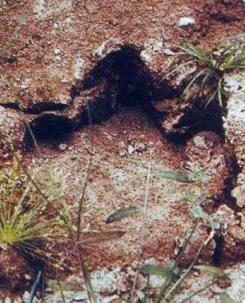
Footprints were found in the banks of the Congo which resemble fossil records of sauropods.
A Brief Analysis
NAME:
Mokele-mbembe is Lingala, and can mean a variety of things. The word is commonly defined as "One that stops the flow of rivers," but can also mean "one who eats the tops of palm trees," "monstrous animal," or even "half-God, half-beast." Mokele-mbembe is also used as a generic term to refer to other animals like Emela-ntouka, Mbielu-mbielu-mbielu, and Nguma-monene.
GENERAL DESCRIPTION:
Mokele-mbembe has been described as an animal with a long neck, a long tail, and rounded shape tracks with three claws. The closest known animal that has these characteristics is a sauropod dinosaur.
HABITAT:
Mokele-mbembe lives in the pools and swamps adjacent to the rivers of the Likouala swamp region of The People's Republic of Congo on the continent of Africa. It is said to use the lakes as a crossing path to go from one river to another.
SIZE:
The body size of each specimen is said to be somewhere between the size of a hippopotamus and an elephant. Its length is reportedly between 16 to 32 feet (5 to 10 meters). The length of the neck, according to various descriptions, is between 5 to 10 feet (1.6 to 3.3 meters). The length of the tail is somewhere between 5 to 10 feet as well, varying slightly.
APPENDAGES:
Interestingly, there have been a few reports of a frill on the back of the head. The frill is said to be like the comb found on a male chicken (cock). There have also been reports of a small horn on its head.
COLOR:
The color of the skin is predominately reddish-brown with a color range from gray to brown. There are no reports of hair on the animal. If there were, it would obviously contradict the reptilian dinosaur theory.
TRACKS:
Tracks possess a significantly rounded shape between 1 to 3 feet (30 to 90 centimeters) in diameter with three claws. The distance between tracks is about 7 to 8 feet (2.1 to 2.4 meters).
SOUND:
The predominant belief is that Mokele-mbembe does not create any sounds, though there have been some conflicting reports. This is probably due to the fact that Mokele-mbembe is used generically for other animals and the sound is being confused with Emela-ntouka, a creature which makes a sound like a snort, howl, roar, rumble, or growl.
FOOD:
The pygmies, natives of the Likouala Swamp region, report that the essential diet of Mokele-Mbembe consists primarily of the Malombo plant. Since it only eats plants, it is classified as an herbivore. The Malombo plant actually describes two plants: Landolphia mannii and Landolphia owariensis.
BEHAVIOR:
Mokele-Mbembe lives underwater most of the time except when it eats or travels to other parts of the swamp. It has as been reported that it does not like hippopotamuses and will kill them on sight, though it does not eat them. According to the pygmies, Hippopotamuses cannot be found where Mokele-Mbembe lives.Here is some recently contributed information by David Woetzel (who has done expeditions in search of Mokele-mbembe):
1.) The older 20-45 ft long creatures live and mate in the Dja and maybe the Sangha rivers. These mature MM's (Mokele-mbembe) have very tough scales, like the back of a crocodile. Also like a croc, their underbelly is much softer. Their coloration is a dulled brownish gray.
2.) The younger creatures live in the Likouala swamp region. Their scales are softer and their colors are a more vivid reddish-brown. They're probably more skittish then their older counterparts.
3.) This sharp contrast in areas by age suggests a migration that only happens once in their lives (although the mother likely goes with its offspring to take them to the swamp).
4.) Their birth instincts are peculiar and vague. The native people say the MM gives birth to live young every 20 years. This is not a trait likely in reptiles, maybe the people their have it wrong because they are not able to find a nest site (some nests have been found) for how territorial these animals are they likely guard their nests very aggressively. They would likely kill anyone that gets close enough to see the eggs.
5.) No matter what, the mother's birth migration probably happens 1 of 2 ways. They either migrate to the swamp and lay eggs (or give birth) there, or they lay their eggs along the river and the mother and offspring go to the swamp together. I'm in favor of that idea because the nests are found along the rivers and the only time more than one MM is seen is when it is with its mother (according to the natives).
6.) The mother remains with her offspring for about a year (it may use this time to take the baby to the swamp and prepare it for life on its own)
7.) The adult male has a shorter neck but it also has a spiky back, and the female has a longer neck without the spikes.
8.) The young all have dermal ridges.
-
Interesting read. Thanks for sharing....
-
Researchers who went to the Congo showed them pictures of various large animals such as elephants and hippos, but the natives and locals identified pictures of a sauropod dinosaur as bearing the most resemblance to the animal, many of whom are cut off from the outside world and who dont even know of dinosaurs.
-
Originally posted by Penqueen:
Interesting read. Thanks for sharing....
A recent documentary on the mokele mbembe
http://www.youtube.com/watch?v=EmsfzYqFeqU (part 1-5)
-
I don't believe dinosaurs still exist at this age
-
Originally posted by Fantagf:
I don't believe dinosaurs still exist at this age
dinosaurs exist at this age.
Good example is the coelacant

Unique in the animal kingdom, with a saga steeped in science and popular imagination, the fabulous Coelacanth ("see-la-kanth"), that 400 million year old "living fossil" fish, swims on! Pre-dating the dinosaurs by millions of years and once thought to have gone extinct with them, 65 million years ago, the Coelacanth was "discovered" alive and well in 1938.
-
o so sorry
tis few dinos escaped from my ark one
no wonder i cant find them at all..
dun worry
they are pretty tame one
-
Originally posted by ☃®:
dinosaurs exist at this age.
Good example is the coelacant
Unique in the animal kingdom, with a saga steeped in science and popular imagination, the fabulous Coelacanth ("see-la-kanth"), that 400 million year old "living fossil" fish, swims on! Pre-dating the dinosaurs by millions of years and once thought to have gone extinct with them, 65 million years ago, the Coelacanth was "discovered" alive and well in 1938.
Thanks, that is something interesting.
-

“A “Jurassic” shrimp, Neoglyphea neocaledonica, believed extinct for 50 million years, found in the Coral Sea. Credit: B. Richer de Forges ©2006″
-
New Species Are Hiding In Plain Sight
19 July, 2007
‘Cryptic species’ are look-alikes.
Two or more species that have no visible differences, but have different genetic makeup- different to the point that there is no crossbreeding between the species.
Cryptic species can come from completely different evolutionary and genetic sources, or they can originally come from the same genetic background, evolving on different lines until they are no longer the same species. In either case, they are genetically incompatible animals, but somehow they still look identical.
In other words- you can only tell them apart by doing genetic tests, or by watching very carefully to see if there are separate breeding groups. Considering this, it is understandable that many of the cryptic species are only now coming to light, and many more may never be found.
The recent rise in genetic profiling of animal species has led to the discovery of literally thousands of cryptic species – animals which previously had been assumed to be of one species have now been found to be genetically unique.
German researchers Markus Pfenninger and Klaus Schwenk noticed an “exponential growth of publications on cryptic species.” They saw the confusion and lack of information surrounding this growing issue, and they decided to do some calculations.
Up until now, it’s been believed that cryptic species were more commonly seen among insects and reptiles, and that they tended to evolve more frequently in the tropics. However, after defining more than 22,000 cases of cryptic species discovered in the past twenty-eight years, the two researchers determined that look-alike species are found in similar frequency regardless of the type of animal or region of the world.
The this information has implications for every aspect of the bological sciences. Biodiversity projects, envronmental conservation, pathological studies, and even human health care could be affected by cases of unnoticed species, or mistaken identities.
How many more could be out there, now that we know that they’re more widespread than anyone thought? -
Originally posted by ☃®:
A recent documentary on the mokele mbembe
http://www.youtube.com/watch?v=EmsfzYqFeqU (part 1-5)
watched the full show. In it, the explorers sweeped the river with sonar and found several large objects underwater. something interesting, it may not be the ancient dinosaurs but something close to that..a living relatives
-
Originally posted by ☃®:
“A “Jurassic” shrimp, Neoglyphea neocaledonica, believed extinct for 50 million years, found in the Coral Sea. Credit: B. Richer de Forges ©2006″
so cuteee
more cute then my cherry shrimp in my tank
wonder can i have one of them too
-
Did Dinosaurs Survive in the Cambodian Jungle Until the Middle Ages?

This image is from Ta Prohm Temple, located in what is now the Cambodian jungle, and built in 1186. Carvings on it seem to suggest that dinosaurs were a part of the locals' life.
The reader who was visiting the area noticed very distinct and clear images that seem to depict a Stegosaurus, indicating that this creature might well have survived up until the Khmer era in the region. One expert on Khmer ruins has told us that it is unlikely that these images are a recent addition to the temple . . . According to conventional science this species existed in North America and died out around 155 million years ago. Villagers in the vicinity of the temple are said to retain traditions of this animal existing until fairly recent times.
-
Rare “Living Fossil” Shark Found in Japan


Earlier this month, amateur fisherman Haruo Kanbe stared out at sea in horror — a monster fish was swimming directly towards him. At first glance the creature snaking through the water looked like a giant eel. The cloudy eyes were especially striking. Triangular teeth flashed inside its open maw.
Normally, the prehistoric creatures dwell between 600 and 1,200 meters (between 1,969 and 3,937 feet) below the ocean surface. Until now, few people have had the opportunity to come face to face with a living specimen.
The frilled shark has hardly changed for 95 million years. That’s why it’s considered a “living fossil.” Unlike other types of shark that evolved later, the frilled shark has six gills on each side instead of five. The first pair of gills is coadunate with the underside of the neck; the protruding tissue gives the shark its name.
One of the creature’s most striking features is that both its upper and its lower jaw are equipped with fork-like, equi-sized teeth.The creature from the depths is one of the rarest fish in the world. Specimens occasionally show up in the Pacific, Indian and Atlantic oceans. They feature on the Red List of Threatened Species compiled annually by the International Union for Conservation of Nature and Natural Resources (IUCN). -
An elephant with a hump on its head was filmed by a tourist in recent years but was supposed to have died off at the last ice age.

-
-
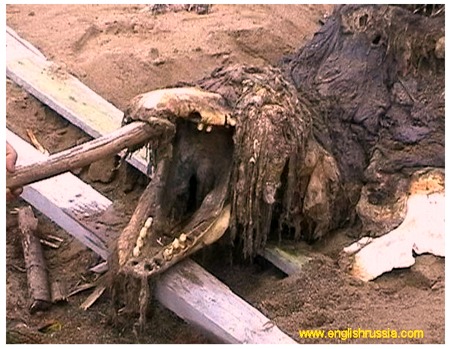
This photograph is of unknown origin . It should be noted that around the area where this photograph was supposedly taken, locals report sightings of " three foot tall, bipedal lizards."

-
This prove that evolution is a hoax.
-
Originally posted by Stomp661:
This prove that evolution is a hoax.
Evolution and prehistoric survivors are not to be confused.
Basically species sub branch out into others but the same animals can stay the same for millions of years.
Evolution will not wipe out the original species.
-
Originally posted by ☃®:
Evolution and prehistoric survivors are not to be confused.
Basically species sub branch out into others but the same animals can stay the same for millions of years.
Evolution will not wipe out the original species.
lol!
That means unlike thier predeccesors , they did not beach themselves to eventually grow legs.
Maybe that also explains why the whale species often try to beach themselves.. hoping to grow legs too eventually ? Or maybe.. its because of sonar waves emitted by one of our technological advances forcing them to become disoriented and hence.. beached themselves.
-
hope is true ... but hope not those meat eater ... if not it will be a disaster
-
jurassic park..
-
Very interesting thread!
Good job... Any more to read?
-
my local eatery already got milo dinosor, why go africa
-
Originally posted by ☃®:
Did Dinosaurs Survive in the Cambodian Jungle Until the Middle Ages?
This image is from Ta Prohm Temple, located in what is now the Cambodian jungle, and built in 1186. Carvings on it seem to suggest that dinosaurs were a part of the locals' life.
The reader who was visiting the area noticed very distinct and clear images that seem to depict a Stegosaurus, indicating that this creature might well have survived up until the Khmer era in the region. One expert on Khmer ruins has told us that it is unlikely that these images are a recent addition to the temple . . . According to conventional science this species existed in North America and died out around 155 million years ago. Villagers in the vicinity of the temple are said to retain traditions of this animal existing until fairly recent times.
it can't be, very unlikely, because Cambodia would had fossil oil to dig up and be the richest country in SE Asia.
