Why no Singaporean will win a Nobel Prize
-
Originally posted by angel7030:
He is model T500G, the latest model of terminator produced, shooting himself on the foot is a re-calibration of his programme is required, he can alway recover it within a few second.
Angel so you sneak out of my bed and post in sgforums again har? come back slp and cuddle with me
-
Originally posted by Phantomnite:
Is that suppose to be sarcastic or you are really trying to put forward some white supremacy here?
no, but who create a Nobel, the white, not us, so by giving to asian, they seek to obtain gracious status, which we dun give a damn, everytime they give some one of asian a nobel, there is uterior motive in it, eg, giving to dalai lama just to anger the chinese, give to the mynamar democracy leader Aung san su kyi to promote democracy, are they sincere in giving with no string attached. -
Originally posted by troublemaker2005:
Angel so you sneak out of my bed and post in sgforums again har? come back slp and cuddle with me
of all the people who scolded me with whatever vulgarities, i dun give a damn and forgive them, for they do not know what they are doing and who I am, but you is different, I hate people dating and showing love to me online...so get out of here!!!make a big mistake dating with you!!
-
Originally posted by angel7030:
of all the people who scolded me with whatever vulgarities, i dun give a damn and forgive them, for they do not know what they are doing and who I am, but you is different, I hate people dating and showing love to me online...so get out of here!!!make a big mistake dating with you!!
see lah no wonder you also never win nobel prize. Got watch ju-on?
-
Awarding the Nobel Peace Prize to the foremost organiser for human rights and democracy in China would reaffirm the values held most dearly by mankind, writes Xu Youyu, philosopher, professor at the Chinese Academy of Social Sciences and holder of the Olof Palme Chair, Sweden for 2001-2002.
The following op-ed is authored by Xu Youyu, philosopher, professor at the Chinese Academy of Social Sciences and holder of the Olof Palme Chair, Sweden for 2001-2002.
"A Letter to the European People:
I am here to urge your support of this year's Nobel Peace Prize being bestowed upon the founder of China's Charter 08, Liu Xiaobo.
In spite of Liu Xiaobo's many friends and supporters, I came to know him quite late, and we first met personally only a few years ago. In the mid-1980s, when Liu Xiaobo rose to prominence within the literary world, I was a visiting research fellow at Oxford, and became familiar with his ideas through Chinese periodicals published overseas.
Contrary to the view held by many, what brought Liu such attention at the time wasn't merely the sharpness of his writing or his pointed critiques, but also how thorough he was in his thinking and how much more influential his criticisms were of mainstream ideology and dogma in China than those of other intellectuals.
Throughout the student-led democracy movement of 1989, I had the opportunity to observe Liu Xiaobo. He had been lecturing abroad for quite some time, but when signs of suppression began to appear and others began making arrangements to flee overseas, Liu Xiaobo instead chose to discontinue his academic pursuits and return to Beijing to immerse himself in the struggle for democracy.
On the nights of June 3rd and 4th, I was in Tiananmen Square, not far from the Monument to the People's Heroes. Liu Xiaobo, along with three other intellectuals, was taking part in the student hunger strike; it was they, who, on the early morning of the 4th, convinced the students to peacefully evacuate the Square and begin discussion with the soldiers suppressing them, negotiating a smooth withdrawal.
I remember clearly the difficulty and pain Liu Xiaobo and his comrades-in-arms— raised as they had been with the most radical type of an education — experienced in reaching this decision, one which only later was understood to have saved the lives of several hundred students.
Liu Xiaobo's involvement in the 1989 democracy movement illustrates his transformation from an eminent cultural critic to public intellectual concerned with social and political problems and human rights activist.
His activities in 1989 can be seen as formative in the entirety of his following writings and other works, characterised by an unwavering bravery and refusal to back down in the face of danger and suppression, by the pursuit and defence of human rights, humanism, peace and other universal values and, finally, adherence to the practice of rational dialogue, compromise and non-violence.
For many years, Liu Xiaobo has been the most representative figure and foremost organiser in mainland China's struggle for human rights and democracy. He has been at the forefront of protests made in support of writers and intellectuals imprisoned for their work, in appeals made for farmers and urban residents deprived of land and home, in advocating for protection of the religious and cultural rights of ethnic minorities in Tibet and Xinjiang, and in fostering constructive dialogue toward seeing peaceful co-existence between Han and all ethnic minorities.
In a series of protests aimed at upholding the fundamental rights of all Chinese citizens, Liu Xiaobo placed consistent emphasis on the fact that the rights and freedoms of all Chinese citizens are protected both by the Chinese constitution and in law, as well as a series of United Nations and international declarations and covenants signed by the Chinese government which safeguard human and civil rights.
Liu placed particular emphasis on seeing the Chinese government's obligation and responsibility to abide by its own constitution and laws as well as international covenants as commitments to both the Chinese people and the international community.
In launching and signing Charter 08 in 2008, Liu Xiaobo's intent was to reaffirm, with the Chinese government already recognising the Universal Declaration of Human Rights and having signed the International Covenant on Civil and Political Rights, that these are the norms with regard to interaction between the Chinese people and the Chinese government: to be a qualified and responsible member of the international community would require China to adopt the universal values embodied within these two documents.
For this, Liu Xiaobo was imprisoned, his third arrest as a result of striving for freedom and democracy in China. On Christmas Day, 2009, Liu Xiaobo was sentenced to 11 years in prison. In his final statement to the court, Liu Xiaobo said that he had neither enemies nor hate; to those who kept him under surveillance and arrested him, to the police who interrogated him and to the public attorneys who prosecuted and judge who sentenced him, the message Liu Xiaobo felt it most important to convey was that despite their various roles leading to his imprisonment, he considered none of them his enemy.
As a political theorist and public intellectual also concerned with social and political problems and the defence of human rights, as well as a signatory to Charter 08, I strongly feel the need to point out that in the judgement read by the court which sentenced Liu Xiaobo, evidence cited to prove Liu's guilt included his participation in Charter 08, that he collected signatures for it, and even the content of the Charter itself - naked provocation of the universal values held by humankind, common norms held by the international community, and especially of the Chinese people themselves.
As I see it, the Nobel Peace Prize both embodies and represents the core values of civilised society: respect for life and faith, the sanctity of the individual and the right to express one's self. Given that Liu Xiaobo and many others signatories of Charter 08 have faced persecution and oppression merely for reaffirming these values, the blatant challenge they face behooves a response from the civilised world.
To bestow the Nobel Peace Prize upon Liu Xiaobo is one of the strongest responses which could be sent.
This would, clearly and unambiguously, reaffirm the values held most dearly by humankind, serve as monumental support for the struggle for the freedom and democracy which China's 1.3 billion people lack, and would mark a major step in defence of world peace.
The Chinese authorities are able to destroy this country's constitution and trample upon its laws wantonly, which is why external voices, voices from the international community, are needed to make Chinese authorities pay heed.
Bestowing the Nobel Peace Prize upon Liu Xiaobo would serve as indirect opposition to the current state of affairs, as well as a both authoritative and effective signal.
Liu Xiaobo's ideas and actions, in my view, are entirely congruous to the actions and ideas held by His Holiness the Dalai Lama, Archbishop Emeritus Desmond Tutu and Aung San Suu Kyi; all have endeavoured to use tactics of non-violence in effecting gradual change, of persuasion and compromise in upholding human rights and in making the transition toward a peaceful society.
With protest movements now taking place all across China within every community and at every level, it is imperative we remain vigilant in preventing violent trends from taking hold. Awarding Liu Xiaobo the Nobel Peace Prize would have just such an effect: people struggling for human rights in China and around the world would find hope and strength in rational, non-violent resistance, and see anew the possibility of putting violence and authoritarian rule where they both belong - in the past and behind us all.
Cordially yours,
Xu Youyu."
http://www.euractiv.com/en/pa/why-nobel-peace-prize-should-go-liu-xiaobo-analysis-498270
-
this was the Dalai Lama Nobel Medal with his famous quote:-
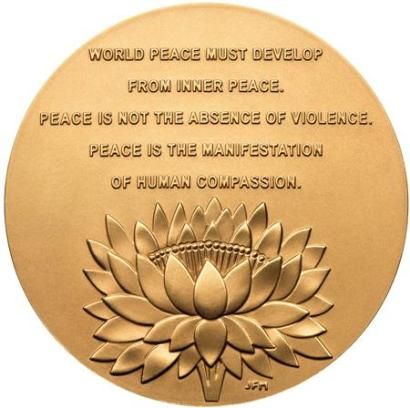
if we reflect to ourselves what makes a Nobel criteria....CHANGE comes from deepest within..
-
For my undying love towards Angel7030 i think i deserves a Nobel Prize.

-
[If this year's Nobel Peace Prize goes to Liu Xiaobo...his life may be at stake...perhaps that may be a consideration not to award him the prize..further to the severity of trade relations with China as well......]
2010 could be China's year for Nobel Peace Prize
OSLO – After its Obama bombshell last year, the Norwegian Nobel Committee could make waves again this year, some predict, by awarding the Nobel Peace Prize to a Chinese dissident.
The Nobel season opens Monday with the Medicine Prize, followed by awards for exceptional work in physics, chemistry, literature and economics.
But all eyes are fixed on the prestigious Peace Prize, which could create an upset again this year if some predictions come true.
"If the Nobel Committee is courageous, and I think it will be, it should reward Chinese dissident Liu Xiaobo," said Asle Sveen, a historian and Nobel Prize specialist.
"There's been talk of a Chinese dissident for the prize for so long," he told AFP.
Such a choice would certainly infuriate Beijing.
Geir Lundestad, the influential secretary of the Nobel Committee, recently said he was warned in June by Vice Foreign Minister Fu Ying that rewarding a Chinese dissident would be seen by Beijing as "an unfriendly gesture" which could affect the relationship between China and Norway.
Liu Xiaobo, a 54-year-old writer, was sentenced last December to 11 years behind bars for subversion after co-authoring a bold manifesto calling for democratic reform, "Charter 08", which was signed by more than 300 Chinese intellectuals, academics and writers, and thousands of others after it was circulated on the Internet.
Online betting website paddypower.com deemed him a gamblers' best bet this year with odds of 6 to 1.
He is ahead of Zimbabwean Prime Minister Morgan Tsvangirai, Russian human rights group Memorial and its founding member Svetlana Gannushkina, and Ireland's Mary Robinson, a former United Nations High Commissioner for Human Rights, who all have odds of 8 to 1.
"Liu would be a popular choice in the Western world, where he could help people forget that Obama fell short of expectations," Sveen said, adding such a pick could help re-establish the prize's luster in the United States.
US President Barack Obama was awarded the Nobel Peace Prize in 2009 after less than a year in office and as Washington was waging wars in both Iraq and Afghanistan.
The pick triggered widespread criticism of the Norwegian Nobel Committee.
This year, the five members of the committee will have a record of 237 candidates to choose from. The list is secret, except for the names revealed by those who suggest them.
"I believe the winner of the 2010 is somebody few people will know about," said Scott London, a US journalist and author who closely follows the Nobels.
"It may be somebody working for peace in an unconventional way -- a peace researcher, for example, or an investigative journalist," he said.
The head of the Peace Research Institute in Oslo, Kristian Berg Harpviken, said this week the committee would probably "be somewhat more traditional in its selection of a candidate than it was last year."
He said Afghan human rights activist Sima Samar, the Oslo-based Democratic Voice of Burma radio and the Special Court for Sierra Leone were likely picks.
Other nominees include three people widely regarded as the creators of the Internet: Americans Larry Roberts and Vint Cerf and Britain's Tim Berners-Lee.
The International Space Station, Congolese doctor Denis Mukwege and Chinese dissidents Hu Jia et Gao Zisheng are also known to be on the list.
-
Latest news - 4 hours ago…and counting down…
Prisoner Liu could become first Chinese Nobel Peace Prize winner....
-
Chinese Nobel Peace Prize Candidate
OCTOBER 04, 2010 11:29
Iranian Nobel Peace Prize laureate Shirin Ebadi is an eyesore for Tehran. When she won the prize for her struggle for democracy and human rights in 2003, the Iranian government experienced agony. Tehran could hardly afford to welcome the award since it clearly understood that the Nobel committee recognized Ebadi to encourage the improvement of human rights and democratization in Iran and the Islamic world. Nevertheless, Iran could also not ignore its first winner of the prestigious award, which was cause for national celebration.
Tehran countered through a passive welcome and continued oppression. It welcomed Ebadi’s honor in the name of the Islamic republic through a government spokesman, and approved a welcoming event of 5,000 people for Ebadi at the airport when she returned after the award ceremony. After a short atmosphere of welcome, Tehran has constantly harassed Ebadi, who is an anti-government activist. Last year, the government took her prize certificate and medal. Under reinforced oppression by the Iranian government, Ebadi has become a fighter who is more aggressively fighting for her nation’s democratization and reform by traveling around the world.
In China, anti-government activist Liu Xiaobo is considered a leading candidate for this year’s Nobel Peace Prize, the winner of which will be announced Friday. In 2008, he led a signature-collecting campaign for a “2008 Charter,” which demanded revocation of China’s one-party rule by the Communist Party and reform. His campaign was assisted by progressive scholars, lawyers and writers. Liu was sent to prison after receiving an 11-year sentence. If he receives the award, he could emerge as China’s version of Aung San Suu Kyi, the symbol of the democratization movement in Myanmar. As such, Beijing has many reasons to fret. Two other Chinese dissidents, Wei Jingsheng and Fu Jia, have also made the list of Nobel Peace Prize candidates this year again after doing so last year.
Beijing is openly staging a plot to block Liu from receiving the award. Geir Lundestad, director of the Norwegian Nobel Institute, which assists in the selection of Nobel laureates, recently said he was threatened by the Chinese foreign vice minister, who warned that giving the award to an anti-government activist will be considered an unfriendly act and hurt Oslo-Beijing ties. China’s diplomatic habit of using retaliation or threats when in conflict with another country is even shaking the foundations of the Nobel Prize. If the Nobel institute succumbs to Beijing’s pressure, the Nobel Peace Prize will see its reputation go into free fall.
Editorial Writer Bhang Hyeong-nam ([email protected])
-
CHINA ACIVISTS DOUBTFUL OF NOBEL PRIZE FOR JAILED DISSIDENT
BEIJING - China's activist community on Monday said they held little hope that jailed political dissident Liu Xiaobo could be named this week as the winner of the 2010 Nobel Peace Prize.
Liu, a 54-year-old writer, was jailed for 11 years in December on subversion charges after co-authoring a bold call for democratic reform and is tipped as a favourite for the prize, the winner of which will be announced on Friday.
"Personally I don't think he will get the prize," his wife Liu Xia told AFP.
"If he wins, of course it will be a big help to (further) his hopes (of greater democracy and human rights in China). I just have a feeling that he won't get it."
In recent years Chinese dissidents have routinely been named as top candidates for the prestigious prize but have not won, activists said.
In 1989, the exiled Tibetan spiritual leader, the Dalai Lama - who is seen by Beijing as a "splittist" despite his repeated calls for autonomy rather than independence for Tibet - was given the honour.
Liu's jailing followed the 2008 release of "Charter 08", a manifesto for reform signed by more than 300 Chinese intellectuals, academics and writers, and thousands of others after it was circulated on the Internet.
The sentence handed down to the activist and former professor, a veteran of the 1989 Tiananmen Square movement who has been repeatedly jailed over the years, sparked international condemnation.
Online betting website paddypower.com has made Liu the favourite to win the Peace Prize, with odds of 3 to 1.
Liu Xia, whose home has been under police surveillance since her husband's sentencing, cited China's pressure on the Nobel Committee earlier this year not to award the prize to a Chinese dissident as part of her pessimism.
The director of the Nobel Institute and secretary of the Nobel committee, Geir Lundestad, told AFP last week that Chinese Vice Foreign Minister Fu Ying had issued a warning against awarding the prize to Liu in a meeting in June.
Other activists and rights defenders also expressed doubts that the prize would be awarded to a Chinese national, citing a series of disappointments in the past.
"I think it will be the same as before," leading human rights lawyer Mo Shaoping told AFP.
He cited previous candidates from China such as dissidents Wei Jingsheng, Xu Wenli and Hu Jia, as well as the Tiananmen Mothers - a group of relatives of victims of the bloody quelling of the 1989 Tiananmen democracy protests.
A few nonetheless held out hope.
"For over 20 years, since 1989, China's civil society has gone through some big changes, while Chinese activists and rights defenders have paid a big price for advancing democracy and the rule of law," rights lawyer Li Fanping told AFP.
"Despite these big changes, Chinese society is still at a critical period, so as China's civil society expands and the international community shows more concern, I hope that this year's Nobel Prize will go to a Chinese activist.
-
CHINA ACIVISTS DOUBTFUL OF NOBEL PRIZE FOR JAILED DISSIDENT
BEIJING - China's activist community on Monday said they held little hope that jailed political dissident Liu Xiaobo could be named this week as the winner of the 2010 Nobel Peace Prize.
Liu, a 54-year-old writer, was jailed for 11 years in December on subversion charges after co-authoring a bold call for democratic reform and is tipped as a favourite for the prize, the winner of which will be announced on Friday.
"Personally I don't think he will get the prize," his wife Liu Xia told AFP.
"If he wins, of course it will be a big help to (further) his hopes (of greater democracy and human rights in China). I just have a feeling that he won't get it."
In recent years Chinese dissidents have routinely been named as top candidates for the prestigious prize but have not won, activists said.
In 1989, the exiled Tibetan spiritual leader, the Dalai Lama - who is seen by Beijing as a "splittist" despite his repeated calls for autonomy rather than independence for Tibet - was given the honour.
Liu's jailing followed the 2008 release of "Charter 08", a manifesto for reform signed by more than 300 Chinese intellectuals, academics and writers, and thousands of others after it was circulated on the Internet.
The sentence handed down to the activist and former professor, a veteran of the 1989 Tiananmen Square movement who has been repeatedly jailed over the years, sparked international condemnation.
Online betting website paddypower.com has made Liu the favourite to win the Peace Prize, with odds of 3 to 1.
Liu Xia, whose home has been under police surveillance since her husband's sentencing, cited China's pressure on the Nobel Committee earlier this year not to award the prize to a Chinese dissident as part of her pessimism.
The director of the Nobel Institute and secretary of the Nobel committee, Geir Lundestad, told AFP last week that Chinese Vice Foreign Minister Fu Ying had issued a warning against awarding the prize to Liu in a meeting in June.
Other activists and rights defenders also expressed doubts that the prize would be awarded to a Chinese national, citing a series of disappointments in the past.
"I think it will be the same as before," leading human rights lawyer Mo Shaoping told AFP.
He cited previous candidates from China such as dissidents Wei Jingsheng, Xu Wenli and Hu Jia, as well as the Tiananmen Mothers - a group of relatives of victims of the bloody quelling of the 1989 Tiananmen democracy protests.
A few nonetheless held out hope.
"For over 20 years, since 1989, China's civil society has gone through some big changes, while Chinese activists and rights defenders have paid a big price for advancing democracy and the rule of law," rights lawyer Li Fanping told AFP.
"Despite these big changes, Chinese society is still at a critical period, so as China's civil society expands and the international community shows more concern, I hope that this year's Nobel Prize will go to a Chinese activist.
-
howcome our opposition leaders never get a nobel prize hor, if one of them get it, it will really help them
-
Originally posted by troublemaker2005:
For my undying love towards Angel7030 i think i deserves a Nobel Prize.
I hope someone can create an UnNobel prize to counteract a Nobel prize, if there was, you should deserves it more than ever, the UnNobel prize -
2010 Nobel Prize in Physics was awarded jointly to Russian-born scientists Andre Geim and Konstantin Novoselov ...
Nobel Committee faces down the dragon
By Sreeram Chaulia
With the Norwegian Nobel Committee scheduled to announce the name of this year's Peace Prize winner on October 8, speculation that jailed Chinese democracy activist Liu Xiaobo is the frontrunner is mounting.
News agencies including Reuters and Agence France-Presse have reported that Liu, who is serving an 11-year prison sentence in Liaoning province for "inciting subversion of state power," is the bookmakers' favorite among 237 nominees to bag the most political of Nobel prizes.
The prognosis has clearly not gone down well in Zhongnanhai, the power center in Beijing, where there is concern about China-bashing and sullying that could jeopardize the country's mounting international influence.
The director of the Nobel Institute, Geir Lundestad, revealed last week that Chinese Deputy Foreign Minister Fu Jing had met him in Oslo in June to deliver a warning that the "unfriendly gesture" of honoring Liu with the prize "would have negative consequences" for bilateral relations between China and Norway.
The Chinese Foreign Ministry confirmed that pressure was being exerted on the Nobel Committee on the grounds that Liu had never promoted "peace between peoples, international friendship and disarmament." According to a ministry spokeswoman, awarding Liu would be contrary to the ideals of the prize's founder, Alfred Nobel.
Although China has a long track record of rebuffing and categorically dismissing international calls for domestic political reform, its climb up the ladder of world-power standings has somewhat increased its sensitivity to foreign criticism of its authoritarian regime.
Chinese strategic elites have strived over the past decade to devise image-burnishing doctrines like "peaceful rise" (Zhongguo heping jueqi), "peaceful development" (Zhongguo heping fazhan) and "harmonious society" (hexie shehui) to counter portrayals of Asia's behemoth as aggressive abroad and bulldozing in its high-modernization drive at home.
Beijing is aware that its growing clout in the international system must be accompanied by improved stature, which is a more amorphous term predicated on accumulated goodwill, soft power and positive feelings.
Dominique Moisi's theory that emotions like fear, hope, humiliation and admiration are as important in international politics as material factors like economic and military calculations explains China's recent attempts to assuage, convince or even coerce the rest of the world to accept its bona fides as a normal state with a humane polity. China's "charm offensive" (Joshua Kurlantzick) is thus a necessary weapon in its ascent as a great power.
Should Liu be named as the peace laureate, Beijing will deem it a public-relations setback because the aftermath of the prize helps train worldwide attention on the cause espoused by the winner.
Older-generation leaders in the Chinese Communist Party still remember the contretemps that followed the Nobel Committee's selection of the exiled Tibetan spiritual leader the Dalai Lama for the Peace Prize in 1989. The combination of the Tiananmen Square crackdown and the conferral of the Nobel on the Dalai Lama increased China’s isolation to its highest level since the Mao Zedong era and deterred foreign direct investment and economic growth in the early 1990s.
Liu could be elevated into international celebrity by virtue of the prize, shining renewed light on China's dark spots, including political prisoners. Although the Barack Obama administration of the United States has thus far dealt with China on pragmatic rather than ideological terms, the democratization drumbeat will become deafening, at least for a while, if Liu wins the prize. Washington then might resurrect the old concern about human-rights violations.
What appears to particularly gall Beijing is that the Nobel Committee might pick Liu as the 91st Peace Prize winner at a time when China is unarguably the second-most powerful state in the world. Lundestad's recent contention - that Chinese pressure did not prevent the Nobel Committee from feting the Dalai Lama in 1989 and will not do so in 2010 either - seems to mock Beijing's belief that it can translate 20 years of economic growth and muscle power into having its way on delicate issues.
Compared to 1989, today's China does enjoy a much bigger arsenal of pressure points and leverage instruments to deter a range of international actors from doing what they would otherwise do for the sake of principle. Beijing enjoyed limited success in 2009 by sending strong signals to the Obama administration not to entertain the Dalai Lama in the White House. When Obama belatedly did meet the Tibetan spiritual leader in February 2010, it was an in camera event with no public photographs, in clear deference to Chinese sentiments.
Similar Chinese warnings fell on deaf ears in France, where President Nicolas Sarkozy openly shrugged off Beijing's anger and met the Dalai Lama in Poland in December 2008. In retaliation for this "unwise move," China threatened to disrupt trade ties with the entire European Union and canceled a planned EU-China summit.
China has also capitalized on its economic and strategic ties with a wide range of countries to win diplomatic concessions on sovereignty disputes that it considers to be its "core national interests."
One of the standard conditionalities for Chinese loans, trade and foreign-investment largesse in Africa and Latin America has been withdrawing recognition of Taiwan and acceptance of Tibet as an integral part of China. The "one-China principle" is a standard feature in mainland China's checkbook diplomacy and has worked to the disadvantage of Taipei, which finds its international repository of state backers shrinking with each passing year.
Without question, China now has the wealth to throw around and buy silence or acquiescence from many world capitals that find themselves in hock to the world's biggest market and a major foreign investor. But the Nobel Committee is a different matter altogether and has matured to define "peace" much more liberally than the traditional "inter-state peace" that Beijing claims to stand for.
The mainstreaming of the international human-rights and environmental consciousness has frequently pushed the committee to award the Peace Prize to domestic activists for political freedom and green justice who struggle against autocratic rulers, notably Aung San Suu Kyi of Myanmar, Shirin Ebadi of Iran, and Wangari Maathai of Kenya.
Some observers have predicted that the Nobel elders in Oslo will avoid "risky" choices after last year's controversial verdict to anoint Obama. Liu's exemplary record of sticking to non-violent means and his martyr-like halo of sacrificing personal freedom for the sake of collective rights for the Chinese people actually make him a safe bet.
Come Friday, should the committee plump for a candidate like Sima Samar - head of the Afghan Independent Human Rights Commission - instead of odds makers' favorite Liu, China will uncork the champagne for possibly pulling off another diplomatic coup.
But China is not quite the British Empire of the 1940s, which might have had a hand in denying Mahatma Gandhi the Peace Prize despite his nomination on five occasions. More crucially, the guiding philosophy of the Nobel Committee has globalized and transformed radically since the dark days of the "White Man's Burden." China's vulnerability to Nobel Peace Prizes cannot be wished away.
Sreeram Chaulia is Vice Dean of the Jindal School of International Affairs (JSIA) at the OP Jindal Global University in Sonipat, India. -
Civic group urges Nobel Peace committee to award Chinese dissident
2010/10/05 23:21:24Taipei, Oct. 5 (CNA) A civic society comprised of professors and academics issued a statement Tuesday calling for this year's Nobel Peace Prize to be awarded to Chinese dissident Liu Xiaobo, who is currently serving an 11-year sentence in Beijing.
The Taipei Society issued the statement ahead of the announcement of the winner, due Oct. 8.
China, with its track record of abusing human rights and repressing political dissidents, naturally regards Liu's Charter 08 Initiative and his bid for the peace prize as threats to the legitimacy of its regime, and has warned the Nobel Peace Committee not to award the prize to Liu, according to the statement.
The group said it stands in solidarity with Liu and called on the Nobel Peace Committee to award the prize to Liu, despite China's official warning.
The society said that a Nobel Peace Prize for Liu would mean not only recognition of his long-term dedication to human rights and democratic reforms in China, but would also send a clear message to the Chinese communist regime that the world stands in solidarity with Chinese people who share Liu's vision for a strong, prosperous and democratic China that respects individual freedom and human rights. (By Eva Feng and Lilian Wu) ENDITEM/J -
who cares a damn about Nobel Prize anymore ????
if Obama and Al Gore can win it....................Mickey Mouse could win one too........
-
Paddy Power: Liu Xiaobo Wins 2010 Nobel Peace Prize
Posted on: Wed, 06 Oct 2010 07:11:22 EDT
Oct 06, 2010 (M2 PRESSWIRE via COMTEX) --
Leading betting firm Paddy Power have today taken the unprecedented step of paying out on imprisoned Chinese dissident Liu Xiaobo as the winner of this years Nobel Peace Prize a full 48 hours ahead of the scheduled announcement.
The bookmaker was forced to cut the odds on Liu Xiaobo winning earlier this week from 3-1 to (odds-on) 4-5 after a late surge of betting including several bets of 200 were placed by punters across the globe.
Paddy Power spokesperson Ken Robertson explains Obviously were taking a risk but its a calculated one. Over the past decade we have never experienced such strong betting support for any individual candidate and this leads us to believe that the Nobel cat is well and truly out of the bag
Paddy Power are paying out over 5,000 today to all those who placed bets on Liu Xiaobo before midnight last night.
Nobel Peace Prize 2010
(Odds at time of payout)
4/5 Liu Xiaobo
10/1 Mary Robinson
10/1 Hu Jia
10/1 Democratic Voice of Burma
11/1 European Union
12/1 Morgan Tsvangirai
12/1 Memorial/Svetlana Gannushkina
12/1 Seema Samar
14/1 Berners-Lee,Roberts & Cerf - The Internet
16/1 Special Court for Sierra Leone
16/1 The Cluster Munitions Coalition
16/1 Thich Quang Do
18/1 Grandmothers of the Plaza de Mayo
20/1 Piedad Cordoba
20/1 Bishop Charles E. Blake
20/1 Wei Jingsheng
20/1 Chen Guangcheng
20/1 International Space Station Programme
25/1 Bill Clinton
25/1 Prem Rawat
25/1 SOS-Kinderdorf International
66/1 Bono
100/1 Tony Blair
All prices remain subject to fluctuation.
-
huh............Bill Clinton and Tony Blair also in the list ah ?
these 2 are the biggest traitors around...............
-
Originally posted by angel7030:
I hope someone can create an UnNobel prize to counteract a Nobel prize, if there was, you should deserves it more than ever, the UnNobel prize
mai howlian. your avatar so small, reel person also don;t know issit like that one mayb steel useother phfotos. send me your real photo i see can giv you makeover and fotohoot and submit win nobel or unnobel whatever price or not -
Originally posted by Asromanista2001:
huh............Bill Clinton and Tony Blair also in the list ah ?
these 2 are the biggest traitors around...............
as long as no bushes, can liao lah -
Originally posted by troublemaker2005:
mai howlian. your avatar so small, reel person also don;t know issit like that one mayb steel useother phfotos. send me your real photo i see can giv you makeover and fotohoot and submit win nobel or unnobel whatever price or not
oh, the wolf finally show his wagging tail liao...chay! i thot a gentleman... -
siao i never say i gentlemen or good guy. i am just average human being i have my wnats and need.s only i can control it. so you saw my wolf tail you have to be respoonsible for that and maryy me. my tail very sacred those see it must marry me
-
Arrrghhh!
-
BEIJING |
(Reuters) - China will try its best to block a Nobel Peace prize for jailed Chinese writer and dissident Dr. Liu Xiaobo, his wife told Reuters ahead of the Nobel Committee's announcement on Friday.
Liu is considered one of the front-runners for the prize, although the Nobel Committee often confounds expectations. Czech politician and former dissident Vaclav Havel is one of those pushing for Liu to win the prize.
The Nobel Committee will announce the winner on Friday.
"This government is one that has never given reasons for its actions. It is a government that thinks there is nothing it can't do," Liu's wife, Liu Xia, told Reuters in an interview.
"To get what it wants, the Communist Party will spare no effort. It will use all types of methods to block the prize or anything else that would hurt the party. They will use their money and power to get others to support them."
Liu Xiaobo was jailed for 11 years in December 2009, more than a year after his detention as lead author of Charter 08, a manifesto issued by Chinese intellectuals and activists calling for free speech and multi-party elections.
He was charged with subversion of state power.
The former literature professor rose to prominence as one of the leaders of a hunger strike during student protests on Tiananmen Square in 1989.
He was later jailed for 20 months and then spent three years in a "labor re-education" camp during the 1990s, as well as months under virtual house arrest.
Liu Xia said she had a feeling Liu would not get the prize.
Deputy Foreign Minister Fu Ying warned the head of the Nobel Institute against granting the prize to Liu during a visit to Oslo this summer, saying it would hurt ties between China and Norway.
A Chinese Foreign Ministry spokeswoman said last month that Liu's actions were "diametrically opposed to the aims of the Nobel prize."
(Editing by Nick Macfie)