Surprising truth on peranakans!
-
History
In the 15th century, some small city-states of the Malay Peninsula often paid tribute to various kingdoms such as those of China and Siam. Close relations with China were established in the early 15th century during the reign of Parameswara when Admiral Zheng He (Cheng Ho), a Muslim Chinese, visited Malacca and Java. According to a legend in 1459 CE, the Emperor of China sent a princess, Hang Li Po, to the Sultan of Malacca as a token of appreciation for his tribute.
who the hell is hang li po?
ans:
Hang Li Po (Chinese: 韓麗寶; pinyin: Hàn LìbÇŽo) was the fifth wife of Malaccan Sultan Mansur Shah (reigned 1456-1477). It is disputed whether Hang Li Po ever existed since she was never recorded in the Ming Chronicles of the ruling Chinese Ming Dynasty nor in the genealogical record of the imperial house of Zhu, the royal family of the Ming dynasty. In addition, the Ming decorum of rites, governed by the Ministry of Rites, in the matter of bestowing the title princess always used two characters followed by the title 公主 (Gong Zhu, a title denoting blood-relation to the Emperor) or 郡主 (Jun Zhu, indicating a relation to a Duke or a non-royal relation), such as was the case with Princess Changping 長平公主 and Princess Dongyang æ�±é™½éƒ¡ä¸». The claim of a Ming princess converting to Islam is also disputed as the conversion of any aristocratic member of the Ming court to a foreign religion or belief was forbidden. A further dispute involves the time of arrival of the Sultan's envoy from Malacca. Some sources claim the reigning Ming Emperor was the Tianshun Emperor (reigned 1457-1464) whilst others state that Han Li Po was a princess in the court of the Yongle Emperor (reigned 1402–1424). There is another speculation, the princess is just a very beautiful maid in the imperial house which was picked to assume the role of a princess.[citation needed] This type of princess usually are sent to far away kingdom that are not significant to the emperor and are not being declare in history book. This kind of practice was common throughout China history.[citation needed]
looks like peranakan heritage is not royal bloodline. -
so if they not royal bloodline then what are they all actually?fake princess?playboy magazine pinups?servants?security guards???!
from looks of it ,they were not the best in chinese civilisation.
-
For notable Indonesian people of Chinese descent, see List of Chinese Indonesians.
- Agnes Monica
- Chris John
- Kwik Kian Gie
- Rudy Hartono
- Liem Swie King
- Susi Susanti
- Mari Pangestu
- Soe Hok Gie
- Titi DJ
- Marga T
[edit] Malaysia
- Tun Dato Sri Tan Cheng Lock - Founder and first President of Malaysian Chinese Association (MCA)
- Tun Tan Siew Sin - Third President of Malaysian Chinese Association (MCA)
- Nyonya Chuah Guat Eng - Novelist
[edit] Singapore
- Goh Keng Swee - First Deputy Prime Minister of Singapore
- Lee Kuan Yew - First Prime Minister of Singapore
- Lee Hsien Loong - Third Prime Minister of Singapore, son of Lee Kuan Yew
- Wee Kim Wee - Fourth President of Singapore
- Dick Lee - Celebrity pop singer, composer and playwright
- Pierre Png - Mediacorp artiste
- Tony Tan Keng Yam - 7th President of Singapore
[edit] See also
-
Since you brought by the topic, I might as well:
THE BABAS OF SINGAPORE
What makes Singapore different? The majority of Singapore's population is ethnically Chinese, but Singapore is largely free of corruption, has sound institutions and the rule of law dominates. It's nothing like China. The answer lies in a historical division in Singapore's Chinese community between the babas and the sinkeh. The sinkeh, comprising the majority of the city-state's population, were the recent immigrants from China, or whose parents were born in China. They spoke Chinese, lived like Chinese and considered themselves overseas Chinese. In Indonesia, such Chinese were called the totok.
The babas, on the other hand, also known as Straits Chinese, were Chinese more in name than practice. They were the descendants of the very early Chinese immigrants (Hokkiens from the Fujian province) to the straits settlements of Malaya (Penang, Singapore and Malacca). They assimilated with both the local Malays and the colonising British, whom they especially admired. The babas developed their own culture, cuisine and language - Malay liberally sprinkled with Hokkien.
The sinkeh were the traders, the coolies and the shophouse owners. The babas became the lawyers, the civil servants and the politicians; they attended the local English-language schools run in the tradition of the UK's public schools, and Oxford and Cambridge. If the sinkeh received an overseas education at all, it was in Nanking or another university in China. Although the sinkeh dominated Singapore's population, it was the babas who dominated public decision-making. In effect, a baba minority captured sinkeh Singapore, and that minority's attitudes were more those of Victorian England than China.
It was the babas who were the framers of Singapore's rules and institutions. Many of Singapore's most prominent Chinese have had baba backgrounds. Lee Kuan Yew, who became prime minister of Singapore aged just 35, is the most obvious example. He claims a Hakka heritage, although his upbringing was that of a baba: at home, he spoke English with his parents and baba Malay to his grandparents. "Mandarin was totally alien to me and unconnected with my life," Lee said of his childhood.
For Lee, Chineseness was an acquired skill and later a political necessity. He was not brought up as a Chinese with a focus on China, but as a baba who looked to England. He followed the conventional career path of a baba and went to London to study law. And so Lee Kuan Yew of Singapore became Harry Lee of Fitzwilliam College, Cambridge. His father had given him and two of his brothers English, as well as Chinese, names. Did Lee run Singapore as a piece of Asia mired in Chinese ways? No. He ran it in a manner to which a British colonial administrator would have aspired.
That other great framer of Singapore's institutions, Goh Keng Swee, who rose to become finance minister and deputy prime minister, is the epitome of the baba elite. Goh was born in 1918 in Malacca, the epicentre of baba culture, into a baba family. His parents were English-oriented Chinese Methodists.
The baba influence is now more subtle, but still there. Singapore's current prime minister Lee Hsien Loong has the strongest baba pedigree of any of the country's leaders.
http://www.managementtoday.co.uk/news/648273/
Endangered species?
For goodness sake, Lee Kuan Yew practically filled the entire cabinet with inbred Peranakans.
For the last few decades in Singapore, the top positions in civil service, statutory boards, armed forces, GLCs have all along been going disproportionately to the Peranakans. That is one reason why Singapore has been run to the ground.
Lee Kuan Yew worked with the Japanese Kempeitai and later the British colonizers to suppress the non-Peranakan Chinese.
That's why he has always been wary of non-Peranakan Chinese and could only entrust power to his own family members and his other Peranakan cronies.
http://tomorrow.sg/archives/2009/02/17/peranakans__going_the_way_of_the.html
Babas And Nyonyas in Singapore
Tang found himself not merely participating in politics, but running for election. His reasons for this decision were very much based on his concerns over what was happening to the Chinese community and other minority communities, in Singapore.Non-English speaking Singaporeans, including Chinese, Malays and Indians have, he says, been discriminated against unnecessarily under the PAP policies, particularly, for example the Chinese-educated, the Buddhists, the Taoists, the Hindus and the Muslims.The discrimination, he says, takes various forms: Nanyang University was restructured; there is no Chinese-language business paper; there is discrimination in the intake of university students, in the engagement of university lecturers and school teachers, in the manning of positions in the army and police forces, and an absence of representation of the non-English-speaking Singaporeans in the decision-making process and in many top government posts.The Ruling Elite of Singapore: Networks of Power and Influence in Southeast Asia
Michael Barr explores the complex and covert networks of power at work in one of the world's most prosperous countries – the city-state of Singapore.
He argues that the contemporary networks of power are a deliberate project initiated and managed by Lee Kuan Yew – former prime minister and Singapore's "founding father" – designed to empower himself and his family.
Barr identifies the crucial institutions of power - including the country's sovereign wealth funds, and the government-linked companies – together with five critical features that form the key to understanding the nature of the networks.
He provides an assessment of possible shifts of power within the elite in the wake of Lee Kuan Yew's son, Lee Hsien Loong, assuming power, and considers the possibility of a more fundamental democratic shift in Singapore's political system.
Lee Kuan Yew worked with the Japanese Kempeitai and later the British colonizers to suppress the non-Peranakan Chinese.
That's why he has always been wary of non-Peranakan Chinese and could only entrust power to his own family members and his other Peranakan cronies.
-
Originally posted by Dalforce 1941:
Since you brought by the topic, I might as well:
THE BABAS OF SINGAPORE
What makes Singapore different? The majority of Singapore's population is ethnically Chinese, but Singapore is largely free of corruption, has sound institutions and the rule of law dominates. It's nothing like China. The answer lies in a historical division in Singapore's Chinese community between the babas and the sinkeh. The sinkeh, comprising the majority of the city-state's population, were the recent immigrants from China, or whose parents were born in China. They spoke Chinese, lived like Chinese and considered themselves overseas Chinese. In Indonesia, such Chinese were called the totok.
The babas, on the other hand, also known as Straits Chinese, were Chinese more in name than practice. They were the descendants of the very early Chinese immigrants (Hokkiens from the Fujian province) to the straits settlements of Malaya (Penang, Singapore and Malacca). They assimilated with both the local Malays and the colonising British, whom they especially admired. The babas developed their own culture, cuisine and language - Malay liberally sprinkled with Hokkien.
The sinkeh were the traders, the coolies and the shophouse owners. The babas became the lawyers, the civil servants and the politicians; they attended the local English-language schools run in the tradition of the UK's public schools, and Oxford and Cambridge. If the sinkeh received an overseas education at all, it was in Nanking or another university in China. Although the sinkeh dominated Singapore's population, it was the babas who dominated public decision-making. In effect, a baba minority captured sinkeh Singapore, and that minority's attitudes were more those of Victorian England than China.
It was the babas who were the framers of Singapore's rules and institutions. Many of Singapore's most prominent Chinese have had baba backgrounds. Lee Kuan Yew, who became prime minister of Singapore aged just 35, is the most obvious example. He claims a Hakka heritage, although his upbringing was that of a baba: at home, he spoke English with his parents and baba Malay to his grandparents. "Mandarin was totally alien to me and unconnected with my life," Lee said of his childhood.
For Lee, Chineseness was an acquired skill and later a political necessity. He was not brought up as a Chinese with a focus on China, but as a baba who looked to England. He followed the conventional career path of a baba and went to London to study law. And so Lee Kuan Yew of Singapore became Harry Lee of Fitzwilliam College, Cambridge. His father had given him and two of his brothers English, as well as Chinese, names. Did Lee run Singapore as a piece of Asia mired in Chinese ways? No. He ran it in a manner to which a British colonial administrator would have aspired.
That other great framer of Singapore's institutions, Goh Keng Swee, who rose to become finance minister and deputy prime minister, is the epitome of the baba elite. Goh was born in 1918 in Malacca, the epicentre of baba culture, into a baba family. His parents were English-oriented Chinese Methodists.
The baba influence is now more subtle, but still there. Singapore's current prime minister Lee Hsien Loong has the strongest baba pedigree of any of the country's leaders.
http://www.managementtoday.co.uk/news/648273/
Endangered species?
For goodness sake, Lee Kuan Yew practically filled the entire cabinet with inbred Peranakans.
For the last few decades in Singapore, the top positions in civil service, statutory boards, armed forces, GLCs have all along been going disproportionately to the Peranakans. That is one reason why Singapore has been run to the ground.
Lee Kuan Yew worked with the Japanese Kempeitai and later the British colonizers to suppress the non-Peranakan Chinese.
That's why he has always been wary of non-Peranakan Chinese and could only entrust power to his own family members and his other Peranakan cronies.
http://tomorrow.sg/archives/2009/02/17/peranakans__going_the_way_of_the.html
Babas And Nyonyas in Singapore
i had no idea the origins of the perankans were so........disturbing.i thought it was as good as their sambal belachan.
-
they were actually gifts to some malay dude by some china emperor.gifts were also fake royalty it seems.that explains many things n organisations in spore.
-
the makers of sambal belacan with the roompah thing is all some elaborate tricky concoction made hundred of years ago?its all aligned to trickery and deception all the while?!
that just so explains it all now.
-
Originally posted by Army 21:
i had no idea the origins of the perankans were so........disturbing.i thought it was as good as their sambal belachan.
they were actually gifts to some malay dude by some china emperor.gifts were also fake royalty it seems.that explains many things n organisations in spore.
That's not the issue.
The issue is that the political bastard peranakan Harry Lee Kuan Yew suppressed the chinese people of Singapore, destroyed their schools, turned them to bananas in order to secure the political power of peranakans.
That is the real issue.
That fucking peranakan bastard Harry Lee Kuan Yew and the suppression of the chinese of Singapore. This is an issue that must be dealt with.
-
why cant they be like the japanese or koreans or even mongolians???when they send something...its always the real honest stuff.!
like that under trickers,,,go round n round no end..like some godamn china ebay seller message me until so many times over why he cant deliver my stuff on time.along with like 50 over disgruntled customers.
-
Originally posted by Dalforce 1941:
That's not the issue.
The issue is that the political bastard peranakan Harry Lee Kuan Yew suppressed the chinese people of Singapore, destroyed their schools, turned them to bananas in order to secure the political power of peranakans.
That is the real issue.
That fucking peranakan bastard Harry Lee Kuan Yew and the suppression of the chinese of Singapore. This is an issue that must be dealt with.
but even if they had an idiot standing on a soap box how did spore end up being supporting them unless the population are ...........defective or worse.
-
But last time Ming China helped the Malays to deal with the portugese colonial bastards.
Martim Afonso de Mello started with six vessels from Malacca[3] on 10 the July 1522 and arrived at Tamao at August to conduct negotiations with the Chinese, due to relations being strained between China and Portugal. Portuguese like Simão de Andrade had been kidnapping Chinese children to sell in Malacca, and ignored Chinese sovereign authority at Tamao, building a fort. Among the rumors spread was that Simao and other Portuguese were cannibalizing Chinese children for food.[4][5] The Chinese responded by blockading the Portuguese.
The Portuguese wanted China to allow them to use Tunmen as a base, and place a fort at its location.[6]
The Portuguese had also conquered the Muslim Malay Malacca Sultanate at theCapture of Malacca (1511). The Malacca Sultanate was an ally of China, and China demanded that the Portuguese withdraw from Malacca and restore the Malay sultan to the throne. The Chinese were notified of the Portuguese conquest of Malacca by the Sultan, and they were displeased about it.[7]
The Chinese held an entire Portuguese diplomatic mission hostage, with Pires as its leader, trying to force the Portuguese to return Malacca to the Sultan in exchange for Pires to be released.[8] This occurred in 1521.[9] The Chinese effectively held the Portuguese embassy hostage, using them as a bargaining chip in demanding that the Portuguese restore the deposed Malaccan Sultan (King) to his throne.[10] The Chinese proceeded to executed several Portuguese by beating and strangling them, and torturing the rest. The other Portuguese prisoners were put into iron chains and kept in prison.[11] The Chinese confisticated all of the Potuguese property and goods in the Pires embassy's possession.[12]
The Portuguese came up with a false explanation that they conquered Melaka due to "the local ruler's tyrannies against the Chinese", which made the Chinese even more suspicious of the Portuguese.[13]
Simao's activities, which were piratical in nature, angered the Chinese people and the Chinese government, which led to the Chinese officials to order the eviction of the Tunmen Portuguese.[14]
-
Hoklo (Hokkien)
Main article: Hoklo people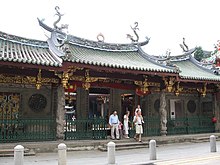
The Hokkien (�建人) constitute around two-fifths of the Chinese Singaporean population. They are the largest linguistic group in Singapore. They come from the Minnan or Hoklo people who originated in the southern parts of the Fujian province, including Xiamen, Quanzhou, and Zhangzhou.
They speak Singaporean Hokkien, the standard of which is based on the Amoy dialect of Xiamen, which is 50.4% comprehensible with Teochew although less so with Hainanese.[6] The Hokkien language was a lingua franca among coastal Chinese and was also used by other ethnic groups such as the Malays and Indians to communicate with Chinese before Mandarin came to dominance during 1980s and 1990s.
Unlike some other areas,[example needed] Singaporeans do not use "Hokkien" as a catch-all in reference to Chinese from Fujian, but only to the Minnan from its southern coast. Thus Singaporean Hokkien is not inclusive of northern Fujianese such as those arriving from Fuzhou, Putian, and so on. Early Hokkien migrants settled around Amoy Street and Telok Ayer Street, forming enclaves around the Thian Hock Kheng Temple. They subsequently set up clan headquarters (Hokkien Huey Kuan) there and later expanded to Hokkien Street and the vicinity of China Street. The Hokkien were the most active in early trading that centred along the Singapore River.
As early settlers came from the southern coast of China, they were active in sea trade and worshipped one of the patron-deities of Taoist pantheon, the Heavenly Mother Ma Zhu, a protectress of sailors. In Singapore, her idol was at the Thian Hock Kheng Temple, which was thus also known as the Ma Zhor Kheng. Other popular deities are the Nine Emperor Gods and the Jade Emperor, who is celebrated on his birthday on the 9th day of Chinese New Year.[citation needed]
A traditional Taoist practice by a spiritual medium (乩童, p jÄ«tóng, Hokkien tangki) is also popular. The tangki goes into a trance and purportedly channels a chosen deity for the petitioner. The deity then provides a wide range of help ranging from religious rituals to answering queries to providing protective talismans.[citation needed]
[edit] Teochew
Main article: Teochew people The Ngee Ann Kongsi is based at the Teochew Building on Tank Road.
The Teochew in Singapore constitute about a fifth of the Chinese population in Singapore, making them the second largest Chinese dialect group in Singapore. They originated from Chaoshan region in eastern Guangdong, in cities like Chaozhou, Shantou, and Jieyang. Many trace their origins from different Northern cities, but were settled there to maintain as county authorities within the south of China.
Despite similarities, the Teochews and Hokkiens consider themselves distinct and did not get along during their early settlement in Singapore, especially during the British colonial era. The Teochew were dominant for a period of time during the 19th century. Mass immigration from Fujian changed this, although the majority of the Chinese along the banks of the Straits of Johor were Teochew until the HDB initiated redevelopment in the 1980s. The Straits Times reports that Hougang still has a relatively high concentration of Teochew residents.[citation needed]
Most Teochew settled along the Singapore River in Chinatown during the 19th and early 20th century. Teochew who settled in Chinatown worked in many commercial sectors as well as the fisheries. Commercial sectors once dominated by Teochews include Circular Road and South Bridge Road. Other Teochew businessmen set up gambier and pepper plantations in the dense forests of north Singapore and Johor Bahru. The Chinese first started their plantations with the approval of the Sultan of Johor and then developed the kangchu (江åŽ�, p jiÄ�ngcuò, lit. "river house") system. Chu was the clan name of the first headman of the plantations in the area. These kangchus gave rise to modern place names such as Choa Chu Kang, Lim Chu Kang and Yio Chu Kang, all of which were plantation areas prior to urban redevelopment.
Early Chinese immigrants clustered themselves to form clan and language associations. These clan associations (kongsi) served as unions for the mostly illiterate Chinese labourers and represented them when dealing with their colonial administrators or employers. One of the more prominent associations for the Teochew was the Ngee Ann Kongsi, formed in 1845 and still in operation.
[edit] Cantonese
Main articles: Cantonese people and Hong Kong peopleThe Cantonese make up 15% of the Chinese Singaporean population. They originated from Hong Kong and the southern region of Guangdong province in China, including Guangzhou, Zhaoqing, Shunde, Taishan, and Heshan.
The Cantonese speak several dialects belonging to the Yue family. Yue Hai is considered the prestige dialect from its occurrence in Guangzhou. Other variants include Luoguang, Seiyap and Gouyeung. The Gwainaam is spoken by immigrants from Guangxi and shares close affinity with Pinghua.
The Cantonese worked mainly as professionals and tradesmen during the early and mid 20th centuries, and their businesses dominated the shop houses along Temple Street, Pagoda Street, and Mosque Street. Cantonese women from the Samsui district worked at construction sites and contributed greatly toward Singapore's development. These Samsui women left their families behind in China and came to Singapore to work at construction sites for a living during the early 20th century. They were noted for their distinctive navy-blue outfits and bright red headgear,[clarification needed] meant to protect their hair as they worked. This headgear was first worn by Wang Chao Yun (王æœ�云, å—å�霞), a concubine of Su Dongpo who lived in the Hakka Fui Chiu district of Guangdong;[citation needed] it eventually became the traditional headgear of Hakkas, whence it was adopted by the Cantonese women who worked alongside them. Cantonese women from the Seiyap district of Jiangmen wore black headgear similar to the Samsui women and mainly worked at Keppel Harbour and the shipyards at the old harbour along the Singapore River. More Cantonese immigrated from Hong Kong in the late 1980s and early 1990s.
As of 2010, Singaporeans recognize Chinatown for having a large number of Cantonese people.
[edit] Hakka
Main article: Hakka people
The Hakka constitute 11.4%.[clarification needed][7] They originated mainly from the northeastern part of Guangdong in China, from such areas as Mei and Dapu. Mr. Lee Kuan Yew, the first prime minister of the Republic of Singapore, has Hakka ancestry tracing back to Dapu.
Since the Hakka language is strongly influenced by Minnan and Cantonese but still somewhat similar to Mandarin, the Hakka were long thought to have migrated from northern China between the 4th and 13th century. Recent genetic studies, however, have shown that the Hakkas have for the most part originated from southern China, like most of the other Chinese language groups in Singapore.[citation needed]
Many Hakka women who came to Singapore during the early 20th century worked in construction sites and wore headgear similar to the Samsui women. However, unlike the Samsui, the Hakka women wore black headgear.
-
Originally posted by Army 21:
but even if they had an idiot standing on a soap box how did spore end up being supporting them unless the population are ...........defective or worse.
The people of Singapore supported the left wing of the PAP led by Lim Chin Siong, not Harry Lee Kuan Yew.
That peranakan bastard didn't have any popular support at all among the local people, that is why he had to resort to autocratic methods to control Singapore. This is the core reason why PAP is so insecure and autocratic.
It is completely impossible to understand Singapore politics without knowing the fact that a tiny minority with peranakans at the core controls a vast majority of dialect chinese, malays and indians.
-
Originally posted by Dalforce 1941:
But last time Ming China helped the Malays to deal with the portugese colonial bastards.
Martim Afonso de Mello started with six vessels from Malacca[3] on 10 the July 1522 and arrived at Tamao at August to conduct negotiations with the Chinese, due to relations being strained between China and Portugal. Portuguese like Simão de Andrade had been kidnapping Chinese children to sell in Malacca, and ignored Chinese sovereign authority at Tamao, building a fort. Among the rumors spread was that Simao and other Portuguese were cannibalizing Chinese children for food.[4][5] The Chinese responded by blockading the Portuguese.
The Portuguese wanted China to allow them to use Tunmen as a base, and place a fort at its location.[6]
The Portuguese had also conquered the Muslim Malay Malacca Sultanate at theCapture of Malacca (1511). The Malacca Sultanate was an ally of China, and China demanded that the Portuguese withdraw from Malacca and restore the Malay sultan to the throne. The Chinese were notified of the Portuguese conquest of Malacca by the Sultan, and they were displeased about it.[7]
The Chinese held an entire Portuguese diplomatic mission hostage, with Pires as its leader, trying to force the Portuguese to return Malacca to the Sultan in exchange for Pires to be released.[8] This occurred in 1521.[9] The Chinese effectively held the Portuguese embassy hostage, using them as a bargaining chip in demanding that the Portuguese restore the deposed Malaccan Sultan (King) to his throne.[10] The Chinese proceeded to executed several Portuguese by beating and strangling them, and torturing the rest. The other Portuguese prisoners were put into iron chains and kept in prison.[11] The Chinese confisticated all of the Potuguese property and goods in the Pires embassy's possession.[12]
The Portuguese came up with a false explanation that they conquered Melaka due to "the local ruler's tyrannies against the Chinese", which made the Chinese even more suspicious of the Portuguese.[13]
Simao's activities, which were piratical in nature, angered the Chinese people and the Chinese government, which led to the Chinese officials to order the eviction of the Tunmen Portuguese.[14]
portuguese ate chinese kids?eww
-
Originally posted by Dalforce 1941:
The people of Singapore supported the left wing of the PAP led by Lim Chin Siong, not Harry Lee Kuan Yew.
That peranakan bastard didn't have any popular support at all among the local people, that is why he had to resort to autocratic methods to control Singapore. This is the core reason why PAP is so insecure and autocratic.
It is completely impossible to understand Singapore politics without knowing the fact that a tiny minority with peranakans at the core controls a vast majority of dialect chinese, malays and indians.
well......it all points out that majority were not warrior types n didnt fight for their rights or humanity till the end. -
seems like most of spore population had past origins which were dumb superstitious sailors,illiterate labourers and samsui women!mostly muscles n brawns.
and most of perankans are politicians and actors.
wad a way to go!
no wonder !i wonder also at times............
-
well......it all points out that majority were not warrior types n didnt fight for their rights or humanity till the end.
They fell to the repression of the PAP regime.
People like Chia Thye Poh:

http://singaporerebel.blogspot.sg/2011/12/dr-chia-thye-poh.html
This type of hokkien chinese like Chia Thye Poh and Lim Chin Siong and Ong Teng Cheong, the peranakan bastard Harry Lee Kuan Yew is most afraid. Because they are the biggest force in Singapore able to threaten his power.
-
Originally posted by Dalforce 1941:
They fell to the repression of the PAP regime.
People like Chia Thye Poh:
http://singaporerebel.blogspot.sg/2011/12/dr-chia-thye-poh.html
This type of hokkien chinese like Chia Thye Poh and Lim Chin Siong and Ong Teng Cheong, the peranakan bastard Harry Lee Kuan Yew is most afraid. Because they are the biggest force in Singapore able to threaten his power.
thepeople didnt fall on purpose.they fell because they had too much muscles suppressing their brainwaves.
-
im pretty sure if the population of spore were those real scholar types and intelligent warriors from ancient china then things would be better for everyone by today.but history implanted those knuckle heads and actors to be in region because asia was simply too humid n hot for most chinese ancient people at time.
-
Who cares about ancestors nowadays anyway? Unless you are some sort of imperialist dog.
-
Originally posted by Uraniumfish:
Who cares about ancestors nowadays anyway? Unless you are some sort of imperialist dog.
if u buy a beef to eat...u wanna know the origins of beef......is ita brahman cow or a hefner cow or a kobe beef cow.although they are cows...their taste is different,,texture different.same as for ancestry of humans.they may look the same but they are different slightly.n this slight means alot of difference to many things. -
why is it there r only 2 persons keep answering this thread?
-
same goes for crabs.......u need a certain kind of crabs for pepper crab!it wouldnt be same or good if u took a flower crab to cook local pepper crab!u need mud crab for the real pepper crab.u may use other kinds of crabs like softshell but the taste n feel would be differnt.
-
Originally posted by foolsh_2000:
why is it there r only 2 persons keep answering this thread?
its 4 ok!!!u can count right? -
Originally posted by Army 21:
if u buy a beef to eat...u wanna know the origins of beef......is ita brahman cow or a hefner cow or a kobe beef cow.although they are cows...their taste is different,,texture different.same as for ancestry of humans.they may look the same but they are different slightly.n this slight means alot of difference to many things.Possibly the worst analogy in all of sgforums. Even those 'warrior type or scholar from China' are not alive today, and their descendants do not have qualities of warriors nor scholars, unless you believe LKY's ideas about eugenics.
In humans, these things are not even genetic, let alon inheritable.
I don't know why, many people in Chinese culture are ancestor minded. They talk about how their ancesters were great intellectuals, and great warchiefs and what not. If they were taking after their ancesters, which they are not, why are the so useless and have accomplished and contributed nothing good?


