Surprising truth on peranakans!
-
i think my fart better. bcos if i just use a lighter to light it up, it burns, at least for a while. but that's real magic you know.
-
Originally posted by troublemaker2005:
i think my fart better. bcos if i just use a lighter to lit it up, it burns, at least for a while. but that's real magic you know.
The magic of methane gas!
-
but not as powerful as the magic of bulshit and word twisting from the pee arse cees. seems like similar to eating dogs and cats - they are so good at twisting them
-
Originally posted by troublemaker2005:
but not as powerful as the magic of bulshit and word twisting from the pee arse cees. seems like similar to eating dogs and cats - they are so good at twisting them
Pee aRse Cees are messed up neurologically, due to generations of inbreeding. What do you expect when population shot up from less than 5 million to 1.3 billion in 4000 years without outsider genes coming in.
-
Originally posted by Uraniumfish:
Pee aRse Cees are messed up neurologically, due to generations of inbreeding. What do you expect when population shot up from less than 5 million to 1.3 billion in 4000 years without outsider genes coming in.
PRCs are ex communists so they behave like ex-mafia. No surprise.
If you like to know the northern Chinese are genetically different from the southern Chinese which is what most of the local Chinese in Sg.

-
Originally posted by Clivebenss:
PRCs are ex communists so they behave like ex-mafia. No surprise.
If you like to know the northern Chinese are genetically different from the southern Chinese which is what most of the local Chinese in Sg.
Cubans and Russians are real tough-guy ex commies, these china people too spineless for even communism, where the rights of blue collar men is the big deal.
-
Originally posted by Clivebenss:
PRCs are ex communists so they behave like ex-mafia. No surprise.
If you like to know the northern Chinese are genetically different from the southern Chinese which is what most of the local Chinese in Sg.
i think that was years ago. thre's s stark difference between our fathers and those now even fresh from the south. they are all for mooney , mindedd rats. -
Peranakans are in some way an accident of history lah! Forget about the Hang li Poh story . Chinamen came to Nanyang because of famine in Mother China . some sold as chue chai slaves for the plantations In Singapore and Malaya ., Some even became gangsters in the Lurut mines the Ghee Hins and the Hai Sans....But the very early ones probably traders or settlers married Batak women and had offsprings - probably the first real Peranakans. Now if you are a half caste- will any other blue blooded Chinese want to marry you in those old traditional days? So no choice - the half caste marry the half caste! the children of such unions married each other and the sub ethnic group - the peranakans took root. But because many of these peranakans were English educated- they rose up socially in the colonial days - and looked upon themselves as "the elites" of the day. And when that happened in the Straits Settlement -suddenly everyone wanted to be peranakan or associated with peranakans. Even those not peranakans but become rich in the Straits settlements took on the cultural life style of the babas and nonyas and passed themselves off as peranakans. Some sinkheks from China later also aspired to marry a local "nonya" -like maybe the kang chu's daughter or the gambir plantation owners daughter....Later on nearer the 1940's poor peranakan families who had lost their fortunes in the war even sought cina gerk son-in-laws who were wealthy but without social status -to replenish family wealth in return for elite social status of a peranakan family, thus the "cheo kia sai" (buay teng lang,selling the lantern) rites whereby the rich cina gerk son-in-law take s on his father-in-laws surname!
-
But because many of these peranakans were English educated- they rose up socially in the colonial days – and looked upon themselves as “the elites” of the day.
Peranakans were trusted by the british. The british put them as heads of political organisations to control the chinese in Malaya and Singapore. The head of the MCP Chin Peng also spoke of this british tactic.
With MCA of Malaysia, it was Tan Cheng Lock, PAP of Singapore is Harry Lee Kuan Yew.
http://en.wikipedia.org/wiki/Tan_Cheng_Lock
The british bastards didn't trust the dialect chinese of southern China. During the colonial era, the british served as the 1st rank of the elite, peranakans and eurasians served as 2nd rank.
After end of colonialism, the peranakans moved up to first rank.
-
Originally posted by Bikeforceful:
Peranakans are in some way an accident of history lah! Forget about the Hang li Poh story . Chinamen came to Nanyang because of famine in Mother China . some sold as chue chai slaves for the plantations In Singapore and Malaya ., Some even became gangsters in the Lurut mines the Ghee Hins and the Hai Sans….But the very early ones probably traders or settlers married Batak women and had offsprings – probably the first real Peranakans. Now if you are a half caste- will any other blue blooded Chinese want to marry you in those old traditional days? So no choice – the half caste marry the half caste! the children of such unions married each other and the sub ethnic group – the peranakans took root. But because many of these peranakans were English educated- they rose up socially in the colonial days – and looked upon themselves as “the elites” of the day. And when that happened in the Straits Settlement -suddenly everyone wanted to be peranakan or associated with peranakans. Even those not peranakans but become rich in the Straits settlements took on the cultural life style of the babas and nonyas and passed themselves off as peranakans. Some sinkheks from China later also aspired to marry a local “nonya” -like maybe the kang chu’s daughter or the gambir plantation owners daughter….Later on nearer the 1940’s poor peranakan families who had lost their fortunes in the war even sought cina gerk son-in-laws who were wealthy but without social status -to replenish family wealth in return for elite social status of a peranakan family, thus the “cheo kia sai” (buay teng lang,selling the lantern) rites whereby the rich cina gerk son-in-law take s on his father-in-laws surname!
You seem to suggest that peranakans are in some way inferior to pure (i.e. inbred) Chinese. Culturally I would say peranakans have it much better than the Chinese, which is all about greed and oppressing others.
-
Originally posted by Uraniumfish:
Culturally I would say peranakans have it much better than the Chinese, which is all about greed and oppressing others.
That's not the case at all with overseas chinese.
-
Originally posted by Dalforce 1941:
That's not the case at all with overseas chinese.
True Dat
-
Originally posted by Uraniumfish:
You seem to suggest that peranakans are in some way inferior to pure (i.e. inbred) Chinese. Culturally I would say peranakans have it much better than the Chinese, which is all about greed and oppressing others.
I don't stand in judgement of anyone. But I do make a distinction , my perception of the real babas and nyonyas of yesteryears who actually spoke the baba patois and actually lived the culturally privilege -lives of babas and nonyas, than the present day all and sundry ones who claim baba and nonya connections just because their grandma happens to wear some sarong ( folded the wrong way) and machine embrioded kebaya bought from Jonker Street in melaka, and to occasionally cook sambal udang and chicken curry (albeit actually Hainanese style)! As for greed and opppressing others- you can find that human failing exist in almost every group of human beings on earth! Power corrupts and absolute power corrupts absolutely regardless of time place and people. It was really ironical when a t a recent keeping the place clean campaign ...a budget was announced to make the place more environmental pleasant , and this Minister said ," Money alone cannot buy cleanliness...it is the responsibilty of everyone!" Almost prophetic ! How true I thought! Indeed how can money buy cleanliness? On the contrary more often, it is the very tainted stains in itself! -
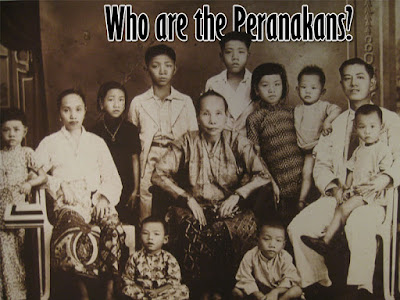 In the late 15th to 16th century, there were Chinese who immigrated to the Indonesian archipelago of Nusantara in order to trade and escape the hardships back in their homeland. Many have started to build their new lives and there communities in Malaka and modern-day Singapore. In time, they began to address themselves as "Nyonya Baba," wherein nyonya is referred to the women and baba for the men.Peranakan referes to the ethnic Chinese populations of the British Straits Settlements of Malaya and the Dutch-controlled island of Java and other locations, who have adopted partially or in full Nusantara customs to be somewhat assimilated into the local communities. Many people associate the Peranakans as the local Chinese elites of Singapore. As most of them have lived for generations and most have not intermarried with Indonesians, Malays, and other races, the Peranakans held a distinctive custom and tradition that is totally unique to the recent influx of mainland Chinese immigrants.They were usually traders, the middleman of the British and the Chinese, or the Chinese and Malays, or vice versa. Being British-educated, many of them have the ability to communicate with their colonial masters and many of them have lost the ability to speak Chinese as they were assimilated to the Malay Peninsula's culture.The term is usually refered to the chinese and so they can be also called as Straits Chinese. There are other races that can be called "Peranakan" in their own way with Hindu Indians are Chitty, Muslim Indians as Jawi Pekan, and Eurasians as Kristang. Even though their native language has gradually disappeared in recent years, many have maintained their culture.What's with the Term?Basically, the word means "descendant" in Indonesian and Malay without any connotation of the ethnicity of descent unless followed with the identifying race so "Cina" for Chinese, "Belanda" for Dutch, and "Jepang/Jepun" for Japanese.A Persian loan word "baba" used in Malay is an honorific for grandparents, which is then used to refer to Straits Chinese men. Its etymology is traced back to Hindustani speakers who used it to refer to Chinese vendors and traders, who were mostly male. Nyonyas were referred to the women and this term is Javanese loan word from the Italian "nona" (grandma) and Portuguese "donha" (lady). Since most Javanese referred foreign women as nyonyas, the term were obviously referred as honorifics to Straits Chinese women.Straits Chinese were defined as those born or living in the Straits Settlements: a British colonial construct of Penang, Malacca and Singapore constituted in 1826.Tracing their AncestryMost Peranakans trace their ancestry to their Hoklo (Hokkien) parentage while a sizable minority are of Teochew and Cantonese descent. Basically, the Peranakans were mixed-race - part Chinese, part Malay/Indonesian. The Baba Nyonya is a subgroup withing the Chinese communities that trace their descendants to the unique Sino-indigenous unions in Melaka, Penang, and Indonesia.Mixed race communities usually possess a mix of cultural traits as written records show. Many Peranakan men took brides from within their local community while some imported brides from China. Some send their daughters to China to find husbands.Many historical sources suggest that early Peranakans married local Malays since some servants, who settled in Bukit Cina, travelled to Malacca with a Yunnanese admiral, a Muslim Chinese. Other experts believed that the Peranakans' Chinese ethnicity has hardly been diluted in the racial mixing. Some Peranakans can be distinguished from those with part Malay ancestry and those without any Malay ancestry.What they SpeakPeranakans speak a creole dialect of Bahasa Melayu called Baba Malay, which contains many Hokkien words. This rare and dying language is usually spoken by older generation Peranakans while the younger generation speak Singaporean English.Famous Peranakans?Here are some of the famous people with Peranakan heritage in Singapore as well as some prominent individuals from Indonesia and Malaysia:Goh Keng Swee - First Deputy Prime Minister of SingaporeLee Kuan Yew - First Prime Minister of SingaporeLee Hsien Loong - Third Prime Minister of Singapore, son of Lee Kuan YewWee Kim Wee - Fourth President of SingaporeDick Lee - Celebrity pop singer, composer and playwrightPierre Png - Mediacorp artisteTony Tan Keng Yam - 7th President of SingaporeTun Dato Sri Tan Cheng Lock - Founder and first President of Malaysian Chinese Association (MCA)Tun Tan Siew Sin - Third President of Malaysian Chinese Association (MCA)Nyonya Chuah Guat Eng - NovelistAgnes Monica - Indonesian recording artist and actressChris John - Indonesian professional boxerKwik Kian Gie - prominent Indonesian economistRudy Hartono - former Chinese Indonesian badminton player who won the men's singles title at the World Championship in 1980Liem Swie King - former Indonesian badminton player who excelled from the late 1970s through the mid 1980sSusi Susanti - Indonesian badminton gold medalist in the 1992 Barcelona OlympicsMari Pangestu - Indonesian minister of Tourism and Creative EconomySoe Hok Gie - Indonesian activist who opposed the successive dictatorships of Presidents Sukarno and SuhartoTiti DJ - Indonesian pop singer
 -
1
The Prospect of the Peranankan Community at the Age of Globalization
By Tan Ta Sen
Ladies and Gentlemen, I felt extremely honoured to be here today to share with
you my thought on the prospect of the Peranakan community at the age of globalization.
Being a Baba and Nyonya yourself, I am sure, you are very concerned about the future of
the Peranakan community. The word “peranakan” is very commonly used in bahasa
Indonesia than in bahasa Melayu. In the past “baba and nyonya” were commonly used for
the localized Chinese. Peranakan in fact includes all localized foreigners or their
descendents. Thus we have the Chinese peranakan (baba & nyonya), Indian peranakan
(Chitty or mamak-Indian Muslim), Portugese peranakan, European peranakan (eurasian
or serani). Melaka is the home of the Peranakans in both Malaysia and Singapore and so
it is not only appropriate and relevant but also historically significant for me to deal with
this topic here. Although I am a Singaporean and I am not a Baba, in the past decades, I
have business concerns in Melaka, and a frequent visitor of Melaka. Thus, I am virtually
a local Melakan, live at the centre of the old town and have witnessed the change that has
taken place in the past two decades.
I would like to begin by giving you a few significant glimpses into the history of
Chinese diaspora as well as the eventual development of the Peranakan community in
Melaka so as to set the tone of proper historical perspective. The Chinese have been
migrating southward from China to Southeast Asia for centuries, driven from their
homeland by economic necessity, political disturbance, flood and drought. Chinese
diaspora outside China are generally addressed as Tang Ren (Teng Lang ��) because 2 since the 7th century in the Tang Dynasty, Chinese mariners and traders were engaging in
considerable international maritime trade, traveling as far afield as East Africa through
the Straits of Malacca. They went to mainland Southeast Asia much earlier and they
were addressed as Qin Ren (��). However, they were merely sojourners before the
14th century. Cheng Ho’s historic seven voyages to the Western Ocean in the early 15th century marked the first wave of Chinese migration to Southeast Asia. Cheng Ho discovered
the presence of Chinese settlements in Island Southeast Asia. Three crew members of
Cheng Ho’s fleet, Ma Huan, Fei Xin and Gong Zhen have recorded their eye-witness
accounts of Cheng Ho’s voyages to the western ocean in their books. They witnessed the
existence of Chinese settlements in Sumatra’s Palembang and Java’s Majapahit, Tuban,
Gresik and Surabaya. This first wave of Chinese emigration was characterized by
indigenization (localization) as these pioneers were quick to interact and even
intermarried with the natives and as a result they were gradually assimilated into
the local population. However, Ma Huan and Gong Zhen made no mention of Chinese
settlement in Melaka but Fei Xin casually referred to some pale-looking people among
the Melaka residents as the “Tang” people. ”Tang” like “Han” is commonly used to refer
to the Chinese. Therefore, we safely conclude that there were a handful Chinese in
Melaka during Cheng Ho’s era and they were too few to form any so-called Chinese
settlement. As Cheng Ho built an outpost in Malacca and all ships going to other ports
were required to assembled in Malacca awaiting fair wind to make the homeward
journey, there were certainly sizable crew members of Cheng Ho’s fleet temporarily 3
putting up in the guanchang (government warehouse complex). Ma Huan, Gong Zhen
and Fei Xin were quite clear about these itinerant Chinese and so it was unlikely that they
would be confused between the itinerant Chinese crew members who were sojourners
and the few Chinese residents.
The legend of Hang Li Poh has hinted the existence of Melaka’s earliest Chinese
settlement at Bukit Cina during the Cheng Ho era. Princess Hang Li Poh has long been
conveniently dismissed by historians as a myth. But I would like to review the Hang Li
Poh story in a fresh historical perspective. On the subject of Hang Li Poh, in my opinion,
it was a historical event which might have possibly taken place. When we survey the
legends of Southeast Asia, especially of Indonesia and Malaya, we often find stories of
Chinese princesses marrying native rulers. It can be attributed to the fact that China
throughout history was a great power and a cultural centre surrounded by undeveloped
native states. These native rulers would feel extremely honoured to marry a Chinese
princess as it could enhance the prestige of the native rulers and win the trust of the
Chinese emperors. During colonial period, it would be great honour for a native to marry
a white girl. In history, there were many examples of Chinese princesses marrying native
rulers such as Princess Wencheng who was married to a Tibetan king and Wang Zhaojun
to a Xiongnu ruler. Hang Li Poh could have been another Wang Zhaojun who was not a
princess but a maid in the imperial palace. In fact, the Malay Annals’ story of Hang Li
Poh marrying Sultan Mansor Shah was an error. The sultan who married Hang Li Poh
should have been Megat Iskandar Shah (Parameswara’s son). Western scholars were also
agreeable to this version but mistakenly regarded her as the daughter of a local Chinese 4
kapitan. The kapitan system was only introduced by the Portuguese in the 16
th century but the Hang Li Poh story took place in the early 15th century. In my view, Hang Li Poh
was very likely one of the maids in Yongle’s palace. In addition, ‘Puteri” in Malay and
Indonesian languages may not necessarily mean “princess”. It is widely used as pet name
for girls like Chinese call their daughters Qian Jin (��) (thousand gold). Historian’s
suggestion about the story of Hang Li Poh as a legend simply because there was no
record on her in the Ming dynastic history may not be totally correct. The Malay and
Indonesian historiographies are fairly similar to the Chinese historiography as literature
and history is inseparable. Literature, biography, even mythology are in complete
harmony with historical facts. Moreover, Hang Li Poh was not a princess, why should
Chinese official record this event?
Cheng Ho’s historic seven voyages to the Western Ocean in the 15th century
opened the door for the Chinese living in the coastal provinces in China such as
Guangdong and Fujian to migrate abroad. The second wave of Chinese emigration took
place between 1644 to 1840s and was characterized by westernization. The
overthrow of the Ming Dynasty by the Manchus in 1644 led to an exodus of Ming
royalists to Southeast Asia. A group of these Ming royalists like Melaka’s second
Chinese kapitan, Li Wei King (���) also known as Li Jun Chang �or Li
Kap took refuge in Melaka and later given the Kapitan post by the Dutch ruler.
These cultured Ming royalists soon made fortunes from trade and were
picked by the Portuguese, Dutch and British colonial governments as community 5
leaders and appointed them as Kapitans in charge of Chinese affairs from the 17th
to 19th centuries. The office of the Chinese kapitan was located in the Cheng Hoon Teng
Temple, the oldest Chinese temple in Melaka and Malaysia. Hence, Cheng Hoon Teng
was the most important power base of the Chinese in Melaka. Cheng Hoon Teng Temple
was jointly established by the first two Chinese Kapitans, Tay Hong Yoe (
��) also
known as Tay Kap and Li Wei King in 1673 . Then, the Chinese population in Melaka
was small about 100 plus; there were 160 Chinese in 1675, two years after the foundation
of the Cheng Hoon Teng Temple. In 1678, the Chinese population increased significantly
to 426. Since they were entrusted to be in charge of the Chinese affairs, they took the first
step to organize the Chinese community by forming the Cheng Hoon Teng Temple.
Li Kap, a native of Xiamen, was one of the Ming royalists who fled from
Manchu rule after the overthrow of the Ming Dynasty in 1644. Together with other likeminded Ming royalists, he took refuge in Malacca. These Ming royalists being learned
Confucian scholars, brought Chinese culture to Malacca. Li Kap went into business and
made his fortunes. He then collaborated with Tay Kap to establish the Cheng Hoon Teng
Temple. Later, he bought and donated a piece of land for use by the Chinese community
in Malacca as a burial ground in Bukit China or Sam Po Hill. It is not surprising that Tay
Kap and Li Kap had targeted temple and burial ground as urgent services for the Chinese
in Malacca. For immigrants the temple is constantly the first refuge to seek salvation of
inner peace and spiritual attachment to and link up with fellow clansmen in a foreign
land, and the cemetery is to ensure the wanderers a last resting place. In any early
Chinese settlement abroad, temple, clan associations and burial ground are always the 6
first forms of social organizations as they bond the immigrant community into a cohesive
society.
In 1698 a French business delegation on its way to China made a brief stopover
in Melaka and visited Cheng Hoon Teng. One of delegation members , Froncois Froger
paid a visit to the Cheng Hoon Teng and he wrote about the temple with a temple layout
plan. He described that the temple consisted of four major sections, namely the main hall,
front hall, inner hall and women’s prayer quarter. On the day of his visit, the temple
priests were performing religious ritual. He was so engrossed that he stayed in the temple
for two hours and jotted down his impressions of the happening. Froger made one
important remark of very historical significance. He called the Cheng Hoon Teng
Temple as “The Pagoda of the Chinese Refugees in Melaka”. It testified the existence
of a considerable group of Ming royalists taking refuge in Melaka after the Manchus
overthrew the Ming Dynasty in 1644. After half a century, this “refugee” impression of
Melaka was still distinctively noticeable.
These refugees or Ming royalists were the pioneers of Melaka Chinese society.
They brought Chinese culture to Melaka shaping the development of the Chinese society
in Melaka and eventually nurtured the birth of a Peranakan Chinese culture showing the
fusion of the cultural traits of both Chinese, English and Malay cultures.
The kapitan system was a legacy of the Portugese, Dutch and British colonial
governments from the 16th to early 19 th centuries. The kapitans were acknowledged as the
Chinese leaders by virtue of their enormous wealth and high social status. Their
descendants attended Portuguese, Dutch and English schools. Many of them worked 7
in foreign firms while others started their own companies engaging in imports and
exports of spices and China trade. They were the forefathers of the westernized
prosperous Peranakans. For instance, Kapitan Chua Soo Chong in the 18
th century was the father of prominent Baba Chua Chong Long and the grandfather of Baba Chua Yan Ling.
The British abolished the Kapitan system in 1825. Thereafter Cheng Hoon Teng
Temple introduced an appointment of temple president to be the leader of the Chinese
community in Melaka in place of kapitan. The temple presidential system was later
abolished in 1915. From 1825 to 1915, there were a total of six temple presidents: Liang
Mei Ji, Si Hoo Keh, Tan Kim Seng, Tan Beng Swee, Tan Beng Jiak and Tan Jiak Wai. Si
Hoo Keh, Tan Kim Seng, Tan Beng Swee and Tan Beng Jiak and so on were prominent
Babas and dominant Chinese leaders in Singapore and Melaka. It shows that the
Peranakans were the backbone of the Chinese in Singapore and Melaka in the 19
th century and the first part of the 20 th century.
In the 18th and 19th centuries the Babas were involved in opium, sireh, nutmeg,
pepper and gambier cultivation, tin mining, commodity trading and property. In the early
20th century, many Babas invested in rubber. Baba and Nyonya were financially better
off than China-born Chinese. Their family wealth and connections with the Malay
royalties and the British and Dutch colonialists enabled them to form a Straits-Chinese
elite, whose loyalty was strictly to Britain or the Netherlands. Most Peranakans were
English or Dutch-educated, as a result of the Western colonization of Malaya and
Indonesia, Peranakans readily embraced English and Dutch culture and education as a 8
means to advance economically. Thus administrative and civil service posts were often
filled by prominent Straits Chinese. Many in the community also worked as compradores
(Chinese middlemen) for big Western companies and banks. The Peranakan community
thereby became very influential in Malaya, Singapore and Indonesia and were known
also as the King's Chinese due to their loyalty to the British Crown.
The third wave of Chinese migration to Southeast Asia in the 19
th century
coincided with political turmoils in China and economic exploitation of Southeast
Asia by the Dutch and British colonial powers. The Taiping Rebellion in China was a
widespread civil war in southern China from 1850 to 1864. The First Opium War from
1839 to 1842 and the Second Opium War from 1856 to 1860 between China under the
Qing Dynasty and the British Empire. These events caused great hardships and economic
dislodgements to the farmers in Fujian and Guangdong. In the meantime, the Dutch and
British colonial governments were earnestly engaged in developing labour-intensive
sugar and tin-mining industries in Dutch Indies (present Indonesia) and British Malaya in
the Malay Peninsula. As a consequence, the job opportunities in Indonesia and Malaya
led to the mass exodus of the dislodged farmers in Fujian and Guangdong to the region.
These new arrivals, mostly illiterate, worked as cheap labourers in plantations and tinmines. As a result of the massive influx of the Chinese immigrants, the China-born
Chinese outnumbered Peranakan Chinese. The demographic change coupled with
the rise of a good number of adventurous new rich who made their fortunes from
tin-mines, gambier and rubber plantations as well as trade, ushered in a new phase
in the history of Chinese Diaspora. The rising China-born Chinese merchants 9
overtook Peranakans as community leaders. They actively built temples, clan
associations and Chinese schools to educate the immigrants’ children. As a result, it
signified a phase of re-sinicization as a dominant feature of this third wave of
Chinese migration and Chinese-educated Chinese became the mainstream of the
Chinese communities.
This re-sinicization process remained predominant during the fourth wave of
Chinese migration which was triggered by the outbreak of the Sino-Japanese War
in 1937. Soon after the war, a great number of Chinese literates and intelligentsia
such as teachers, journalists and so on migrated to Southeast Asia and they
reinforced dissemination of Chinese culture in overseas Chinese communities.
The post-war political developments in Indonesia, Malaysia and Singapore
had great impact on the history of Chinese Diaspora. The end of the Pacific War in
1945 saw a rise of multi-racial nationalist movements in Southeast Asia and people
of all ethnic groups of former colonies were united to fight for independence.
Changing Chinese communities entered a phase of commitment to national identity
after World War Two. We saw two noticeable features in this process. Firstly, the
rise of a local pan-Chinese identity signified the decline of the Chinese dialect or
sub-ethnic groups including the Peranakan Chinese when the Chinese joined hands
with the Malays and Indians in the struggle for independence. Secondly, after
independence, the Chinese moved to adopt citizenship and develop a sense of
national identity and actively engaged in nation-building. 10
Now we come back to review how these postwar changes had affected the
Peranakan community. As a community that always considered Malaya home, many
Peranakans were involved in civic projects and local government. Due to their strict
loyalty, they did not support Malaysian Independence. Things started to change in the
later half of the 20th century, with some leading Melakan Peranakans, for examble Tan
Cheng Lock and Tan Siew Sin, starting to support Malaysian independence.
Peranakan culture has started to decline in Malaysia and Singapore after
Independence. Without British colonial support for their perceived racial neutrality, they
have been faced with a cultural identity crisis. The Japanese Occupation and the
Government policies in both countries following Independence from the British have
resulted in the assimilation of Peranakans back into mainstream Chinese culture.
Singapore classifies the Peranakans as ethnically Chinese, so they receive formal
instruction in Mandarin Chinese as a second language instead of Malay. In Malaysia, the
standardization of Malay as Bahasa Melayu (required for all ethnic groups) has led to a
disappearance of the unique characteristics of Baba Malay. The Peranakan culture is
losing popularity to modern Western culture, but to some degree, Peranakans try to
retain their language, cuisines and customs. Young Peranakans still speak their creole
language, although many young women do not wear the kebaya. Marriages normally
follow the western culture because the traditional Peranakan customs are losing
popularity.
The situation has been aggravated in the present age of globalization in which we
see the fifth and last wave of Chinese emigration into Southeast Asia in the last 30 years 11
since the Chinese government relaxed the policy on overseas emigration. The rapid
economic integration and the improved political relations between ASEAN and China
resulted in new Chinese migration to Southeast Asia being possible and acceptable.
Following the rise of China as a world’s powerful political and economic nation, China’s
export, Chinese investment and contracted project constructions in Southeast Asia, have
risen dramatically with massive new Chinese immigrants coming into Southeast Asia.
This new wave of Chinese migrants to Southeast Asia and beyond is
unprecedented in Chinese history not only because the migrants originate from northern
and central Chinese provinces, but also because travel has become easier due to better
transportation links both inside and outside of China. That is results in potentially larger
numbers than previous waves of Chinese migration throughout the globe. These new
immigrants are a breed apart from their forebears, who spoke regional dialects and
exhibited little nationalism, identifying more with the localities in China from which they
hailed. The recent arrivals are not only better educated, speak Mandarin, but also tend to
identify with China as a whole. They are patriotic and loyal to the motherland. They are
currently rising up as an important force within overseas Chinese and ethnic Chinese
communities. However, the new immigrants have to move along with time to develop a
sense of national identity and integrate into the mainstream local Chinese society.
The Peranakans were therefore squeezed on the one hand by the governments’
nation-building policies, and on the other hand by the influx of the Chinese new
immigrants. Despite the national overtone of nation-building policies, it consciously
draws Peranakans into the mainstream Chinese society politically and culturally. The
Chinese immigrant phenomenon also puts pressure on the Peranakans to be re-sinicized. 12
Hence, in the 21st century, the Peranakans face the same dilemmas and problems
as other Chinese communities in Singapore and Malaysia: the decline of traditions, the
inability to speak the dialect, the growing number of mixed marriages. All these factors
lead to the great changes in the culture and uncertainty about the future. The frenzied
activities revolving around Peranakan life and language in this decade could perhaps be
seen as the frantic last throes of a declining community. But the Peranakan community
seems determined to re-assert its identity in the face of encroaching modernity and loss of
traditional culture and within the context of language shift and re-acculturation.
In short, the Peranakan community was born during the Cheng Ho and western
colonial eras. Their main characteristic was at first being localized (indigenized-Malay or
Indonesian) ; westernized during colonial era, and re-sinicized at the present national
stage.
Thank you.
http://www.chengho.org/downloads/TTS-_Peranakan_talk.pdf
-
The Penang nonyas and babas are different from the melaka baba nonyas. Penang nonya speak Penang Hokkien not baba patois and there is more Siamese influence even in their food ad dressing. A lot of their food is assam sourish based like their Penang Laksa. Melaka nonyas and babas speak the patois , and also have very tanned-skinned , fierce looking ancestors - resembling the Bataks . Many these days who claim peranakan ancestory are actually merely the descendants of successful semi-English educated Chinese who made good in the Straits Settlements of Penang Melaka or Singapore, took on some of the lifestyle traits and practices of the babas and nonyas and referred to themselves as Straits- born chinese rather than China- born chinese. Even the China born chinamen who were sold to Southeast asia to work in plantations ..had dreams of marrying the plantation owners daughter or nonya( local or straits - born Chinese women) Many actually succeeded to do so before the Japanese invasion , as some of the poorer peranakan families unable to flee in time from Spore and Melaka to Thailand or Burma , married off their daughters in haste to cina tok toks of the day ...rather than risk their daughters being raped by the brutal Japanese soldiers!
-
Originally posted by Bikeforceful:
The Penang nonyas and babas are different from the melaka baba nonyas. Penang nonya speak Penang Hokkien not baba patois and there is more Siamese influence even in their food ad dressing. A lot of their food is assam sourish based like their Penang Laksa. Melaka nonyas and babas speak the patois , and also have very tanned-skinned , fierce looking ancestors – resembling the Bataks . Many these days who claim peranakan ancestory are actually merely the descendants of successful semi-English educated Chinese who made good in the Straits Settlements of Penang Melaka or Singapore, took on some of the lifestyle traits and practices of the babas and nonyas and referred to themselves as Straits- born chinese rather than China- born chinese.
Even the China born chinamen who were sold to Southeast asia to work in plantations ..had dreams of marrying the plantation owners daughter or nonya( local or straits – born Chinese women) Many actually succeed to do so before the Japanese invasion , as some of the poorer peranakan families unable to flee in time from Spore and Melaka to Thailand or Burma , married off their daughters in haste to cina tok toks of the day …rather than risk their daughters being raped by the brutal Japanese soldiers!
So what?
-
can we put what has been documented here into the perenakan museum?
-
Originally posted by troublemaker2005:
can we put what has been documented here into the perenakan museum?
More like the 'Chinese ironic-supremecy museum'.
-
Originally posted by Uraniumfish:
So what?
So too bad! - lots of fake babas and nonyas around!
