Countdown
-
Thanks Bodhi Hut and AEN for the info on sambhogakaya...
-
Originally posted by Bodhi hut:
my understanding is..法身,应身,化身。。。。in chinese..
extract from my forum
北方世界ä¸æœ‰ï¼Œè¿žå�Žè—�世界,是佛报身之净土。
连��世界之三�尊者,
毗��那佛
文殊�薩
普賢�薩
�称�严三圣。
毗��那的��是,光明�照,�一切处,大日�照。
å��ä½›å��之ä¸ï¼Œæœ‰æ¸…净法身佛毗å�¢é�®é‚£ä½›ï¼Œåœ†æ»¡æŠ¥èº«å�¢èˆ�那佛,å�ƒç™¾æ„�化身佛释迦牟尼佛。
三身四智http://www.dharma.com.tw/X2GB/D21Story/S5044.htm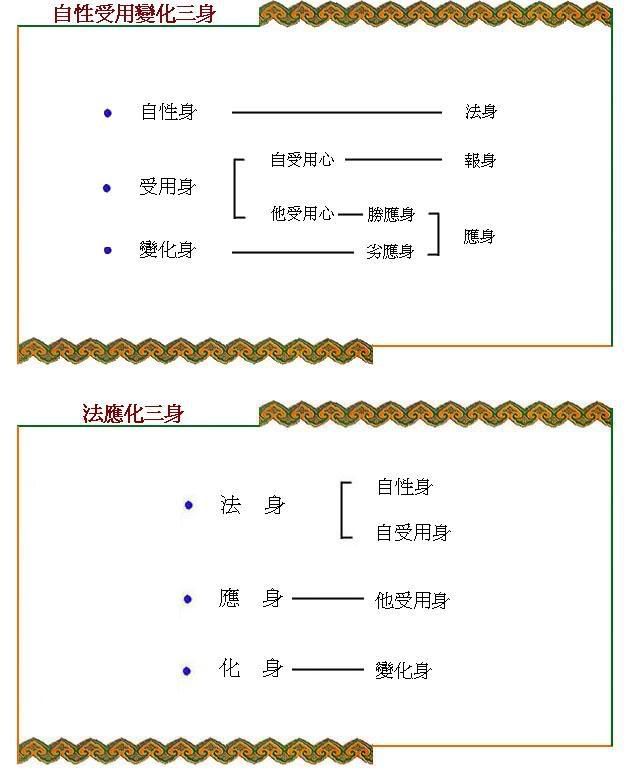
what is 应身。btw about the origin of the world ,buddha refute the teaching of 外é�“,who said there is one creator of the world.æœ‰ç”ŸäºŽæ— ã€‚but buddha said it's å› ç¼˜å’Œå�ˆè€Œç”Ÿã€‚
-
http://www.msnbc.msn.com/id/25098001/ Heard rumours about this gamma ray telescope launched recently just to observe planet X
-
Lastly whether this niribu it is real or not will be decided by next year mid 2009 since it will visible to everyone on this planet
-
Originally posted by rokkie:
what is 应身。
that say, 法身 is like the Full Moonï¼Œå ±èº« is like the Crescent moon,应or 化身 is like the many reflection of the moon in the water/pools/ponds etcs everywhere.三身 trikÄ�ya. 三寶身 The threefold body or nature of a Buddha, i.e. the 法, å ±, and 化身, or dharmakÄ�ya, sambhogakÄ�ya, and nirmÄ�ṇakÄ�ya. The three are defined as 自性, å�—用, and 變化, the Buddha-body per se, or in its essential nature; his body of bliss, which he "receives" for his own "use" and enjoyment; and his body of transformation, by which he can appear in any form; i.e. spiritual, or essential; glorified; revealed. While the doctrine of the trikÄ�ya is a MahÄ�yÄ�na concept, it partly results from the HÄ«nayÄ�na idealization of the earthly Buddha with his thirty-two signs, eighty physical marks, clairvoyance, clairaudience, holiness, purity, wisdom, pity, etc. MahÄ�yÄ�na, however, proceeded to conceive of Buddha as the Universal, the All, with infinity of forms, yet above all our concepts of unity or diversity. To every Buddha MahÄ�yÄ�na attributed a three-fold body: that of essential Buddha; that of joy or enjoyment of the fruits of his past saving labours; that of power to transform himself at will to any shape for omnipresent salvation of those who need him. The trinity finds different methods of expression, e.g. Vairocana is entitled 法身, the embodiment of the Law, shining everywhere, enlightening all; Locana is å ±èº«; c.f. 三賓, the embodiment of purity and bliss; ÅšÄ�kyamuni is 化身 or Buddha revealed. In the esoteric sect they are 法 Vairocana, å ± AmitÄ�bha, and 化 ÅšÄ�kyamuni. The 三賓 are also 法 dharma, å ± saá¹…gha, 化 buddha. Nevertheless, the three are considered as a trinity, the three being essentially one, each in the other. (1) 法身 DharmakÄ�ya in its earliest conception was that of the body of the dharma, or truth, as preached by ÅšÄ�kyamuni; later it became his mind or soul in contrast with his material body. In MÄ�dhyamika, the dharmakÄ�ya was the only reality, i.e. the void, or the immateria1, the ground of all phenomena; in other words, the 眞如 the tathÄ�gatagarbha, the bhÅ«tatathatÄ�. According to the Huayan (Kegon) School it is the ç�†or noumenon, while the other two areæ°£or phenomenal aspects. "For the VijñÄ�navÄ�da... the body of the law as highest reality is the void intelligence, whose infection (saṃkleÒ«a) results in the process of birth and death, whilst its purification brings about NirvÄ�ṇa, or its restoration to its primitive transparence" (Keith). The "body of the law is the true reality of everything". Nevertheless, in MahÄ�yÄ�na every Buddha has his own 法身; e.g. in the dharmakÄ�ya aspect we have the designation AmitÄ�bha, who in his saṃbhogakÄ�ya aspect is styled AmitÄ�yus. (2) å ±èº«SambhogakÄ�ya, a Buddha's reward body, or body of enjoyment of the merits he attained as a bodhisattva; in other words, a Buddha in glory in his heaven. This is the form of Buddha as an object of worship. It is defined in two aspects, (a) 自å�—用身 for his own bliss, and (b) ä»–å�—用身 for the sake of others, revealing himself in his glory to bodhisattvas, enlightening and inspiring them. By wisdom a Buddha's dharmakÄ�ya is attained, by bodhisattva-merits his saṃbhogakÄ�ya. Not only has every Buddha all the three bodies or aspects, but as all men are of the same essence, or nature, as Buddhas, they are therefore potential Buddhas and are in and of the trikÄ�ya. Moreover, trikÄ�ya is not divided, for a Buddha in his 化身 is still one with his 法身 and å ±èº«, all three bodies being co-existent. (3) 化身; 應身; 應化身 nirmÄ�ṇakÄ�ya, a Buddha's transformation, or miraculous body, in which he appears at will and in any form outside his heaven, e.g. as ÅšÄ�kyamuni among men.
/\