Kinwashi Tour Japan Thread
-
ALN very long never go woodland eat sashimi liao... cos soc never win $... taxi never earn $... knn
-
Originally posted by ALN:
ALN very long never go woodland eat sashimi liao…
cos soc never win $... taxi never earn $...
knn
like tat parang nber fly?? :P -
Originally posted by ALN:
ALN very long never go woodland eat sashimi liao…
cos soc never win $... taxi never earn $...
knn
Not a probelm.. new place.....new found place recently?
You want to go to explore this place with Komade.
This one sure 100 per cent you never try, this.
-
Originally posted by komade:
like tat parang nber fly?? :PHaha... this ones, sure parang fly??
1 to try?
-
Sea Salt... why? I know.
been to this place before.
DOTCH Tokuno Island Sea Salt
-
Tokunoshima. Kagoshima.
-
One of my favourite song.
got a CD back from there,
still playing while I driving,
on and off,
some of my Japanese paxs on board,
uncle how come you know this song,
haha..... southern island song..mah.
ya.... you are right.
-
-
This classical...also not bad.
-
This version.
-
This another kind of song, that also love to listen.
-
Back to Beef talks.
-
Are you sure with kind of extra services... the meat will be more tender.
Kobe.
Actually I know what the secret, but not to break people ricebowl.
why, I know.
my friend Suzuki chan told me the story..
So ... Kagoshima beef, are they the same as like Kobe.?
-
-
So what is Kobe beef.
pay for more.
the beer and the massage and the advertisement.
than became famous.
this is Japanese marketing power.
promoting their product.
-
ok... hear-say.
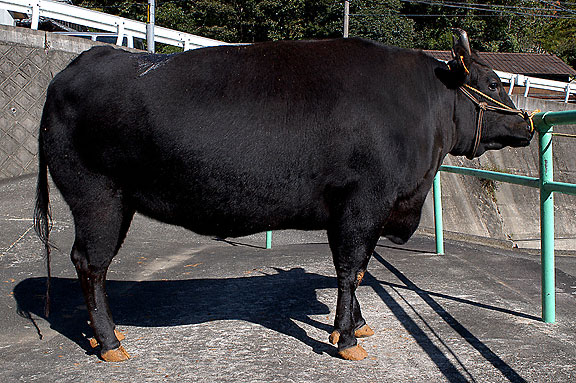
Kobe beef traditionally comes from Wagyu cattle. ... are a group of wild cattle on Kuchinoshima Island south-west of Kagoshima Prefecture. ...
The History of Kobe beef.
http://www.luciesfarm.co.uk/artman/publish/article_37.php
-
These four breeds are now considered indigenous to Japan, but are not genuinely native cattle. There are two isolated populations of native cattle in existence. The Mishima wild cattle on Mishima Island (located in the Sea of Japan off Yamaguchi Prefecture) have never been crossed with modern European breeds. While they represent a genuine genetic curiosity, as of 1983 there were fewer than 40 head. The second, and more numerous, are a group of wild cattle on Kuchinoshima Island south-west of Kagoshima Prefecture. The progenitors of both the Mishima and Kuchinoshima cattle were probably brought to Japan by the ancestors of the modern Japanese people more than 2,000 years ago. Biochemical and genetic tests indicate that the native cattle are more closely related to the cattle of Northern Europe and Scandanavia than they are to the cattle indigenous to Taiwan, the Philippines, and other South East Asian Countries.
-
O...you can sing.
-
-

About a Japanese cow
Matsusaka beef / Kobe cow / an Oomi cow is famous as a representative to a Japanese cow.
There are dozens of kinds of the Japanese Japanese cow, too, but more than 85% are the systems of the Tajima cow! I stand, and, in the highest peak of the Japanese cow, as for Tajima cow lineage which anyone recognizes, anything is the number one in the world! The excellent cow which changed a national black color Japanese cow! !
I say with "Hyogo product Tajima cow" now when the circulating Tajima cow says to the market precisely.
A standard is more than A-1 with the black-haired Japanese cow that the definition of the Hyogo product Tajima cow fattened up it in Hyogo, and higher than A4-6 of a thing of less than A4-6 are Kanbe cows. In brief, the cow which was not able to become the Kobe cow suffers from Hyogo product Tajima cow.
The Tajima cow which we sell is raised in Tajima born in Tajima! It is completed as the best cow simply because I am brought up at a suitable place so that the cow book comes. Including the environment where it was endowed with, I make full use of high quality water, secret feed, high fatting technology, and it is the best beef ã�Œã�¯ã�¾ã� Tajima cow of the black color Japanese cow which it pours warm love into one 1, and it created (the standard, more than A4 -6, sale only for A5).
The ã�¯ã�¾ã� ã�® Tajima cow does not circulate in the market. Ranks are different with the same Tajima cow. I ask not to make a mistake.
Tajima cow(The living body reads with a Tajima cow. I read with Tajima beef when I become the meat.)
The origin of the Tajima cow
Based on a myth reaching this district, it is told for amenohiboko"アメノヒボコ" story ※ 1. This legend is a mysterious story beforeamenohiboko"アメノヒボコ" visiting the country of Tajima from the Korean Peninsura in the days of four or five centuries B.C. It is a person said to that amenohiboko"アメノヒボコ" affected cow culture origin of the ground of Tajima greatly, and the legendary cause and the story that it was it are written down to the description of folk history written in 712.
The Tajima district is known as the land where the cow which is more excellent than ancient times is produced in an area equal to the country of north Tajima of Hyogo. It is covered and there are few rice fields and night dew goes down and grass soft in the summer is good and only grows in the snow in winter in a complete mountainous country with the village every mountain or mountain, valley circle because the temperature difference in the night and day is big. Support life of people of Tajima, and this which black cattle is which has been loved like a family is Tajima cow.
"I plow the fields, I pull a cart are edible and are suitable" for "Japanese clerk "※ 2 edited more in the Heian era 1200 years ago sequel to"
-
source
 Kobe Top Sirloin Steak Wagyu Style
 -
source

So can you tell which is better quality..... Top picture from Kobe.
Above from Kagoshima.
1. after cooking can you tell which is the best.
2. only before cooking, you can see the actual piece of meat.
3. as a consumer can you tell, Kobe or Kagoshima.
-

A steak of Kobe beef.
The Birthplace of Japanese Beef
Kobe beef is known the world over. The exact origins of Kobe beef are uncertain; what is known, however, is that on January 24, 1872, Emperor Meiji was served beef and that this prompted the spread of beef to the dinner tables of ordinary families. Kobe beef is produced in the Tajima region, located in the northernmost part of Hyogo Prefecture, of which Kobe is the capital city. Only beef that conforms to the strictest standards is certified as Kobe Beef, often described as "marbled beef" due to the fine, marbled patterns of fat that characterize its appearance. When cooked, this fine web of fat melts, softening the surrounding muscle tissue to yield a succulent flavor and texture -
Best Wagyu Bulls 2009-10
Note: Progeny test data was compiled following the Indirect Examination process described in the ‘Japanese AI bull selection’ subsection. Some apparently low BMS scores are due to early slaughter in progeny test programs.
1. FUKUNOKAMI (Miyazaki / Prefecture)

-
- Kitaguni 7/8 (Itozakura) X Tadafuku (1/2 Dai 20 Hirashige, 1/2 Kikuyasu)
- 50% Itozakura, 37.5% Kedaka, 12.5% Tajima
- Progeny Test
- BMS – 4.2
- DG – 0.94
- RE – 53
- Good Marbling, Good Depth
- Weak shoulder, small frame
- Vendor’s Comment: Consistent and reliable
2. Shigekatsusakae (Iwate/ LIAS)

-
- Hirashigekatsu (Kedaka) X Yasusakae (Tajima)
- 50% Kedaka, 37.5% Tajima, 12.5%
- Progeny Test
- BMS – 3.5
- DG – 0.98
- RE – 52
- Good Marbling, RE, good temperament,
- Calving difficulty
- Vendor’s Comment: Consistent and reliable
3. KATSUTADAHIRA (Kagoshima/ Private)

-
- Hirashigekatsu (Dai 20 Hirashige) X Tadafuku (Yasumi Doi X Shigekanenami)
- 75% Kedaka, 25% Tajima
- Progeny Test - NA
- Good Marbling, Good Depth
- Weak shoulder, small frame
- Vendor’s Comment: Good growth and good temperament
4. KITAHIRAYASU (Tottori/ Private)

-
- Yasufuhira (Yasufuku X Yasufuku) X Kikuteru Doi (Kikumi Doi)
- 100% Tajima
- Progeny Test –
- BMS – 3.1
- DG – 0.91
- RE – 50
- Good Marbling (Fine), large RE
- Low Milk, Thick P8 fat, Rough temperament
- Vendor’s Comment: Great bull for Kedaka, Fujiyoshi female
5. YURISHIGE (Kagoshima/ Private)

-
- Hirashigekatsu (Dai 20 Hirashige) X Kamitakafuku (Tadafuku X Fujihana)
- 62.5% Kedaka, 25% Tajima, 12.5% Okayama
- Progeny Test –
- BMS – 3.4
- RE – 48
- Good Marbling, growth, balance and volume
- Vendor’s Comment:
6. DAI 1 HANAGUNI (Aomori/ Prefecture)

-
- Kitaguni 7/8 (Dai 7 Itozakura) X Hanasakura (Itohana)
- 75% Itozakura, 25% Kedaka,
- Progeny Test –
- BMS – 2.7
- DG – 1.03
- RE – 43
- Good Growth, marbling
7. SHIGEHIRO (Miyagi/ Prefecture)

-
- Shigekatsu (Shigekanenami) X Itoharunami (Itofuji)
- 50% Tajima, 50ï¼… Fujiyoshi
- Progeny Test – (Field Test)
- BMS – 7.4
- DG –
- RE – 64
- A4 / 5 % = 79%
- Very strong Marbling, large RE, Fine Marbling
- Growth variation, weak, thickness of rib.
8. KATSUHIRAMASA (Miyazaki/ Prefecture)

-
- Hirashigekatsu (Dai 20 Hirashige) X Yasuhira (Yasufuku)
- 50% Kedaka, 50ï¼… Tajima
- Progeny Test – (Field Test)
- BMS – 6.6
- DG –
- RE – 59.3
- A4 / 5 % = 87.5%
- Superior growth and marbling
- Very consistent marbling ability.
9. YASUSHIGEKATSU (Shimane/ LIAS)

-
- Hirashigekatsu (Dai 20 Hirashige) X Yasufuku (Yasumi Doi)
- 75% Kedaka, 25% Tajima
- Progeny Test –
- BMS – 3.5
- DG – 1.05
- RE – 53
- Good Marbling, Good Growth
- Vendor’s Comment: Work well with Kitaguni 7/8
10. TADAFUJI (Miyazaki/ Prefecture)

-
- Hirashigekatsu (Dai 20 Hirashige) X Yasuhira (Yasufuku)
- 75% Kedaka, 25ï¼… Tajima
- Progeny Test – (Field Test)
- BMS – 7.3
- DG –
- RE – 60.9
- A4 / 5 % = 100%
- Good growth, large RE area, Good temperament, good milk
- Rough Marbling, calving difficulty.
-
-