Aussie dollar--jumping kangaroo or paper kangaroo?
-
Having at least a 5-rm, an executive flat or a HUDC unit, aiming to upgrade to a condominium or a private property, or at least an Executive Condominium is a must. Thus, many caught with large mortgage commitments are now trying their best to dispose of their large properties in order to downgrade. 5-room, Executive, HUDC apartments are increasingly out of reach to the new entrants of the middle-class dream. Yet a four room flat for the young middle class is a minimum - which is quite a large space if they have no children yet. However, even this category of flats and its value remains unpredictable for the future. It is important also to take note that the purchase of houses does go hand in hand with the desire for the best renovations and fittings. Thus, depending on income levels, many take renovation and hire-purchase loans for home re-modeling, household appliances, sophisticated home entertainment systems, computers and furniture.
Many have been weaned on overseas travel at least once a year to exotic places. They play or aspire to play golf hence country club memberships are desired, if not at least a visit to the driving range. Having a car but expecting to buy a more expensive car even though it is now largely an expense item is a common practice. Hunting for liquid cash for investment and stock speculation are seen as normal. Even tertiary students, before graduating and getting a job, explore credit for overseas travel. The desire for overseas and further education has become a pursuit for many. Parents and individuals take study and personal loans to realize this wish. Others have immediate needs - at least a two-year package for hand phones (with a desire for a yearly upgrade to keep up with the latest models), wearing branded clothes togged with the latest fashion accessories, indulging heavily in movies, Internet and the weekly pubbing and clubbing. Some are fond of going to the gym or thinking of joining one. Others join such establishments but do not use the facilities fully. Then there are the other expanses. Dinning out, owning a palmtop, buying CDs, books and magazines to name just a few. There is also the desire to consume ?culture? as fashion. Hence, some attend art and music performances at regular intervals. How deep their appreciation of ?culture? is off course another matter. Nevertheless it is another set of expenses. The aspiration for the good life is valid, but it needs to be tempered by one?s affordability and responsibility to live within one?s means.
Once the boon of the middle class, the asset accumulation and life-style policies of the PAP are increasingly narrowing their choices or leaving them in debt. Many apply for credit cards, but credit is not an option. After all if you chalk up large bills on your card that you cannot pay, you are eventually made a bankrupt. Hence it is not surprising that the number of people going bankrupt in the recent years have increased. Those who pursue their material wants, although they cannot really afford them, get into heavy financial obligations and have problems managing them. For Singapore banks it meant that bad debts that they had to write-off reached a 12 year high in June 2003 and could get worse if unemployment rises (31 July 2003, Reuters).
The consequence is an emotional and spiritual vacuum in society caused by the singular pursuit of materialism. Consumerism has created a status-conscious society where the goods you posses mark the size of your worth. Personal values revolve around up-market, up-grading, up-lift, up-ward looking, etc. "UP" is the buzz word. Life continues in this manner in spite of frequent calls by many to stress the non-material dimension of life.
Pursuit of materialism has its social impact. For example, it does not support marriage. If you are unable to be materially attractive you chances at marriage are also low. By extension it is having a bearing on the desire to have children, as the cost of raising children is enough to dissuade many from procreating. A middle-class family is usually a double income family with a maid. Some want to stick to one or 2 children, a few even no children. They practice a two or one child policy without government intervention. They do not live with parents because they value privacy. Relationship with parents may be limited to weekend visits or a meal outing. If there are frequent visits it could be for practical considerations such as having a cooked meal or for child caring reasons.
Work ethic and employer ? employee relations are also affected. It is not uncommon for individuals to expect salary increases every year otherwise the decision is to job hop. Jobs are treated in terms of the market value of the job. A job is seen as a means to a high flying career path. Similarly, working environments where employers are not sensitive to the needs of working parents can also emerge. It was painfully obvious when the foot and mouth disease broke out in October 2000. A majority of the employers wanted to make sure that their employees came to work - never mind if his or her child is sick. The welfare of the employee and his family does not feature prominently in such a working culture.
Materialism has also given rise to a self-centeredness that is becoming the hallmark of the young. Public service and duty is not a priority, thereby creating a dearth of young people in civil and social organizations. This occurs at a time when the financially and socially displaced rely heavily on charitable organizations to help them tie over their various predicaments. Materialism has led to a lack of social empathy. While the young might be articulate, they also presume themselves to be of high standard and tend to look down on people who may have made mistakes in life.
Other reasons include Singaporeans non-awareness of the problem and its significance. Those below 35 have been brought up naive in political knowledge. Many don't know what's going on around them both socially and politically. Others are reluctant to be involved in alternative policy formulation exercises apart from those sanctioned by the PAP. Some in this category might even criticise the political opposition, and try to demonstrate they are better. But have no courage to show how good they can be by making a public contribution and take a differing stand vis-?-vis the PAP.
Health care, housing, utilities are all essentials. As such, long-term mortgages for public housing, loans for further education (locally) or even health care that place heavy financial burdens on people are major concerns. Whereas cars, overseas education and travel maybe not for some. However given the PAP policies of pursuing materialism, loans for overseas education and the seven-year lease on car (now even 10 years is allowed) has made it also a concern for those who want it and it figures importantly in their financial plan.
Because the social cost of materialism are all linked to a generation of PAP policies Singaporeans have all become and can be classified as ?poor? in certain ways.
Unemployment, dipping wages and rising costs
According to quarterly reports by Singapore's Department of Statistics, unemployment has been steadily increasing. By June 2001, unemployment had reached 3.4%, breaching the international satisfactory unemployment level of 3.0%. Singapore?s unemployment rate worsened to 4.7 percent in December 2001, the highest in 15 years, as companies laid off workers to weather the recession.Unemployment stood at 4.5% in the first and second quarters of 2003 as confirmed by the Manpower Research and Statistics Department report on ?Labour Market, Second Quarter 2003?. The rate exceeds the 4.4 percent recorded in December 1998 during the Asian financial crisis. The Manpower Research and Statistics Department published a report on "Labour Market, 2001" in March 2002 in which overall unemployment rate was projected to reach about 5.5 - 6% by the second half of 2002 ? an estimate that has been confirmed with the 5.9% figure for the third quarter of 2003. The record rate of 6.0 percent was in March 1986 resulting from the mid-1980s recession.
-
With unemployment figures hovering at about 4.5% and set to peak at 5.5%, there is increasing realization that a certain fixed level of unemployment that goes beyond the international satisfactory unemployment level of 3.0% might become a permanent feature of society.
It is not usual to have government lead surveys of wage to show that since the Asian crisis wage growth has reached pre-crisis levels. However a comparison of the pay increase of the rank-and?file employees will show that throughout the 1990s average annual wage growth has been declining from 10% to 8% in the early half to 7% to 5% in the later half (see page 4, Report on Wages in Singapore, 2002). This is largely due to attempts to keep business costs down, as employers see a cut in wages as one way of keeping costs down.
In fact, total wages comprising of basic wages, annual wage supplement and variable bonuses came to standstill in 2002, a drop from the 1.1% rise in 2001 (Report on Wages in Singapore, 2002). For the rank and file worker there was a cut in wages by 0.3% in 2002 down from a 1.2% gain a year earlier. The variable wage component of all workers (which includes the 13th month allowance and other variable bonuses) fell 15% from 2.09 months of the basic salary in 2001 to 1.77 months in 2002 (Report on Wages in Singapore, 2002). Needless to say, the rank and file workers experienced a drop of 19% in 2002.
It has been highlighted that the Per capita GDP in 2000 at around US$23,000 was higher that many First World countries but the remuneration received by Singapore workers or wage share in GDP was about 42 percent, which is unusually low compared to developed countries and lowest among the Asian NIEs. Some economists have therefore remarked that Singapore, while having attained a First World per capita income, in reality has kept in place an income structure that is closer to that of a Third World country (Department of Statistics, 2001).
What has been a trend for many years now is increasingly kicking in - the cost of living has risen and continues to rise. Health care, housing, utilities, education and the purchase of consumer goods are expensive and are eating into one?s income ? that is if you have one. Coupled with the prolonged economic downturn, the loss of jobs and a drop in the value of assets has made many financially vulnerable leading to a new kind of poverty situation.
The rise of the new poor
Singapore is facing an emerging problem of relative poverty called the new poor - where societal expectations of continued economic growth and prosperity are increasing replaced by a sense of economic uncertainty and long-term financial insecurity.?Absolute poverty? which refers to a lack of the basic requirements to sustain physical life - the subsistence poverty of not having sufficient food and adequate shelter are largely accepted in Singapore as have been adequately tackled. This is the popular understanding of poverty in Singapore even though there are scattered reports of homeless families and destitute individuals in the local media.
A close examination of socio-economic conditions in present day Singapore shows that much has changed under the economic policies of the PAP ? there is the rise of a new phenomenon. Other than the traditional poor, there is now the new poor, the middle-income people who find themselves in a bind. The ?middle-class? which at times was portrayed as the ?new rich? is finding that the cost of living for maintaining a certain life-style associated with being middle-class is outstripping income.
If we just say cost of living has gone up, the PAP will argue, based on the CPI, that the cost of living has not increased much or is even lower now. For instance they are likely to argue that the average household income by work rose by 156 per cent in 1990 over 1980 and by 61 per cent in 2000 over 1990. And that these increases are much higher that the corresponding increases of 18 and 16.4 per cent respectively in general food prices (see ?Food Prices Today, Singapore Statistics Newsletter, March 2002). However, it is the cost of living associated with ?Life Style? as promised by the PAP is what the middle class is having problems with.
Many in this stratum of society have lost jobs. Suddenly they find that all this while they have been living on a thin line of affordability in terms what they were assured they could afford as a middle class life-style. They have accumulated long term financial commitments they now have to honour even though they are unemployed. Others who seem, in material terms, well-off are challenged in terms of financial obligations, ability to manage them adequately and capacity to cope with the accompanying social fallout. Meanwhile, the gap between the rich and the poor continues to widen. It has created a condition where there is now real poverty among the middle-class once perceived to be affluent.
Asset accumulation policies have created a condition where many Singaporeans were made asset rich but cash poor. For instance, the purchase and speculation of prices of both public and private housing is one example. Underlying this development was the steady rise in land costs in Singapore and a general upward swing in the cost of living.
This is where the relative definition of poverty comes in ? the new poor. ?Relative poverty? is used to demonstrate the inadequacy of definitions of absolute or primary poverty by referring to the cultural needs (social expectations) of individuals and families within the context of an industrialized society. It is a relativistic definition that relates poverty not only to physical needs but also to the norms and expectations of society. In the Singapore case ? it?s the ever rising expectations of a higher standard of living and life-style promised by the PAP which unfortunately resulted in binding many Singaporeans into long term financial obligations which they are unable to honour in an increasingly uncertain job market ? hence making them ?poor?.
-
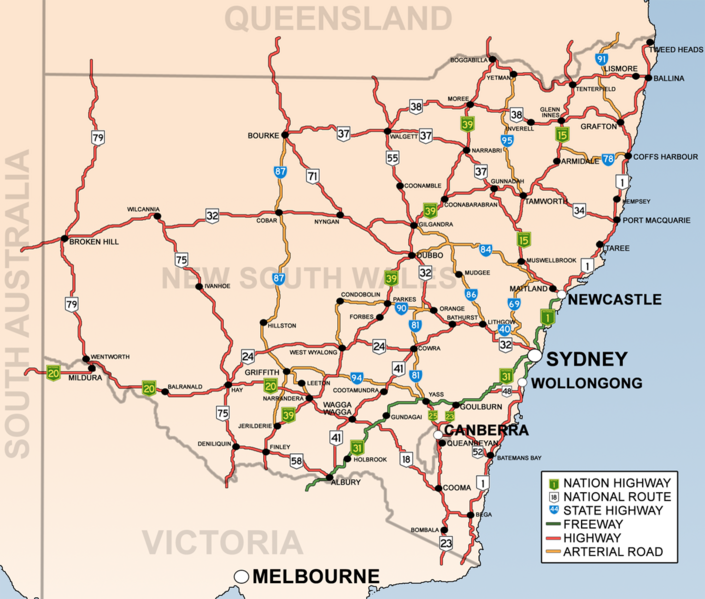
Why do NSW need to sell off forefathers' assets to survive?
NSW,where Sydney and Canberra situated but under ACT administartion,
has to sell off some assets,like
from schools to retirement homes and CBD office blocks, are to be sold - along with a range of government businesses such as NSW Lotteries
OMG!What are happening now?This is just the beginning of credit crunch.
Pl take note NSW need to sell assets:
the Government struggles to meet surging expenses with revenues that have been slashed by the weak NSW economy.
This is damn different to Singapore gavaman sells off few Power
Gens companies and previouly sold off Singapore Post .
SG is not short in $$.Right?There are US$x00 billions in Temasek
and GIC!!
If SG needs selling off assets to pay for budget,it will be the time
of farewelling to PAP!!
So,Sg Ty,before u posts anything,pl think for 30 minutes and
give me some DIRECT,RELEVANT,TIMELY AND INTELLEGIENT
responses.Ok?
NSW is not NT or WA of Oz.NSW is very rich.Sydney is well sought by many
Singaporeans .Why does NSW become like this?
The Government hopes to raise $5 billion from asset sales between 2008 and 2012, budgeting for $870 million this financial year alone from additional asset sales.
This does not include the estimated $1.5 billion to be raised from selling government businesses such as NSW Lotteries.
The Treasurer, Eric Roozendaal, said yesterday that the Government should be involved in delivering "core services" to residents of NSW, indicating support for winding back the role of government in other areas.
Core services!!I think education (schools ) and retirement homes
shall be one of them.
Have u guys remember Hong Kong also sold off ALL shopping
centers (ie ALL shops) in ALL public housing.
about 50% of HK population stay in public housing,rented or
subsidzed sale flats!!
why NSW need to sell off forefathers' assets?
Read the comments of oz then u can know better.
Lotteries, schools in super sell-off
Now a state recession even closer
 JESSICA IRVINE | NSW is at even greater risk of slipping into recession after the
state mini-budget, economists say.
JESSICA IRVINE | NSW is at even greater risk of slipping into recession after the
state mini-budget, economists say.Brakes put on spending, drivers slugged

NSW is trying to get out of a $1bn hole by increasing parking fees and Harbour Bridge tolls.
nnnnnnnnnnn -
In Singapore, the new knowledge-based economy means that many of our unskilled and semi-skilled workers, especially those in their forties who still have families to support are becoming ?redundant? unless they retrain, upgrade their skills and use information technology. The sad aspect is that the PAP government does not understand that even for subsidized and allowance giving retraining programs, people still need enough hard cash to stay alive. Many in this category have long mortgages (up to 30 years) for public housing and with upgrading, incurring additional long-term payment expanses. Further, if workers are retrenched, the number of years they have served in a company may not count towards their retrenchment benefits. For example, if workers are paid retrenchment benefit at the point of retrenchment, the number of years of service does count, the benefit is usually calculated based on number of years of service. However, some company may mot be able to pay retrenchment benefit due to losses.
For the younger workers or fresh graduates, the recession not withstanding, jobs are harder to come by, have to settle for less pay and work longer hours. But there is no guarantee that tertiary education locally or abroad translates immediately into a job. Many graduates spend months, some over a year, looking for a full-time job. Others work temporarily in between - if they can find something. Relief teaching and giving tuition is the most common type of work undertaken by unemployed graduates.
It is increasingly evident that the financial commitment elicited by the new economy will not be matched by a guarantee of life-long employment and financial security. For those employed, the presence of personal savings may not be large enough to cushion unexpected long-term unemployment prospects. If made redundant, the only option is to find stopgap measures of work such as being a security guard, cleaner or taxi driver that will take them away from their traditional area of skills and training to a saturated unskilled employment market where there is competition with school leavers, retirees and foreign workers. What about others who do not work - housewives, retirees, the handicapped, students and children?
When the concept new poor was first mooted by the Workers? Party in the run up to the Singapore 2001 General Elections, both PAP politicians and journalists (Tan, 2001) from the mainstream media claimed that that everyone was a new poor if they experienced a reduction in usual earnings. In particular some tried to link the New Poor phenomenon to people who choose to be unemployed or refuse to adjust their ego by accepting jobs with a relative lower status. Others argued, the situation of this group is exaggerated. However a distinction has to be made between the ?behaviour or choices? of some who are affected by relative poverty and those really financially burdened. In fact, the psychological behaviour of some who are unable to adjust to the new social-economic reality and who suffer from material acquisition withdrawal symptoms should be in part be blamed upon the PAP?s 40 year policy of material acquisition.
The new poor is larger ? it is a social and economic phenomenon that has been inflicted on the middle-class as a result of the PAP policy of asset accumulation and asset inflation. It has brought to a sudden halt this asset accumulation/inflation?s upward lunge and has left a significant portion of the middle class in a financial bind. Coupled with this, is the problem of maintaining an expected standard of living and life style of the middle class.
It has been noted that since late 2001, professionals, managers, executives and technicians have formed nearly 40% of those laid off (16 September 2003, Today). There also been a rise in the number of middle-class cases seeking help at selected welfare organizations (see also 16 September 2003, Today). Hence, it had earlier prompted PAP MP Ho Geok Choo to plead that the ?new poor of Singapore? such as the professionals, managers, executives and technicians who have been affected by job losses be also considered for assistance programmes (Business Times, 2 September 2003).
For our purposes I want to stress that the New Poor concept refers to middle class and NOT the upper rich class though they suffer as well, may be poorer than before, but still remain relatively rich.
The articulation of poverty is central to any discussion of social inequality, including the debate of who is poor and the reasons for their poverty. The poor have often been blamed for their poverty, which is seen as the consequence of some form of personal inadequacy such as ficklessness or idleness. However, this is not the case. The existence of poverty in terms of the social and economic structures of industrialized societies is an important feature to consider. In the Singapore case, it's the plight of the new poor.
PAP?s Response
Part of the problem resides in PAP government?s policies that seek profit. Wealth redistribution is cast aside in favour of forcing high growth to mediate poverty levels ? an ineffective solution. A scrutiny of the rich to find ways to accommodate the poor is prematurely discharged as the ?politics of envy?.The PAP government?s response to the increasing financial difficultly faced by many Singaporeans has been a series of short term responses. Its has dished out New Singapore Shares, Economic Restructuring Shares, re-training grants and a series of financial assistance packages for those who are hard hit.
However, the impact on the household size, official unemployment status, overseas resident Singaporeans who may not be experiencing the hardship of those resident locally and age must be evaluated to ensure that taxpayers? money distributed as handouts are indeed reaching those who actually need it and not the other way around. Further, these are only short-term measures using taxpayers' money to temporarily relieve the need to adjust to cost of living increases, they are not a long-term solution to keeping the costs of living down. Instead the PAP government should evaluate whether its government policies are the culprit behind these price increases.
Meanwhile, the PAP government has asked Singaporeans to bear the brunt of cost cutting measures by taking wage cuts and lowering their expectations in life. The Central Provident Fund ? (Singapore?s social security system) has been re-structured. Now there is even talk of devaluing the Singapore dollar and bringing property prices down. But it is unclear whether in the long run jobs will be saved or Singapore will attract more investments. Nevertheless, the above short term solutions currently remain as the PAP governments? response for ensuring cohesion in society.
-
For instance, it will not be unusual to note that Singaporeans and non-Singaporean observers would have difficulty in accepting that the new poor stands to affect social cohesion. Most will instead point out that social cohesion in the Singapore context is always viewed in terms of race relations not social class. Therefore to these observers the relationship between new poor and social cohesion would seem patchy and superficial. They would find it difficult to grasp immediately the fragility of bonds between people caused by materialism.
Instead they would argue that everyone and everywhere people are caught up in materialism, so why should Singapore be different. There is a latent fear that de-emphasing materialism would lead to giving up the comforts of modernity. Hence they would want a clear answer as to what ?Singapore? would be if materialism were de-emphasised. In fact, many are afraid of being ?poor? and might reject any notion that they are indeed suffering from relative poverty.
Similarly there will be a claim that all systems are run by elite. Hence, if the elite system in Singapore is abandoned, low class people will end up running the system. The rationale behind this argument is that the PAP elite has run Singapore well. Although critiques realize there are problems they cannot accept intellectually that others, other than the PAP sanctioned elite can run the country. They may be reluctant or uncomfortable to repossess and take responsibility for policy making.
Singapore being a society where much has been spoon fed by the elite, hence whenever any policy is criticized the standard knee jerk reaction would be to request for solutions. There will be a demand for instant gratification by way of policy solutions. Hence it is important to take note that much energy will be spent asking for ideas and solutions. Example, ?Please tell us in concrete terms how are you going to help the new poor? What is the effective solution?? Most cannot accept that solutions have to jointly discovered, debated and implemented. They are not used to the idea that to some extent they need also to invest in solutions. They might not understand that alternative ideas need to be strategically presented and within context. By simply announcing them, may not result in effective implementation.
Some would even raise the question whether it is fair to blame the PAP for materialism. Instead, there will be a tendency to blame the people themselves. Critiques would argue that people voted for all these material benefits that the PAP offered them. There is a certain inbuilt reluctance to level blame on the elite, instead critiques prefer to transfer it to the people.
All definitions by nature are contested notions. The new poor is no different. It is a political handle and debating its definition is part of the process. But more importantly the new poor is a figurative definition and its measure is what the layman makes sense of.
However, the pressure will always be there to provide a technical definition. Such requests will be made even by people who can intellectually agree that the act of definition itself might be difficult. Yet people these people cannot help themselves but ask for a fixed answer. It will be difficult for them to try to figure out the answer themselves in a culture where a singular elite has been responsible for decisions.
Conclusion: building social cohesion ? including everyone
Nevertheless, an alternative formula has to be found. Singaporeans need to review their old compact with the existing government under the People?s Action Party.A new social cohesion compact is needed to create a bond among the people that goes beyond materialism, emphasises genuine multiculturalism and includes meaningful civil and political participation. Towards this end two recommendations may be considered as starting points.
First there is a need to bring to public attention to the phenomenon of new poor and explain to Singaporeans the implications it holds for social cohesion. Unless the problem is recognized as being there and identifying why it arose and who is responsible, it will be difficult to frame the opportunities for introducing solutions
Second, there is a need to introduce a wide consultation process to find out what Singaporeans want and how they would like to go about addressing the problem. While it might be easily to think up solutions in the abstract, it is important the ownership over policy making is re-introduced into Singaporean society and people get the feeling that there are a different set of actors who will be willing to politically implement them.
With these two options as a modest step forward, we can begin to deliberate how to face up to the challenges of the new poor and social cohesion in Singapore.
-
References
?First World Per Capita Income But Third World Income Structure? Wage Share and Productivity Improvement in Singapore? (2001) Singstat Newsletter, Singapore: Department of Statistics?Food Prices Today? (2002) Singapore Statistic Newsletter
Gomez, James (2002) ?Singapore: Rising Costs, Dipping Wages?, Asian Labour Update (Issue 42, January ? March), Hong Kong, Asia Monitor Resource Center.
Gomez, James (2001) ?New Poor?, Hammer, Singapore: Workers? Party.
?Labour Market, Second Quarter 2003? (2003) Manpower Research and Statistics Department, Singapore: Ministry of Manpower.
?Labour Market, 2001? (2002) Manpower Research and Statistics Department, Singapore: Ministry of Manpower.
"Make CPF voluntary, or scrap it: MPs," (2003) Business Times, 2 September.
?More Singaporeans want to migrate, Australia is top choice? (2003), Agence France Presse, 27 February.
?The Political Process and the 2001 Parliamentary Elections in Singapore? (2001), Washington D. C.: National Democratic Institute
?Report on Wages in Singapore, 2002? (2003) Manpower Research and Statistics Department, Singapore: Ministry of Manpower.
Restall, Hugo (2000) ?More transparency, please?, Asian Wall Street Journal, 8 August 2000.
?Rise of the ?new poor? in Singapore? (2003) Daily Express News, 7 November. (Sabah, East Malaysia)
-
Seah Chiang Nee (2003) ?Push to review scholarship system?, The Star, Malaysia, 31 August.
?Singapore Residents by Age Group and Ethnic Group, End June 2003? (2003) Statistics Singapore Keystats - People, Singapore: Department of Statistics, http://www.singstat.gov.sg/keystats/mqstats/mds/mds21a.pdf
Tan Tarn How (2001), ?Will the real New Poor please stand up??, The Straits Times, 21 October.
Teo Hwee Nak, (2003) ?Squeeze in the middle: CPF changes likely to hit professionals, senior execs?, Today, 16 September.
-
NSW get the honor to impose road toll!!
welcome to Sydney--manual road pricing!?

The biggest surprise in the mini-budget was news that the Sydney Harbour Bridge and Tunnel will be the first motorways in Australia to use time-of-day tolling.
From next year, motorists who use the Bridge or Tunnel at peak times will pay a peak toll of $4, compared with the current charge of $3.NSW taxpayers slugged extra $3.6bn
Welcome to NSW, the big tax state
-
This news is not just about labor safety,labor union,and politics.
This is about the management of a nation.
Can u explain to me more.Some pple oppose
desalination plant in Sydney.
http://www.theaustralian.news.com.au/story/0,25197,24639213-601,00.html
Minister leads union raid on desalination plant construction site

-
Oz tax payers to subsidy US car giants!!
THE American owners of local Ford and Holden plants will be laughing at the Australian "suckers" who have handed them a $6.2 billion industry assistance package, former car company executives say.
Expressing disappointment yesterday at the latest industry handout, industry veterans said the money would ultimately end up back in Detroit rather than bolstering needy sectors of the local industry.
Former managing director of Mitsubishi Australia Graham Spurling said the car companies would get a "free ride" from the Rudd Government on research and development.
US Car giants 'laugh at Aussie suckers...
,m,,,
-
Singapore: Rising Costs, Dipping Wages
By amrcCreated 09/13/2007 - 16:59By James Gomez
Singapore, the only Southeast Asian country to avert a recession during the Asian Crisis, became the only Southeast Asian country to fall into a recession, or to quote the Trade & Industry Ministry on 18 May 2001, a “technical recession”. The city-state enjoyed a prolonged period of economic growth between 1986 and 1997 averaging 8.6 percent per annum. However, after the Asian financial crisis, Singapore’s GDP is more volatile -

According to quarterly reports by the government, unemployment has been steadily increasing in the run up to the recession. By June 2001, unemployment had reached 3.4 percent, breaching the internationally accepted unemployment level of three percent. The official unemployment rate worsened to 4.7 percent in December 2001, the highest in 15 years, as companies retrenched workers. The rate exceeds the 4.4 percent recorded in December 1998 during the Asian financial crisis. The Manpower Research and Statistics Department published a report, Labour Market 2001, in March 2002 in which the overall unemployment rate was projected to reach about 5.5 - six percent by the second half of 2002. The record rate of six percent was in March 1986 resulting from a recession.1
Meanwhile, the cost of living in Singapore has not been reduced by much even in the economic downturn. During the second half of 2001, the Consumer Price Index (CPI) rose 0.5 percent for households in the lowest 20 percent income group but fell by 0.3 percent for the top 20 percent income group. For households in the middle 60 percent income group, the CPI remained stable in this period. Households in the lowest 20 percent and middle 60 percent income groups registered lower inflation rates of 1.3 percent and 0.4 percent respectively in 2001, the rises being due to dearer cooked food and higher electricity tariffs. The CPI for households in the top 20 percent income group dipped by 0.2 percent in 2001, due largely to lower car prices.2 In a study done by the Relocation Journal & Real Estate News in August 2000, Singapore was the fifth most expensive city to live in after New York, Seoul, Tokyo, and London.
It is with this backdrop that one should understand the wage situation and the impact on workers. Except for unionised companies in Singapore, there is no legal minimum wage. Therefore there is really no jurisdiction over how much an employer should pay an employee or offer a job-seeker.
Between an employer and employee, there exists a contract of service and the terms and conditions cannot run contrary to the Employment Act, which stipulates the minimum standards for an employee, e.g. overtime, annual leave, and maternity benefit, but nothing governs the actual salary that should be paid to an employee, apart from compensation calculations in the Third Schedule of the Employment Act and that employees who earn more than S$1,600 (US$869)3 are not entitled to overtime etc.
In unionised corporations, the minimum wage is spelt out in a collective agreement (CA) between company and union, legally endorsed and renewed once every two to three years. It also provides for an annual increment, being negotiable on an annual basis after National Wages Council (NWC) recommendations. But if the company can prove that it is not doing too well, any agreed increment can be smaller or even waived for the year, and the CA can be re-negotiated before it expires. There is also an Industrial Arbitration Court if employers refuse to up salaries in the CA to a reasonable level.
However, wage negotiations between employer and union rest on the employer’s right to a final say, and typically in Singapore, success rests much on the usual day to day ‘good relations’ between employers and unions, that help foster the possibility of securing better benefits for workers. Direct confrontation between employer and employees, using the courts, is generally frowned upon.
The Ministry of Manpower in December 2001 backed a call from the NWC for severe restraint or cuts in wages. Citing worsening economic conditions and uncertainty in 2002, the government urged companies to freeze or cut wages in the city-state’s worst recession yet. A survey quoted in the Straits Times revealed that 18 percent of Singapore-based companies had already frozen pay levels in 2001 and 28 percent planned to do so in 2002. During the financial crisis in 1998, the NWC asked workers to accept wage cuts of between five and eight percent.
At the height of the 1998 financial crisis, the government announced a blanket policy of cutting the employers’ share of monthly Central Provident Fund (CPF) payments to employees from 20 percent to 10 percent. This policy was aimed as a cost saving package to revive the economy but it placed the burden on ordinary wage earners and not on the state’s coffers. This 10 percent cut was applied to all companies regardless of profitability and financial situation. It penalised workers even in companies that were breaking profit records. Overnight, many workers had trouble keeping up their mortgage payments that were serviced through the CPF. Instead they had to dig into their salaries to make up the difference. There was a public outcry and some quick fix measures were assembled to assist those who were unable to continue paying mortgages.
It was then that the NWC recommended the monthly variable component (MVC), to allow companies to adjust monthly wage bills quickly to remain competitive and minimise job losses. This move exempted the government from involvement and becoming the target of bad publicity and collective unhappiness of the workers whose wages are cut. Over the years the number of companies that use the MVC has increased and wages in general have become more flexible. For instance the variable component of total wages was 15-16 percent in 2000 compared to 11 percent in 1997. The Ministry of Manpower is now seeking to speed up the implementation of the MVC even further and to promote performance-based pay structures to replace seniority-based systems. In addition, other components of the employment benefits system, including implementing medical co-payment and changing retrenchment compensation so that companies have greater flexibility in managing wage costs.
The central issue in introducing and operating the MVC is how to define a justifiable cut in each industry, especially in large MNCs where profit transfer between countries could be easily carried out. Since financial situations and management capabilities vary from company to company, it is unclear whether the Ministry of Manpower and the National Trades Union Congress (NTUC) are sufficiently informed about the technical details of industries to function as a watchdog against unjust wage-cuts or to set out intelligent guidelines for a MVC cut.
Major concerns are, how much to allow companies/government to cut the MVC? How to calculate and define a cut? Does a well managed economy require frequent MVC wage-cut to rank and file workers to keep employment levels? Can a company convert part of a worker’s present salary into MVC?
As cited earlier, Singapore is the fifth most expensive city to live in. Of all components of cost, workers’ wages are not the highest contributing cost factor. Workers’ wage levels have actually fallen behind other Asian countries such as Japan, South Korea, and Hong Kong. If factors other than workers’ wages are the biggest contributors to high costs, it is not logical to pursue wage cuts as a priority. More should be done to lower government charges and duties.
There is a concern that adjusting the workers’ wage structure for the sake of keeping business costs low may be abused, leaving workers more vulnerable. For instance, it is not usual for government wage surveys to show that since the Asian crisis wage growth has reached pre-crisis levels. However a comparison of pay increases of rank-and-file employees shows that throughout the 1990s average annual wage growth declined from eight to ten percent in the early half to between five and seven percent in the latter. This is largely due to attempts to keep business costs down, and wage cuts are one way of doing this.
Employers are suspected of using the economic crisis as an excuse to restrain wage increases, creating an employer’s market. For instance, the starting salary of university graduates in the latter half of 2001 fell to pre-1997 secondary school-leaver levels. Without a minimum wage, employers, even when making profits, can offer graduates salaries below what used to be the graduate benchmark of $1,600.
Wage issues remain problematic as they are not regulated by law. The NTUC is said to play a pragmatic role, but a tame one in the perception of some. Part of the problem is that the NTUC is aligned with the ruling People’s Action Party (PAP) and therefore its independence is questionable. Changes arising from economic restructuring, which included job cuts and new forms of employment relationships, are unsettling workers and testing worker-employer relations. But the PAP wants to deepen the tripartite partnership between its administration, the employers, and the NTUC, to preserve ‘harmonious’ industrial relations.
The push for more MVC is in the name of minimising retrenchment in a volatile economy. The increasing attack on wages is explained in part as a result of a drop in workers’ productivity. So workers are presented as receiving less wages because they are less productive and not because the PAP administration has introduced a policy that penalises workers first.
The MVC is a political solution to a political problem. It is of no help in saving jobs at all. It is unclear whether MNCs will stay in Singapore simply because they can cut wage costs by five to ten percent when wages constitute less than ten percent of total costs to most MNCs. Such cuts are increasingly painful for workers when the CPI does not fall in the same period. If workers’ wages are cut by more than ten percent without corresponding reductions in other living costs, more people will find it difficult to make ends meet.
A thorough review of all other aspects of the Employment Act is thus urgently required to meet the fast changing job environment. It is worrisome that historically the government has a tendency to chant policies that favour large MNCs and government linked companies (GLC) and ignores the needs of small- and medium-sized enterprises (SME). Tremendous efforts have to be made to regain the balance where SMEs can co-exist with MNCs and GLCs for a more balanced and sustainable economy.
Because Singapore is small, housing space, land use, transportation, water, and electric supply, must become more efficient. But they are increasingly costly and without subsidies. Additionally, health care, education, food, and recreation are also becoming expensive. There is increasing public pressure to review policies to include further concessions on state subsidies and relief.
With increasing anxiety to make ends meet, more workers are treated for depression as Singapore slips into its deepest recession. The Institute of Mental Health reports that the number of patients has almost doubled since April 2001. Psychiatrists confirm that more people are now treated for depression. Men, especially 30 to 49 year-olds, feel the most heat in the current economic meltdown.
The government has long rejected the notion of a welfare state, preferring short-term incentives to those in need to avoid relying on welfare. In Singapore, families shoulder part of the responsibility and more than 260 private welfare organisations take up the rest, some aided by public money. However the challenge is for the government to provide a safety net for people when the global economy is volatile, impacting the local one, and family and community support is gradually being eroded.
In the run up to the general election in November 2001, the government announced budget measures that included tax relief and rebates for conservation charges and utilities. To boost PAP chances in the elections it introduced New Singapore Shares which is essentially a staggered cash handout. However, such rebates and handouts are not efficient ways to redistribute accumulated state wealth and are not targeted to reduce basic household needs or to create jobs. Most see them as short-term stop gap measures motivated by electoral politics.
There has been some decentralised and delegated social service through the government administered Community Development Councils (CDC) aimed at identifying and helping the poor. Short-term loan schemes have also been introduced. The budget for CDCs grew from S$19 million in 1997 to S$153 million in 2001, largely due to social assistance schemes. But eligibility for government assistance is stringent so as not to encourage a dependence mentality. The Ministry of Community Development and Sports, together with other agencies link short-term financial assistance closely with job counselling, job seeking, training, and placement.
However, short-term assistance is generally judged as not guaranteeing that the unemployed can become economically stable. Job placement services have on many occasions not been successful. A Jobs Task Force has been set up to give training, job assistance, and counselling to those affected by economic restructuring. There have also been promises of jobs in new ‘growth areas’. But what ‘growth areas’ are, how many they will employ, and when, is not clear. Areas such as wafer fabrication and biotechnology that were celebrated as the way forward are high-tech and need specialists so their contribution to job creation is questionable. The promise that more Singaporean companies operating world-wide will facilitate Singaporeans to work overseas is also speculative. Most Singaporean companies overseas are GLCs and it is unclear how good they are at creating new jobs at home.
In this context, there is a need to review the CPF scheme, to ensure that in addition to providing members with adequate savings for housing, medical, and retirement, that there is a scheme where some form of social security is available for sudden job loss and a means to tide over times when jobs are scarce. In the absence of new jobs for older and retrenched workers, rules need relaxing to allow the growth of a ‘regulated informal sector’. Singaporean workers need to be able to operate from home to keep costs down and at the same time to be gainfully employed to make a contribution to the economy and society.
James Gomez is chairman of the Think Centre Asia, based in Bangkok
Notes
1 Statistical source: Department of Statistics, Singapore
2 Ibid.
3 US$1.00 = S$1.84 .Source: ALU Issue No. 42, January - March 2002
-
The Poor and Social Reality in Singapore
<!--/adcode-->Does it mean that because we are educated that we think that people are merely lazy? Or do we think we have done our job just because we have policies* available to help the people? It is one thing to have policies, it is another to have enough people to implement them effectively. It is one thing to be educated, it is another to think that every Singaporeans have the same opportunity as you to be educated.
As James Scott argues, I paraphase, Let’s not conflate state’s policies with the actual social reality and implementation on the ground. Wise words indeed.
Help for the poor: So close, yet so far
By Vivi Zainol, For The Straits Times
WHY do needy Singaporeans continue to fall through the cracks despite the Government’s array of public aid schemes?
To tackle this question, 18 of my students at Ngee Ann Polytechnic interviewed more than 30 low-income households for a vacation module. They found the biggest barriers to be education and language.
Many are illiterate. With little knowledge or understanding of schemes to help them, it’s not surprising that some say they know the Government is helping them, but they feel it is not doing enough.
Some would rather get an extra job than ask for help. Others struggle to make themselves understood and say they do not have the time, money or energy to make return trips to their MP or Community Development Councils (CDCs) to ask for more help.
For those who did bother, a common complaint heard by students was that the CDC officers are rude.
Several years ago, as a Straits Times community reporter, I had heard the same comment when I asked a woman with three children, and whose husband was in jail for a drug offence, why she did not ask for help. Describing how her experience with CDCs turned her off, she said a CDC officer had sarcastically asked her: ‘Didn’t your husband leave you any money?’
‘If he had, why would I be asking for help?’ said the troubled woman, who had contemplated suicide.
One group of Ngee Ann students decided to observe CDC officers in action after receiving the feedback. At one CDC, officers were unfailingly polite - it was the low-income group which was being demanding and uncooperative. However, all the CDC officers were Chinese - help-seekers speaking Malay and Indian had to struggle to make themselves understood.
At another CDC, student Nurlina Fatima Shafrin, 18, recalled how a CDC officer was heard commenting loudly to another officer nearby on how ‘irritating’ the people who had come to ask for help were, even when the latter, who were filling up forms, could hear them.
What is interesting to note is that interviews by students uncovered a perception among low-income earners that the higher-educated tend to look down on them and are arrogant. Formally attired CDC officers also unintentionally give the impression that they are less approachable.
Not all CDC officers are trained social workers - there are not enough social workers to go around in Singapore.
Also, some members of the low-income group can be downright prickly, believing they have a right to receive handouts from the state.
But surely everybody deserves good customer service regardless of income group? The poor have their pride too.
Could CDCs perhaps train their staff to understand the sensitivities and psyche of the lower-income group? Steps could also be taken to ensure that staff on duty speak different languages and dialects. Members from the low-income group could even be employed to help.
It’s good news indeed to hear that the Government has raised public assistance spending from $96 million to $140 million, and ComCare funding from $43 million to $67 million. With that much money allocated to the needy, it makes sense to ensure these funds reach the ones who need immediate assistance.
Take Mr Ramasamy Ratran, a 52-year-old Indian man, who was a pitiful sight when my students and I chanced upon him. He was lying on the dusty floor in his rented two-room flat, having been discharged from hospital just two weeks earlier.
Fortunately, a former female neighbour and a male friend had taken it upon themselves to look after Mr Ramasamy, who is epileptic and living on his own. Medical social workers had settled his hospital bills, but he was getting no financial help while he was recuperating and unable to work.
‘Can you please help him? He needs help. When I first came two weeks ago, there was no electricity. His flat was in total darkness,’ pleaded the former neighbour, who had helped to top up his prepaid utilities smart key to get the electricity back on.
Mr Ramasamy was not the only one my students and I found in need of assistance. When barber Yahya Pinghani, 39, was hospitalised for a kidney problem, he could not work and had no daily income for weeks. His children skipped school that week because there was no money for the bus fare.
Mr Pinghani’s wife Murni, 41, complained how, after three weeks, her single friend who had applied for help with her at a CDC had already received assistance while she and her family were still waiting. She revealed that her family owed a whopping $4,000 in utilities bills.
CDCs do give $200 once-off emergency assistance, after which the needy wait six to eight weeks for CDCs to respond. So what do they do when help is a long time coming? Many see their MPs, getting a $50 cheque for their trouble, or resort to collecting food from voluntary welfare organisations. How many know that they can get immediate assistance from your Citizens Consultative Committee? I did not either, for that matter, till I asked around.
Perhaps it is time that bulletin boards in HDB flats were put to better use. They could advertise where the poor can get help and give details of the schemes. Many low-income earners are illiterate, but the ones who are not will surely help to spread the word around.
It could also be made mandatory for medical social workers in hospitals to inform social workers or CDCs when a person who is from the low-income group is discharged so they will give him temporary financial assistance during his recovery period.
Last year, the Ministry of Community Development, Youth and Sports (MCYS) set up a community care network for the elderly in Ang Mo Kio. Under this scheme, grassroots leaders are trained by family service centres to identify needy households.
Perhaps if this outreach scheme is formally extended to include all needy Singaporeans, not just the elderly, it could be used to ensure no one falls through the cracks and to explain the help schemes available to the needy.
MCYS minister Vivian Balakrishnan recently called on Singaporeans to be eyes and ears on the ground, saying ‘we need the whole of society’ and not ‘an army of bureaucratic civil servants’, when he outlined $140 million worth of initiatives for the low-income group.
The findings of the 18 Ngee Ann polytechnic students who ventured out of their classroom may not be conclusive, but simple observations like theirs should not be belittled. Like any jigsaw puzzle enthusiast will tell you, even one small piece makes a difference.
The writer is a lecturer at the School of Interdisciplinary Studies at Ngee Ann Polytechnic.
-
Singapore's Poor
No poverty in S'pore? Think again.
Singapore's poor emerge as delicate political issue
Asian Wall Street Journal
January 30, 2007
SINGAPORE
By YAROSLAV TROFIMOV
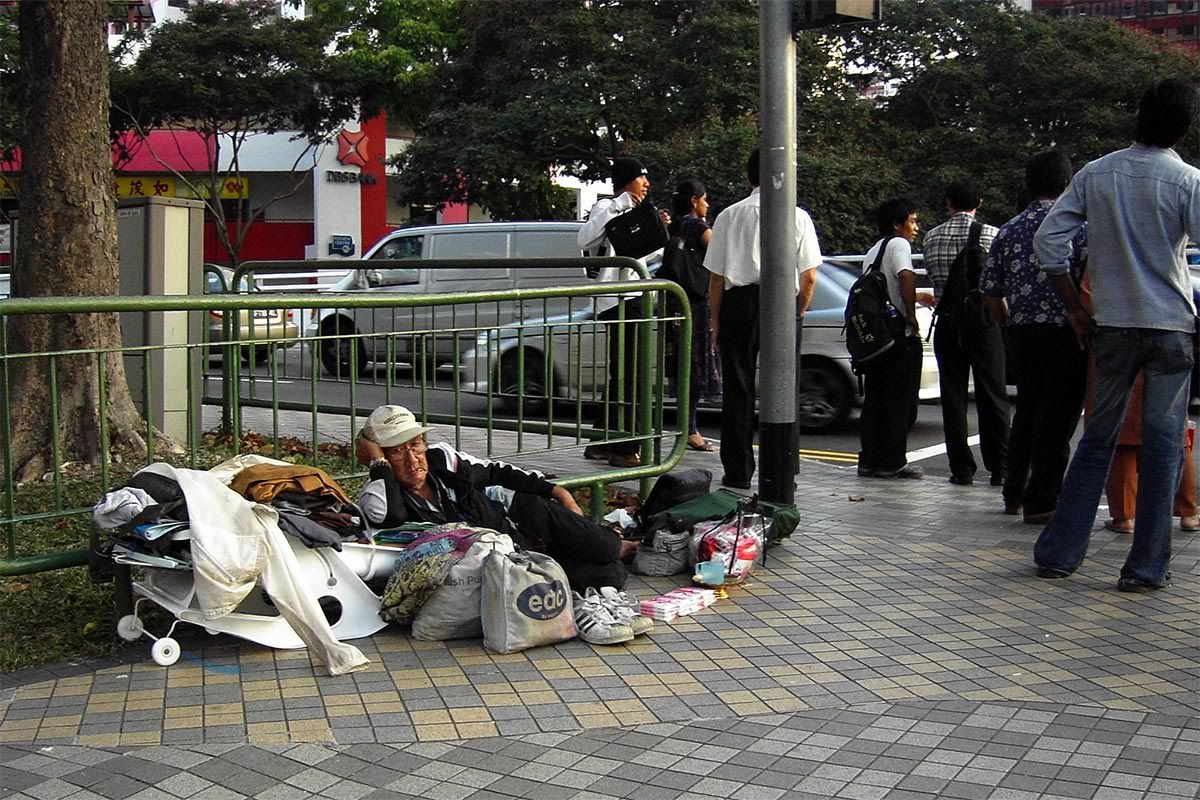
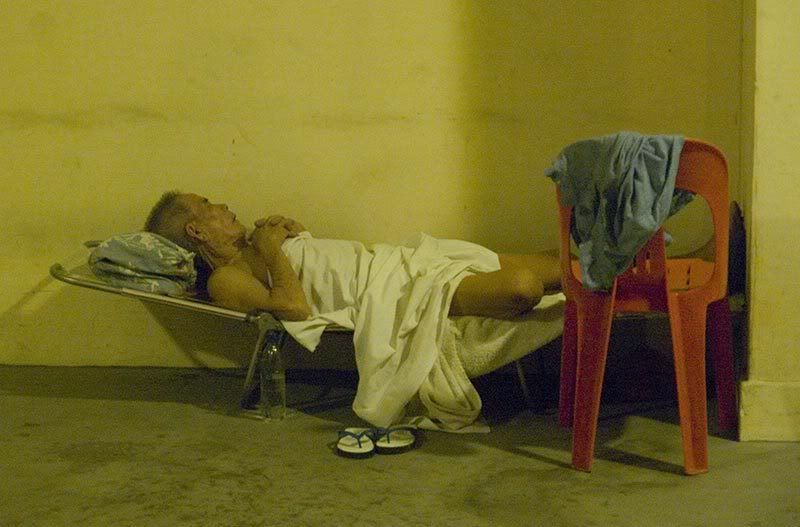
DURING rush hour in Singapore's ultramodern subway system, wrinkled old ladies squat on the underpass floor with handfuls of small tissue packets that they sell at one Singapore dollar, or 65 US cents, apiece.
These are the poor of Singapore, left behind by the boom that has transformed this tropical island of 4.5 million people into a regional business, finance and technology hub. Poverty here isn't nearly as desperate as in its Asian neighbors, or even many Western societies. But it has become an increasingly sensitive political issue, prompting new tax and social policies that the government is expected to unveil in the annual budget presentation Feb 15.
According to official statistics, at least 40% of Singapore's households saw their real incomes decrease from 2000-2005 -- while the overall economy posted some of the world's highest growth rates, surging by 7.7% last year.
"The question is, who is all this growth for?" says Manu Bhaskaran, an adjunct fellow at Singapore's Institute of Policy Studies and a partner at the Centennial Group, an advisory firm. "Shouldn't the government be aiming for lower growth, but better distribution? "
The government's strategy so far is to pursue a balancing act of generating more revenue for helping the poor without scaring off the global investors who have long been attracted by the city-state's low-tax regime. "The dual objective is to ensure that the Singaporean economy continues to remain competitive, and to strengthen the inclusiveness of Singaporean society," says Lim Swee Say, secretary-general of the National Trades Union Congress and a government minister.
Most of Singapore's poor are in their 50s or older, and many are onetime manufacturing workers who lost their jobs to cheaper competitors in China, Vietnam or India. Many lack education and English-language skills that are needed to prosper in expanding sectors such as services and finance.
It is only in recent months that senior officials began to speak out on the problem of structural poverty, recognizing the potential perils for a multiracial, multireligious society such as Singapore's. "It is essential for us to tilt the balance in favor of lower-income Singaporeans, because globalization is going to strain our social compact," Prime Minister Lee Hsien Loong said in a speech last fall.
Singapore's People's Action Party, founded by Mr Lee's father Lee Kuan Yew -- who is still a senior government member with the title of Minister Mentor -- has controlled the island since independence in 1965, winning nearly every seat in parliamentary elections. The country's mixed population of Chinese, Malays and Indians has accepted decades of the PAP's often authoritarian rule in exchange for phenomenal economic growth that has transformed this former British trading outpost into one of the world's most prosperous states.
While providing subsidized housing and health care, Singapore's government has long resisted calls for European-style unemployment benefits for the poor, describing welfare as a "dirty word" and rejecting the idea of a minimum wage. Instead, the government has come up with the concept of "workfare" -- a large-scale program to top off the incomes of those Singaporeans who accept low-paid work. Details of the program will likely be given in the budget presentation.
"We can't stop the income gap from widening because the wages are determined by the global competition for knowledge workers, and by the excessive supply of unskilled workers," says Mr. Lim, the minister and union leader. "But what we're trying to do is to make sure that the widening income gap doesn't necessarily translate into a widening social gap."
Most developed economies fund such social programs by redistributing wealth through progressive taxation: the top-bracket federal income tax rate is 35% in the US, and at least 40% in most of Western Europe. But Singapore is ideologically opposed to this model: the island-state has been steadily slashing its top income-tax rate, from 55% at independence in 1965 to 28% in 2000, to 20% today. Making up for the shortfall in revenue, Singapore established a general sales tax, currently at 5%.
It is the sales tax that the government is planning to tap again to pay for the "workfare" initiative. According to Mr Lee, with the new budget the sales tax is likely to rise to 7% -- a measure that, economists calculate, will generate some S$1.5 billion of extra government revenue.
The plan is far from popular. In the two months since Mr Lee in November first mentioned a likely sales-tax rise, the proposal elicited unusually vocal criticism from Singapore's corporate world and opposition leaders alike. The influential Singapore Chinese Chamber of Commerce and Industry complained the sales-tax increase is "likely to have an immediate and detrimental effect on local spending," undermining Singapore's long-term competitiveness.
Sylvia Lim, leader of the Singapore Workers' Party and an opposition Parliament member, also pointed out that the poor -- the ostensible beneficiaries of the proposal -- would be hurt the most. "We need to strengthen our safety nets through some redistributive policies," she asserted, adding that consumption taxes, such as the sales tax, "are generally regressive and likely to compound the underclass problem."
While the government usually ignores the minuscule opposition in this tightly regulated country, the business community's pleas found a receptive audience. Aware that corporate taxes are even lower in rival business centers such as Hong Kong and Ireland, Singapore signaled it would sweeten the pill for businesses: To compensate for the higher sales tax, the corporate tax rate, currently 20%, would be shaved by at least one percentage point.
"This is a tough and competitive world," Minister Mentor Lee told Singaporean journalists as he explained the planned corporate-tax cut. "People don't come here because they like Singapore -- they come because the returns are better." -

-


-
Singapore’s healthcare system - uniquely Singapore? F1 or F9? (Part 1)
Friday, 18 May 2007, 3:00 am | 1,094 views
 By Leong Sze Hian
This is part one of a three-parts chronological treatise on healthcare issues over the last 2 years or so, like means-testing, non-priority for subsidised rates healthcare, wards down-grading, medical fees competition, costs of medicines and alternatives, healthcare spending, MediShield, ElderShield, implications for foreigners, PRs and Singaporeans, etc.
What will the future of healthcare be like for Singaporeans? What are some issues that we may need to be concerned with? What are your fears? What sort of healthcare system do you want? How do we compare with other countries?
Here are the first 3 issues with our healthcare system.
F1. May 2007 - REVERSE MEANS-TESTING:
 I went to the Travellers’ Health and Vaccination Clinic at Tan Tock Seng Hospital for a Yellow Fever vaccination recently. The charge was $130.20, compared to just $15 for the same vaccination I had at the same clinic 10 years ago. This is an increase of 768 per cent or a 24 per cent compounded increase per annum.
 The clinic was furnished lavishly with leather sofas, leather chairs, paintings on the walls, flowers in vases, etc, like a five-star hotel. The same vaccination costs about HK$200 (S$39), A$50 (S$63) and 35 euros (S$72) in Hong Kong, Australia and Ireland, respectively.
Why has the cost of vaccination increased by so much over the last 10 years, when inflation in Singapore was less than 2 per cent per annum?
When I paid the $130.20 fee, the staff gave me a brochure and said that if I had a platinum credit card, I would receive a 12 per cent discount for health screening.
Why do the more affluent who qualify for a platinum card get a discount of 12 per cent, whereas the lower income have to pay 13.6 per cent more, in a government restructured hospital?
Is this not, in a way, like reverse means testing - the rich pay less, the poor pay more?
F2. April 2007 - ELDERSHIELD:
 The MOH has announced that the two insurers of ElderShield will give a one-time rebate to policyholders because of low claims relative to the premiums collected, since the scheme started.
Why pay a rebate, and increase premiums at the same time? Why not just use the excess funding accumulated to reduce future premiums or increase benefits?
At the end of last year, there were about 750,000 policyholders, with a total of 2,366 successful claims. About 16 per cent of claims declined. The claims payout last year was about $8.5 million (2,366 claims x $300 monthly x 12 months).
Even if we assume all 750,000 policyholders paid the lowest premiums at age 40 of $169.74 (male $148.84 + female $190.63 divided by 2), premiums per year were $127.3 million ($169.74 x 750,000 policyholders).
This means the claims ratio was only about 6.7 per cent ($8.5 million in claims but $127.3 million in premiums).
As the 2,366 claims were the cumulative total for the four years since the scheme started, the claims payout over premiums per year is actually much lower.
What was the claims ratio for each of the four years of the scheme? I believe this may be the most profitable insurance scheme in the history of insurance in any country.
How much profit has been made since the scheme started?
Notwithstanding the proposal to increase the monthly payout by $100 and the payout period from five to six years, in view of the above, how is it possible that the proposal now is to have existing policyholders pay a one-off adjustment to make up for lower premiums paid in earlier years under the current ElderShield scheme, increase premiums of about $10 a month for the older age group, and have policyholders registered automatically for the new scheme after September pay premiums of $1 to $2 more a month?
As to the opt-out rate having gone down steadily from 38 per cent when the scheme was launched to 14 per cent last year, there are 1.26 million residents (Singaporeans and PRs) aged 40 to 64, according to the Department of Statistics’ ‘key statistics demography Singapore residents by age group end June 2006′.
So, isn’t the opt-out rate about 40 per cent (with about 750,000 policyholders among 1.26 million residents)?
Does the Ministry of Health’s study on the opt-out rate refer to the current opt-out rate of new entrants who reach age 40, or the overall opt-out rate of those eligible?
F3. April 2007 - HOSPITAL WARDS DOWNGRADING:
 The Health Minister clarified in Parliament on April 10 that downgrading to subsidised wards is a two-day process and his plans to introduce means testing in hospitals within a year.
 Some Singaporeans who can afford higher class wards might be reluctant to opt for them, fearing that their hospital stay might be prolonged due to unexpected complications and the charges incurred might exceed their Medisave account balance, medical insurance and cash reserves.
Thus, higher-income Singaporeans might opt for Class C or B2 subsidised wards if, for example, they believe that they could be required to stay in hospital for longer than, say, five days. The logic is that if it’s five days or less, they might think that they can afford the luxury of higher class ward facilities. But, since there is always the possibility of them staying for an indefinite period, they might think it is better not to risk opting for a higher class ward.
Now that this worry is being exacerbated by means testing, the problem of overcrowding in Class C wards may get worse.
In any case, when the Class C or B2 ward is full, one can go to a higher class ward and still pay the lower rates. So, why risk opting for a higher class ward in the first place?
In this regard, I would like to suggest that patients and their families be assured that if they opt for a higher class ward, and end up staying for much longer than expected, such as over three weeks, they will automatically be allowed to downgrade to C class or B2.
This may result in fewer people opting for C class or B2 on admission to the hospital.
 Currently, those who opt for a higher class ward, and subsequently request for downgrading, are subject to means testing — this I believe is what Singaporeans fear most. Thus, this may be the root cause for many patients opting for subsidised wards.
 It was clarified in Parliament that it takes two days or longer to process a ward-downgrading request, if patients are unable to produce the relevant documents to support their applications when means-testing is involved.
Only those with a per capita family income of $1,000 a month or lower can downgrade to Class B2, and $500 or lower to Class C. For outpatients applying to downgrade, it takes an average of two weeks to secure an appointment with a medical social worker to assess whether the patient qualifies.
So, for say a three-person family with a household income of just $1,501 a month, downgrading to Class C is not allowed. Only 1 per cent of patients in Class A or B1 wards who sought to downgrade were successful.
Judging from this, no wonder Singaporeans are opting for lower-class wards — due to the fear of not being able to downgrade.
-
TOC Report: Singaporean, 57, employed, married but cannot buy HDB flat
Wednesday, 12 November 2008, 10:06 am | 864 views
Andrew Loh / Deputy Editor
 Mr Sinnathamby Silvalinkam, 57, is a very disheartened and desperate man.
 Five months of correspondences with the Housing and Development Board (HDB) have failed to help him get what he desperately needs – a roof over his head for himself and his 41-year old wife, Emma Joy.
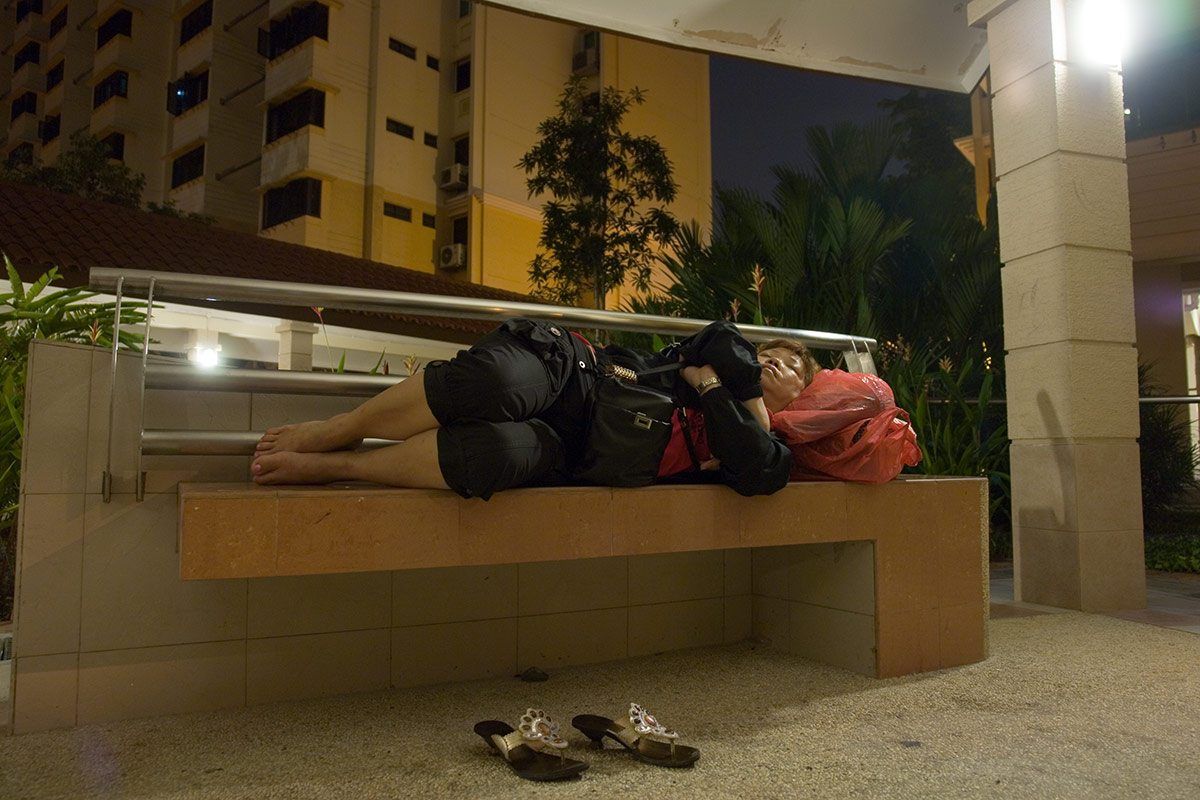
Despite being employed and married, the HDB and the CPF Board have rejected his application to release his CPF in order for him to purchase a 3-room HDB flat. This has led to Mr Silvalinkam and his wife having to put up at his sister’s one-room rental flat. He sleeps in Bishan Park on weekends.
Mr Silvalinkam’s friend contacted The Online Citizen (TOC) as a last resort in the hope that the HDB will be compassionate about his friend’s circumstances.
Mr Silvalinkam’s current predicament started in 2006 when he sold his 3-room flat in Ang Mo Kio to settle some debts he had incurred. He had borrowed some money from a friend to help with his family expenses. Mr Silvalinkam has three younger sisters and two younger brothers, all of whom got married before him. “It was a negative sale,” he told TOC, referring to the sale of the flat which he had bought in 1999 in the open market.
After the flat was sold, he rented a room in the same flat from the new owner for $800 a month and lived there until July this year. The landlord informed him in April that he was raising the rental to $1,200. “How can I continue to rent from him? My salary is only $1,500,” said an exasperated Mr Silvalinkam, who has been working as an operations assistant since 1996. “After I pay rental, transport and food, I have nothing left,” he said. “It’s like living from hand to mouth.”
Caught in a corner
It was then that the couple, who have been married for 14 years, applied to the HDB for a rental flat. Unfortunately, the HDB told them that they were ineligible because one, applicants must not have sold an HDB flat within 30 months from the date of application; two, the applicant must be a Singapore citizen and “have a proper family nucleus comprising at least one other Singapore citizen or permanent resident”; and three, the household income must not exceed $1,500 per month.
“But all our applications for my wife to obtain PR status have been rejected by the ICA,” explained Mr Silvalinkam. ICA is the Immigration and Checkpoints Authority in charge of approving such applications. According to Mr Silvalinkam, the ICA rejected their repeated application “because of my finances”. With his wife not being able to get PR status, his hope of purchasing a flat from the HDB was dashed.
The HDB suggested to him that he could, however, purchase a resale flat in the open market under the Non-Citizen Spouse Scheme (NCSS).
No to HDB flat, yes to resale flat
The couple decided to do that. Mr Silvalinkam had $13,000 in his ordinary account and he had sold his Ang Mo Kio flat for $140,000 in 2006. Since he was also 55 years old then, half of his proceeds went into his Retirement Account while the rest, in cash, was used to pay rental and settle his debts.
But they ran into problems with the HDB again. He was told that the money in his CPF Retirement Account could not all be used to purchase a flat.
The HDB, however, told him that it could give him a loan of $57,000 to purchase a flat under the NCSS and that he could use a part ($28,000) of his CPF Retirement Account as well. However, the total amount of $85,000 would still not be enough to get the couple a flat in the open market. He requested that the CPF Board released the rest of his funds in his Retirement Account.
His request was denied.
Singaporeans above 55 are required to retain a minimum sum of $94,600 in their Retirement Account – half of which must be in cash and the other half in the form of property pledge.
Mr Silvalinkam was informed by the CPF Board that he would be able to draw on his Retirement Account for his living expenses when he has reached 64 – seven years from now.
The HDB explained to him that he needed to retain $47,300 as his part of the minimum sum of $94,600. “It is important that the Retirement Account savings is preserved as it may be the only source of income which members can turn to for financing living expenses when they reach their draw-down age,” the CPF Board explained in a letter to him.
But this left Mr Silvalinkam bewildered. “Why can’t they release my CPF money so I can have a roof over my head?” he asked. He feels that he is being caught in a no-way-out situation.
Thus began a 5-month long attempt to get the HDB to reverse its decision. Mr Silvalinkam turned to his friend, Mr Viswa (not his real name), for help in writing to his Members of Parliament and with the various government departments. So far, he has approached almost all the MPs in his constituency – Mr Lee Hsien Loong, Mr Wee Siew Kim, Mr Inderjit Singh, Mr Ho Peng Kee and had approached the secretary of the Minister of State for National Development, Mrs Grace Fu, as well. All to no avail.
He suffered a heart attack in 2005 and sees a doctor every month. “It costs at least $150 each time,” he says. He visits a cardiologist every four months for his condition.
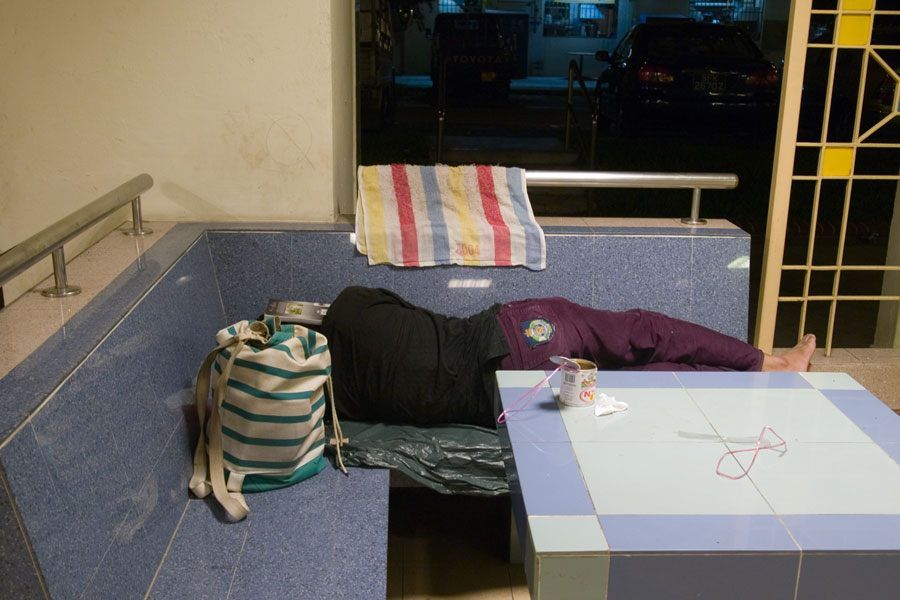
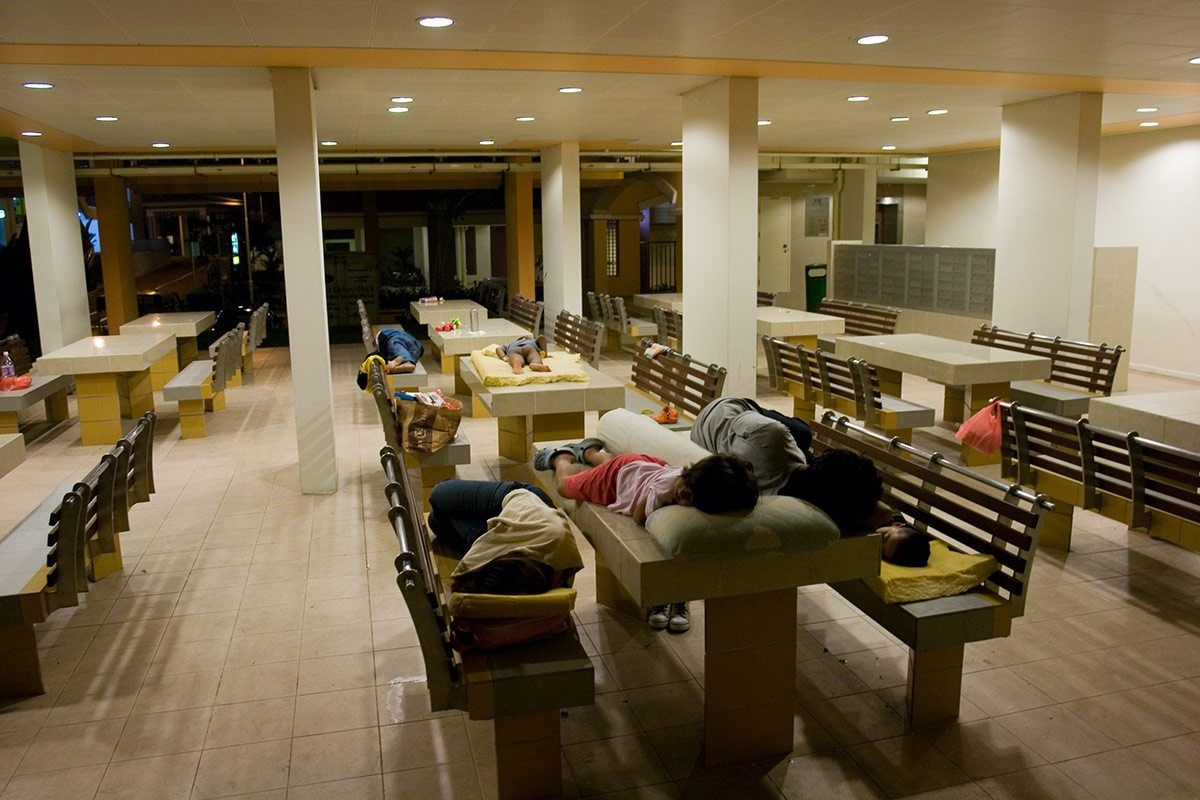
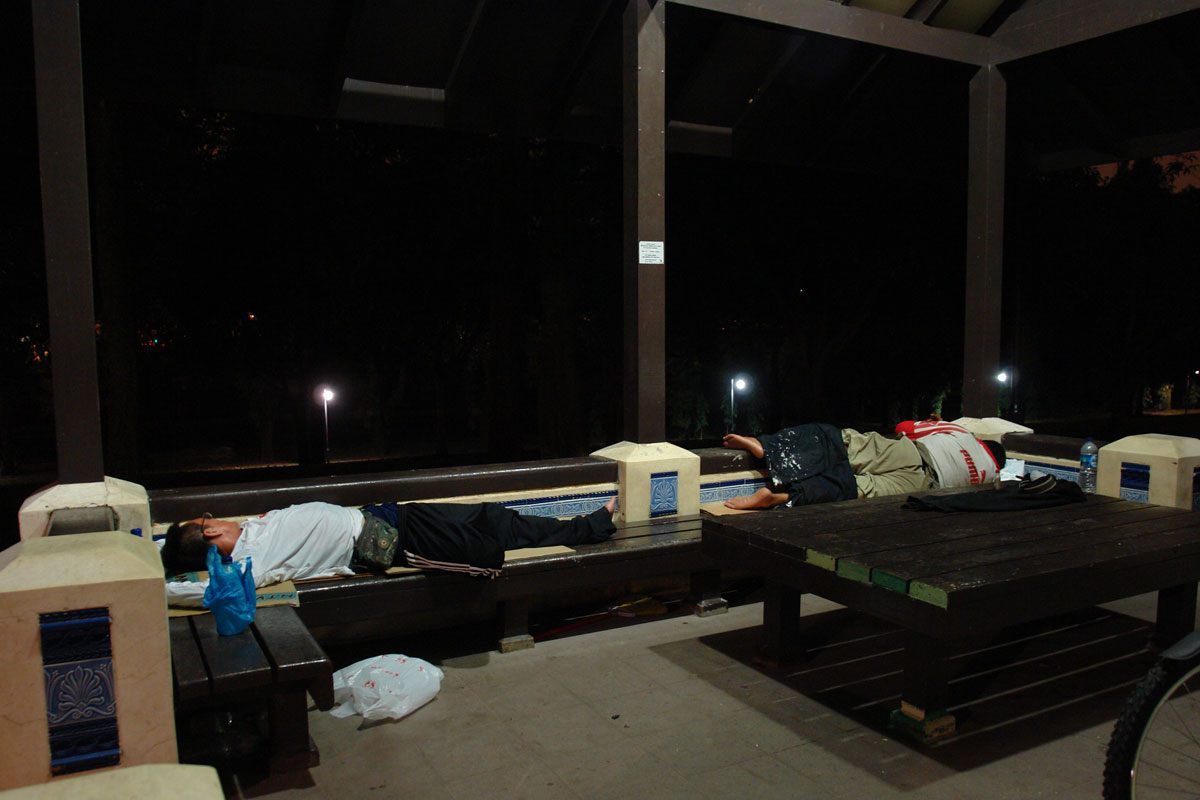
He sleeps at Bishan Park on weekends and on some week days so that he can save money when he goes to work. He works in Ang Mo Kio and he stays on some days with his sister and her three teenage children in her one-room rental flat in Boon Lay. “It’s expensive to travel from Ang Mo Kio to Boon Lay,” he explained. “On weekends, I sleep at Bishan Park to save money.” Mr Silvalinkam told TOC. He would wash up at coffeeshops in the mornings before going to work.
Mr Silvalinkam told TOC that his wife had tried applying for a job several times but has been unsuccessful. She is in Singapore on a Long-term Social Visit Pass, thanks to PM Lee who had helped her obtain it. She too is presently living with Mr Silvalinkam’s sister. “She sleeps in the balcony,” Mr Silvalinkam told TOC. When he is at the place, he too sleeps in the balcony with his wife.
In his last few correspondences with the HDB in October, the HDB continues to deny him his request. His friend, Mr Viswa, has referred him to the Ang Mo Kio Family Service Centre for help.
The HDB, when told about this, replied that it is waiting for the centre’s report.
“My age is catching up with me now,” Mr Silvalinkam said wistfully. “I am already 57.”
-
are u migrating to sydney this holiday?
Prepare to pay more in publich transport!!
No big projects and a huge fares rise
A SLASHING mini-budget from a new State Government administration has crippled long-held plans to expand public transport across Sydney, cutting costs and axing projects, but at the same time rolling out a huge increase in the price of train fares.
The Government has factored in a roughly 38 per cent increase in train fares while making deep cuts on essential large-scale transport infrastructure projects that have been promised for years.
The removal of the $12 billion North-West Metro alone will save almost $1 billion over four years. Between 2010 and 2012, instead of outlaying hundreds of millions of dollars for new railways - the centre of the last budget - Treasury will have sliced the Ministry of Transport budget by $1.14 billion.
Meanwhile, the Government will recoup more than $200 million in increased train fares over the next four years.
Health is priceless
Nurses' overtime slashed in health revamp
OVERTIME for nurses will be dramatically cut back and casual doctors will no longer be able to name their rate under a range of measures aimed at slicing more than $943 million off the health budget over the next four years.
The announcements in the mini-budget were made a day before the Australian Medical Association was expected to release a damning report showing public hospitals were operating at unsafe occupancy levels and with workforce shortages. The NSW president of the AMA, Brian Morton, said NSW would have to spend $1 billion immediately for 1000 hospital beds needed to deliver adequate health care.
1000 beds may cost NSW 1.2 billions.SG new
New 550-bed Jurong hospital by 2015: Khaw
-costs 0.9 million a bed.Say 30% in Oz to build,1.17 million per bed.
Can NSW afford to build?
;..
-
- NSW people have to pay more and ERP like toll fees!!
- Seven miles from Sydney, but it's a lot further by bus
- Congestion charge will do nothing to get cars off the road
- Cost of parking goes stratospheric
-
kkk
Is 4 years jail enough to deter others to committ violent sexual
attacks?Took images the violent act and use as a hand phone
screen savers!!
Did the Appeal Judges send a wrong message to bad guys:
Hi Guys.Only 4 years jail for great funs!!
WTF!!
Is 19 years big enough to bear the consequences of his violent
sexual attacks
Police later found the footage, which he had transferred to his own phone.
Photos taken during the incidents were also stored on the phone and he had used one as his screen saver.The victim was tied up with a belt and left to sleep overnight restrained, and when he untied her the next day the beatings and sex attacks continued.
When her tormentor fell asleep the woman was able to escape and seek help from a neighbor.
The man pleaded not guilty to most charges at his County Court trial, admitting the events took place but claiming they were all consensual.
A jury convicted him of eight counts of rape, five of intentionally causing injury, and one of indecent assault.
He pleaded guilty to a charge of false imprisonment and was cleared of six more counts of rape and five other charges.
But the man appealed the 12-year jail term handed down by the County Court judge who branded his acts cruel, sadistic and repulsive.
Today the Court of Appeal found the term – which required him to serve at least nine years – was “greater than was warranted”.
Justices Geoffrey Nettle, Kim Hargrave and Mark Weinberg said the man was only 19 at the time and had no history of sexual offending.
“It cannot be forgotten that the public is also protected when an offender is rehabilitated,” the justices said.
The Court set a new term of 10 years’ jail with a minimum of seven years. The man has already been behind bars for more than three years.
The Justices agreed with the original sentencing judge that the man should remain on the sex offenders register for the rest of his life.Victoria
Sick rapist in court win
 A VIOLENT rapist who filmed himself attacking a woman could walk free from prison in just four years after winning an appeal.
NO WANDER VICTORIA CRIMES RATE IS 10 TIMES OF SINGAPORE.
PL read my separate thread.
,,,,,
-
-
I cant believe it.
Two days ago Oz PM Rudd just announced a life line of 6 billions to
cars manufacturing industry.
10 Nov 2008A New Car Plan for a Greener Future
Today,Secretary to the Treasury
said he would not endorse the plan!!
Pl note he is just a public servant,unlike the Treasurer is a politician.
@@@@@@@@2
I made my worry here the running of oz gavaman,like
if any major decisions are decided by Cabinets or extra items
budget approved by Parliment,like the cars 6 billions life line.
I think this news prove my worry.
Samantha Maiden, Online political editor TREASURY secretary Ken Henry has refused to endorse the Government's $6 billion car industry assistance package.
- TAX: System "too complex"
- SPEECH: Stone accuses Henry of 'big error'
- PLAN: Giants 'laugh at Aussie suckers'
- RUDD: Drive for green cars
But Dr Henry said he would say that every time there were reductions in car tariffs there were parallel assistance measures announced.
“What this package has done is to increase the generosity of those assistance measures and to extend them for a further four years and that's all I am prepared to say about that policy decision.”
His remarks follow a report in The Australian today where former executives said the American owners of local Ford and Holden plants would laugh at the Australian "suckers" who have handed them a $6.2 billion in assistance.
-
if u think oz like open competition,u may be right on many
sectors.But not in cars sector.read for yourself how oz
is so protective their car industry.
No wander oz so eager to have a major portion of naval building
on their soil.
However,their aim just to create jobs at short term.
How much skills they learn? I dunt know.
SG take technology transfer together.
Same auto sector, different rip-off
Michael Stutchbury, Economics editor FOR decades, the car industry ripped off buyers by inflating its prices behind a high import protection wall.