The first time I considered in the possibility of Extraterrestrial Visitation in ancient China was when I was reading a book on Chinese Mythology more than a decade ago. There it said that the “Gods” came out of the belly of flying Dragons. Contrary to the popular notion of the Dragons themselves being deities to worship, these references clearly implied that they are only vehicles. The image of fire-spitting, flying dragons landing and “Gods” getting out of their “belly” comes up again and again throughout Chinese Mythology. This is how our ancestors would most likely describe air- and spacecraft if they had no word for or concept of them.
Was the first Chinese Emperor an Extraterrestrial?
Huang-Di (2697-2598 B.C.) or “The Yellow Emperor” is considered to be the first emperor of China and the ancestor of all Chinese.
Chinese scholars have always argued whether Huang-Di was “real” or “mythical”. Depending on the source you can either read that he was a god-king, a mythical-king, a real king, a god-like-king, a “son of the heavens” or a half-god. I would like to suggest that the solution may lie somewhere in between: He was real but not human. We know from other ancient cultures and especially from ancient Egypt that those kings and rules that descended from the skies were referred to as “Gods” and their offspring (from relations to humans) as “half-gods”. Chinese accounts are no different in this respect.
According to legend, before Huang-Di was born there was “a radiance from the great star Chi and the Dipper Constellation (Ursa Major). His conception was marked by a “thunderclap on a clear day in the skies”. Huang-Di then begins his unification of China and is also credited with being a culture-hero, having brought traditional Chinese Medicine (including acupuncture) to the country. His wife taught the Chinese how to make silk. (this is consistent other ancient legends that also attributes a woman “who came from the skies” to have taught silk manufacture. More on this later).
He was said to live in the Kunlun-Mountains which are in the heart of Tibet. After he lived and ruled for over 100 years he is said to have prepared his “return to the skies”. Then a metallic Dragon “descended from the sky and took Huang-Di away”. Some sources say that he did not die then but lived another 200 years in the Syuan Yuan stars (the Leo Constellation).
Huang-Di is also said to have authored a book called “Bai Ze Tu” which describes 11520 types of “shapeshifters, monsters, spirits, beings” in the Universe. This book is considered lost. A book of his that was not lost is titled “Handbook on Sex” and is probably the oldest known book on Sex known to us. Some sources also cite Huang-Di as having instructed Lao Tzu…the originator of Taoism.
Of course everything involving space-travel is considered “mythical” by modern scholars. But another reason Huang-Di himself is said to be “mythical” is because he reigned prior to the Shang-Dynasty (1766 – 1122 B.C.) which is the first era that was thoroughly documented. Seeing everything pre-Shang-Dynasty as purely “mythical” came to an abrupt halt when Chinese Archaeologists discovered evidence that the complex Chinese system of writing was already fully developed at the beginning of the Shang-Dynasty and that it indeed dates back at least to 2000 B.C.
Many ancient accounts on Huang-Di keep referring to him as an inventor or developer of odd mechanical devices. A machine called “the south pointing chariot” helped him win various battles. Another odd device which Huang-Di is supposed to have invented is what is translated as “a tripod”. This “tripod” was 4 meters in height and “100s of energies filled its inside” and made “odd noises”. According to legend this tripod depicted “dragons flying in the clouds”. Furthermore, the tripod was set up at the “Summit Lake Mountain” (one of Chinas most famous mountains because of this legend) and “had to be pointed at the Syuan Yuan star” (our name for the brightest star in this Constellation is Regulus). This is also the star Huang-Di is said to be from. Apparently this “tripod” was also able to store data, as they say it recorded the life and times of Huang-Di.
Huang-Di’s “Dragon” is not described as some mythological creature but as a device to ascend to “the suns”, as a means of transportation and that this dragon is more than three thousand years old. The Biography of Huang-Di states that the Changhuan covers an extreme distance in only one day and that a human who “rides” it can reach and age of two thousand years. This is quite consistent with many other global myths and religious accounts of time dilation in regards to the “vehicles of the Gods”.
If these descriptions, straight from books on Chinese Mythology sound like so many other ancient accounts of Gods and Half-Gods around the globe, then its probably because there is some truth in them.
Source: Chinese Mythology
The Beginnings were more Advanced than later Periods
From Ancient Egypt we know that earlier dynasties appear to have been more advanced than later ones. Later Pyramids for example, were always less elaborate and grand as the original Pyramids of Giza. This, of course, contradicts conventional thought that supposes an upward evolution of all ancient cultures. The same type of De-Evolution can also be seen in parts of ancient South America. It can also be seen more recently in that our middle ages were in many ways less knowledgeable than their ancestors (The Greeks knew the earth was round wheras middle age doctrine said the earth is flat).
We could discount De-Evolution as an oddity, a rare anomaly…except that we also have the same thing in China.
Aliens or Ancestors? The Mysteries of Sichuan Excerpts only (for more, see linked source):
Huang Nengfu, a professor of arts and design at Tsinghua University and an eminent researcher in Chinese clothing from different dynasties, considers the garment to be the country's oldest existing dragon robe. He also thinks that the pattern is the work of the famous Shu Embroidery.
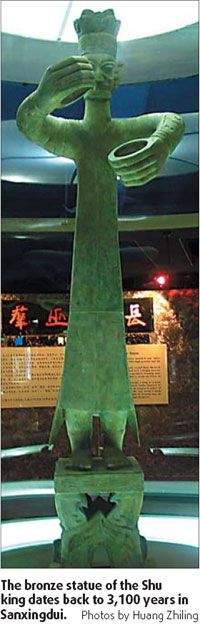
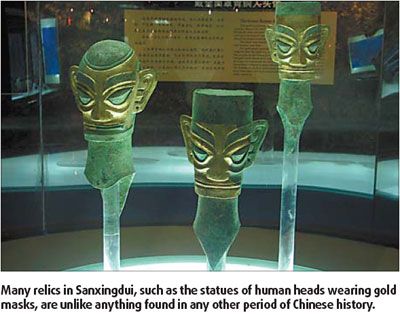
Many theories also surround the fall of the Sanxingdui civilization, which seemingly disappeared without a trace, leaving behind objects unlike anything found in any other period of Chinese history.
Archaeologists have been left wondering what the purpose of the objects was and how such an ancient culture, at the very beginning of Chinese civilization, could be so advanced.
What follows are a few other unexplained mysteries picked up while researching the topic.
The Case of Lady Dai
In 1972 three burial mounds were found, quite unexpectedly, in Changsha, South Central China. The three tombs contained all sorts of artefacts, art and mummies from the Han Dynasty (200 B.C. – 24 A.D.) One of them contained a female corpse called Lady Dai. To the archaeologists great astonishment, Lady Dai lacked the usual signs of decay.
'No one's found anything remotely equivalent to this. If she'd only been buried a year I would be amazed at how well-preserved she was.
'To think that she's been buried for 2,000 years and is in this condition is baffling.' Dr Higham said: 'This is the bestpreserved ancient body ever found.
This is something you never find even in Egypt. Tutankhamun, for example, comes out as a sort of shrivelled up little corpse compared with the extraordinary preservation of this woman.' The tomb offers several clues.
Source
All indicators – smooth skin, body fat, strong muscles – made the impression of a very fresh corpse and not one that was buried for more than 2200 years. Back then this corpse was considered a sensational find among scholars. Meanwhile it has been hushed-up, covered-up by a media-blackout – to the extent that nobody goes into detail on it. Why? Because the body was preserved by a liquid substance that indicates advanced technology. The corpse has now been deteriorating since it was excavated and exposed because we lack the technology to preserve it as the ancients did. A recent news item:
CHANGSHA: The bones of an ancient female mummy excavated from the Mawangdui Tombs in Central China more than 30 years ago, are starting to disintegrate. According to Luo Xuegang, head of the human anatomy research centre with Xiangya Medical Sciences College, the bones of the female mummy of Western Han Dynasty (206 BC-AD 24) have started to decalcify. The discovery was made through a recent X-ray observation. "The decalcification might be caused by the fluids used to preserve the body being too acid. We can adjust the pH to ensure the ...
Source
A General Info Source:China Daily Article
Some scientists suspect the real key to her preservation, however, may lie in the reddish liquid in which the body was immersed. If so, the secret may have died with her. Tests have revealed it is mildly acidic and contains magnesium and salt, but have so far failed to identify all the contents. ...
Source
So there you have it: Scientists have discovered a liquid that is capable of better corpse preservation than our own and they do not know what the liquid consists of.
The Qufu Mystery
This is the Tomb of the mythical chinese emperor ShaoHao located at a town/place called Qufu. Its the only known stone-pyramid in China. Whats odd about the Chinese name "Qufu" is that the ancient Egyptian Khufu is said to be the builder of the Great Pyramid of Giza (although there is not much evidence for this). I stumbled upon the name-sync by chance while surfing around for Pyramids in China. Is this just a coincidence? Or did Chinese travellers copy the name from Egypt? Or is there a more mysterious and forgotten story behind this?

Silk: An Extraterrestrial Import?
The Ancient Chinese are not the only ones to say that silk came from outer space. This is what ancient Khmer (of Cambodia) oral traditions say about the origins of silk:
Five female “superhumans” flew down from the sky to earth for no other purpose than to “have fun”. One of them Sota Chan cannot resist the Temptation and steals six good smelling twigs from a poor Chinese Peasant Loem-Sang. After the girls return home to the “heavens” God Indra is enraged by the ladies interference in human affairs and, as punishment, orders Sota Chan to spend six years on earth as Loem-Sangs wife! Sota chan reluctantly (“without hope in her heart”) returned to earth. Surprisingly Loem-Sang is not willing to marry her so she has to persuade him to. She promises to teach him skills and arts that “nobody else here knows”. So he marries her and she teaches him how to weave and process a type of silk “not seen on earth before” and that silk is admired by all. After a year she gets pregnant and gives birth to a child which is “half human, half Demi-God”. His non-human mother gives him the name Preah Pisnokar. The first years of his life he spends eagerly drawing and painting animals, humans and geometrical figures. By the time he is five Sota Chans exile on earth is over and she flies back to the heavens.
So how do modern day scholars interpret this story? They say it "symbolically" means that the Sota Chan returned to the Chinese "Emperors Court". Its interpretations bereft of any logic or sense that make me prefer the original ancient sources over those of the modern "scientific community" sometimes. Why would anyone have to "fly" to the Emperors Court?
Source: Khmer Mythology
Continued in next post by TheWayISeeIt...
[edit on 29-4-2009 by Skyfloating]

reply posted on 29-4-2009 @ 02:06 PM by TheWayISeeIt
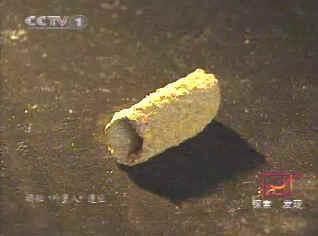
The Baigong Pipes Discovered on the banks of a salt lake in the largely inaccessible and uninhabitable area of Qinghai, China the mysterious ‘Baigong Pipes’ are truly one of the great geological anomalies and OOPART discoveries in recent history. This ancient, other-worldly piping system is located in and around Mt Baigong, which itself is incongruously topped by a 60 meter ‘iron’ pyramid.
The largest example of the clearly engineered pipes can be found in one -- of three -- of what resemble ‘dug out’ caverns. The one that is still accessible has a 40 cm half-pipe that runs at an angle from the ceiling of the cave, tilting all the way to the back. Another pipe of the
same exactdimensions is buried in the cave floor with only its opening revealed.
Dozens more of these iron pipe openings are located above the caves entrances.
The pipes themselves not only run in and around Mt. Baigong, as well as into the salt lake, but many smaller ones are scattered on the lakes shore in an east-west pattern;
all of them perfectly round with some measuring as narrow as a toothpick. More remarkably
none of them is blocked or congested by sand.
Why that is… is a geological mystery.
The site was first found in 1998 by a group of U.S. scientists who were in search of fossilized dinosaur remains. They estimated the date of the pipes at 300,000 years old. The find was reported to the Chinese government and subsequent studies have been quietly conducted, actual tests have now shown the pipe-network dates to precisely the time Huang-Di is said to have emerged from them ‘belly of a dragon’, 3000 BC:
Engineer Liu Shaolin from Xitieshan Smelting Plant who carried out the analysis says the levels of silicon dioxide and calcium oxide point to the pipes being on the mountainside for a long time - although his estimate was significantly more recent than the U.S. scientists' original theory that the iron was 300,000 years old. Liu found that it was 5000 years old; impressive, considering modern human smelting methods date back a mere 2000 years.
While often described as ‘Iron’ a 2002 analysis showed that the pipes are composed of:
“...30 per cent ferric oxide, with high content of silicon dioxide and calcium oxide; eight per cent of the sample's makeup was categorized "unidentifiable".
Link for both posts To further drive-home the extraterrestrial aspect of these pipes let’s look at the last, brief report that the Chinese government released in 2007 where geologist Zheng Jiandong states:
"There is indeed something mysterious about these pipes," he explained, "for example, the size of the pipes tends to be small and some of them are highly radioactive."
Link
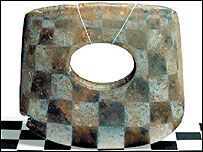
Anomalous Technology Emerges in the Neolithic China It was recently discovered by Harvard University researchers that inhabitants of Stone Age China suddenly began using diamond to polish corundum – the second hardest mineral known to man after diamond. The earliest polished tool
found thus far dates back to
approximately 2500 BC a full two-thousand years before the technology was commonly considered to have been implemented.
Not only did this ability suddenly emerge, to then be lost in further evidence of devolution, but the quality of the workmanship, the high-sheen to which these tools were polished, was such that
we still cannot reproduce it today.
However, even with the best modern polishing technologies available, the research team could not achieve a surface as flat and smooth as that on the ancient axe. The ancient craftsmen must have used highly sophisticated techniques.
Link x
x