æ‚Ÿé“是哪个心
-
Originally posted by An Eternal Now:
The emphasis on æ— åˆ†åˆ«å¿ƒ is not on 分别, but rather it is it is on 内外, "我" å’Œ "对象", "人" å’Œ"法" 的对立/分别. As Thusness said, 一切的呈现å�³'心',有了彼与æ¤çš„分别å�³'识'.
The reason why we take our 分别 to be real, to be "有实体" is because we think that there is a Subject/Perceiver/Observer (我/观者) looking at a real self-existing Object (实在的对象), like "I" am looking at my "table", as if there is a "me" and a "table" as separate entities.
Because of the illusion of a fundamental duality of Subject and Object, 内 and 外, we experience the world as an "I" which dualistically perceive "it" as a collection of objects which interact causally in space and time. That is Samsara.
But Ultimate Reality is Non-Dual... our Buddha-Nature, or the True Nature of Reality (佛性/法性) is æ— å†…å¤–ï¼Œæ— æ–¹æ‰€ï¼Œæ— ä¸è¾¹...
Enlightenment is realising there is There is only one reality -- this world, right here...
...Nirv�ṇa is the world as it is in itself, nondualistic in that it incorporates both subject and object into a whole which, M�dhyamika insists, cannot be characterized (Chandrakīrti: "Nirv�ṇa or Reality is that which is absolved of all thought-construction"), but which Yog�c�ra nevertheless sometimes calls "Mind" or "Buddhanature," and so forth.
When some Zen master hear a sound or see something break, and suddenly attain Enlightenment, it is because for that moment the illusion of the Self has broken down... in that moment, there is no 观者 (perceiver/observer), 对象 (i.e 'bell'), there is only 清�觉... which is 佛性... just the pure awareness/hearing/sound. And it is realised that all along, there is just hearing, no hearer... and the hearing IS the sound, the seeing IS the scenery, they are not separate, no seer/observer apart from seen/observed. Everything is pure awareness, and there is only that, there is no I.
This is exactly the same as what a Zen Master said upon his enlightenment:
“When I heard the sound of
the bell ringing, there was no I,
and no bell, just the ringing.”This is what the scriptures meant by è§�色明心,闻声悟é�“.
The 心 here is 真心/一心/佛心/佛性, not the 妄心. Like what 黄檗希è¿�禅师 said, “ è¾¾ æ‘© 大 师 到 ä¸ å›½ , 唯 说 一 心 , 唯 ä¼ ä¸€ 法 , 以 ä½› ä¼ ä½›ï¼Œ ä¸� 说 ä½™ ä½› , 以 法 ä¼ æ³• , ä¸� 说 ä½™ 法 。 ”
And because 有了彼与æ¤çš„分别å�³'识', Enlightenment is ä¼ è¯†æˆ�智. As Thusness explains that the Great Round Mirror Wisdom (大圆镜智) is a wisdom that transformed totally the wrong view of phenomena as “out there or in here” to all as the manifestation of our pristine awareness due its emptiness nature. It is the experience of Dharmakaya (法身).
I think the first article on the 唯识浅谈 thread explains well, you may want to read it carefully: http://buddhism.sgforums.com/forums/1728/topics/324944
However his terminology of '心' and '识' may be a little different.
................
A song by my Master:
ä¸€æ— ä¿®æŒ�æŒ
修修修,���,
得到了��,宇宙的富�,
é�žç©ºé�žæœ‰ä¸ï¼Œæ³•æ€§é��虚空,
还有什么人我是é�žï¼Œè¿˜æœ‰ä»€ä¹ˆçƒæ�¼è½®å›žï¼›
二å…æ—¶ä¸ï¼Œå…‰æ˜Žè§‰ç…§ï¼Œ
éš�缘生æ»å�³äº†ï¼Œæ— 处ä¸�是圆通,
çœ‹ç ´æ”¾ä¸‹ï¼� 自由自在ï¼�
粗衣淡食,茅屋蔽身,
白雪当阳,万里长空,
晚上一轮明月,冬天处处和风,
å››å£ç™¾èŠ±å¼€æ”¾ï¼Œé£˜æ’万年馨香,
醒�� ��� ��� 醒��
高山的暮鼓,远处的晨钟。
有了彼与æ¤çš„分别å�³'识'。i have search the internet, i cannot find this sentence in any article, i think this is Tusness' personal opinion,
Then i got the following
是诸识转�,  分别�所分别,
   由æ¤å½¼çš†æ— ,  故一切唯识。”由一切ç§�识,  如是如是å�˜ï¼Œ
   以展转力故,  彼彼分别生So i think this means the conciousness, start from the 8th conciousness,诸识转�.
由�说我法,  有��相转。
  彼ä¾�识所å�˜ï¼Œã€€ã€€æ¤èƒ½å�˜å”¯ä¸‰ï¼šã€€è°“异熟ã€�æ€�é‡�,  å�Šäº†åˆ«å¢ƒè¯†ã€‚”
�阿赖耶识,  异熟一切�
the 8th conciousness, alaya change to 末那 conciousness, 末那 conciousness change to the 6th conciousness,
由一切�识,  如是如是�,
   以展转力故,  彼彼分别生when the conciousness is changing, because of 展转力, 分别is generated.
So i don't agree
有了彼与æ¤çš„分别å�³'识'
The post seems quite confusing, hope it doesnot cause any misunderstanding, and Thusness, i don't mean to confront you, just discussion
So i think on Alaya conciousness level, there will be no 分别, only when alaya conciousness change to the lower conciousness, the fenbie is generated, that's all
-
An explanation of Non-Duality by someone Thusness thinks is truly enlightened:
Just a quick stab at this based upon part of Daniel's answer from before, I'm sure he will have far more detail, but I think I can address this a little. The answer to "What is cognizing the self-luminous flickering sense-field" is actually partially within your question. In other words, it is very helpful, as you have done here, to take the pronouns out of the equation from time to time (i.e. my senses, my attention) and de-humanize it a bit with words such as "What?" That might actually lead a little closer when it comes to certain forms of inquiry than usually can happen when pronouns are stumbling a practitioner in the narrative back toward personal identification. Secondly, when I see Daniel's sentence "Even the looking is just a causal, transient process, not self, not other, part of a naturally unfolding field of experience that never needed to nor did contain any experiencer apart from that which is experienced," it is pointing to a specific revelation - in fact the revelation at the heart of it all. And that revelation is "all sensations are aware where they are." The "What" that is taking this in does not exist, but that first has to be grappled with through the increase of direct perceptual intake and discernment through practice and contemplation and wrestling with these realities. In other words, "your" ears are not hearing the bubbling brook over there - the sound of that brook is taking the sound of brook in, directly, in the field at a certain distance from the body - with the illusion being created that it is being heard by the ears, through mental processes, as a separate observer. The more the perceptual nature and processes are dissected and investigated & the more the sense of separation is challenged/dismantled, the more it is directly seen how the sense-field is one, (i.e., is not "solid form" full of separate conscious objects) and is senseing itself.
-
Originally posted by rokkie:
有了彼与æ¤çš„分别å�³'识'。i have search the internet, i cannot find this sentence in any article, i think this is Tusness' personal opinion,
Then i got the following
是诸识转�,  分别�所分别,
ç”±æ¤å½¼çš†æ— ,  故一切唯识。”由一切ç§�识,  如是如是å�˜ï¼Œ
以展转力故,  彼彼分别生So i think this means the conciousness, start from the 8th conciousness,诸识转�.
由�说我法,  有��相转。
å½¼ä¾�识所å�˜ï¼Œã€€ã€€æ¤èƒ½å�˜å”¯ä¸‰ï¼šè°“异熟ã€�æ€�é‡�,  å�Šäº†åˆ«å¢ƒè¯†ã€‚”
�阿赖耶识,  异熟一切�
the 8th conciousness, alaya change to 末那 conciousness, 末那 conciousness change to the 6th conciousness,
由一切�识,  如是如是�,
以展转力故,  彼彼分别生when the conciousness is changing, because of 展转力, 分别is generated.
So i don't agree
有了彼与æ¤çš„分别å�³'识'
The post seems quite confusing, hope it doesnot cause any misunderstanding, and Thusness, i don't mean to confront you, just discussion
So i think on Alaya conciousness level, there will be no 分别, only when alaya conciousness change to the lower conciousness, the fenbie is generated, that's all
Discriminations and dualistic cognition happens only in Conscious level. Alaya which is our subconscious, is pre-conscious, pre-discrimination, pre-duality. So in this sense, of course I agree with you that in the Alaya conciousness level, there will be no 分别, only when alaya conciousness change to the lower conciousness, the fenbie is generated.
However, the ignorance are like seeds planted in the Alaya. The karmic propensity of seeing in terms of duality and self are planted deeply into the Alaya.
When we enter into deep dreamless sleep at night, there is completely no conscious experience, there is no experience of duality or discrimination either. As Thusness said before, deep dreamless sleep is the deepest level of nondual samadhi. But there is no insight. We can't gain insights from this level, and we don't even have any conscious awareness or memory of being in this state.
But when you enter into dreaming phase, 7th consciousness arise. When you enter the waking phase, 1~6th consciousness arise. Dualistic experience only occurs in the Dreaming and Waking phase. (however if you are enlightened, there is no dualistic consciousness, only non-dual experience)
Then does that mean our deep dreamless sleep/pre-conscious state is enlightenment? No.
This is because the latent seeds of the 8th Consciousness which is pre-conscious persists as a potential in deep sleep (but not yet manifesting)... that is why when someone wakes you up from your deep sleep, our karmic propensity will again quickly ripen into manifestation as the illusion of duality (subject/object dichotomy).
Enlightenment totally transforms to the deepest level of our psyche... it completely transformed totally the wrong view of phenomena as “out there or in here” to all as the manifestation of our pristine awareness due its emptiness nature. It is the experience of Dharmakaya (法身).
Here the emphasis is on wrong views/ignorance. These wrong views are deep imprints of our 8th consciousness and has to be eradicated through insight. For example in deep dreamless sleep, there is no thoughts and thus no illusion of "duality" or "false views" either, yet does that mean enlightenment? No. Hence achieving a state of non-discrimination and no-thought does not itself mean awakening, as every day we spend time in that state in the deep dreamless sleep yet without gaining any 'insights'.
Hence there is no other adequate means to achieve liberation other than a transformation/awakening/quantum shift of perception that reaches into our deepest subconscious (8th consciousness) -- because if we get rid of discrimination through concentration at the conscious level by shamatha, it is only a temporary state and the seeds/karmic propensity will continue to manifest again later. But when the seed is removed, birth and death ends right there.
The ä¼ è¯†æˆ�智 occurs at all levels including the Alaya, and only when the Alaya is completely transformed is there complete enlightenment. Though Alaya is prior to 分别, the seed/propensity to see in terms of Self and Duality and Inherency is there and continues to hold influence over us in all our waking hours.
Hence true inner transformation/awakening must sink and takes place deep into our 8th consciousness, burns away our dualistic/inherent seed or karmic propensity of seeing. This is known as the eradication of fetters/afflictions/ignorance through the power of insight/wisdom.
It completely untangles the knot of perception of viewing dualistically and inherently at the deepest level, and this is also known poetically as the awakening of the Wisdom Eye.
-
I just did a random search and found a very good explanation on the 8th Consciousness:
http://www.kheper.net/topics/Buddhism/Yogacara_glossary.html
Alaya-vijnana, or "store consciousness" -- one of the central technical terms of Yogacara (Vijnanavada, Vijnaptimatra) philosophy of Mahayana Buddhism. Early Buddhists taught about existence of six-fold consciousness, that is the conciousness of five types of perception (visual, audial, etc.) and of "mind" (manovijnana). The Yogacarins analysing the source of consciousness added two more kinds of consciousness. They are: klistamanovijnana, or manas, that is the ego-centre of an empirical personality, and alaya-vijnana which is the source of other kinds of consciousness. Alaya-vijnana is above subject-object opposition but it is not a kind of absolute mind: alaya-vijnana is momentary and non-substantial. Every sentient being with the corresponding to this being "objective" world can be reduced to its "own" alaya-vijnana. Therefore, classical Yogacara states the existence of many alayas.
The Alaya-vijnana is a receptacle and container of the so-called "seeds" (bija), or elementary units of past experiences. These bijas project themselves as an illusionary world of empirical subjects and corresponding objects. All other seven types of consciousness are but transformations (parinama) of alaya-vijnana. In the course of its yogic practice a Yogacarin must empty
alaya-vijnana of its contents. Thus the Yogacarin puts an end to the tendency of external projections of alaya-vijnana changing it into non-dual (advaya) wisdom (jnana) of Enlightened mind. -
As a concluding note to this topic, enlightenment is a permanent quantum shift in perception/awakening that transforms not only our conscious level of experience but also transforms our subconscious (alaya) into wisdom.
From the transcript of a sharing on Lankavatara Sutra/楞伽� (http://buddhism.sgforums.com/forums/1728/topics/262408) by Thusness in 2007,
...The momentum is so subtle that you canÂ’t see it, unless you meditate. That is why you have to meditate. Meditation is for you to calm yourself down so that your mind can be clear enough to sense this patterns. This momentum. This continuous momentum that is taking place from moment to moment. Now, why do I want to stress this momentum? Because many people mistook reality, because this momentum is always taking place and without being truly mindful, you just assume it to be like that. It is a spell. It is a magical spell that bonds. So we are blinded because of the spell, and consciousness reacts to this spell, which is just a bond. Just a bond. And you just canÂ’t see. And consciousness is full of these bonds, all around, and you canÂ’t see. These bonds are what that prevent us from understanding. Now, therefore, you have to take the Seventh Consciousness in the Cittamatra and the Eighth Consciousness very seriously. The conscious mind cannot do much things. Whatever you think you have a way of doing something can only take place not immediately. They can only take place as a form of imprint, very deep into your consciousness. Becomes imprint and momentum, and then resurface out as effects only at much later dates. It always work this way. This is what one has to understand. So now, this is the momentum that is preventing a person from seeing... -
Originally posted by An Eternal Now:
Here's an attempt to try to answer and also to ask questions.. please correct wherever necessary..
1) Can you give an example of dualistic and inherent view and what different impacts they have on our experience? Also it is said/described in the realisation of non-duality that the dream-like nature of phenomenality is seen. Is this a form of insight into non-inherency also? Or there are various depths to this insight?
2) "The All" as described by Buddha consists of 18 dhatus or the 5 skhandas, that is all there is to phenomenality... and is the 'non-dualistic' way of describing phenomena: there is no who, there is no experiencer, feeler, thinker, doer, but rather... thoughts, feelings, experience arise and pass momentarily according to conditions. Similarly, there is no self/'who' reincarnating, rather, upon condition birth arises.
This 'better way' of describing is still conceptualization but necessary to instill Right Views (the first of the 8 fold path) necessary as a requisite to enlightenment. This is because latent tendencies are linked with tightly held views deep in our psyche/subconscious and is always surfacing in our daily experience as our dualistic/inherent way of perception.
It is not wrong to form concepts in this case, because the teachings of No-Self and Emptiness are really good and necessary skillful means to bring about realisations.
To take a quote off from the Hindu Advaita Vedanta tradition, and even though he was not refering to the view of Emptiness, I guess the metaphor could still be similarly used for the view of Emptiness: "This problem was once propounded to Sri Ramana Maharshi. He was asked how it could be valid to use the mind to deal in any way with the problems of the mind. He replied that a stick is used to stir up a fire in which weeds are being burned and, in the end, the stick itself is also consumed."
Emptiness is also empty -- the last stage is to leave the raft behind the shore, into the viewless view of emptiness happening. Still, you have to take the raft first before you can reach the shore.
3) Means mistaking that we can forcefully do away with our dualistic/inherent views by suppressing thoughts from arising. Even though thoughts may temporarily subside, the karmic propensity/seed/conditioning is still latent in our subconscious/8th-consciousness. That is why enlightenment is only possible through development of insight, not shamatha/concentration, though the latter can be an aid.
4) Means the insight burning away the bonds latent in our subconscious. The insight sinks into our consciousness and burns away the dualistic/inherent seed of perception. Or as Dharma Dan calls it, the fundamental knot of perception.
5) Dualistic and inherent views keeps us in samsara, in the chain of Greed, Hatred, Ignorance. It is the source of all confusions and sufferings. For example, desire is the inner deficiency due to seeing a split, and in the attempt to bridge the gap there is further longing and separation. These views are the cause of endless sufferings, the cycle of rebirth and karma.
These dualistic and inherent views have the power of blind us, to bind us to a spell-like state. We take our dualistic projections to be reality, and thus do not experience liberation, and dull our luminosity.
6) Right Views plant the seed that transforms our way of perceiving, so that when the seed meets the other right conditions (like practicing mindfulness, etc) insight can arise.
For example: 'who feels' or 'who experience' is a wrong concept, but rather, the question should be put forth this way: with what condition does Feeling arise? Feeling is a self-luminous arising, there is no watcher apart from all arising and subsiding.
Another example: we always think that there is a self or an experiencer, such that when we inquire into rebirth (or anything), we will be confused with "who is reborn?" Buddha taught us the right way of perceiving is not to ask "who" (irrelevant, since there is no inherently existing self -- rebirth is a continuation of a process, not the passing on of any sort of self-entity), but rather, upon what condition does birth arise (in this case, affliction and action).
Yet another example: If we were to ask, "If you lost your shoe, are you still you?" or "If you lost your hands, do you still exist?". It almost seems certain to say "Yes, of course I am still I." because we always assumed there is a truly existing "Self" experiencing changes, though in reality there is no fixed Self or an experiencer: there is only Self1, Self2, Self3, moment to moment our mental and karmic factors arise spontaneously but in a disjoint way. We are not a permanent self, we are momentary selves and nothing stays, everything is ever flowing.
The right views reconstruct our inherent/dualistic way of viewing into seeing All as the flow of dharmas unfolding according to condition. However 'right views' can still remain at a pretty conceptual (still, necessary) level until there is insight/realisation.
7) To go beyond our conditionings/constructs to experience first hand what Reality is beyond conceptual fabrication, instead of what we thought it should be. To directly experience what impermanence, arising and passing is. To directly experience non-duality/no-self... and to experience the workings of our karmic propensities/bonds and how they cause suffering. Basically, being aware of the three basic facts of existence/the three dharma seals.
In a moment of naked awareness, it may be also seen that all our dualistic and inherent projections are really just thoughts without reality. Thus the conditioning/belief in the thoughts loosen.
What Is is beyond all conceptual grasp, is vividly present prior any arising thought.
8) Without right views, though naked awareness maybe experienced when thoughts subsides, but the latent propensity of seeing dualistically/inherently may still be deeply conditioned. Thus even when a glimpse of pure awareness happens, it may be distorted into the 'I AM'.
One more thing... the moment we believe in our projections, our labels and objectification of 'things', we treat duality and separation (subject apart from object) as real. Just like labelling things (table, chair, me, you) for conventional purposes is not itself a problem, but the problem is mistaking our labels to refer to a self-existing/inherently existing 'separate' 'object'. That means believing our labels actually refer to an actual, externally existing thing -- that is the illusion. So much so that whenever see this greenish thing we immediately believe our labelling "This is a Tree" to be absolute, to be refering to an inherently existing object.
Because of this spell-like state of believing in (false) duality, we become 'contracted' into the false sense of a separate self experiencing a world fragmented into separate objects and fail to see that in fact all is One Mind, there is no "me" apart from the "tree" or anything existing "out there" apart from Mind. All is happening in one non-dual space, one field of aliveness appearing in its diversity where there is neither subject nor objects or any form of separation, only one flow of pure awareness. Everything, every experience right where they are is One Mind or Buddha, from the bird chirping to words appearing on screen.
Our dualistic and inherent propensities is so deep that whenever we see an object, lets say a tree, after a fleeting moment of pure awareness before duality, the projection of duality sets in because we constantly reference our experience with our knowledge/past experience and thus we dualistically project what we experienced to be external objects.
This constant cross-referencing produce the illusion of a persisting Subject experiencing temporally persisting objects interacting in space and time, which is the world of duality, which is samsara. Samsara is just our illusory dualistic projection while we are ignorant, it never was real.
Non-dualistic and non-inherent insight clarifies the true nature of reality and thus removes this veil at a fundamental level (means deep 'in' our Alaya/Storehouse consciousness) so that we will experience Reality in bare, without the confusion of reality being separated into 'Two'. We no longer 'experience reality falsely'. That is Nirvana.
It is like seeing a mirage, the ignorant mistakes the mirage for a real external object/entity which is separated from himself, the enlightened sees the mirage (thought, experiences, etc) as simply empty-vibrating energy of his luminous nature without solid, external self-existence. It is in essence only the flickering illusory manifestation of Awareness/Mind.
And Thusness mentioned that non-dual insight and non-inherent insight affects different kinds of 'bonds'... just my understanding, non-dual insight is like there is no "tree" separate from awareness, mind and object have always been one, yet there is still a referencing to the "tree" as an inherently existing object. There is a belief in the 'treeness' and that it has certain fixed attributes, shapes and colours. And this belief in inherency will subtly create an impression of duality because we still view things as objects, instead of awareness as empty spontaneous arising of dependent origination. This viewing of phenomena as inherent objects instead of simply pure manifestation of Awareness will affect non-dual clarity.
In reality everything arising as awareness is utterly conditioned and has no inherency... awareness and conditions are inseparable, and yet seemingly paradoxically (but actually isn't), precisely because everything is dependently co-arisen that every moment/emergence of experience is spontaneous and unconditioned (since they are neither subject nor objects interacting causally in space time and every moment of self-luminous manifestation is 'complete and absolute in itself') and are not a persisting entity, each moment a complete reality in itself, changing moment to moment due to conditions. Perhaps 'dependent co-arising' is a more precise term than 'dependent origination' as the latter may be misunderstood to be linear cause and effect operating in space-time rather than what is directly experienced as the unconditioned reality. In non-dual and non-inherent understanding, cause and effect are one even in apparent space-time gap.
The principle/'formula' for Dependent Co-Arising is taught by Buddha as such:
When there is this, that is.
With the arising of this, that arises.
When this is not, neither is that.
With the cessation of this, that ceases.When insight into the emptiness/non-inherency/dependent co-arising nature of all phenomena occurs, the last stand of duality collapses, all modes of inquiry, and experiencing become perfectly aligned into non-dual luminosity and the empty nature of all phenomenon (Dharma Nature), i.e. Dependent Arising. These "aspects of reality" are actually not two, as the Tibetan masters call Buddha-Nature/the nature of reality, the union of luminosity and emptiness. Emptiness as a teaching is just a concept and a raft to give rise to the insight of non-inherency -- when awakening to Emptiness occurs, the raft is then 'left behind at the other shore' into the viewless view (or non-view) of emptiness happening, which is the non-dual and non-inherent luminosity/clear light mind... as explained in the topic that Longchen has recently posted in Very good articles on mental activities.
I must also add that glimpses and experiences of the luminosity of our Buddha-Nature can occur much earlier, yet without insight into its non-dual and non-inherent nature... and the overemphasis on the luminosity aspect at an earlier stage without correct understanding might be dangerous and can even increase our subtle attachment to 'Self' and potentially cause other problems such as insomnia/sleeplessness. Both our moderators Thusness and Longchen got stuck at this stage for 10~20 years before realising No-Self and Emptiness.
As Thusness posted more than 1.5 years back,
In Buddhism what that is most important is the no-mirror reflecting (stage 5). That is entry towards pathless and effortless. Without it, all rest is the bond at work and continual creation of wholesome actions to counter unwholesome action.
Many non-dual fail to realize the deep latent propensities in our consciousness. Not knowing that the progressive stages that one undergone are nothing but mere working of these tendencies. This is a pity. Failure to realize this, one fails to see how consciousness works.
Constant identification itself will create this pattern that sinks deep into consciousness. Take note. No one can escape, not even the Blessed One. There always has been no-self, there is only One Reality but the propensities over countless lifetimes will continue to take place through mere momentum. This is what we are all facing.
Knowing this, right and firm establishment of view of the dharma seals is most crucial. Through diligent practice of mindfulness and together with the right views from start will help to prevent unnecessary pitfalls. Any transcendental experiences and insights that occurred during our journey will then be correctly understood. The experiences will in turn re-enforce our understanding instead of misleading us into the sense of 'Self' and further strengthen the bond.In fact the teachings on the luminous aspect of our true nature is not peculiar to Buddhist teachings, it's taught in the Vedas, Upanishads (Hinduism), as well as the Christian/Islamic/Judaist/Taoist mystical traditions... to many of these traditions, the experience/realisation of this luminosity aspect alone is "enlightenment".
Unfortunately the overemphasis is also part of modern Buddhism (not all though). This is not to say that luminosity is not important, in fact the experience of luminosity is most precious and transcendental, but it must be cleansed by the truth of no-self and emptiness otherwise it becomes a double edged sword.
As Thusness said before about four years ago, "what buddha taught is about emptiness, not the 'self' luminosity, coz there is already so much being written in the hindu vedas.", and,
[19:21] <^john^> learn how to experience emptiness and no-selfness. :)
[19:22] <^john^> this is the only way to liberate.
[19:22] <^john^> not to dwell too deeply into the minor aspect of pure awareness.
[19:23] <^john^> of late i have been seeing songs and poems relating to the luminosity aspect of Pure Awareness.
[19:23] <^john^> uncreated, original, mirror bright, not lost in nirvana and samsara..etc
[19:23] <^john^> what use is there?
[19:24] <ZeN`n1th> oic...
[19:24] <^john^> we have from the very beginning so and yet lost for countless aeons of lifes.
[19:25] <^john^> buddha did not come to tell only about the luminosity aspect of pure awareness.
[19:25] <^john^> this has already been expressed in vedas.
[19:25] <^john^> but it becomes Self.
[19:25] <^john^> the ultimate controller
[19:26] <^john^> the deathless
[19:26] <^john^> the supreme..etc
[19:26] <^john^> this is the problem.
[19:26] <^john^> this is not the ultimate nature of Pure Awareness.
[19:27] <^john^> for full enlightenment to take place, experience the clarity and emptiness. That's all.Finally I must remind again that each level is a matter of degree of luminosity and clarity. Though clarity/luminosity and emptiness are spoken as if they are different aspects, they are fundamentally one and inseparable.
-------
Some quotation on Dependent Origination --
Buddha:
"Whoever sees Dependent Origination sees the Dhamma; whoever sees the Dhamma sees Dependent Origination."
"Whoever, Vakkali, sees the dhamma, sees me; whoever sees me, sees the dhamma."
-
For those who are unfamiliar with the teachings of Shunyata/Emptiness and Dependent Arising, which is an essential teaching of Buddhism, Thusness offered an explanation in the past:
Like a red flower that is so vivid, clear and right in front of an observer, the “redness” only appears to “belong” to the flower, it is in actuality not so. Vision of red does not arise in all animal species (dogs cannot perceive colours) nor is the “redness” an attribute of the mind. If given a “quantum eyesight” to look into the atomic structure, there is similarly no attribute “redness” anywhere found, only almost complete space/void with no perceivable shapes and forms. Whatever appearances are dependently arisen, and hence is empty of any inherent existence or fixed attributes, shapes, form, or “redness” -- merely luminous yet empty, mere Appearances without inherent/objective existence. What gives rise to the differences of colours and experiences in each of us? Dependent arising... hence empty of inherent existence. This is the nature of all phenomena.
As you've seen, there is no ‘The Flowerness’ seen by a dog, an insect or us, or beings from other realms (which really may have a completely different mode of perception). ‘'The Flowerness' is an illusion that does not stay even for a moment, merely an aggregate of causes and conditions. Analogous to the example of ‘flowerness’, there is no ‘selfness’ serving as a background witnessing either -- pristine awareness is not the witnessing background. Rather, the entire whole of the moment of manifestation is our pristine awareness; lucidly clear, yet empty of inherent existence. This the way of ‘seeing’ the one as many, the observer and the observed are one and the same. This is also the meaning of formlessness and attributelessness of our nature. -
Back to the topic, i think Non dual is a good conduct, because it show the no self teaching of buddha, but in the first place, how to get to that, for ordinary person, it's very misleading to teach them Nondual, i think we have to first achieve self, than noself, how to achieve self, it's by alaya conciousness, it's interesting here, because alaya conciousness have another name ,如��, 如�法�. In short rulaizang is purified alaya conciousness, which i think it's a very importent standard to judge whether someone have been enlightned already, to achieve this first, i think it's safe to play the rest of buddhism doctrine.
I think intriguing here, Non dual is not greatly mentioned in chinese buddhism, yes, there are many thing related to that, but not great emphasize on that, chinese culture, have many similar thought overlappiing that, such as 物我两忘, by forgetting the differentiation of subject and object, the unification of suject and object is achieved.
But i search the web, there indeed got some school related with Non dual, in that , the Non duality is the top priority.There also extract some saying from sutra, like you said, by hearing there is no hearer, sorry, if i quote the sentence wrongly.
In contrast, chinese buddhism, absorb some of chinese culture, which fundamentally is æ— ä¸º, no interference, so there is a saying, ä½›é�“ä¸�二. No matter tibetan buddhism or chinese buddhism, no interference play a big role, like 元音è€�人 said , åœ£äººçš†å› æ— ä¸ºè€Œå�„有所得, by no interference, the sage accomplish different subject base on their own nature,
There is no self, so who is enlightening, is a famous dilemma in chinese buddhism, yes, buddhism teach us no attached to self, but by my experience, i judge that, so everything in buddhism we have to take middle way thinking, we stay away from self, but not extinguish self.
-
[reply removed]
-
for the wuwei's explanation, the best thing i found on internet is
是故è�–人内修其本,而ä¸�外飾其末,ä¿�其精神,å�ƒå…¶æ™ºæ•…ï¼Œæ¼ ç„¶ç„¡çˆ²è€Œç„¡ä¸�爲也,澹然無治而無ä¸�治也。所謂無爲者,ä¸�先物爲也。所謂〔無〕ä¸�çˆ²è€…ï¼Œå› ç‰©ä¹‹æ‰€çˆ²ã€”ä¹Ÿã€•ã€‚æ‰€è¬‚ç„¡æ²»è€…ï¼Œä¸�易自然也。所謂無ä¸�æ²»è€…ï¼Œå› ç‰©ä¹‹ç›¸ç„¶ä¹Ÿã€‚
�先物为,
i guess there are also some factor of Non dual in this sentence, so i think no interference is a good explanation, because everything come in effect automatically,
but no-self means there is no self apart from or within every arising and ceasing. This sentence i didn't get very much, no self automatically means there is no self, the self, object merge with the subject, so the self is gone, become universal. But it's got religious and high brow. I think a person can achieve that already is one proof of that he is enlightned.
But there are many factor come into play to prove that a person is enlightned, Non dual is one, there are many else, such as �地�,�行�,欢喜地,you feel joyful, 慧焰地,�退地,远行地。i think 如��,is the most important criteria to judge he is enlightned or not.
Eventually it really become automatic, like when chanting, the highest level, is æ— å¿µè€Œå¿µï¼Œchanting but you don't know that.
-
Don't mind my previous reply, Thusness said it's too confusing, so I removed...
Will try again another day. There's some points to be taken note of.
-
ok
-
Originally posted by rokkie:
In contrast, chinese buddhism, absorb some of chinese culture, which fundamentally is æ— ä¸º, no interference, so there is a saying, ä½›é�“ä¸�二. No matter tibetan buddhism or chinese buddhism, no interference play a big role, like 元音è€�人 said , åœ£äººçš†å› æ— ä¸ºè€Œå�„有所得, by no interference, the sage accomplish different subject base on their own nature,
There is no self, so who is enlightening, is a famous dilemma in chinese buddhism, yes, buddhism teach us no attached to self, but by my experience, i judge that, so everything in buddhism we have to take middle way thinking, we stay away from self, but not extinguish self.
First let me talk about Wu-Wei, there will be follow up posts to explain other issues.
We must understand that Wu Wei has several different definitions and explanations (see http://ccbs.ntu.edu.tw/FULLTEXT/JR-PHIL/loy3.htm), but the enlightened person is only concerned with the Wu-Wei of Non-Duality.
You may sit on a rock and not move for a thousand years, or be politically uninvolved etc, not interfering with any mundane matters, but you are no closer to enlightenment. So this is obviously not the Wu-Wei that true practitioners are concerned about. This Wu-Wei simply leads to nowhere.
Furthermore, any conscious attempt to act 'naturally', any attempt itself will become unnatural and dualistic. Unless you reality Non-Duality. Then you realise there never was actor apart from the action/activity. Before that, we simply divide using dualistic thought what is 'natural' and 'unnatural'.
But none of our actions will be natural when we are still conscious of a doer/actor that is apart from the activity, because there is the ideation of an 'I' that can 'do something', and that actions are done by me, the doer, controller. And complete "not acting" requires eliminating the sense-of-self which is inclined to interfere.
Hence David Loy (zen teacher and academic) says here in the article http://ccbs.ntu.edu.tw/FULLTEXT/JR-PHIL/loy3.htm
"None of the preceding is a refutation of the view that wei-wu-wei is natural, nonwillful action, and so forth. The problem is rather that such descriptions do not in themselves go far enough; but allied with the proper criterion they may be valuable. In fact, the concept of nondual action that I shall offer can be seen as such a criterion. The root irruption of the natural order of things is man's self-consciousness, and the return to Tao is conversely a realization of the ground of one's being -- including one's own consciousness. If consciousness of self is the ultimate source of unnatural action, then natural action must be that in which there is no such self-consciousness -- in which there is no awareness of the agent as being distinct from "his" act."
.
.
"As usually understood, "action" requires an agent that is active; "nonaction" implies a subject that is passive, which does nothing and/or yields. The "action of non-action" occurs when there is no "I" to be either active or passive, which is an experience that can be expressed only paradoxically. The simpler interpretations of wu-wei as noninterference and yielding view not-acting as a kind of action; nondual action reverses this and sees nonaction -- that which does not change -- in the action."
So now, I propose that the true meaning of Wu-Wei means that there is no doer apart from actions, controlling actions, or a thinker thinking thoughts. This is Wei Wu Wei, or the action of non-action, or spontaneous arising.
But without the insight into Non-Duality, we can forget about spontaneous arising, all perceived effortlessness is just effort in disguise... because the sense of an agent/self is still present. As Toni Packer said, Until effortlessness presents itself, we can't help effort-ing - coming from thinking. and "Effort" or "effortlessness" can be misleading terms.
Also, without the sense of an agent, there is no movement... why?
Notice that the sense of a permanent/continuous self, an agent, that is split off and behind all action and manifestations, is behind the sense of the continuity of an agent behind actions, and also the sense of movement of action -- because it appears that you are an observer or a doer standing back apart from the actions, and observing the actions taking place. That means the notion of a separate doer performing Activity 1, Activity 2, Activity 3, observing the activities taking place, and thus linking them up together into a movement from A1 to A2 to A3. (See the visual analogy below)
That means, there is a continuously existing 'I' that is acting and performing and controlling and responsible for all actions, that continues to persist and producing all actions.
But if we look deeply into our experience, there is no such thing as a continuously existing/persisting or a fixed self. There really is only moment to moment manifestation -- right now there is sensation of typing on the keyboard very fast, sound of the typing, the sound of music, text appearing on the screen, thoughts appearing and disappearing simultaneously.
Everything is happening and changing every moment, but there is no doer that can be found apart from moment to moment arising and passing at lightning speed. Actions and deeds are performed, but no doer or controller thereof. Every moment arise according to conditions and never stays even for a moment, empty of any inherent existence... every manifestation is manifested according to specific/varying conditions. And every moment of manifestation pass as soon as they arise, completely ungraspable, empty, disjoint.
Hence since every moment is complete as it is and yet empty of inherent existence because it is conditioned manifestation, there is no such thing as a 'fixed' or 'continuous' self, or a doer separate from action.
Action (wei) is actually not one whole thing performed by a single doer, it actually is moment to moment arising of Activity1, Activity2, Activity3, Activity4, without any self controlling. And you are not a separate watcher, or a doer of deeds -- you are everything arising moment to moment, including actions, arising according to conditions. Because you are not a watcher or a doer standing back from action, but is every moment of action, there is no action or movement being observed from the perspective of a separate self... there is no 'you' that feels like 'it' 'did something'.
And since there really are just moment to moment occurence/activities/manifestation, without a separate doer, there is no movement. There is action, but no doer of action.
Movement implies that there is a movement from Activity 1 to Activity 2, with a self persisting through Activity 1 to Activity 2, producing and observing them.
But by understanding that there is merely arising and ceasing due to the empty nature of our non-dual luminosity, there is no such thing as from Activity 1 to Activity 2, nor a separate observer.
There is simply Activity 1, Activity 2, arising due to conditions, never the same for a moment. There is no movement, and no actor.
And because everything is arising spontaneously, disjoint, complete-in-itself and not produced by a persisting and separate doer (there is no separate agent apart from transient manifestation), this is truly spontaneous and 'natural' manifestation... and is unconditioned reality itself.
Everything is simply the miraculous activities of Buddha-Nature, they are mere reflections, appearances, luminous-empty apparitions. No actions is done by 'you'. There is no 'you'. There is just 佛性的妙用. In the act of walking there is no doer, there is just the act of walking itself, that is the miraculous activities of Buddha-Nature. It is just a pure happening without movement, without going anywhere, and without an 'I' that is doing anything. It just self-arise when there is condition. Everything is yuan qi, thoughts are yuan qi, intention to act is yuan qi, action is yuan qi, existence continues to arise, the earth will spin, and everything is no different from this moment of heartbeat. Everything is Self-So. Completely wu-wei yet not contradicting 'wei', hence 'wei-wu-wei'. Everything is activities of pure awareness. As 1st Patriarch Bodhidharma said, “Buddha is the Sanskrit for what you call aware, miraculously aware. Responding, perceiving, arching your brows, blinking your eyes, moving your hands and feet, it’s all your miraculously aware nature. And this nature is the mind. And the mind is the buddha. And the buddha is the path. And the path is zen. But the word zen is one that remains a puzzle to both mortals and sages. Seeing your nature is zen. Unless you see your nature, it’s not zen…”
So spontaneous/natural manifestation has to do with the reality of No-Self and Emptiness, and that every manifestation only 'exist' where they are (but does not remain) for just a moment (and is ungraspable, empty, ever-changing), according to conditions. Every moment's experience is complete by itself and disjoint, manifesting according to conditions... and is completely beyond the duality of a subject/doer and an object/deed-being-done. Whatever 'existence'/'experience' (feeling of keyboard typing, words on screen, etc) is simply pure awareness, words can never explain 'It' (the 'It' is also empty), but it can be directly experienced and felt.
Then we can start to understand what is Wu-Wei. The true experience of Wu-Wei is also the experience of Vipassana (Guan), as David Loy puts it:
"Ordinary mind is the Tao [37] because, when they are free from intentional action, daily activities are realized to be nondual. This gives insight into how the "mindfulness of body" described in the Satipaá¹á¹hÄ�na SÅ«tra, and TheravÄ�da vipassana practice in general, might function: In the slow "walking meditation" of vipassana, for example, one "lets go" of all intentions by concentrating on the act of walking itself. This also explains why those Zen koans which ask "Why...?" never receive a straight answer. "Unmon said, 'The world is vast and wide like this. Why do we put on our seven-panel robe at the sound of the bell?'" [38] From a contemporary Zen master's commentary on this case:
... Some of you are familiar with the last line of the mealtime sutra, "We and this food and our eating are equally empty." If you can acknowledge this fact, you will realize that when you put on your robe, there is no reason or "why" in it... There is no reason for the "why" in anything! When we stand up, there is no reason "why". We just stand up! When we eat, we just eat without any reason "why". When we put on the kesa (seven-panel robe), we just put it on. Our life is a continuous just... just... just. [39]
This passage clarifies what "intentionless activity" means. From the usual perspective, it seems impossible to avoid intentions. We eat to satisfy our hunger, for example, and even taking a walk can be seen to have a purpose such as to relax. But the claim just presented is that even now actions of ours like dressing and eating are not purposive. "Intentionless activity" does not mean merely random and spontaneous action, but involves realizing the distinction between thought (the intention) and the action. The thought (for example, "time to eat") is whole and complete in itself; the act (eating) is also whole and complete in itself. It is when the two are not experienced wholly and discretely but only in relation to each other, the first as if "superimposed" upon the second, that action seems intentional and therefore dualistic, and there is the sense of an agent/mind that uses the act/body for the sake of..."
p.s. about the Event 1, Event 2, here's a visual analogy:
from the topic Nondual Thinking and the Mahayana Deconstruction of Time
The image of a worm hesitant to leave its hold was used in a personal conversation I had in 1981 with a Theravada monk from Thailand, a meditation master named Phra Khemananda. This was before I discovered the passage from Ramana Maharshi; what Khemananda said was not prompted by any remark of mine, but was taught to him by his own teacher in Thailand. He began by drawing the following diagram:
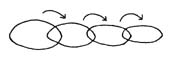
Each oval represents a thought, he said; normally, we leave one thought only when we have another one to go to (as the arrows indicate), but to think in this way constitutes ignorance. Instead, we should realize that thinking is actually like this:
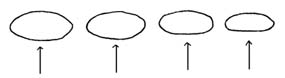
Then we will understand the true nature of thoughts: that thoughts do not arise from each other but by themselves.
This understanding of thoughts-not-linking-up-in-a-series but springing up nondually is consistent with D. T. Suzuki's conception of prajna:
It is important to note here that prajna wants to see its diction "quickly" apprehended, giving us no intervening moment for reflection or analysis or interpretation. Prajna for this reason is frequently likened to a flash of lightning or to a spark from two striking pieces of flint. "Quickness" does not refer to progress of time; it means immediacy, absence of deliberation, no allowance for an intervening proposition, no passing from premises to conclusion. [28] -
Originally posted by rokkie:
Eventually it really become automatic, like when chanting, the highest level, is æ— å¿µè€Œå¿µï¼Œchanting but you don't know that.
No, habitual is not the same as spontaneous. I would say that 'æ— å¿µè€Œå¿µ' can easily become misunderstood as becoming habitual. For example you never drive a car before, so it feels very unnatural. Then after getting used to it, it feels very 'natural' to drive the car. Similarly, it feels very 'natural' to brush our teeth because it is routine and habitual -- but this is not the same thing as realising spontaneous manifestation, or non-dual action. True realisation is in seeing there is no separate agent apart from the act/manifestation/experience.
Now as David Loy explains what Wei Wu Wei/Action of Non-Action/ä¸ºæ— ä¸ºmeans, "As usually understood, "action" requires an agent that is active; "nonaction" implies a subject that is passive, which does nothing and/or yields. The "action of non-action" occurs when there is no "I" to be either active or passive, which is an experience that can be expressed only paradoxically. The simpler interpretations of wu-wei as noninterference and yielding view not-acting as a kind of action; nondual action reverses this and sees nonaction -- that which does not change -- in the action."
We can use this explanation of Wei Wu Wei/Action of Non-Action/ä¸ºæ— ä¸º to explain the same principle in "å¿µè€Œæ— å¿µ, æ— å¿µè€Œå¿µ"
The true realisation of "å¿µè€Œæ— å¿µ, æ— å¿µè€Œå¿µ" is in realising the non-dual nature of reality. Why? As rephrasing what David Loy said, we can also say that As usually understood, "念" requires an agent that "念"; "æ— å¿µ" implies a subject that is passive, which does not "念". The "å¿µè€Œæ— å¿µ" occurs when there is no "I" to 念 or æ— å¿µ, which is an experience that can be expressed only paradoxically. ... nondual action reverses this and sees æ— å¿µ in the 念.
and also a further explanation:
But how does the nonduality of agent and act resolve the paradox of "the action of nonaction"? One may accept the negation of a subject, in which case the action cannot be something "objective," yet there is still an action. The answer is that, when one completely becomes an action, one loses the sense that it is an action.
... For an action of the whole being does away with all partial actions and thus also with all sensations of action (which depend entirely on the limited nature of actions) -- and hence it comes to resemble passivity.
This is the activity of the human being who has become whole: it has been called not-doing, for nothing particular, nothing partial is at work in man and thus nothing of him intrudes into the world. (Buber) [33]As long as there is the sense of an agent distinct from the action, the act can be only "partial" and there is the sensation of action due to the relation between them. Only in nondual action can there be no sense of an ego-consciousness outside the action, for otherwise there is a perspective from which an act is observed to occur (or not occur). When one is the action, no residue of self-consciousness remains to observe that action objectively. The sense of wu-wei is that of a quiet center which does not change although activity constantly occurs, as in Chuang Tzu's "Tranquillity-in-Disturbance."
Such an action can be experienced as nondual only if it is complete and whole in itself. It must not be related to anything else, for such relating is an act of thought, which shows that there is thinking as well as acting and the action is only "partial." If the nondual act is complete in itself and does not refer to something else, it turns out to be meaningless: that is, it simply is what it is (tathat�) . This pinpoints the problem with intention, since it is the reference to some goal to be derived from the act that gives the act meaning. In contrast, the d�nap�ramit� of Mah�y�na is generosity in which the giver, the gift, and the recipient are all realized to be empty (śūnya): "Here a Bodhisattva gives a gift, and he does not apprehend a self, a recipient, a gift; also no reward of his giving." [34] Such "giving Of no-giving" (as it might be termed) can be done "without leaning on something" because there is no intention tied to it. The best giving, like the best action generally, is "free from traces," in which case there is not even the sense that it is a gift.
Also another thing that we must understand that through the practice of chanting, we can build up such a momentum that serves as a positive strength helping us in our daily lives and even in dreams (we can chant in nightmare and in dreams also, some people can do that)
This momentum replaces and counter-acts our negative momentum, and brings calmness.
But this alone will not bring enlightenment, this will not bring insight. Because it is dealing with the area of concentration and building positive momentum, it is not dealing with the area of insight and awareness.
When we are talking about developing insight, it is all about our true nature. For that, we have have to directly experience that pure awareness, to directly experience our true nature.
When we achieved certain strength through shamatha, concentration, through building up the positive momentum by techniques and skillful methods such as the practice of chanting, we can then use that strength for the purpose of finding out our true nature, such as through self inquiry or vipassana. But the practice of shamatha (Zhi4) or the building up of the positive momentum itself will not result in enlightenment. Even if you entered into samadhi through shamatha, it is not enlightenment.
Like what Thusness said:
Thusness: Ok. I think when we view consciousness, we have to understand that there are a few things. We cannot keep on thinking about the objective world first. We must see how consciousness reacts. That is if we react very intensely, strongly towards symbols, then whatever reactions will go back deep into your consciousness. This is one thing. My perspective is that when you chant, you are not dealing with our luminous clarity. We're dealing with propensities deep in your consciousness. Insight meditation itself deals directly with this clarity. That is the luminous clarity. But if we were to continue to chant, you are actually focusing more on the deeper layers of consciousness that deals with propensities and the power of concentration. Do you see what I mean? It's not so much of the luminosity. However, the chanting itself, when it takes strength, it creates a kind of momentum. A momentum that synchronises not only with your sub-conscious or the deeper layers of your consciousness, but also your conscious level. This means it can sync the two layers into one. This syncing the two into one clears your mind, clears your thoughts. And then at this time, you ask who you are, that is, not letting the momentum take place, but just feel and sense... then you ask what is it. At that moment, you might see your reality. But your mind must be able to settle down first. But you must know there is a difference between working at the concentration level, dealing with the karmic propensities and creating new momentums, and practicing insight meditation that touch directly the clarity and the luminous nature, are two different things. You see what I mean or not?
Participant 1: Yeah I think so. This means that I still need to do insight meditation?
Thusness: Yes you have to do insight meditation. Even if you attain calmness you still have to do insight meditation. You must feel the awareness... You must sense it everywhere... That is very important for liberation. Now when we talk about awareness, we don't call it Self or we don't call it Mind. Why people call it Awareness is because they do not want to call it Self, because there is no Self. The reason they said Awareness, is because Awareness is not an entity. It is not a thing. It is just a point of luminous clarity. It is just clarity. But because we are so accustomed to thinking things in terms of object and subject, we always take Awareness as something. It must be somewhere inside, residing somewhere. Even if it is not residing inside the body it must be somewhere, someplace. This is the problem, you see. So when you say that let’s be aware. We always think of “how?” How to be aware? When we say “where is awareness”, they always look for a place, they always look for a something. This is how the mind react, this is what I call a momentum. They always behave this way. They do not know how to say “Just do nothing. Everything is expressing itself by clarity.” They always want to react, you see what I mean? -
Originally posted by rokkie:
But there are many factor come into play to prove that a person is enlightned, Non dual is one, there are many else, such as �地�,�行�,欢喜地,you feel joyful, 慧焰地,�退地,远行地。i think 如��,is the most important criteria to judge he is enlightned or not.
Yes, a person who becomes enlightened will naturally traverse/go through the different stages of enlightenment, such as 慧焰地,�退地,远行地, and so on.
The criteria however, even at the 1st enlightenment experience, is the realisation of emptiness/no-self. Then there is a progressive deepening of that realisation, until at the 8th bhumi or 10th bhumi, one reaches the stage of no-more-meditation (Thusness thinks it can be more appropriately called 'no-more-practice' since 'meditation' here implies 'practice' more than 'sitting meditation'). At that stage, there is no longer any effort in sustaining practice -- self-liberation becomes totally effortless and happening all the time.
As for 如��, i.e. Tathagathagarbha, everyone has 如��. When there is Full Enlightenment, it transforms into 法身 (Dharmakaya). Same essence but one is refering to pre-enlightenment, one refers to post-enlightenment. Even right now you have 如��.
-
Originally posted by rokkie:
This sentence i didn't get very much, no self automatically means there is no self, the self, object merge with the subject, so the self is gone, become universal. But it's got religious and high brow. I think a person can achieve that already is one proof of that he is enlightned.
No, unification of subject and object is not enlightenment. Non-Duality/No-Self is not a stage of subject merging with object. Such experiences can be induced by strong concentration but is itself not an awakening of insight.
Why is the experience of Unification/Merging not the realisation of Non-Duality? Because non-duality of subject and object is not a stage, it is the nature of reality at all times. If one experiences 'unification', that is not enlightenment.
As I wrote before,
First I do not see Anatta as merely a freeing of personality sort of experience as you mentioned; I see it as that a self/agent, a doer, a thinker, a watcher, etc, cannot be found apart from the moment to moment flow of manifestation or as its commonly expressed as ‘the observer is the observed’; there is no self apart from the arising and ceasing. A very important point here is that Anatta/No-Self is a Dharma Seal, it is the nature of Reality all the time -- and not merely as a state free from personality, ego or the ‘small self’ or a stage to attain. (related article: http://awakeningtoreality.blogspot.com/2007/07/bernadette-roberts-interview.html) This means that it does not depend on the level of achievement of a practitioner to experience anatta but Reality has always been Anatta and what is important here is the intuitive insight into it as the nature, characteristic, of phenomenon (dharma seal).
To illustrate further due to the importance of this seal, I would like to borrow a quote from the Bahiya Sutta (http://www.accesstoinsight.org/tipitaka/kn/ud/ud.1.10.irel.html)
‘in the seeing, there is just the seen, no seer’, ‘in the hearing, there is just the heard, no hearer’…
If a practitioner were to feel that he has gone beyond the experiences from ‘I hear sound’ to a stage of ‘becoming sound’ or takes that ‘there is just mere sound’, then this experience is again distorted. For in actual case, there is and always is only sound when hearing; never was there a hearer to begin with. Nothing attained for it is always so. -
Originally posted by rokkie:
But i search the web, there indeed got some school related with Non dual, in that , the Non duality is the top priority.There also extract some saying from sutra, like you said, by hearing there is no hearer, sorry, if i quote the sentence wrongly.
In contrast, chinese buddhism, absorb some of chinese culture, which fundamentally is æ— ä¸º, no interference, so there is a saying, ä½›é�“ä¸�二. No matter tibetan buddhism or chinese buddhism, no interference play a big role, like 元音è€�人 said , åœ£äººçš†å› æ— ä¸ºè€Œå�„有所得, by no interference, the sage accomplish different subject base on their own nature,
So as shown above, Wu Wei cannot be realised without realising Non-Duality.
Otherwise, it becomes mistaken as routineness, or becomes mistaken as inaction (sitting like a rock), or one attempts to fabricate 'naturalness' while the illusory sense of 'I' is still there (thus unnatural), i.e. the notion that there is a doer/controller is not seen through.
Hence, it is only by realising the non-duality of subject and object can there be real enlightenment.
-
Originally posted by rokkie:
There is no self, so who is enlightening, is a famous dilemma in chinese buddhism, yes, buddhism teach us no attached to self, but by my experience, i judge that, so everything in buddhism we have to take middle way thinking, we stay away from self, but not extinguish self.
There is already no self, how to stay away from self, how to extinguish self?
However it should be emphasized that no-self is not non-existence, but no-self means there is no self apart from or within every arising and ceasing. In the moment of hearing, there is just sound, not a hearer. There is just thoughts, no thinker. It does not mean you don't exist (non-existence is one of the 4 extremes rejected by the Buddha, along with existence, both existence and non-existence, neither existence nor non-existence), or that you will cease to exist upon realisation (can't be done -- already no self, how to cease) -- it is only the illusion of the subject-object split that needs to be seen through.
-
Originally posted by rokkie:
Back to the topic, i think Non dual is a good conduct, because it show the no self teaching of buddha, but in the first place, how to get to that, for ordinary person, it's very misleading to teach them Nondual, i think we have to first achieve self, than noself, how to achieve self, it's by alaya conciousness, it's interesting here, because alaya conciousness have another name ,如��, 如�法�. In short rulaizang is purified alaya conciousness, which i think it's a very importent standard to judge whether someone have been enlightned already, to achieve this first, i think it's safe to play the rest of buddhism doctrine.
You have an altruistic view and tried to link no-self with morality.
However you have to understand that in Buddhism, No-Self is not related to morality, non-attachment to self, non-egotism, selflessness, or any of such notions. All these are important, but are not the teaching of No-Self in Buddhism, and these practices do not lead to liberation or enlightenment, though they can build up good karma and thus good rebirths.
So we should not misunderstand that No-Self is good conduct -- it is not a conduct, it is the nature of reality at all times. And it is only the arising of insight into the ever-present nature of reality that liberates.
In Buddhism, No-Self is one of the 三法� (Three Dharma Seals/Three Characteristics of Existence).
The implication that No-Self is a Seal of Reality means that at all times, all phenomena and at all times our experience exhibits the characteristic of No-Self.
This means that all along, there never was a self, even if you are un-enlightened, or if you are selfish, or egotistic, etc, there is still no self. Not a moment is there actually a 'separate self'...
Ordinary unenlightened beings think that there is a fixed self, an observer. But in actuality this is not the case. Our experience is momentary and does not constituted a fixed and inherent self or soul.
As Thusness wrote before:
Life (Self) is nothing other than the continuous flow of the Now Moment.
The Now Moment ceases as it arises. This moment must completely ceased
and serves as the CAUSE for the next moment to arise.
Therefore Self is a process of series Self1, Self2, Self3, Self4, Self5, Self6...etc
A fixed entity 'Self' does not exist, what really exists is a momentary Self.
Under deep meditation, one is able to observe and sense the karmic and mental factors from moment to moment,
it is these factors that are succeeded from moment to moment and life and life but not a fixed entity.Furthermore, there is no separate agent/self/observer/doer apart from moment to moment manifestation. That means in Hearing, there is just Sound, just the Tonggg -- no Hearer or Bell ringing.
All these are not just a concept. If we can observe our experience at all moments we can realise/discover the fact of no-self in all our every moment experience, as a seal of reality, not to be mistaken as an altruistic state of egolessness.
-
If you're patient enough, you may also want to read the new topic I posted upon Thusness's recommendation: The `No-Self' Nature of People and Things
-
BTW I also want to add: we cannot be mistaken that wu wei means not using our intentions. It does not mean random and spontaneous. Intention must still arise (if you sit on a stone for a thousand years, you think your legs will start moving by itself?)
But intention is seen as itself a complete nondual reality, and the action is a complete nondual action without splitting it into a doer and action. Intention is not mistaken as the doer of the deed. Every moment of manifestation is complete in itself, non-dual and unconditioned (in the sense that it is not conditioned in a dualistic manner, and every dependent arisen appearance is complete as it is). But every moment of manifestation is self-arising and self-liberating.
And as Thusness has said before:
Thusness says:
'wei' and 'wu wei' should be seen whether it is efforting or effortless.
Thusness says:
We try to understand, analyse what causes 'effort', what is the real cause of 'effort' and 'self'.
Thusness says:
What prevent effortlessness and naturalness.
Thusness says:
for this we have to experience the deepest sense of non-grasping, non-abiding, the total willingness to let go.
Thusness says:
Eventually we become clear what the 'sense of self' is and 'touch' the heart of effortlessness.
Thusness says:
What it is is beyond speech. :)
Thusness says:
it is like dispassion...cannot be taught and nothing negative.
Thusness says:
a person that is truly wu-wei is undefined and free from all arbitary thoughts and definitions that imobilized his move.David Loy (Article above):
This passage clarifies what "intentionless activity" means. From the usual perspective, it seems impossible to avoid intentions. We eat to satisfy our hunger, for example, and even taking a walk can be seen to have a purpose such as to relax. But the claim just presented is that even now actions of ours like dressing and eating are not purposive. "Intentionless activity" does not mean merely random and spontaneous action, but involves realizing the distinction between thought (the intention) and the action. The thought (for example, "time to eat") is whole and complete in itself; the act (eating) is also whole and complete in itself. It is when the two are not experienced wholly and discretely but only in relation to each other, the first as if "superimposed" upon the second, that action seems intentional and therefore dualistic, and there is the sense of an agent/mind that uses the act/body for the sake of..."
-
First let me talk about Wu-Wei, there will be follow up posts to explain other issues.
We must understand that Wu Wei has several different definitions and explanations (see http://ccbs.ntu.edu.tw/FULLTEXT/JR-PHIL/loy3.htm), but the enlightened person is only concerned with the Wu-Wei of Non-Duality.
You may sit on a rock and not move for a thousand years, or be politically uninvolved etc, not interfering with any mundane matters, but you are no closer to enlightenment. So this is obviously not the Wu-Wei that true practitioners are concerned about. This Wu-Wei simply leads to nowhere.
Furthermore, any conscious attempt to act 'naturally', any attempt itself will become unnatural and dualistic. Unless you reality Non-Duality. Then you realise there never was actor apart from the action/activity. Before that, we simply divide using dualistic thought what is 'natural' and 'unnatural'.
But none of our actions will be natural when we are still conscious of a doer/actor that is apart from the activity, because there is the ideation of an 'I' that can 'do something', and that actions are done by me, the doer, controller. And complete "not acting" requires eliminating the sense-of-self which is inclined to interfere.
Hence David Loy (zen teacher and academic) says here in the article http://ccbs.ntu.edu.tw/FULLTEXT/JR-PHIL/loy3.htm
"None of the preceding is a refutation of the view that wei-wu-wei is natural, nonwillful action, and so forth. The problem is rather that such descriptions do not in themselves go far enough; but allied with the proper criterion they may be valuable. In fact, the concept of nondual action that I shall offer can be seen as such a criterion. The root irruption of the natural order of things is man's self-consciousness, and the return to Tao is conversely a realization of the ground of one's being -- including one's own consciousness. If consciousness of self is the ultimate source of unnatural action, then natural action must be that in which there is no such self-consciousness -- in which there is no awareness of the agent as being distinct from "his" act."
.
.
"As usually understood, "action" requires an agent that is active; "nonaction" implies a subject that is passive, which does nothing and/or yields. The "action of non-action" occurs when there is no "I" to be either active or passive, which is an experience that can be expressed only paradoxically. The simpler interpretations of wu-wei as noninterference and yielding view not-acting as a kind of action; nondual action reverses this and sees nonaction -- that which does not change -- in the action."
So now, I propose that the true meaning of Wu-Wei means that there is no doer apart from actions, controlling actions, or a thinker thinking thoughts. This is Wei Wu Wei, or the action of non-action, or spontaneous arising.
But without the insight into Non-Duality, we can forget about spontaneous arising, all perceived effortlessness is just effort in disguise... because the sense of an agent/self is still present. As Toni Packer said, Until effortlessness presents itself, we can't help effort-ing - coming from thinking. and "Effort" or "effortlessness" can be misleading terms.
Also, without the sense of an agent, there is no movement... why?
Notice that the sense of a permanent/continuous self, an agent, that is split off and behind all action and manifestations, is behind the sense of the continuity of an agent behind actions, and also the sense of movement of action -- because it appears that you are an observer or a doer standing back apart from the actions, and observing the actions taking place. That means the notion of a separate doer performing Activity 1, Activity 2, Activity 3, observing the activities taking place, and thus linking them up together into a movement from A1 to A2 to A3. (See the visual analogy below)
That means, there is a continuously existing 'I' that is acting and performing and controlling and responsible for all actions, that continues to persist and producing all actions.
But if we look deeply into our experience, there is no such thing as a continuously existing/persisting or a fixed self. There really is only moment to moment manifestation -- right now there is sensation of typing on the keyboard very fast, sound of the typing, the sound of music, text appearing on the screen, thoughts appearing and disappearing simultaneously.
Everything is happening and changing every moment, but there is no doer that can be found apart from moment to moment arising and passing at lightning speed. Actions and deeds are performed, but no doer or controller thereof. Every moment arise according to conditions and never stays even for a moment, empty of any inherent existence... every manifestation is manifested according to specific/varying conditions. And every moment of manifestation pass as soon as they arise, completely ungraspable, empty, disjoint.
Hence since every moment is complete as it is and yet empty of inherent existence because it is conditioned manifestation, there is no such thing as a 'fixed' or 'continuous' self, or a doer separate from action.
Action (wei) is actually not one whole thing performed by a single doer, it actually is moment to moment arising of Activity1, Activity2, Activity3, Activity4, without any self controlling. And you are not a separate watcher, or a doer of deeds -- you are everything arising moment to moment, including actions, arising according to conditions. Because you are not a watcher or a doer standing back from action, but is every moment of action, there is no action or movement being observed from the perspective of a separate self... there is no 'you' that feels like 'it' 'did something'.
And since there really are just moment to moment occurence/activities/manifestation, without a separate doer, there is no movement. There is action, but no doer of action.
Movement implies that there is a movement from Activity 1 to Activity 2, with a self persisting through Activity 1 to Activity 2, producing and observing them.
But by understanding that there is merely arising and ceasing due to the empty nature of our non-dual luminosity, there is no such thing as from Activity 1 to Activity 2, nor a separate observer.
There is simply Activity 1, Activity 2, arising due to conditions, never the same for a moment. There is no movement, and no actor.
And because everything is arising spontaneously, disjoint, complete-in-itself and not produced by a persisting and separate doer (there is no separate agent apart from transient manifestation), this is truly spontaneous and 'natural' manifestation... and is unconditioned reality itself.
Everything is simply the miraculous activities of Buddha-Nature, they are mere reflections, appearances, luminous-empty apparitions. No actions is done by 'you'. There is no 'you'. There is just 佛性的妙用. In the act of walking there is no doer, there is just the act of walking itself, that is the miraculous activities of Buddha-Nature. It is just a pure happening without movement, without going anywhere, and without an 'I' that is doing anything. It just self-arise when there is condition. Everything is yuan qi, thoughts are yuan qi, intention to act is yuan qi, action is yuan qi, existence continues to arise, the earth will spin, and everything is no different from this moment of heartbeat. Everything is Self-So. Completely wu-wei yet not contradicting 'wei', hence 'wei-wu-wei'. Everything is activities of pure awareness. As 1st Patriarch Bodhidharma said, “Buddha is the Sanskrit for what you call aware, miraculously aware. Responding, perceiving, arching your brows, blinking your eyes, moving your hands and feet, it’s all your miraculously aware nature. And this nature is the mind. And the mind is the buddha. And the buddha is the path. And the path is zen. But the word zen is one that remains a puzzle to both mortals and sages. Seeing your nature is zen. Unless you see your nature, it’s not zen…”
So spontaneous/natural manifestation has to do with the reality of No-Self and Emptiness, and that every manifestation only 'exist' where they are (but does not remain) for just a moment (and is ungraspable, empty, ever-changing), according to conditions. Every moment's experience is complete by itself and disjoint, manifesting according to conditions... and is completely beyond the duality of a subject/doer and an object/deed-being-done. Whatever 'existence'/'experience' (feeling of keyboard typing, words on screen, etc) is simply pure awareness, words can never explain 'It' (the 'It' is also empty), but it can be directly experienced and felt.
Then we can start to understand what is Wu-Wei. The true experience of Wu-Wei is also the experience of Vipassana (Guan), as David Loy puts it:
"Ordinary mind is the Tao [37] because, when they are free from intentional action, daily activities are realized to be nondual. This gives insight into how the "mindfulness of body" described in the Satipaá¹á¹hÄ�na SÅ«tra, and TheravÄ�da vipassana practice in general, might function: In the slow "walking meditation" of vipassana, for example, one "lets go" of all intentions by concentrating on the act of walking itself. This also explains why those Zen koans which ask "Why...?" never receive a straight answer. "Unmon said, 'The world is vast and wide like this. Why do we put on our seven-panel robe at the sound of the bell?'" [38] From a contemporary Zen master's commentary on this case:
... Some of you are familiar with the last line of the mealtime sutra, "We and this food and our eating are equally empty." If you can acknowledge this fact, you will realize that when you put on your robe, there is no reason or "why" in it... There is no reason for the "why" in anything! When we stand up, there is no reason "why". We just stand up! When we eat, we just eat without any reason "why". When we put on the kesa (seven-panel robe), we just put it on. Our life is a continuous just... just... just. [39]
This passage clarifies what "intentionless activity" means. From the usual perspective, it seems impossible to avoid intentions. We eat to satisfy our hunger, for example, and even taking a walk can be seen to have a purpose such as to relax. But the claim just presented is that even now actions of ours like dressing and eating are not purposive. "Intentionless activity" does not mean merely random and spontaneous action, but involves realizing the distinction between thought (the intention) and the action. The thought (for example, "time to eat") is whole and complete in itself; the act (eating) is also whole and complete in itself. It is when the two are not experienced wholly and discretely but only in relation to each other, the first as if "superimposed" upon the second, that action seems intentional and therefore dualistic, and there is the sense of an agent/mind that uses the act/body for the sake of..."
p.s. about the Event 1, Event 2, here's a visual analogy:
from the topic Nondual Thinking and the Mahayana Deconstruction of Time
The image of a worm hesitant to leave its hold was used in a personal conversation I had in 1981 with a Theravada monk from Thailand, a meditation master named Phra Khemananda. This was before I discovered the passage from Ramana Maharshi; what Khemananda said was not prompted by any remark of mine, but was taught to him by his own teacher in Thailand. He began by drawing the following diagram:
Each oval represents a thought, he said; normally, we leave one thought only when we have another one to go to (as the arrows indicate), but to think in this way constitutes ignorance. Instead, we should realize that thinking is actually like this:
Then we will understand the true nature of thoughts: that thoughts do not arise from each other but by themselves.
This understanding of thoughts-not-linking-up-in-a-series but springing up nondually is consistent with D. T. Suzuki's conception of prajna:
It is important to note here that prajna wants to see its diction "quickly" apprehended, giving us no intervening moment for reflection or analysis or interpretation. Prajna for this reason is frequently likened to a flash of lightning or to a spark from two striking pieces of flint. "Quickness" does not refer to progress of time; it means immediacy, absence of deliberation, no allowance for an intervening proposition, no passing from premises to conclusion. [28]============================
Your first paragraph, seems talking about wuwei, and going to the theory of wuwei, for me wuwei seems have different meaning for different people, there is no universal explanation, several years ago i may look at wuwei in another way different from what i am thinking now, as long as it generate a sense in your heart of empty, it's good, i love quote wuwei wu buwei together,
《é�“å¾·ç»�》第37ç« è¯´ï¼š“é�“å¸¸æ— ä¸ºè€Œæ— ä¸�为”,第48ç« å�ˆè¯´ï¼š“为å¦æ—¥ç›Šï¼Œä¸ºé�“æ—¥æ�Ÿï¼Œæ�Ÿä¹‹å�ˆæ�Ÿï¼Œå�ˆè‡³äºŽæ— ä¸ºï¼Œæ— ä¸ºè€Œæ— ä¸�为矣
that's the beauty of Tao, there is never a fixed entity, when is wuwei when is wubuwei is up to you, i believe some philophy function to you only by the first thought come into your head when u reading it. Because we don't need many reason for everything we do, we drived by intuitive .
When i first read the translationg about wuwei, become no action, i feel a little bit uncomfortable, seems the translating is not quite the exact meaning of wuwei , but when you explain in this way, no action means there is no actor, coincide the Non dual theory, i feel i am more comfortable.
For me
所謂無爲者,ä¸�先物爲也。所謂〔無〕ä¸�çˆ²è€…ï¼Œå› ç‰©ä¹‹æ‰€çˆ²ã€”ä¹Ÿã€•ã€‚
it's quite enough to explain wuwei already, the paragraph help u better understand wuwei, but when u do daily stuff, the theory drives u, is the first wuwei means to you, the paragraph may served good for scholar discussion purpose.
i believe people is changing, just like in your paragraph, self1 ,self2, self3, but cannot deny that there is an inherent continuity of the change, and the change is because some reason, so sometimes we wuwei, sometimes we wu buwei,it depends on the situation going on, by doing that, we are looking for to maximize our happiness.
-
Originally posted by An Eternal Now:
No, unification of subject and object is not enlightenment. Non-Duality/No-Self is not a stage of subject merging with object. Such experiences can be induced by strong concentration but is itself not an awakening of insight.
Why is the experience of Unification/Merging not the realisation of Non-Duality? Because non-duality of subject and object is not a stage, it is the nature of reality at all times. If one experiences 'unification', that is not enlightenment.
As I wrote before,
First I do not see Anatta as merely a freeing of personality sort of experience as you mentioned; I see it as that a self/agent, a doer, a thinker, a watcher, etc, cannot be found apart from the moment to moment flow of manifestation or as its commonly expressed as ‘the observer is the observed’; there is no self apart from the arising and ceasing. A very important point here is that Anatta/No-Self is a Dharma Seal, it is the nature of Reality all the time -- and not merely as a state free from personality, ego or the ‘small self’ or a stage to attain. (related article: http://awakeningtoreality.blogspot.com/2007/07/bernadette-roberts-interview.html) This means that it does not depend on the level of achievement of a practitioner to experience anatta but Reality has always been Anatta and what is important here is the intuitive insight into it as the nature, characteristic, of phenomenon (dharma seal).Because non-duality of subject and object is not a stage, it is the nature of reality at all times.
But for most people we do not see the nature of reality as it is, so finally by reading sutras or meditation, we finally see the nature as it is, for us, the subject and object reunify, because it seperate for long time, because of our delusion, æ— æ˜Žï¼Œi think unification of subject and object, is just a "plain english" way to say non duality of subject and object,
Nonduality is not the goal but the path to achieve ultimate joyfullness and peacefulness, see reality as it is, even see reality as it is, is not the top concern, as like some pop star, they are being 包装,so he whom appear to us may not be who he is, but never mind , we just want to be entertained. I think the ultimate goal of practising buddhism is to maximize the joyfullness,minimize the suffering, just like 4圣谛,苦 ç� 集 é�“,is it? We pratise buddhism all because of suffering, and we want to minimize it by practising it. -
Originally posted by An Eternal Now:
There is already no self, how to stay away from self, how to extinguish self?
However it should be emphasized that no-self is not non-existence, but no-self means there is no self apart from or within every arising and ceasing. In the moment of hearing, there is just sound, not a hearer. There is just thoughts, no thinker. It does not mean you don't exist (non-existence is one of the 4 extremes rejected by the Buddha, along with existence, both existence and non-existence, neither existence nor non-existence), or that you will cease to exist upon realisation (can't be done -- already no self, how to cease) -- it is only the illusion of the subject-object split that needs to be seen through.
already no self, is for someone who enlightened already, not for ordinary people, so i on behalf of some ordinary people, we still attached to self, say 'everything in buddhism we have to take middle way thinking, we stay away from self, but not extinguish self.' because your emphasize on nonduality of subject and object seems imply that we should stay away from self.
If i do not get u right, maybe because i always cannot understand this sentence "no-self means there is no self apart from or within every arising and ceasing". what is arising , what is ceasing?
"In the moment of hearing, there is just sound, not a hearer. There is just thoughts, no thinker" here also seems also imply that, then your explanation afterward,
"It does not mean you don't exist (non-existence is one of the 4 extremes rejected by the Buddha, along with existence, both existence and non-existence, neither existence nor non-existence), or that you will cease to exist upon realisation (can't be done -- already no self, how to cease) -- it is only the illusion of the subject-object split that needs to be seen through."
Seems that illusion of subject-object split, so we seems have to take suject and object to be one, same thing, so if say apple is same thing to orange, so you mean apple is not a non existence, it's same thing to orange, so why need the two different name? As a result of the Nonduality of orange and apple, there seems no necessity to use the two name refering the same thing, if they are exactly the same thing. IT's confusing, that's go back to the topic, if you and the world are non dual, taking you as object and the world as subject, you become the world, then there is two world you disappear, or another way, the world become you, then there is two you, the world disappear. But the world is out there it cannot change, so probably you change to world, so you disappear,
Is that a proof of the non existence of self, when nonduality of subject and object is achieved
-
Originally posted by rokkie:
i believe people is changing, just like in your paragraph, self1 ,self2, self3, but cannot deny that there is an inherent continuity of the change, and the change is because some reason, so sometimes we wuwei, sometimes we wu buwei,it depends on the situation going on, by doing that, we are looking for to maximize our happiness.
There is change and continuity, but not a 'entity' that continues -- continuity happens, rebirth happen, but not the reincarnation of a soul/self.
Whether action arise or not is ok, the enlightened person is truly undefined and free from all arbitary thoughts and definitions that imobilized his move.